The LONGRED Oyster-x and LifeSparks 100% Natural Pain Relief Supplement were found to contain prescription-only medicines which are not allowed in health supplements, says the Health Sciences Authority.
Source link
Health warning issued against 2 supplements with 'undeclared potent ingredients'
Parallel imports hit 24% of 65,412 cars registered
SINGAPORE – The Vezel compact SUV continues to power the Honda brand after three quarters and could help the parallel import (PI) industry to achieve record market share by year-end.
In the first nine months of 2016, 15,448 PI cars were registered, accounting for 23.6 per cent of Singapore’s total 65,412 registrations thus far. Last year, the PI industry accounted for 14.8 per cent of the Republic’s total of 57,589 new registrations.
So far, the highest market share enjoyed by PIs in recent years was 23.8 per cent in 2008, when the total market size was 97,348.
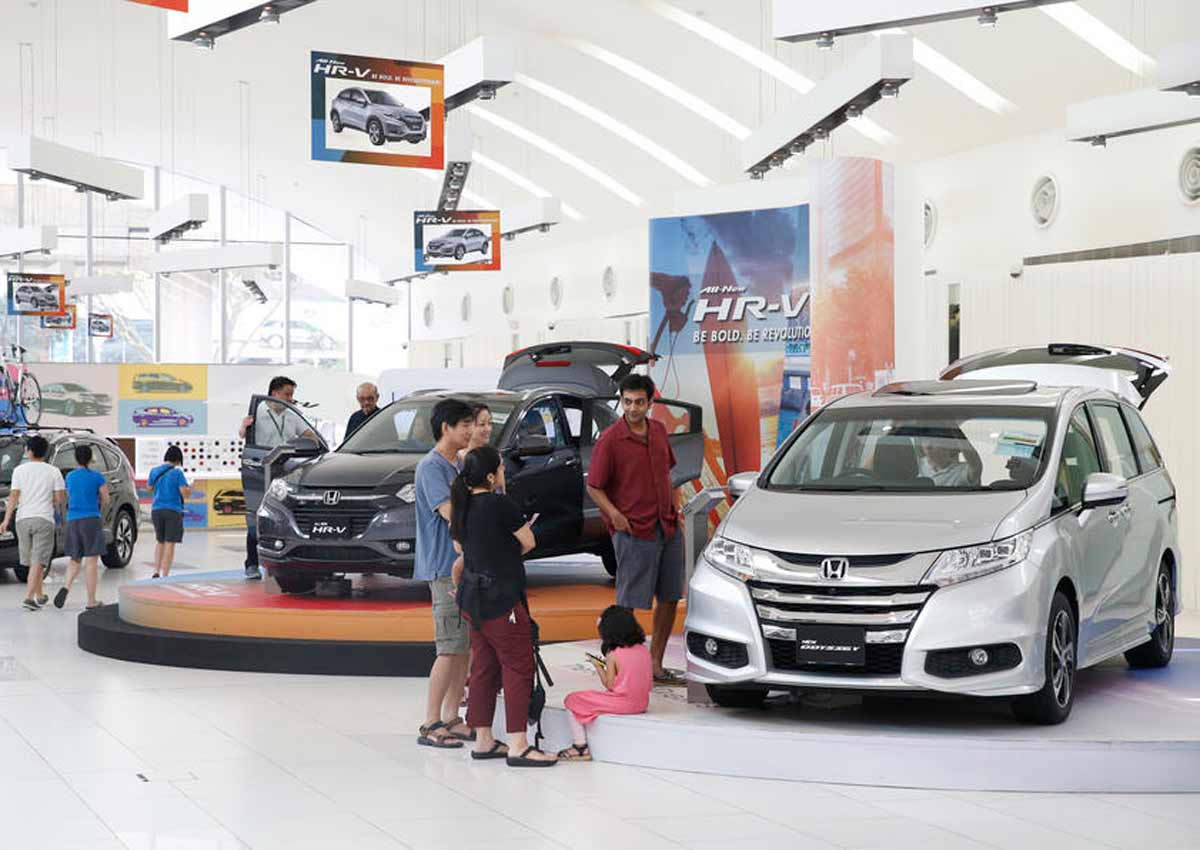
Among such cars, that is, those not offered by authorised distributors, Honda was the top brand between January and September this year, with 9,442 registrations (see table). This means six in 10 PI cars sold wear Honda badges on their grilles.
Toyota was second with 5,435 registrations.
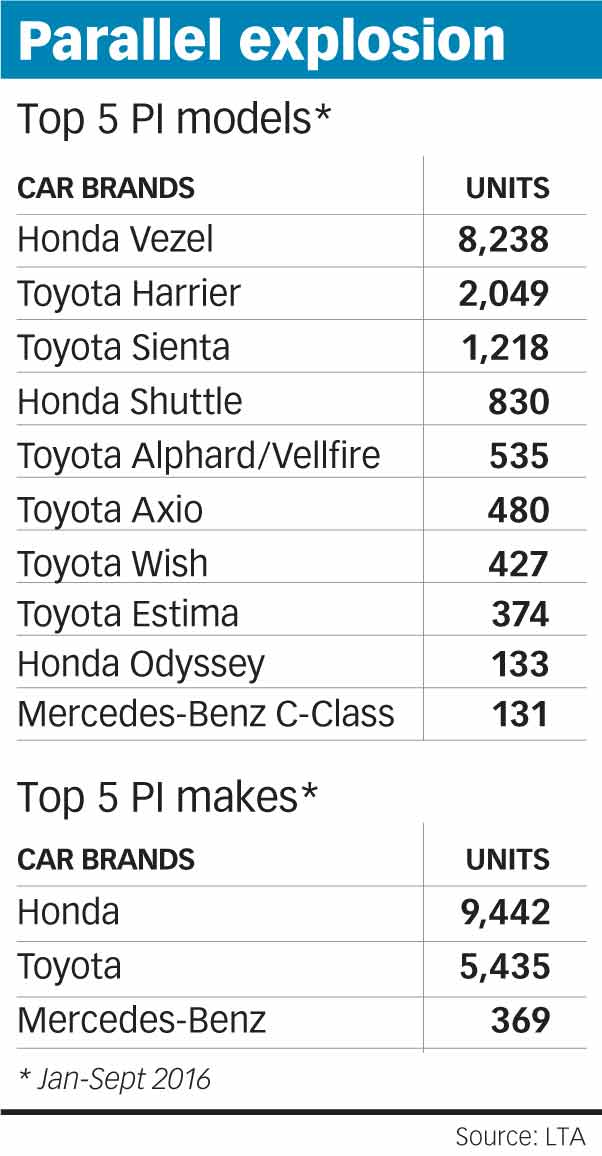
The third most popular PI brand was Mercedes-Benz, but its numbers are tiny compared to the two Japanese juggernauts – just 369.
As was the case last year, the Honda Vezel was the top PI model, with 8,238 year-to-date registrations. The size of its success elevates it to Singapore’s overall top model.
Among authorised distributors, the top model – the Toyota Corolla Altis compact sedan – managed to notch up only 3,711 units, or less than half the Vezel’s tally.
Among the top five PI models, the year-to-date rankings are unchanged from three months ago. The Toyota Harrier mid-size SUV is still the runner-up with 2,049 units, while the Toyota Sienta is No 3 (1,218 units).
They are followed by the Honda Shuttle (830) and Toyota Alphard/ Vellfire (535).
But below them, there has been an interesting reshuffle. The Estima mid-size MPV slips to No 8 spot (374), switching places with the Toyota Axio compact sedan (480), which now takes the Estima’s old No 6 position.
The Toyota Wish (427) stays put at No 7, but a couple of hitherto-unseen models are lurking just outside the top 10 – the Toyota Aqua compact hatchback (105 units) at No 11 and the brand new Nissan Serena mid-size SUV (50), which was launched in Japan only a few months ago, at No 13.
The managing director of a PI company attributed the strong PI sales to this year’s significantly larger certificate of entitlement (COE) quotas, which have led to lower COE premiums and hence, increased affordability.
But while he agreed that 2016 would be a banner year, he added that he was unsure if it could turn out to be a record-breaking year for the trade. “If you are comparing this year with last year, yes, PIs are doing very well. But if you expect PIs to hit an all-time high, then I am not so sure,” he said.
The reason is that demand for new cars has softened in the past couple of months amid a slumping economy. He said: “Overall market demand has slowed down at least 30 per cent in the last three months. And both PIs and agents are feeling it equally.”
332963
 Photo Gallery
Top 10 parallel import car models 2016
-

<!–
-

<!–
-

<!–
-

<!–
-

<!–
-

<!–
-

<!–
-

<!–
-

<!–
-

<!–

This article was first published on October 19, 2016.
Get The Business Times for more stories.
Image:
Publication Date:
Wednesday, October 19, 2016 – 14:00
Keywords:
Send to mobile app:
Source:
Rotator Image:
Story Type:
Others
Thailand tries to stay the course in extraordinary times
As the Thais grieve over the passing of King Bhumibol Adulyadej, his daughter, Princess Maha Chakri Sirindhorn, took time out on Monday to present awards to model farmers in the Asia-Pacific.
Yesterday, the Thai Cabinet also met after four days of mourning.
Thailand is trying to stay the course in extraordinary times.
331856
Photo GalleryA look back at Thailand’s King Bhumibol Adulyadej’s life
-

<!–
-

<!–
-

<!–
-

<!–
-

<!–
-

<!–
-

<!–
-

<!–
-

<!–
-

<!–
-

<!–
-

<!–
-

<!–
-

<!–
-

<!–
-

<!–
-

<!–
-

<!–
-

<!–
-

<!–
-

<!–
-

<!–
-

<!–
-

<!–
-

<!–
-

<!–
-

<!–
-

<!–
-

<!–
-

<!–
-

<!–
-

<!–
-

<!–
-

<!–
-

<!–
-

<!–
-

<!–
-

<!–
-

<!–
-

<!–
-

<!–
Prime Minister Prayut Chan-o- cha declared that his military govern- ment’s “road map” back to democratic rule would be unaffected by the bereavement.
“Nothing has changed,” he told reporters. “The policies of this government, the laws – including elections – will be according to the road map.”
But many things have changed.
King Bhumibol accepted the crown in 1946, on the same day that his brother, King Ananda Mahidol, was shot dead under mysterious circumstances.
His coronation took place four years later.
When the world’s longest- reigning monarch died last Thursday, triggering an outpouring of grief in the kingdom of 68 million people, his heir apparent, Crown Prince Maha Vajiralongkorn, abruptly asked for time to mourn with the people before taking the throne.
332474
Photo GalleryThailand’s Crown Prince Maha Vajiralongkorn, soon to be King
-

<!–
-

<!–
-

<!–
-

<!–
-

<!–
-

<!–
-

<!–
-

<!–
-

<!–
-

<!–
-

<!–
-

<!–
-

<!–
-

<!–
-

<!–
-

<!–
-

<!–
The request activated a legal clause where the president of the Privy Council – a group of royal advisers – then stands in as regent.
The council head is former prime minister and army general Prem Tinsulanonda, 96, who was a confidant of King Bhumibol. Key ministers have tried to explain who is really in charge.
Over the weekend, Deputy Prime Minister Wissanu Krea-ngam, the legal brains of the Cabinet, told reporters that “the continuity of the royal line is uninterrupted because the start of the new reign would be counted from Oct 13”, the day King Bhumibol died.
General Prayut, citing his Saturday meeting with the Crown Prince together with Gen Prem, then relayed the heir apparent’s words asking people not to be confused or concerned.
Given King Bhumibol’s popularity, some quarters have taken kindly to the Crown Prince’s request for more time.
“He would like to pay the last homage to the King as a son, not as a monarch,” Mahidol University peace studies academic Gothom Arya told The Straits Times.
It is unclear when the new king will ascend the throne.
Gen Prayut yesterday said it would be appropriate to proceed once funeral rites are over.
He said the new king would sign off on the new Constitution, which was approved by Thais in a referendum in August and will usher in an elected government under keen junta oversight.
The body of King Bhumibol is lying in the Grand Palace, where Thais from all over the country are turning up to pay their respects.
The Crown Prince reportedly assigned his sister, Princess Sirindhorn, to oversee the arrangements for cremation.
An entire crematorium needs to be built in an open field next to the Grand Palace.
With the official mourning period set to last one year, the erstwhile bright and colourful kingdom has turned monochrome.
There is a run on black clothing. State-run banks will distribute black shirts to eight million low-income earners.
People are being taught how to dye their clothes black.
On television, black-clad newscasters stand before screens that air images in black and white.
Websites are getting the same treatment.
332244
Photo GalleryThais in Singapore and Thailand mourn passing of King Bhumibol
-

<!–
-

<!–
-

<!–
-

<!–
-

<!–
-

<!–
-

<!–
-

<!–
-

<!–
-

<!–
-

<!–
-

<!–
-

<!–
-

<!–
-

<!–
-

<!–
-

<!–
-

<!–
-

<!–
-

<!–
-

<!–
-

<!–
-

<!–
-

<!–
-

<!–
-

<!–
-

<!–
-

<!–
-

<!–
-

<!–
-

<!–
-

<!–
-

<!–
-

<!–
-

<!–
-

<!–
-

<!–
-

<!–
-

<!–
-

<!–
-

<!–
-

<!–
-

<!–
-

<!–
-

<!–
-

<!–
-

<!–
-

<!–
-

<!–
-

<!–
-

<!–
-

<!–
-

<!–
-

<!–
-

<!–
-

<!–
-

<!–
-

<!–
-

<!–
-

<!–
-

<!–
-

<!–
-

<!–
-

<!–
-

<!–
-

<!–
-

<!–
-

<!–
-

<!–
-

<!–
-

<!–
-

<!–
-

<!–
Near the Grand Palace, volunteers are offering free food and drinks in the spirit of “doing good deeds for our father”.
But the fervour has a darker edge: mobs who intimidate and assault people deemed to have insulted the monarchy.
Some guidelines are getting a relook.
The government initially told people to refrain from entertainment for 30 days, but later said entertainment businesses can operate behind closed doors.
Media agencies, which have halted commercials out of respect for the late king, are monitoring public sentiment nervously to decide when it would be appropriate to restart ads.
In the weeks ahead, Bangkok will have a delicate job of figuring out how far it should – or can – go in honouring its late monarch.

This article was first published on Oct 19, 2016.
Get a copy of The Straits Times or go to straitstimes.com for more stories.
Image:

Publication Date:
Wednesday, October 19, 2016 – 14:00
Keywords:
Send to mobile app:
Source:
Story Type:
Others
More cases of reckless e-scooter riders surface, raising concerns over safety
Multiple incidents of people on e-scooters taking to the roads and travelling at high speeds has sparked worry online.
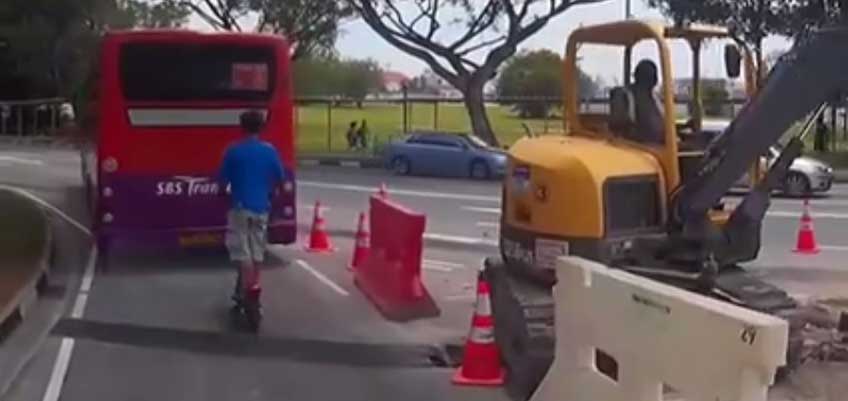
Last Friday (Oct 14), a one-and-a-half minute video was uploaded to Facebook, showing a man on an e-scooter travelling very close to the back of a bus, before moving into the second lane. He was travelling next to the bus before overtaking it.
According to Shin Min Daily News, he was believed to be travelling at 50kmh along Aljunied Road, towards MacPherson Road. The time and date stamp on the video showed that it happened on Friday, at around 1pm.
Later on Monday (Oct 17), two videos of reckless e-scooters were uploaded on the Roads.sg Facebook page.
The first shows a man riding his e-scooter in the middle lane of a busy road, said to be Serangoon Road.
In the video, which lasts less than half a minute, a motorist honks the e-scooter user, who wobbles a little before filtering to the right-most lane.
The second video was of six e-scooters with very bright headlights, zooming along a road. The time and location of where the video was recorded are not clear.
The e-scooter users were believed to be travelling between 80kmh to 90kmh in the 8 sec video.
These incidents come after another clip of an e-scooter user overtaking a bus was uploaded on citizen journalism site Stomp on Sept 22.
In the minute-long clip showing a user wearing a helmet and riding on the left-most lane of the three-lane Mandai Road, the e-scooter user is seen passing a bus, nipping in ahead of a taxi, before cutting back close in front of the bus.
According to what was said in the video, the e-scooter was travelling at at least 60kmh.
Netizens have expressed concern over the safety of the e-scooter riders, and urged the authorities, such as the Land Transport Authority (LTA), do something about the situation.
Facebook user Rudy RR said that “crashing one of those things (the e-scooters) at those speeds, and without sufficient protective gear” might lead to severe injury or even death.
Said Facebook user Gabriel Sim: “Hope LTA ( does) something about it.”
Read Also: Woman still unconscious after e-scooter accident
This article was first published on OCT 18, 2016.
Get a copy of The Straits Times or go to straitstimes.com for more stories.
Image:

Publication Date:
Wednesday, October 19, 2016 – 11:48
Keywords:
Send to mobile app:
Source:
Rotator Image:
Story Type:
Others
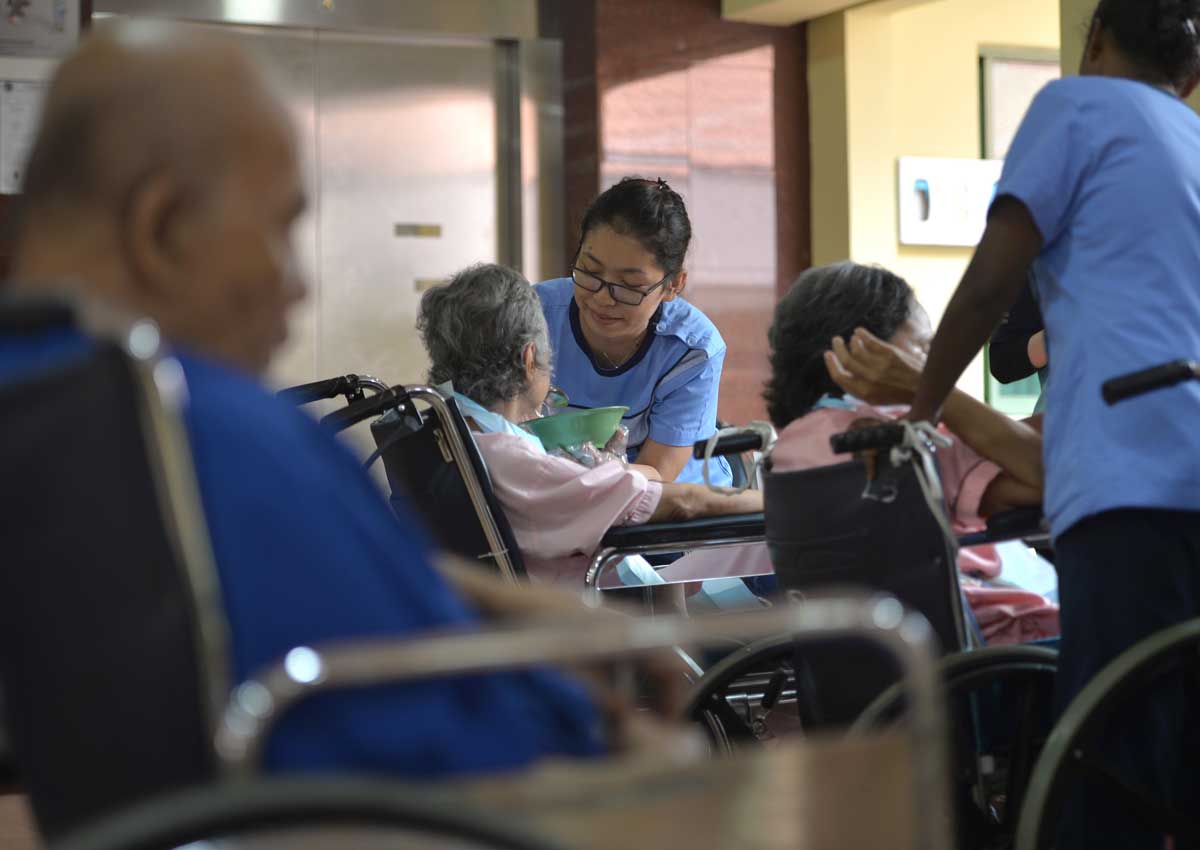
S'poreans okay with moving to nursing homes in their old age
Singaporeans are willing to live in nursing homes or shared communities with other seniors in their twilight years, but provided they have some privacy.
About half of nearly 1,000 Singaporeans said in a survey that they would be willing to move into a nursing home when they get old, but six in 10 would prefer single or twin- bed rooms rather than six- or eight- bed wards that are common here.
The reason for wanting the smaller rooms was to maintain privacy.
A similar picture also emerged for assisted-living facilities.
About half of the respondents said they would be willing to move into these homes, where seniors get help for personal care like bathing and going to the toilet.
But nine out of 10 said they would prefer single or twin-bed rooms.
Such group homes are common in countries like Australia and Japan, but do not exist in Singapore.
About 950 Singaporeans and 50 permanent residents aged 30 to 75 took part in the survey commissioned by insurance cooperative NTUC Income and philanthropic organisation the Lien Foundation.
Yesterday’s release of the findings came about two weeks after the foundation published a report on nursing homes which found that despite the growing elderly population, seniors have few housing options other than nursing homes.
The report estimated that 50,000 seniors here will need some form of residential care facilities by 2030, though there are currently only about 12,000 nursing home beds.
On the lack of choice in retirement living arrangements, Mr Gabriel Lim, the Lien Foundation’s programme manager, said: “I wonder how many Singaporeans choose a nursing home for their family members with the same care that they choose a handphone.”
The survey also found that eight in 10 Singaporeans worry about growing old.
Topping their worries is whether they can look after themselves when they are old.
The fear of running out of savings was next, followed by healthcare and medical expenses.
One of the bright spots in the findings was that nine out of 10 respondents were aware of services available to the elderly, such as daycare centres and homecare services.
Researcher Radha Basu, who wrote the report on nursing homes, said: “Dormitory-style living continues to be the default option in Singapore nursing homes, including in new homes.
Clearly there is a disconnection between what consumers say they want and what’s on offer, including in new facilities.”
In conjunction with yesterday’s survey, NTUC Income also launched an insurance plan covering diseases that affect older people like Parkinson’s, dementia and Alzheimer’s.
The new plan covers policyholders until the age of 100.
This article was first published on Oct 19, 2016.
Get a copy of The Straits Times or go to straitstimes.com for more stories.
Image:
Blurb:
<p>Singaporeans are willing to live in nursing homes or shared communities with other seniors in their twilight years, but provided they have some privacy.</p>
Publication Date:
Wednesday, October 19, 2016 – 14:00
Keywords:
Send to mobile app:
Source:
Story Type:
Others
HDB industrial land, properties to come under JTC
The transfer, which will affect about 10,700 industrial units and 540 industrial land leases, will help the Government to better support small- and medium-size enterprises (SMEs), HDB and JTC said in a joint press release.
Source link
Health supplements flagged for containing undeclared potent ingredients

SINGAPORE – The Health Sciences Authority (HSA) urged members of the public on Wednesday (Oct 19) not to purchase or consume two health products sold locally, including a “pain relief supplement” that was found to contain six undeclared potent…
Source link
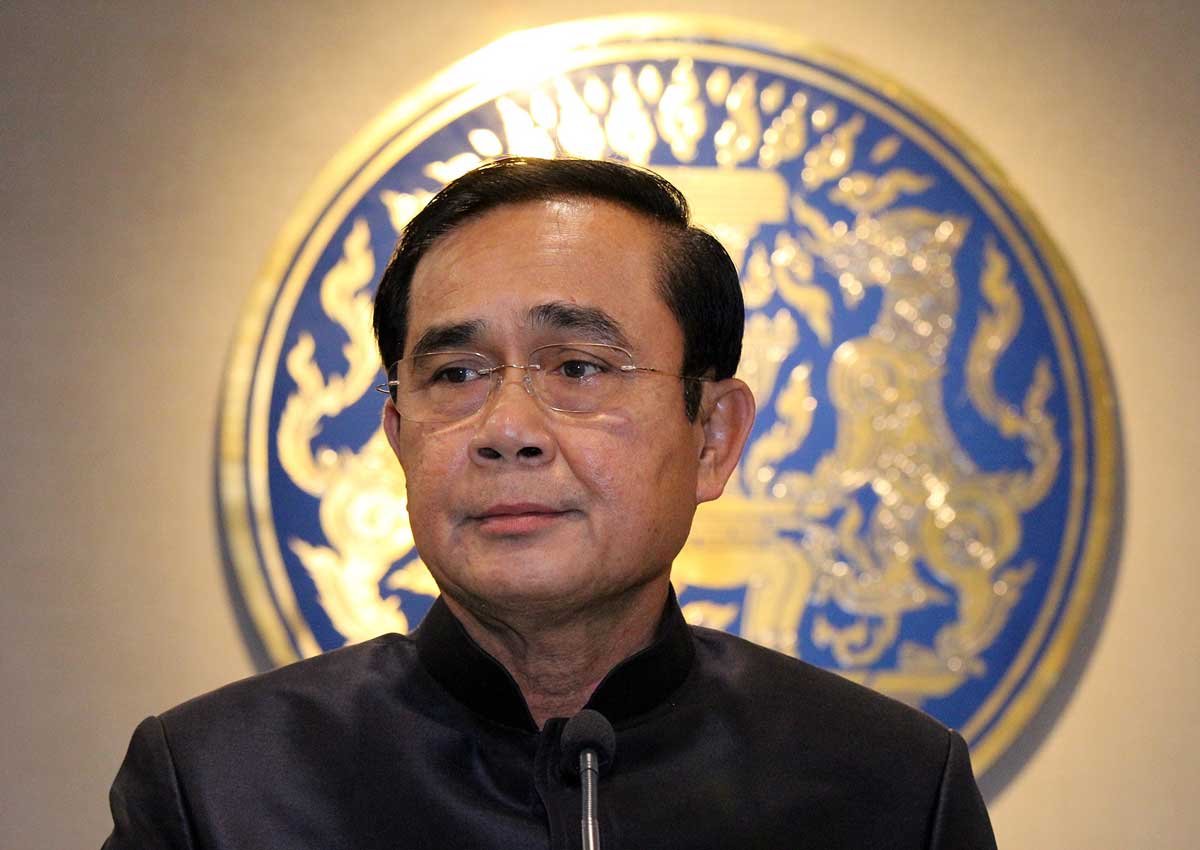
King's succession will happen within weeks, says Thai PM
The new king will be the one to endorse the new constitution before it comes into force in accordance with the government’s planned “road map towards democracy”, Prime Minister Prayut Chan-o-cha said yesterday (Oct 18).
“It is resolved now that once the mourning ceremonies have passed a period of seven or 15 days, it should be appropriate to follow the [2007 charter’s] Article 23,” Prayut said after a Cabinet meeting yesterday.
Article 23 specifies: “[I]n the case where the Throne becomes vacant and the King has already appointed His Heir to the Throne under the Palace Law on Succession, BE 2467, the Council of Ministers shall notify the President of the National Assembly.
The President of the National Assembly shall then convoke the National Assembly for the acknowledgement thereof and shall invite such Heir to ascend the Throne and proclaim such Heir King.”
Prayut said: “Please do not cast doubts on the succession to the throne. It will follow the |charter, palace law and customs. Our road map will also certainly be unaffected.”
The premier’s remarks, together with the road map’s requirement that the charter draft be promulgated within a few months, suggested the possible period when the new king will be crowned.
Constitution drafter chief Meechai Ruchuphan submitted the final draft of the charter to the Cabinet on October 11, while the prime minister had 30 days to consider before seeking Royal endorsement.
That endorsement that will require up to another 90 days, meaning that the charter draft should be promulgated, at the latest, by February next year, said Deputy Prime Minister Wissanu Krea-ngam, a legal expert. His Royal Highness Crown Prince Maha Vajiralongkorn, the only legitimate heir to the throne, has not yet assumed the throne because he has preferred to join the public mourning for His Majesty King Bhumibol Adulyadej before proceeding with the succession.
The Crown Prince’s decision temporarily delayed a process designated by Article 23, referred to in this case by the current charter draft, in which the president of the National Assembly would invite the heir to ascend to the throne and proclaim him king.
In the interim period before the heir is proclaimed under Article 23, the president of the Privy Council, General Prem Tinsulanonda, became Regent pro tempore and acting head of state in accordance with Article 24.
The Regent would act on behalf of the throne “only on the basis of necessity”, Prayut said.
332459
Photo GalleryLarge crowds gather as convoy transports Thai king’s body to Grand Palace
Source:
-

<!–
-

<!–
-

<!–
-

<!–
-

<!–
-

<!–
-

<!–
-

<!–
-

<!–
-

<!–
-

<!–
-

<!–
-

<!–
-

<!–
-

<!–
-

<!–
-

<!–
-

<!–
-

<!–
-

<!–
-

<!–
-

<!–
-

<!–
-

<!–
-

<!–
-

<!–
-

<!–
-

<!–
-

<!–
-

<!–
-

<!–
-

<!–
-

<!–
-

<!–
-

<!–
-

<!–
-

<!–
-

<!–
-

<!–
-

<!–
-

<!–
-

<!–
-

<!–
-

<!–
-

<!–
-

<!–
-

<!–
-

<!–
-

<!–
-

<!–
-

<!–
-

<!–
-

<!–
During his news briefing, Prayut emphasised that the government would strictly adhere to the road map without delay during the mourning period.
The government would also continue to drive the country forward, including adopting the late King’s initiatives, including the sufficiency economy philosophy to help the Kingdom to achieve the 2030 UN Sustainable Development Goals, Prayut said.
“Please turn your grief into uniting power and use your wisdom to move forward,” he said. “We also have to help create |correct understanding together.”
Image:
Publication Date:
Wednesday, October 19, 2016 – 11:05
Keywords:
Send to mobile app:
Source:
Video Media:
Other Video Media
Story Type:
Others
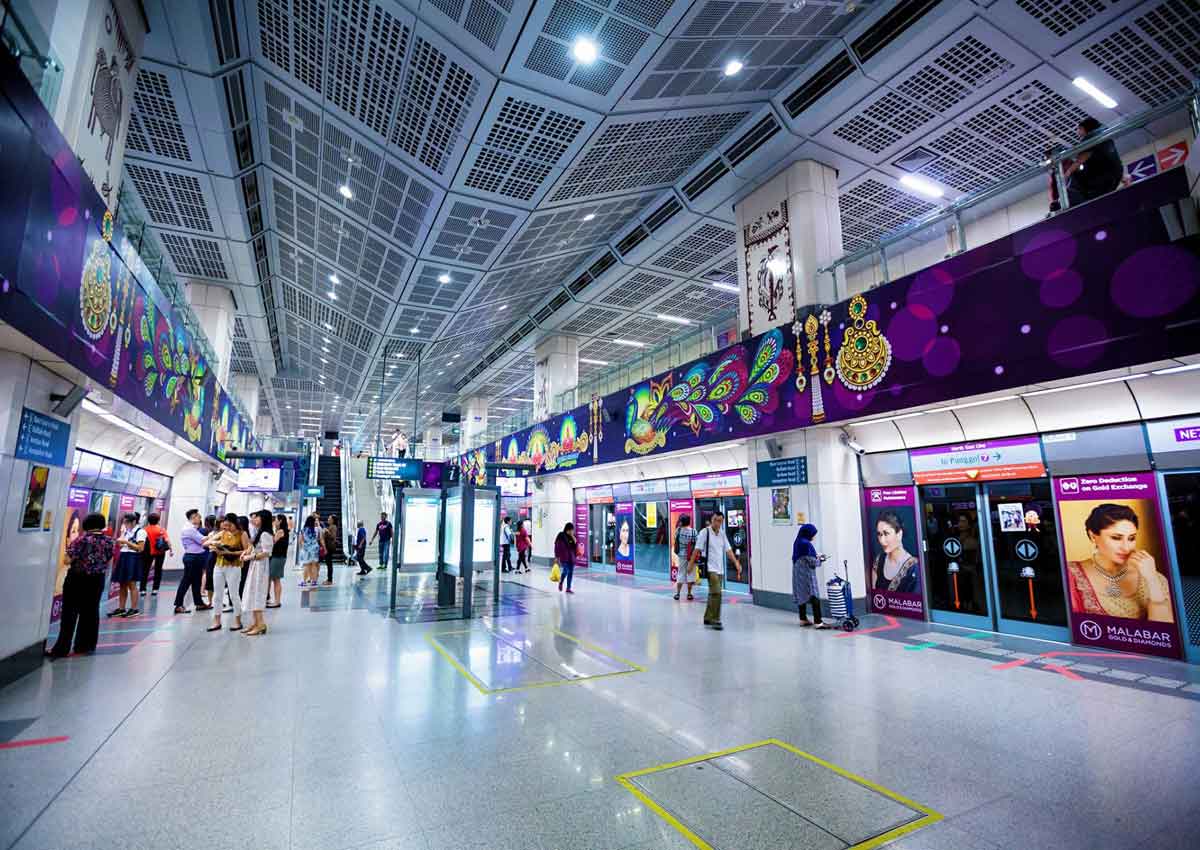
Indian media praise Singapore's first-ever Deepavali-themed NEL train
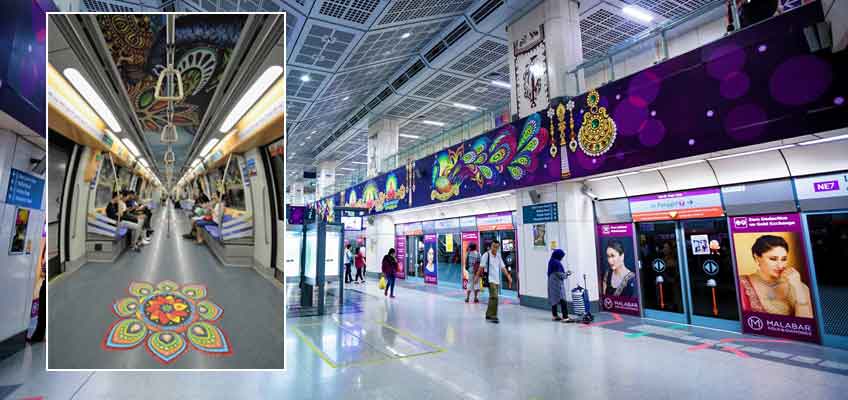
If you’ve taken a ride on a specific North East Line train this week and noticed how intricately decked the interior of the cabins are in Deepavali designs and colours, you are not alone.
Word of the first-ever Deepavali-themed train in Singapore, launched last Saturday, was picked up by many news publications in India even if it did not receive as much fanfare in the local media.
Publications such as the India Times, The Indian Express and News18.com reported on the unique set-up of this year’s initiative.
The cabins of the trains are decorated with colourful pictures of diyas (oil filled lamps) and garlands. As seen in the photos uploaded on LTA’s Facebook post, images of lotus, peacock, and jewellery associated with the festival are also spotted in the cabins and both the NEL and Downtown Line platforms at Little India Station.
And with the Festival of Lights, observed by Hindus, just 10 days away, the initiative by the Land Transport Authority has only served to add to the celebratory mood.
India Times said: “This train looks as if it is hosting a mini-festival inside it – with colourful walls and floor.
And how did the Singapore public respond to the decorative trains? Well, several Facebook users left positive comments on LTA’s post of the initiative, commending the effort as a good way to promote multiracial and cultural relations.

In a forum letter to The Straits Times, reader Mr Kumar Pillay Thangavalu said: “Kudos to the Land Transport Authority for the Deepavali decor on MRT trains…I am sure we will see more of such decorated trains for other festivals too, to reflect and enhance the rich multicultural society we have.”
332931
Photo Gallery
1st Deepavali-themed train launched on NEL
Source:

<!–

<!–

<!–

<!–

<!–

<!–

<!–

<!–

<!–
Besides the decorations at Little India Station and on the trains, Deepavali-themed lights have been put up on the roads along Little India, with lotuses and peacocks making up the top lights.
It is reported that LTA had collaborated with Little India Shopkeepers and Heritage Association for the project. According to LTA, the specially-themed train will run till mid-November.
stephluo@sph.com.sg
Image:
Publication Date:
Wednesday, October 19, 2016 – 14:15
Send to mobile app:
Source:
Rotator Image:
Story Type:
Rewritten Story
Motorcyclist killed in collision with lorry in Tuas
The motorcyclist was pinned under the lorry and was pronounced dead by paramedics at the scene.
Source link


