BENGALURU, India – They are not easy to spot. Working in vegetable patches and on millet fields in India’s southern state of Karnataka, farm labourers caught in debt bondage suffer mainly in silence.
But Gopal V has lived with this silence for long enough.
Now 44, the son of bonded labourers is on a mission to identify workers trapped in debt bondage – and to make sure they get justice.
“My parents worked endless hours not for money, just food,”Gopal said.
“They worked for a landlord in my village, whose house I still can’t enter. He paid them back with a little food, and my father died in bondage.”
Now, he travels across villages around Anekal, near the city of Bengaluru, looking for people like his parents.
There is an urgency to his search, he says, because he wants to “get them out before they die”.
India banned the practice of bonded labour in 1976, but the country is still home to 11.7 million bonded labourers, according to the International Labour Organisation (ILO).
The labourers may be working to pay off a loan from their employer, or a debt inherited from a relative.
Jeevika, a non-profit organisation that works to eradicate bonded labour in the southern state, said it identified 12,811 bonded labourers in Karnataka between 2012 and 2015.
Most of them are still waiting for state authorities to give them release certificates and compensation money, it said.
Its founder, Kiran Kamal Prasad, estimates that there are up to 200,000 bonded labourers across Karnataka.
“It is a perennial problem that persists in the agriculture sector,” said Druthi Lakshmi of the state’s rural development department.
“We know they are really poor, illiterate people who often go back to the same landlord for work after they are rescued because the rehabilitation money is not enough.”
The government is in the process of undertaking a more comprehensive survey to identify people in bondage, she added.
Gopal and others like him who work in partnership with Jeevika use their childhood memories of suffering and debt bondage to encourage others to find a way out of it.
“The fear of the landlord still exists in our (lower-caste) Dalit communities and people refuse to acknowledge they are in bondage,” said Ramakrishna V, also the son of a bonded labourer.
“It takes a lot of talking before they break down and admit they are paying off a loan they took many, many years ago,” said Ramakrisha, now a lawyer fighting for workers’ rights in court.
THREATS Activists say most people trapped in bonded labour are unaware of the fact they might have paid off their initial loan 10 times over.
In addition, the 1976 Abolition of Bonded Labour Act cancels any dues that may be pending when a worker is rescued from bondage, they said.
Jayaboraiah, 47, recalled how he was studying in his room when the landlord of his hostel came knocking.
“He said my father had disappeared without repaying the 800 rupees (S$17) loan he had taken to start a sericulture (silk production) business.
I dropped out of school and spent eight years working in his home and field to pay off that loan,”Jayaboraiah said.
But a glance at a report on bonded labour in a newspaper one morning led him to a government office to ask for help.
“Now I know the law and am able to explain to families in debt bondage that they have repaid their dues and should now be demanding minimum wages,” he said.
All three men said their personal experience of growing up in the shadow of debt bondage helps them to start a conversation about the issue in villages where traditionally lower-caste people still find it “almost impossible to leave the clutches of a landlord”.
Gopal said: “We are constantly threatened and so are workers, but we keep going to villages and areas where Dalits live and we lived until recently.
“It takes a lot of probing before anyone admits to having taken a loan and working to repay it.
It takes us months to build trust,” he said.
Gopal’s three daughters have documented the lives of their grandfather and uncles who worked as bonded labourers.
“I tell them about it because it is the reality from which they have emerged, and it makes them sensitive to the fact that many more still need help,” Gopal said.
Sanam Luang and surrounding roads were turned into a sea of black yesterday as a massive crowd of mourners from all over the country joined the heartfelt singing of the Royal Anthem in a historic assembly in memory of the beloved King Bhumibol Adulyadej.
Despite the heat, the crowd stood calmly and sang as one, many with tearful eyes, while raising portraits of His Majesty and banknote bearing his image.
“When I am alone, I always miss him [the King]. I don’t know what to do. So, I came here to join others in singing the Royal Anthem. I’m glad to be part of this epic moment,” Sunee Boonrod, 70, Bangkok told The Nation.
The mass recital of the Royal Anthem was accompanied by a 200-piece orchestra and a 150-strong chorus under the baton of renowned music director Somtow Sucharitkul. The stage was set at the centre of Sanam Luang, a park adjacent the Grand Palace, where royal and religious rites have been taking place following the King’s death on October 13 at the age of 89.
This most heartfelt tribute yesterday was filmed by prominent director MC Chatrichalerm Yukol and his 1,300-strong production crew, with 50 cameras, including two drones and cameras positioned on two cranes, as well as 25 microphones set up in six locations to capture the event.
The film, which will include added footage of His Majesty’s royal activities, will be shown on TV and cinemas across the country from next week. The crowd at yesterday’s event was estimated to be around 150,000, according to deputy police spokesman Maj-General Songpol Wattanachai. The number could have hit 250,000 if whole surface of Sanam Luang and the surrounding roads were filled, he said.
Photo: AFP
Prime Minister Prayut Chan-o-cha expressed admiration for the thousands who took part in the event, especially those who had travelled long distances and began arriving very early in the morning.
Government Spokesman Lt-General Sansern Kaewkamnerd quoted the PM as saying that because everyone shared the same heart, and despite the burning sun, the people had created one of the greatest and most impressive spectacles showing Thais’ respect and loyalty to the late King.
Crowds have been massing outside the Grand Palace, with many journeying from far-away provinces to pay respects to HM the King.
Some have pitched tents on a large grassy field outside the Royal compound, while others have slept on simple bamboo mats.
Overall, yesterday’s event went smoothly, said new Bangkok Governor Pol General Aswin Kwanmuang.
Photo: AFP
“There are 2,000 security officers and seven security checkpoints. Also, 140 tents are provided around the park with capacity to accommodate over 20,000 people. For medical treatment, hospital staff and doctors are on standby at 11 points for emergency cases,” Aswin said.
However, according to a source from the BMA, hundreds of missing person cases were reported yesterday.
“The number of the missing cases today [yesterday] is around five times higher than previous days,” the source said.
However, the source said most of the missing people were found.
But as of 5pm, dozens of the reported missing people remained lost, according to the source.
Meanwhile, hundreds people of all ages passed out around noon yesterday at the height of the anthem event, according to a source of the joint safety command centre.
However, Aswin said there was no serious health cases, with most cases people passing out.
333242
Photo Gallery
Amateur illustrators and designers show their love for Thai King on social media
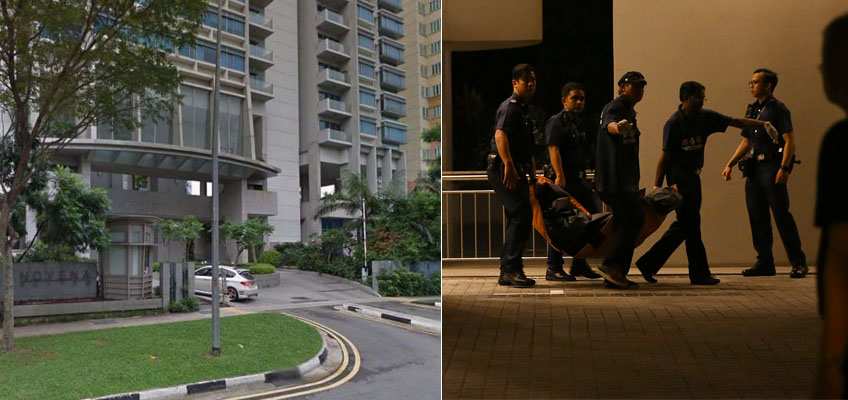
SINGAPORE – A 46-year-old man was found motionless at the foot of a block in Novena Suites on Moulmein Road around 6.55pm on Saturday (Oct 22).
In a residential unit of the same block, a 44-year-old woman, believed to be his wife who had been separated from him for two years, was found motionless in a bedroom on the 13th floor.
The woman was identified as Ms Ng Soo San, and the man, Mr Wang Chan Foo. It is believed that Ms Ng’s body was discovered a few hours after Mr Wang was found at the foot of the residential block. Both were pronounced dead at the scene.
The Singapore Civil Defence Force (SCDF) said Mr Wang had been standing on a balcony’s parapet when it responded to the incident. Several calls for assistance had been made before 7pm.
He fell when SCDF was deploying an inflatable life pack. Officers subsequently entered the unit at the request of the police and found Ms Ng lying in the house.
We are constantly told how glib, torpid, and entitled they are.
In youth speak, they are the worst.
But a casual experiment here at The Business Times (BT) has shown them to be less uniform than thought.
Their spending habits, in particular, turned out to be extremely diverse – informed more by their parents’ wealth and largesse, and less by some notional demographic common ground.
Coined in 2000 by researchers Neil Howe and William Strauss, the term “millennials” refers to those born in 1982 and some 20 years thereafter.
While Mssrs Howe and Strauss saw the young generation as one full of promise – their book was titled “Millennials Rising” – the term has acquired a pejorative patina over time.
Three years ago, Time Magazine famously characterised millennials as “the me me me generation” – “lazy, entitled narcissists who still live with their parents”.
It’s a stereotype that lives on, especially in the financial sense.
A 2012 study by the Pew Research Institute found that about one-fifth of millennials in their 20s still draw an allowance from their parents or family.
More middle-aged parents say they are the primary source of financial support for their adult kids, too.
Even so, these statistics are based on millennials in the US; what does the picture look like in Singapore?
With a bumper crop of interns this year, BT decided to conduct its own non-scientific investigation.
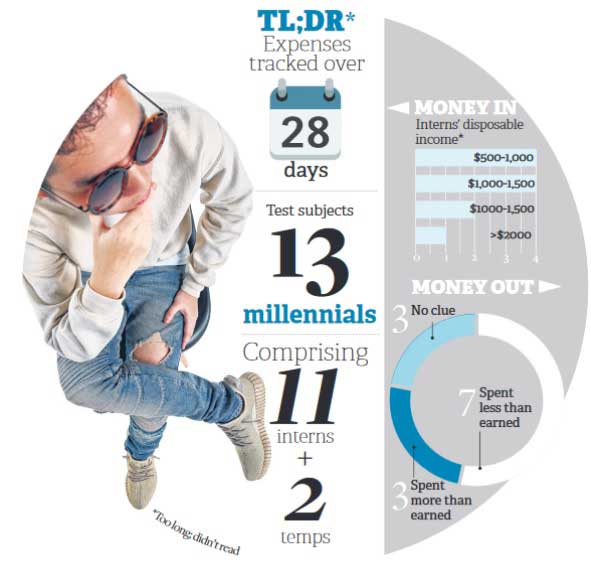
We asked 13 young millennials – comprising 11 interns and two temp staff – to meticulously track their expenditure every day, over four weeks.
Three were in their teens, eight were aged 20 to 25, and the two temps were older than 25 but under 30.
Infographic: Angeline Ngiam
Hilarious one moment and heartbreaking the next, these are their stories.
First, the basics: Where their spending money came from. For starters, our interns drew a salary of either S$550 (polytechnic students) or S$800 (university students).
The temp workers were paid more, although BT is not disclosing these figures.
On top of their salaries, eight of the 11 interns continued to receive an allowance from their parents or family – with the lowest monthly sum being S$100, and the highest, S$800.
Three had other part-time jobs to raise additional cash – one babysat on the weekends, while two gave tuition to younger students.
These different streams of income meant widely varying levels of purchasing power.
The interns had disposable incomes ranging from S$650 to more than S$2,000.
But when it came to spending within their means, only half – or seven of the 13 millennials – managed it.
Three weren’t able to say for sure, because they failed to track their spending diligently; the other three ended up spending more than they earned.
Profligacy and prudence
The three who spent beyond their means were female, and in every case, big-ticket shopping items were the culprits.
For example, one spent S$3,000 on a Tod’s handbag, with her parents forking out half of the money required.
A further S$375 was spent on a Kate Spade bag, this time without her parents’ help.
Explaining why her parents agreed to help her pay for the Tod’s bag, the intern says: “They knew that I had wanted that Tod’s bag for quite long, so they said: ‘Why don’t you save up half, then we’ll pay for the other half,’ (because they knew) there’s no way I can produce S$3,000 for a Tod’s bag.”
Another intern, meanwhile, spent almost two grand in four weeks on clothing, accessories, make-up, as well as hair and skin care: S$1,040 on clothes, bags, and shoes from online retailers ASOS and Shopbop; S$300 on “lotions and potions” from Amazon; S$364 on make-up from various brands at Takashimaya; and S$195 on three jars of Dior moisturiser.
Taken together, this came up to S$1,899.
She paid for less than half of this herself, and her parents footed the rest of it.
She knows that this sounds extravagant. Hair and skin care, as well as make-up, are “investments in (her)self”, she believes.
“I see these as necessities, but I think my understanding of what I ‘need’ in life is a little bit warped,” she says.
“I’m the kind of person who says I can’t survive without my Clarisonic.”
(For the uninitiated, Clarisonics are a high-end brand of motorised facial cleansing brushes, that cost upwards of S$200.)
To be sure, these interns were only able to splash out on pricey goods because of their parents’ perpetual succour.
Indeed, the more prodigal ones tended to have greater parental financial support.
The first intern, for instance, was given an Audi that she cannot drive, because she does not yet have a driver’s licence.
The second intern’s parents match her salary “as an incentive for (her) to work” – effectively doubling her monthly income.
Other parents, though, take a wholly different approach.
One intern is expected to contribute a portion of her salary towards the family’s car loan.
She has also been told that once she graduates and gets a full-time job, she will have to help service her parents’ mortgage as well.
Another intern describes her family as “not very well-to-do”.
Her four-room HDB flat houses 10 people – her father, stepmother, grandfather, grandmother, two siblings, two step-siblings, and a helper. Her bedroom is shared four ways: with her sister, stepsister, and helper.
She gets no allowance from her divorced parents; it is her grandfather who gives her S$10 a day as pocket money.
Because this excludes Saturday and Sunday, this adds up to S$200 in allowance per month – a quarter of what some of her peers receive.
It’s a sum she feels guilty accepting, too, given that her grandfather is already in his 70s.
The 19-year-old says: “I grew up in a family where it was my grandpa who was always giving us an allowance.
Because of that, he’s still working in some shipping company.
“I feel bad because I still get an allowance; it should be the other way around.
“So when I make a big purchase – my phone, or my laptop – I’ll work and save it to buy it on my own, instead of having to make (my family) pay.
It makes me understand how difficult it is to earn money, and how easy it is to just spend it.”
For her, part-time jobs have been par for the course since she was 17, when she entered the working world as a Starbucks barista.
In the two years since, she has rolled sushi at Makisan, curated tours at the Mint Museum of Toys, handled events at Culinaryon, and waitressed at Marina Bay Sands.
Unsurprisingly, she was one of the thriftiest in the BT group – often paying less than S$5 per meal, staying in on weekends, and taking public transport with her student concession pass.
What’s trending
Despite being such a variegated bunch, BT’s millennials showed some commonality in their spending habits – particularly with regard to food, transport, and entertainment.
For one thing, most of them ate pretty poorly. Several favoured cup noodles for dinner, with one intern confessing: “I realise it’s bad for my health, but I really love it.”
Breakfast choices were also not the most fresh or nutritious.
One intern spent S$9 on breakfast at doughnut store Krispy Kreme, while another frequently ate at McDonald’s for his first meal of the day – at least once each week.
In fact, McDonald’s was a popular choice among the group.
One intern, for instance, ate six dinners and one lunch at the fast food chain – chalking up seven meals at McDonald’s over 20 work days.
For transportation, most preferred to use their student concession passes for public transit.
But a sizeable number – five, to be exact – travelled exclusively by private car hires.
This didn’t necessarily translate into more money for taxi companies like ComfortDelGro, because only one of the five would flag down such cabs.
The rest – two temps, two interns – only used ride-booking apps like Uber and Grab.
When asked why, one intern says: “I dunno leh, I don’t like that taxi car smell.”
He later qualifies his answer: “I don’t, like, hate taxis. It’s just about what’s more convenient or faster.”
This intern favoured Grab over Uber because of the former’s fixed-rate system – where one is told from the outset how much the ride will cost.
“Uber can be cheaper than Grab, but the fares are not fixed.
So if you’re stuck in a jam or the driver takes a longer route, (you’ll end up paying more). But with Grab, the fee is fixed from the beginning; I like knowing how much I’m spending before I get into the car,” he says.
(Since Aug 31, Uber has instituted upfront fares in Singapore.
Explaining the move, Uber said: “Based on tests in other cities, riders request more trips if they are offered an upfront price.
In other cities like the US, trip requests increased even during surge times.”)
This affinity for on-demand services also manifests in the way they consume movies, TV shows, and music. At least five members of the group subscribe to a music- or movie-streaming service such as Spotify, Apple Music, and Netflix.
One millennial even pays US$6 a month for membership with SuperChillin.net – an invite-only website described as “an illegal movie streaming paradise”.
He likes the illicit site because it boasts current-season TV episodes and movies – which kosher providers like Netflix aren’t always able to offer.
That doesn’t mean every millennial is necessarily pouncing on new and techie things, though.
The same intern who uses Uber, Apple Music, and SuperChillin.net also still buys physical books, or borrows them from the library.
“I’ve tried using my sister’s Kindle, but I still prefer to have the physical heft (of a book) in my hand,” he says.
Other minutiae
Trawling through 13 millennials’ spending records can make one feel like a financial Peeping Tom.
One intern included a line item for 72 condoms for S$58.
In a footnote, she wrote: “We buy these things in bulk online because 1. it’s cheaper, and 2. we’re lazy to keep repurchasing.
We typically go through 12 a month, so I guess you can ‘amortise’ the total cost over six months? S$58/24weeks = S$2.40 per week.
So I guess the cost for this week should be S$2.40 instead of S$58? LOL…”
Other spreadsheets revealed intimate details too, albeit of a different nature.
One chronicled almost-daily charitable contributions – S$2 here to an aunty selling tissue paper at Yishun or Braddell MRT, S$5 there to a mosque’s charity box.
All told, his donations – about S$22-25 per week – made up a third of his overall spending.
The upshot
Expenditure aside, the 28-day experiment revealed – to the millennials’ surprise – just how little attention they had been paying to their cashflow.
Until this exercise, none of the 13 had ever tracked their spending formally.
Only two said they had a rough idea of where their money was going, but even this was down to the loose (and notoriously inaccurate) approach of a running mental tab.
When asked for their thoughts at the end of the exercise, the overarching refrain was: “OMG, I didn’t realise how much I was spending.”
Here’s the kicker, though. Despite admitting that they probably should track their day-to-day expenditure, none of them have continued to do so.
One intern says: “I downloaded an app to help me track my expenses. I think it was quite interesting because I had never done it before, so I didn’t know how much I was spending weekly.
“But I didn’t continue the practice after because it’s a bit tedious to key it in, although I think it’s my responsibility to track. It’s a good practice, especially as I go into adulthood.” He turns 20 this year.
To be fair, BT’s sample of millennials was pretty young (11 of the 13 were under the age of 25).
It’s possible that when they graduate and enter the working world – assuming their parents no longer finance their spending then – they will be more compelled to keep better tabs on their hard-earned cash.
It is difficult to sum up the findings of BT’s humble experiment, precisely because the group has proven so diverse.
If anything, the results show that the millennial next door isn’t as archetypal as anyone might think.
Most discussions about millennials have focused on their shared traits – many of which are uncomplimentary.
But what is worth considering instead is the disparity than can exist – even amongst a modest 13 people, who share a workplace and are similarly youthful.
What does it mean, that despite or because of their various backgrounds, they had ended up here?
And as a wider question for all millennials in a time of growing inequality, will their respective trajectories be boosted by privilege or hobbled by circumstance?
These are imponderables.
But we wish this generation every success.
They will each, in their own way, need it.
This article was first published on Oct 22, 2016. Get The Business Times for more stories.
Speaking at an international conference on the modernisation of Chinese medicine, the Health Minister said accumulating evidence-based research was key to TCM’s continued development.
Get around town, meet friends and family, or simply chillax at your favourite café with this $5 off promo code. Get $5 off discount for one standard Grabtaxi ride from 22 – 28 October.
BEIJING – The leaders of the world’s most powerful political party gather in Beijing on Monday for a conclave that could change the course of Chinese history.
In meetings at the exclusive Jinxi Hotel, safe from the public’s prying eyes, nearly 400 top members of the Chinese Communist Party will confer for four days, discussing changes to how the giant party will be managed.
The meeting, according to the official Xinhua News service, will focus on the issue of “party discipline”.
The dry rhetoric hides what may be a ferocious, high-stakes battle for control over the world’s second largest economy.
The Sixth Plenum, as the meeting is known, comes as the party – which has more than 88 million members – faces a period of tectonic change.
Since taking its helm in 2012, General Secretary Xi Jinping has sought to bend it to his will, and taken control of more levers of power than any leader since Mao Zedong.
And his anti-corruption campaign has laid waste to the party’s organisational chart, felling seemingly invincible bastions of power such as former security czar Zhou Yongkang, and paralysing lesser bureaucrats across the nation with fear.
Xi has described the party as a “magic weapon” that can be used to implement reforms necessary to achieve his goal of the “Great Rejuvenation” of the Chinese nation, an idea that he frequently describes as the “Chinese dream”.
But attempts to rein in sclerotic state-owned enterprises – which control strategic sectors of the economy and are sources of patronage for powerful politicians – have met stiff resistance from entrenched interests.
“These reforms have really gone nowhere over the last three years,” said Anthony Saich, an expert on Chinese politics at Harvard University.
“Clearly, Xi sees the party as the only vehicle that can push ahead with reforms.
He does not trust society or the state to move ahead with the reforms he wants.”
At the meeting, he added, “there will be jockeying between those who enjoy Xi’s support and those who are negatively affected by the campaign against corruption and by the potential for further reforms of the state-owned sector”.
For Xi, improving party discipline means more than simply reducing cadres’ bad behaviour.
“He has been very ambitious in grabbing power, in arrogating powers to himself,” said Willy Lam, a China expert at the Chinese University of Hong Kong.
The “major motivation” of any new rules passed during the plenum will be to “consolidate (Xi’s) position as the big boss”, he said.
Several measures have already been introduced to make sure party members toe Xi’s line, he added, including prohibitions against officials making “groundless criticism”.
“Only one person in the party, namely Xi Jinping, has the right to define what the political rules are,” Lam added.
The meeting comes as speculation mounts that Xi could look to stay on in power after 2022, when he would normally be expected to step down after two terms in office.
Such a move would be “an extremely risky proposal, as it would create severe frictions among China’s political elite”, the Mercator Institute for China Studies’ president Sebastian Heilmann wrote in a research note.
Xi is also China’s president, but derives his power from his Communist Party post.
He will take the plenum as an opportunity to “strengthen his leadership position and the base of his power in office”, according to Mao Shoulong, a professor at Renmin University in Beijing.
The anti-corruption drive has had “breakthroughs” in previously untouchable areas, he said.
But its effectiveness may have conversely weakened the party Xi hopes to save, according to a Friday editorial about the Sixth Plenum posted on the web site of “Seeking Truth”, an important party journal.
The campaign has disciplined hundreds of thousands of members and, in the process, “illuminated the universality and seriousness of the corruption of power within the party”, it said, a revelation that has “seriously weakened the foundations of the party’s rule and its ability to govern”.
Critics say the drive has been used for internal faction-fighting and, in the absence of systemic reforms, does not tackle the root causes of graft.
Hu Xingdou, an expert on China’s governance at the Beijing Institute of Technology, hoped the meeting would introduce and enforce rules to make party members more accountable and transparent, such as a national property registry.
“There have been regulations in the past, but none of them were implemented,” he said.
This time, he said, “I hope that they can pass public disclosure of assets.
“Only in this way can they win the entire nation’s respect.”
Actor Song Joong-ki has reportedly donated 20 million won (S$24,600) to a charity group dedicated to helping victims of sexual slavery during World War II on Tuesday.
A representative for the Nanum House comfort women charity group said Thursday, “We received a generous donation of 20 million won under the name Song Joong-ki on Tuesday.
We asked his agency and they said it was in fact actor Song Joong-ki who donated.”
“At first when we asked, the agency didn’t even know.
He tried to donate secretly” said the representative.
Comfort women were young women and girls who were forced into sexual slavery by the Imperial Japanese Army during World War II.
Song is currently filming “Battleship Island” alongside actors So Ji-sub and Hwang Jung-min.
He will play the role of a member of an independence group who sneaks onto Hashima Island to rescue the Koreans who were forcefully taken there during the Japanese colonisation of the peninsula.
DAVAO CITY – President Rodrigo Duterte on Friday said he would invite for coffee the police officer who rammed into Wednesday’s protest line outside the US Embassy in Manila to ask him why he did it.
“I will try to talk to him peacefully, invite him for coffee,” Duterte said. “I will also talk to the activists.”
He said he was not justifying the act of PO3 Franklin Kho but he might have been under stress at that time.
“They were surrounded by a group of militants,” Duterte said, “Nobody would do that, maybe he was under stress, they might have ganged up on him,” Duterte said.
“I’m trying to look at it from different dimensions,” he said, adding that he also wanted to know what really happened.
Sandugo, the group that led the Lakbayan-rally from Mindanao to Manila, said it was ready to dialogue with Duterte over the issue of the violent dispersal of the rally.
Sandugo co-convenor Piya Macliing Malayao, one of those severely injured when Kho rammed the police van he was driving into the protest line, said the dialogue would help them “clarify the events that transpired during the violent dispersal.”
333413
Photo Gallery
Police van rams into protestors outside US Embassy in Manila
Malayao said while Duterte claimed he was “not justifying” the actions of the police, it was clear that the President had only heard the side of the police.
“With all due respect, Mr. President, the initial briefing you might have been given on the incident might be lacking,” Malayao said on Duterte’s statement that Kho might have acted on instinct of self-preservation.
“For one, various video footage of the incident show that the police vehicle in itself was positioned in an area with much space to manoeuvre.
Yet, PO3 Kho still recklessly driven in reverse and then forwards several times, toppling many unsuspecting protesters who by that time were still reeling from the effects of the tear gas that was just released moments before,” Malayao said.
She said Duterte “really needs to be given a full view of what transpired, as it is apparent that he has been given limited information on the incident.”
“At least, he admitted that he still needed to know what actually transpired. Initially, we are relieved by his pronouncement that he will be meeting with both the police and the demonstrators and personally do the questioning,” Malayao said.
Duterte said he will talk to both sides because there’s no more room for fighting now that his administration is pursuing talks with the Communist-led National Democratic Front of the Philippines (NDFP).
“There’s no more Left here, we are talking,” Duterte said.
“I don’t want a quarrel between the police and the militants,” Duterte said, “It’s about time that we treat this with civility, di lang basta hulihin ang pulis, o ang pulis naman, coming in with a swagger, beating people, I don’t want that to happen in my administration,” he said.
“I’m praying to God we will succeed in the peace talks,” Duterte said.
Duterte also stressed that policemen should not be allowed to carry firearms during demonstrations.
“The most that the demonstrators can do is to cause damage,” he said, “I don’t want to see firearms during demonstrations, no M16s, we are not fighting here.”
“Those are anathema in the modern sense of the word,” he said. “There’s always the right to dissent, that’s part of the territory of democracy,” Duterte added.
Jerome Succor Aba, a Moro militant leader and co-convenor of Sandugo, said he welcomed Duterte’s renewed commitment to pursuit a just and lasting peace.”
“We look forward to sitting down with the President and talk to him about our call for the abrogation of lopsided treaties with the United States, along with the pull-out of US troops and installations in the country, and the call for accountability against the historical injustices perpetrated by US imperialism against the Moros and indigenous peoples-calls that are necessarily connected with his announcement of separation from the US both militarily and economically,” Aba said.
The National Democratic Front in Southern Mindanao said US imperialism and “rabid anti-Duterte clique of the ruling class” were to be blamed for the violent dispersal of the rally.
“Wednesday’s violent dispersal showed only too clearly the extent to which the reactionary state armed forces will employ in order to protect US imperialist interests in the country,” Rubi del Mundo, the NDF Southern Mindanao spokesperson, said in a media statement.
“This recent attack on our national minorities in defence of US imperialism should therefore only strengthen the President’s resolve to abrogate all onerous economic and military agreements with the United States and continue to push for an active and independent foreign policy,” Del Mundo added.