Home Blog Page 2397

Benedict Ang: Leaving the National Football Team for a Life in the Cage

0

Evolve MMA’s Benedict Ang is living out his dreams.

The undefeated featherweight prospect is set to battle fellow unbeaten mixed martial artist Ahmed “Wolverine” Mujtaba at ONE: DEFENDING HONOR on Friday Night, 11 November, live in front of a hometown crowd at the Singapore Indoor Stadium.

Ang enjoys competing inside the cage and having the support of the nation on his side. But although MMA is the 20-year-old’s passion nowadays, it was not his first love.

His first love was football. As a matter of fact, he played the sport at a very high level.

When Ang was 15, he had the opportunity to play football for the Singapore national football team. Most youngsters would give anything to have that chance, and Ang got the opportunity to suit up for the Under-15 squad.

“It was been my dream as a kid growing up, so it was definitely a big achievement when I made the Under-15 National Team,” Ang says. “Cristiano Ronaldo was my inspiration. Football is perhaps the biggest sport in Singapore.”

Representing the country on the highest level as a teenager was not only an outstanding achievement, but it further motivated him to give his maximum effort on the field. 

“[I felt] immense pride, of course,” he says. “It sounds silly, but I treated it like I was playing in the World Cup.”
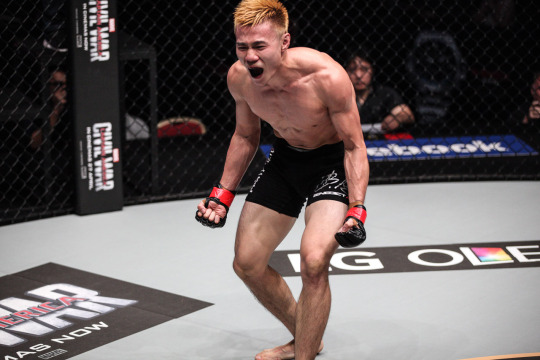
In 2013, however, he quit the sport to pursue an MMA career. He left the national team just before his first amateur fight. Though his friends, family, and teachers were all shocked at his decision, they were nonetheless supportive and proud of him for heading into the cage to engage in single combat.

In addition to leaving the national squad, Ang also gave up playing for his football club. He was playing for the highest caliber team in the country, so it is easy to assume his teammates and coaches would be upset that he was stepping away to pursue a different sport.

Fortunately, there were no bad feelings. In fact, Ang recalls that they did not say much, just: “Alright, go for it.”

Stepping on the football pitch is a completely different feeling from stepping inside a cage. Not only are you completely alone in the cage, but you also have an opponent who is trying to physically impose their will. 

Also, from a mental perspective, football is a team sport  and you must rely on everyone around you, whereas with MMA, while you train as a team, you enter the cage alone.

All of that appealed to the young Singaporean. 

“I feel MMA is the most honest sport,” he says. “You get in there alone, and all your hard work and effort will show. 

“You cannot lie or depend on anyone else when the cage door shuts. I just enjoy going in there and testing myself.”

Something clicked inside young Singaporean’s head when he decided to make the switch from football to MMA. He wanted a challenge in life and one he could take on himself. 

The ex-footballer wanted to test his personal limits So far, he has passed the test with flying colors as he has won all three of his professional bouts, which have been contested inside the ONE Championship cage.

“I think I realized that MMA is the ultimate test anyone can ask for, and I wanted that challenge,” the Evolve MMA product admits. “I am all set out to be the best that I can be.”

Ang’s next test is on Friday Night at ONE: DEFENDING HONOR and he will look to pass the test for a fourth time.


Image: 
Benedict Ang: Leaving the National Football Team for a Life in the Cage
Category: 
Publication Date: 
Wednesday, November 9, 2016 – 07:02
Send to mobile app: 
Source: 


Story Type: 
Others

Source link

Victim of brutal murder always came home with gifts for her son

0

Brother of Indonesian victim says she left for Hong Kong to find work just a month after giving birth to son

Her baby was just 40 days old when Ms Sumarti Ningsih left for Hong Kong in 2011 to work as a domestic helper.

It wasn’t an easy decision for the single mother to leave the newborn and her family behind in Indonesia.

But the 23-year-old had no choice because in their small town of Cilacap in Central Java, work was hard to come by.

It was a question of putting food on the table.

Ms Ningsih’s brother, Mr Suyitno, told The New Paper over the phone from Cilacap yesterday: “She did not just send us money, she also brought much joy to our household. Every one was happy when she was around.”

But their world came crashing down when Ms Ningsih and another Indonesian woman, Ms Seneng Mujiasih, were brutally killed in Hong Kong two years ago.

The murderer, British investment banker Rurik Jutting, was sentenced to life in prison yesterday.(See report on facing page.)

Upon hearing news of the verdict, Mr Suyitno, 27, said his family could finally feel “relief” after two years of waiting.

Speaking in Bahasa Indonesia, he said: “We as a family are happy with the verdict and we’re thankful to the government which took our family’s side.”

But he added that his family intends to ask for compensation and will be consulting their lawyers.

Mr Suyitno, who is unemployed, said his sister would occasionally visit her son, Muhammad Hkafiz Arnovan, bearing toys and clothes.

The boy, now five, would happily accept these presents from the woman he called “auntie”, without knowing she was his mother.

He was taken care of by Mr Suyitno’s parents, and to him, they were his parents.

Mr Suyitno said Ms Ningsih never came home empty-handed.

He said: “When she came back, she would bring clothes or toys for her son, even though he did not know who she really was.

“She just wanted the best for him.”

Mr Suyitno said they have since told the son that the “auntie” will not come home with presents again.

Mr Suyitnodescribed his sister as a “happy and fun person” whose top priority was her family.

To support her family, she started working at a young age as a babysitter and cleaner.

Despite being away, Mr Suyitno said his sister “never forgot” about her family.

She would regularly send back money and would always remind her family to “give Hkafiz what he wanted”.

ODD JOBS

The family of four now survives day-to-day by doing odd jobs.

In the two years since Ms Ningsih was murdered, Mr Suyitno said his family had always stayed away from news about the investigations or the trial because the grisly details were too much for them to bear.

“People would come up to us and give us updates. To be polite, my family would listen but would never ask to find out more,” he said, his voice cracking.

He added: “Each new piece of information was too horrific to imagine. We did not seek it out.

“We just want good memories of her.”

She would bring clothes or toys for her son, even though he did not know who she really was.

– Mr Suyitno

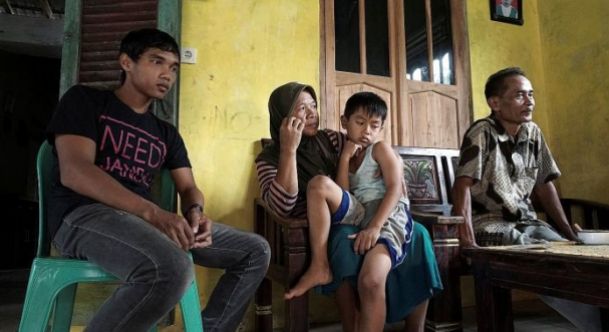
GRIEVING: (From left) Ms Sumarti Ningsih’s family, elder brother Suyitno, mother Suratmi, son Muhammad Hkafiz Arnovan and father Ahmad Kaliman, in their house in Cilacap. PHOTOS: REUTERS,

Source link

British investment banker jailed in HK for murder is an 'extreme danger to women'

0

They had gathered in front of the Hong Kong High Court yesterday morning, waiting for the verdict on British banker Rurik Jutting.

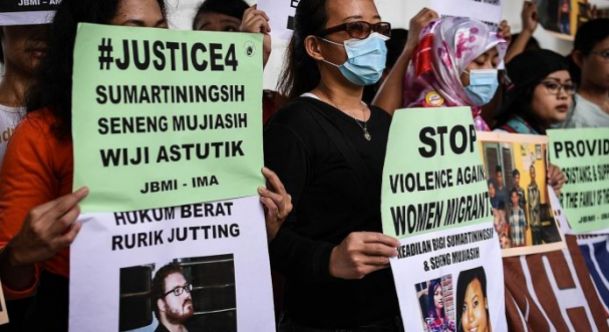
The dozen or so protesters from the Network of Indonesian Migrant Workers and Asian Migrants’ Coordinating Body (AMCB) carried placards bearing the names of the two victims, Sumarti Ningsih and Seneng Mujiasih, both Indonesians.

They demanded justice for the victims and wanted an end to violence towards women.

Ms Sringatin, a spokesman for AMCB, said: “Justice for the two murder victims (is) also justice to all women migrants in Hong Kong and elsewhere in the world.”

She also read statements from the families of the two victims.

“Since the death of Ms Mujiasih, her mother has been suffering from diabetes and high blood pressure which damaged her eyesight. Her father is unable to work any more because he needs to take care of his wife and elderly grandmother.”

Ms Mujiasih’s family added that they would be seeking compensation.

– Hoe Pei Shan

Source link

Could one of them be our next President?

0

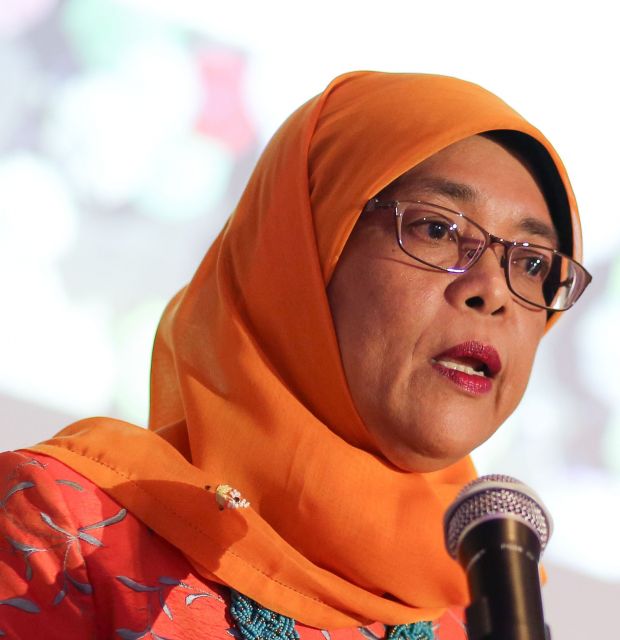
MADAM HALIMAH YACOB, 62

APPOINTMENTS

2001 to now: Member of Parliament

2011 to 2012: Minister of State (Ministry of Community Development, Youth and Sports)

2012 to 2013: Minister of State (Ministry of Social and Family Development)

2013 to now: Speaker of Parliament

WHY HER?

“She is a trained lawyer. Was in the top echelon of NTUC, then MP, Minister of State, and Speaker. In short, she is very well-qualified. I believe she is also well-liked. As an added bonus, she is a woman.”

– Associate Professor Tan Ern Ser, National University of Singapore

“Usually, candidates (for the Presidency)  don’t step down from their current positions and stand for election immediately because they may be seen as too closely associated with the governing party.

– Mr Mano Sabnani, political observer and chief executive officer of Rafflesia Holdings, a media and financial consultancy company


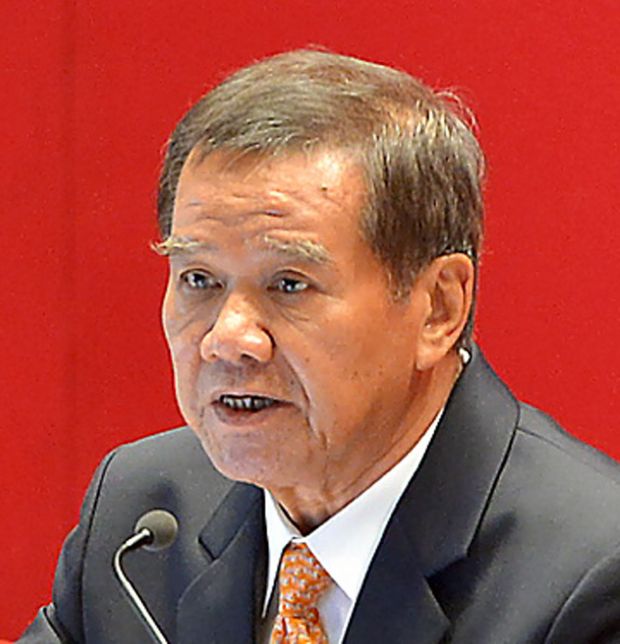
MR ABDULLAH TARMUGI, 72

APPOINTMENTS

1984 to 2011: Member of Parliament

1989 to 1993: Deputy Speaker

1993 to 2002: Minister-in-charge of Muslim Affairs

1994 to 2002: Minister for Community Development

2002 to 2011: Speaker of Parliament

2012 to now: Member, Presidential Council for Minority Rights

WHY HIM?

“He’s been retired from politics for some years  now.  So he could be seen as not closely linked to the political establishment.”

– Mr Sabnani

“That Abdullah Tarmugi was born to a Malay father and a Chinese mother, and the fact that his wife is also Chinese may well be an added advantage as the portrayal of a multicultural identity is likely to resonate with the society at large here.”

– Dr Mustafa Izzuddin, Iseas-Yusof Ishak Institute


MR BAHREN SHAARI, 54

APPOINTMENTS

2010 to 2015: Global Head (Southeast Asia), Bank of Singapore

2015 to now: Chief executive officer, Bank of Singapore

2012 to now: Non-executive and independent director, Singapore Press Holdings

WHY HIM?

“He is known to many in the community, but he may have to boost his profile beyond the community should he be interested to run for president.”

– Dr Mustafa

Source link

Was brutal murder over a card game?

0

Prosecution says Pakistani duo then killed housemate, cut off his legs and stuffed him into two bags

He won money from his two housemates after beating them in a game of cards.

But the win may have cost Mr Muhammad Noor, 59, his life.

The legless body of the Pakistani national was found stuffed inside a suitcase found at Syed Alwi Road in Little India at about 6pm on June 11, 2014.

The police later found another suitcase containing his dismembered legs at a nearby Muslim cemetery.

Mr Muhammad Noor’s two housemates were arrested and charged with murder.

The trial of Rasheed Muhammad, 45, and Ramzan Rizwan, 27, who are also from Pakistan, started in the High Court yesterday.

The New Paper previously reported that the three men hailed from the same village in Pakistan and came to Singapore to sell tissue paper.

Deputy Public Prosecutor (DPP) Ong Luan Tze said in the prosecution’s opening statement that the three men stayed at the same lodging house in Rowell Road.

Rasheed and Mr Muhammad Noor shared a room while Ramzan stayed in another room.

Some time before June 11, 2014, the trio were gambling with cards and Rasheed and Ramzan lost some money to Mr Muhammad Noor, said DPP Ong.

It was not mentioned in court what game they were playing or how much money the victim had won.

Rasheed and Ramzan allegedly plotted to kill Mr Muhammad Noor to recover their losses.

Some time past midnight on June 11, they allegedly met outside Mr Muhammad Noor’s room and discussed how to attack him.

They entered the room and Ramzan allegedly grabbed a shirt hanging on the back of the door and pressed it against Mr Muhammad Noor’s face.

Meanwhile, Rasheed allegedly used a cloth string to strangle Mr Muhammad Noor.

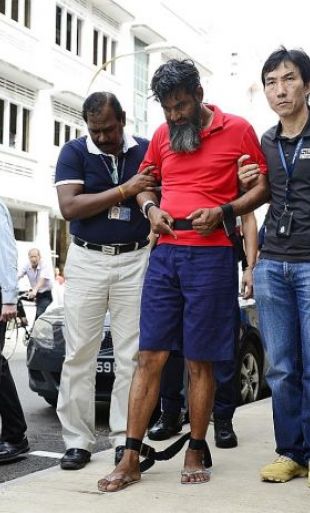
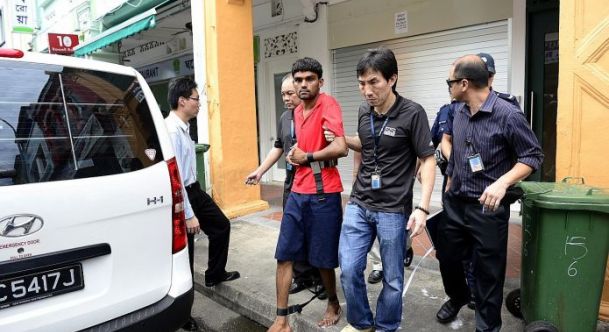
GRISLY FIND: (Above) Rasheed Muhammad (in red) using his foot and fingers to point out to investigators what appears to be dried bloodstains on the pavement along Syed Alwi Road.PHOTOS: ST & TNP FILE, LIM KOK YOU

They continued pressing on the victim’s mouth, nose and neck until he became motionless, said DPP Ong.

The two men allegedly took $6,000 from him.

Between 9am and 11.15am, Rasheed and Ramzan went to Mustafa Centre, where Rasheed bought a grey luggage bag and an electric jig saw, said DPP Ong.

They went back to Rowell Road, where they bought a bow saw and some rubbish bags.

SAWED OFF

They returned to Mr Muhammad Noor’s room and allegedly sawed off both his legs at the upper thigh.

They allegedly packed the legless body and the legs in separate rubbish bags.

The body was stuffed into the grey luggage bag.

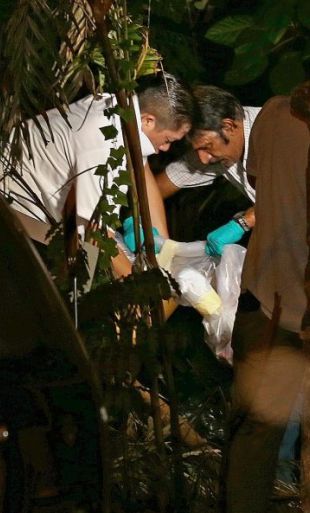
DUMP SITE: Police officers at the forested area at the Jalan Kubor Muslim cemetery, where the bag containing Mr Muhammad Noor’s severed legs were found. PHOTOS: ST & TNP FILE, LIM KOK YOU

Between 11.45am and 11.56am, they returned to Mustafa Centre and bought another luggage bag – a black one – before going back to the room, where they allegedly stuffed the legless body into the bag.

They then cleaned the room using soap powder, said DPP Ong.

At 12.25pm, they allegedly left the room with the two luggage bags.

Ramzan went to the Jalan Kubor Muslim cemetery and left the black luggage bag which contained the legs there.

He went to look for Rasheed, who was pulling the grey luggage bag along Syed Alwi Road towards the cemetery.

But the wheels of the bag broke, so the two men tried lifting it.

Blood started dripping out of the bag, prompting them to abandon it on Syed Alwi Road, said DPP Ong.

The bag was discovered by an 81-year-old man, who tried to push it towards a police station.

Some passers-by tried to help him, only to discover a body inside, and the police were called.

Ramzan and Rasheed were arrested the next day and Rasheed led the police to the Muslim cemetery where officers recovered the bag with the legs, said DPP Ong.

The prosecution will produce evidence from 66 witnesses, including forensic pathologists, a fingerprint expert, doctors and police officers, over the 10-day trial.

Ramzan is represented by Mr R.S. Bajwa and Rasheed is represented by Mr Wong Siew Hong.

The trial continues today.

If convicted of murder, they will face the death penalty.

In hindsight, with this knowledge, I may not (have proceeded)… I would have referred him (Ramzan Rizwan, above) for psychiatric help.

— ASP Tan Boon Kok replying to the accused’s lawyer R.S. Bajwa on whether he would have taken a statement from him if he had known the man was suffering from a depressive disorder


Source link

PM Lee: Singapore needs a multi-racial elected president

0

HOW?

After consulting the Attorney-General, Prime Minister Lee Hsien Loong said the racial provisions will apply from Dr Wee Kim Wee’s term.

As the presidents after that were Chinese, Indian and Chinese, this means a reserved election for a Malay candidate will be due next year.

This is because based on the hiatus-triggered model, there will be a reserved election for a minority candidate if there has not been a candidate of that particular race after five terms.

There has not been a Malay president for more than 46 years.

RACE FACTOR

As the Head of State, the president represents all Singaporeans.

Therefore, regardless of ethnicity, his office must be multiracial, as with his approach, to reach out to all races, connect with every Singaporean, said Mr Lee.

“If the president, who is the symbol of a multiracial nation, always comes from the same race, not only will he cease to be a credible symbol of our nation, but the very multiracial character of the nation will come under question.

“Every citizen, Chinese, Malay, Indian, or some other race, should know that someone of his community can become president, and in fact, does become president,” he said.

THE NEIGHBOURS

Race and religion are hot issues among our neighbours, too, he said.

In Jakarta, Indonesia, there was violence and rioting over Basuki Tjahaja Purnama, who is running for re-election as governor.

Better known as Ahok, he is Chinese and a Christian.

Citing a Quranic verse, his opponents told the Muslims not to vote for him.

Mr Lee said: “They called him a ‘Kafir’, an infidel, a strong word. Ahok responded in a YouTube video and accused them of lying and misinterpreting the Quran.

“Then they attacked Ahok for blasphemy.

“In Malaysia, politics is based on race and religion – the anti-thesis of the way politics is conducted in Singapore.

“Political Islam is a dominant feature. PAS (Pan-Malaysian Islamic Party) has tabled a hudud bill in parliament. The Barisan Nasional government has allowed it to be put on the Order Paper.

“Non-Muslim parties are deeply upset about this, but they know that in such matters, they do not decide. The divide between the races is very deep,” Mr Lee said.

THE US EXAMPLE

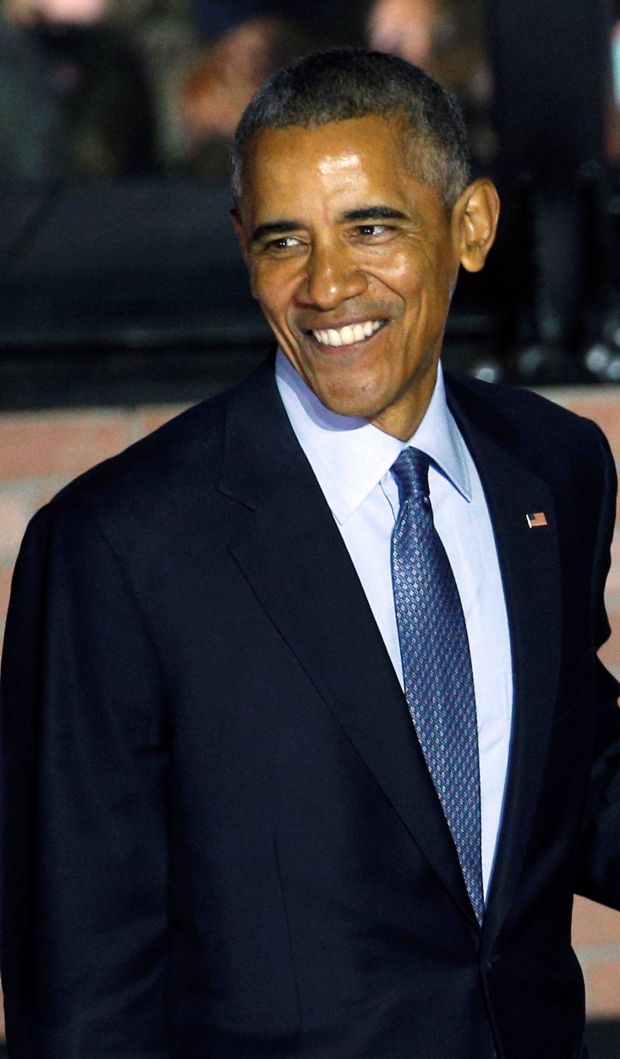
When Mr Barack Obama (above) became the US President, it was a breakthrough for African-Americans.

People started thinking that thought race no longer mattered in US politics.

Eight years later, in the election between two white candidates, Mrs Hillary Clinton and Mr Donald Trump, race is “front and centre” on top of issues like globalisation, jobs and insecurity, said Mr Lee.

THE CHINA FACTOR

From government-to-government projects to community events here, Singapore and China share substantial relations.

But there is a risk.

People may misunderstand and think of Singapore as a Chinese country because of our Chinese majority and cultural familiarity.

They may forget that Singapore is actually an independent sovereign country, cooperating with other countries on the basis of our own national interests and positions.

“It can lead to misunderstandings, it can lead to unrealistic expectations and it can lead to us being carried away, even domestically, and forgetting this fundamental fact about Singapore, that we are independent, sovereign and multiracial in Southeast Asia.

“That is what we must always remember,” said Mr Lee.

Source link

Win tickets to Lee Jong Suk fan meet

0

Lee Jong Suk will be coming to Singapore to have his first fan meeting Variety in Singapore on Nov 12.

We are giving you a chance to meet the South Korean actor/model in person where he will be playing games with fans and will also be performing a few songs.

Lee, 27, made his debut as a runway model in 2005, and was the youngest male model ever from the Seoul Collection programme for Seoul Fashion Week. He went on to do acting on the small screen where he starred in many popular dramas, including Pinocchio, I Hear Your Voice and School 2013.

The Variety fan meet will be held at MegaBox Convention Cenre @ BigBox (Level 3) at 7pm on Nov 12.

We have two pairs of Category 1 tickets (each worth $238) to give away, courtesy of IMG Productions Singapore.

To win, answer the question below.

Contest closes Friday, Nov 11, 12pm.

Source link

WP accuses ruling party of making changes to further its own interests

0

SINGAPORE — The Workers’ Party’s (WP) top leaders on Tuesday (Nov 8) slammed the Elected Presidency (EP) scheme as a “nightmare”, and claimed that the proposed changes to the institution were meant to further the ruling party’s own political interests.

“This Bill is evidence of how a nightmare may come back to haunt us,” said WP chairman Sylvia Lim during the second day of the parliamentary debate on the proposed constitutional amendments to the scheme.

The WP has been against the EP since it was introduced in 1991, saying it undermines parliamentary democracy and could potentially cripple a non-People’s Action Party (PAP) government in its first term, among other objections.

Ms Lim noted that the EP scheme was first mooted to safeguard national reserves from being squandered.

However, the PAP government has amended the Constitution “again and again, as unintended consequences arose”, she said, referring to the 2011 Presidential Election.

The polls — which saw four candidates, including former PAP stalwart Tan Cheng Bock, taking part — ended with former Cabinet Minister Tony Tan winning by a narrow margin.

The outcome of the 2011 polls had caused uneasiness within the PAP, said WP chief Low Thia Khiang in his Mandarin speech.

“Despite all this manoeuvring, the PAP nearly succumbed to their own wishful thinking. That’s why they hurriedly conducted this exercise … to stop this frightening situation from happening again in the next Presidential Election,” he added.

Mr Low said the proposed changes — reserve elections for a particular race if it had not been represented for five consecutive terms, and tightened eligibility criteria — will reduce the quantity of eligible candidates, leading to either uncontested elections or “pro-PAP personnel” participating in the elections.

He also noted that should the PAP lose a General Election in the future, the Elected President would be able to turn the new, non-PAP government into “a lame duck”, unable to touch past reserves or appoint key officials.

“We feel that the PAP is only concerned with its own interests, and leaving Singapore to face great risks in the future,” said Mr Low.

Ms Lim, calling for a return to the original system of having Parliament appoint the President, said such a mechanism would elevate the highest office of the land above politics.

Instead of being regressive, reverting to such a mechanism will naturally ensure minority representation in office, she suggested.

“However, the Government seems to be locked into its position that there must be an elected President, and is devising more ways to check him,” Ms Lim said.

While the Government is aware that it would be unwise to let one man have too much power, she noted that the proposal to strengthen the Council of Presidential Advisers (CPA) is “fraught with difficulties”.

Increasing the CPA’s clout will turn it into a power centre, which is untenable as it is an unelected body, she pointed out.

Ms Lim added that residents had questioned why the Government was rushing through the proposed changes to the EP scheme in Parliament at this time. “Surely there is still time for any change to be carefully considered for implementation in the following Presidential Election in 2023, rather than the one next year?” she said.

Source link

Next presidential election to be reserved for Malay candidates

0

SINGAPORE — Singapore could see the its first elected Malay President in over 40 years come the Presidential Election due next August, with the Government intending to entrench a hiatus-triggered model in January that ensures minority representation in the highest office of the land.

Prime Minister Lee Hsien Loong announced the move on the second day of parliamentary debate on the proposed amendments to the Elected Presidency (EP) scheme, which at times saw heated exchanges over the workings of the Workers’ Party’s (WP) proposal of an elected Senate as an alternative to the EP, and why the opposition party was only mooting the idea now.

Among the 16 lawmakers who rose to speak on the matter on Tuesday (Nov 9), the higher bar for aspirants from the private sector was also one concern. Holland-Bukit Timah GRC MP Christopher de Souza, for example, noted that Singapore’s first four presidents — who had gone on to achieve great things for the nation — would have struggled to meet the new criteria.

A constitutional commission had recommended restricting a presidential election to a minority race that does not have an elected representative for five straight terms, or 30 years. Mr Lee said the Government intends to implement this by amending the Presidential Elections Act in January, on the Attorney-General’s advice to start the count from the first President to exercise powers under the EP scheme, Dr Wee Kim Wee.

With the current EP term being the fifth, the upcoming presidential election will be reserved for Malay candidates under the hiatus-triggered model, since the previous and current presidents have come from the Chinese and Indian ethnic groups, Mr Lee added.

“That means if a qualified Malay candidate steps up to run, Singapore will have a Malay President again … this would be our first after more than 46 years, since our first president Encik Yusof Isak. I look forward to this,” said Mr Lee.

In his speech, Mr Lee also explained why alternatives that have been proposed to the EP scheme would not work here.

On the suggestion to have a non-elected President that holds the same custodial powers as that of the elected President today, Mr Lee pointed out that the unelected President will find it hard to stand his ground when he has to say no to an elected Government.

The same issue arises with another suggestion to have a President chosen by Parliament but have his powers vested in the Council of Presidential Advisers (CPA). Since CPA members are unelected, but effectively become the decision-maker, they would also have difficulties saying no to the Government, said Mr Lee.

Even if the CPA were to be elected, multiple elections would have to be held for Presidential advisors instead of just one to elect the President, he added. Each election risks being politicized and the problem will be amplified, not reduced.

As to the proposal to have a non-elected President with a purely ceremonial role, as it was before 1990, Mr Lee said this arrangement would fail to safeguard and stabilise the system.

After WP chief Low Thia Khiang put forward his party’s idea for an eight-member elected Senate to have custodial powers over Singapore’s reserves, several MPs from the ruling People’s Action Party pressed the opposition party for details of how such a system would work. In response, Mr Low urged the House not to be “bogged down by details” and to focus the debate on the fundamentals of their proposal.

The other issue that dominated Tuesday’s debate concerned the raising of the eligibility criteria for presidential candidates.

MP Zaqy Mohamad (Chua Chu Kang GRC) said that if the key criteria to evaluate a potential candidate’s ability was his corporate track record, it would be neither reflective nor healthy for governance in the long-run. The gauge to measure the next President should be broader, not narrower, he added.

Mr de Souza also asked whether the Republic’s first four presidents — Encik Yusof Ishak, Dr Benjamin Sheares, Mr Devan Nair and Dr Wee Kim Wee — would have met the new criteria proposed.

Nominated MP Mahdev Mohan asked if it was the Government’s position that the President must be a “professional equal” to the CPA, which he added was “no mean feat” considering the credentials of the council’s existing members.

Urging the Government not to overly focus on a candidate’s competency to make decisions on the second key to the reserves, Mr de Souza said that a prospective President should be people-centred, community-centred and nation-centred.

NMP Kuik Shiao-Yin said that for a President to be a unifying symbol, he or she cannot just wear the right skin tone. Instead, that individual must have the political courage and moral gumption to navigate divides of class and partisan politics and hold the space between the races.

The debate continues on Wednesday.

Source link