Home Blog Page 2389

Extended leave benefits for dads, unwed moms passed into law in Singapore

0

SINGAPORE: New fathers will get two weeks of Government-paid paternity leave, while unwed mothers will get 16 weeks of maternity leave from Jan 1 next year, after Parliament passed changes to the Child Development Co-Savings Act (CDCA) on Thursday (Nov 10).

Currently, fathers are entitled to only one week of compulsory, Government-paid paternity leave, with a second week provided by their employers on a voluntary basis. Unwed mothers, meanwhile, are entitled to eight weeks of maternity leave under the Employment Act.

DADS CAN TAKE UP TO TWO MONTHS’ LEAVE IN BABY’S FIRST YEAR

The Amendment Bill also provided for shared parental leave to be increased from one to four weeks, from Jul 1 next year. This refers to leave taken from the spouse’s maternity leave, if she opts to share it.

Shared parental leave was introduced in mid-2013. According to data from the Ministry of Social and Family Development (MSF), about 1,400 mothers shared maternity leave with their husbands last year, roughly the same as in 2014.

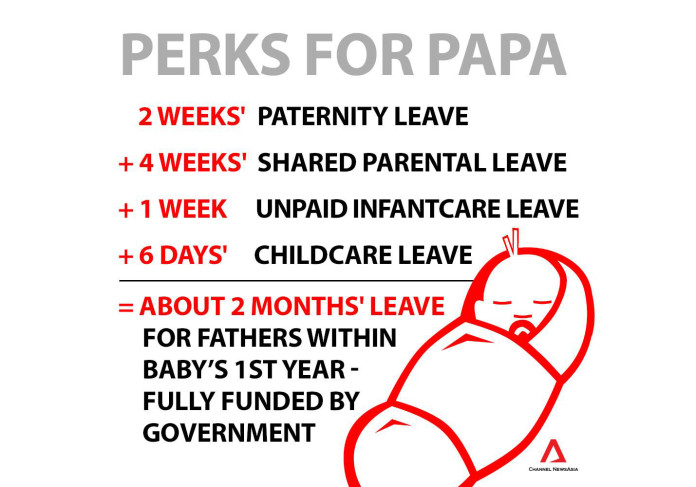
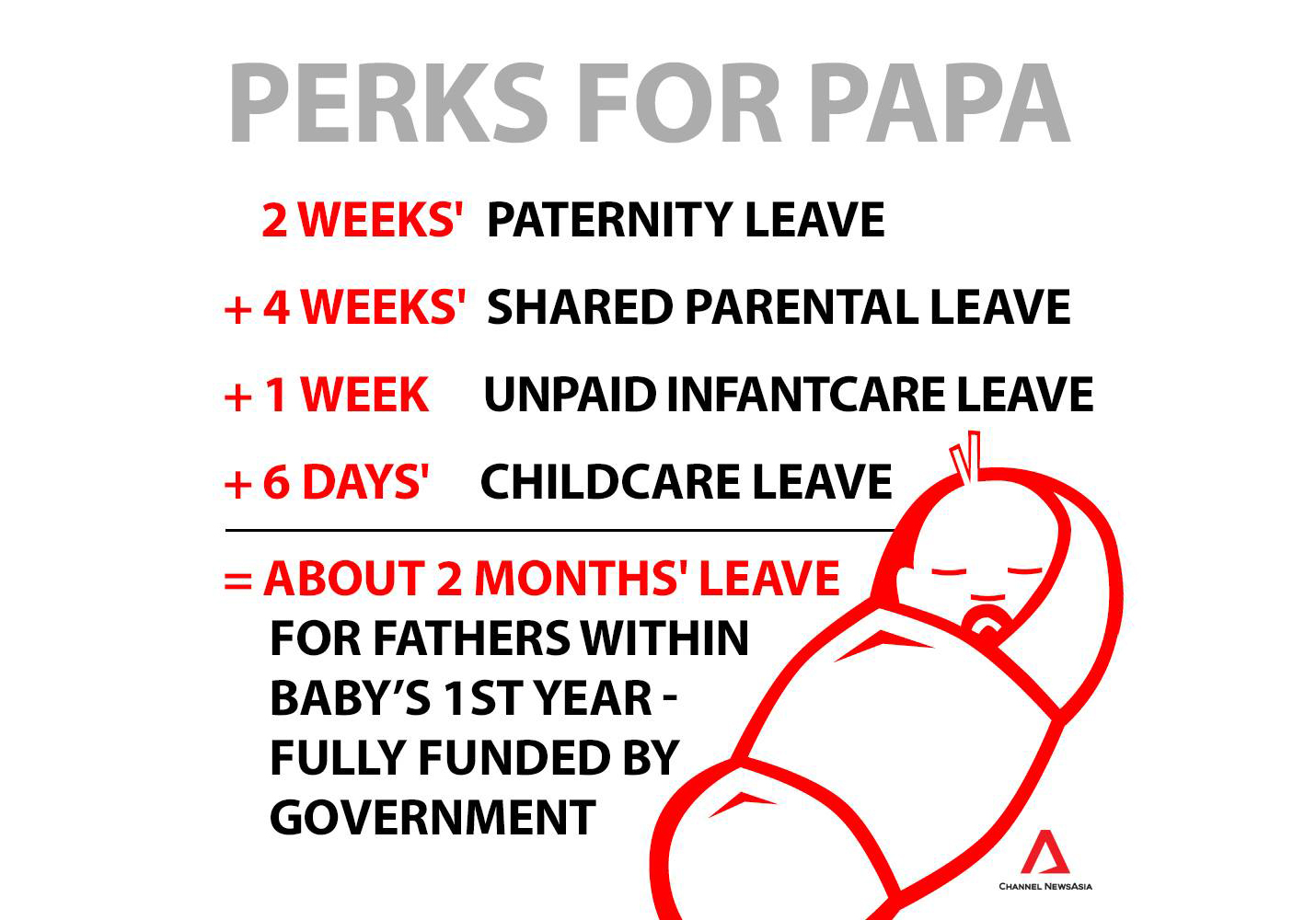
Including the six days of childcare leave and one week of unpaid infant care leave that fathers are currently entitled to, the changes bring the number of leave days fathers can take in their child’s first year to up to two months.
PARITY FOR CHILDREN BORN TO UNWED MOMS

The extension of maternity leave benefits to unwed mothers complements an earlier move to ensure that children will not be excluded from state support for the fact that they were born to unwed parents.

Earlier this year, Minister for Social and Family Development Tan Chuan-Jin announced that children of unwed parents, born from Sep 1, 2016, will be eligible for Child Development Account benefits. These accounts help pay for childcare and healthcare needs, with the Government matching deposits made by parents up to S$6,000.

Based on statistics provided by MSF, there were 518 children born to unwed mothers in 2015, compared to 557 in 2014. 

SUPPORT FOR ADOPTIVE PARENTS

Other key changes to the CDCA provide for greater support for adoptive parents.

From Jul 1 next year, adoptive mothers will get 12 weeks of adoption leave. For the first and second child, the first four weeks of the leave will be paid for by their employers and the last eight weeks will be funded by the Government. For the third and subsequent child, all 12 weeks of leave will be funded by the Government.

Currently, adoption leave is for four weeks, and is fully paid by the Government.

From Jan 1, unwed people adopting children will qualify for leave, with women eligible for adoption leave and men eligible for paternity leave. This is intended to help those who are eligible bond with and care for their adopted child.

There were 326 adoption applications in 2015, down slightly from 352 in 2014. In general, about half of all adoption applications are for children below 12 months old.

Less than than 5 per cent of adoption applications are by unwed people, according to data provided by MSF.

TERMS AND CONDITIONS

Two weeks of paid paternity leave: Fathers can choose to clear the two-week block of leave within 16 weeks from the birth of the child.

Alternatively, they can work out an agreement with their employer to take the leave flexibly by days within a year from the birth of the child.

Four weeks of shared parental leave: Parents can decide how to apportion the four weeks of shared parental leave between them at any time before the child turns 1 year old. The decision cannot be changed once it is made.

Fathers can choose to use the shared leave in one continuous stretch or flexibly by days, subject to his employer’s agreement.

12 weeks of adoption leave for mothers: This must be used within a year from the birth of the child. The mother should clear the leave at one go from the date of her formal intent to adopt. Alternatively, she can work out an agreement with her employer to clear an eight-week stretch and take the remaining four weeks of leave flexibly.


Source link

Coach semi-annual sale offers up to 50% off selected styles from 18 Nov – 14 Dec 2016

0

Coach semi-annual sale starts 18 Nov – enjoy up to 50% off selected styles!

Coach semi-annual sale offers up to 50% off selected styles from 18 Nov – 14 Dec 2016

Coach will be starting their Semi-Annual Sale from 18 November till 14 December this year. Enjoy up to 50% off selected styles. UOB cardmembers enjoy additional discount

Source

Darker prospects for Asia as trade deals come under threat

0

Singapore

IT’S like waking up to a bad dream. Defying the odds, Republican Donald Trump has won the race for the White House, an upset for the political establishment. Betting markets gave him just a 25 per cent chance of occupying the White House, suggesting that recent polls once again failed to gauge the depth of opposition to mainstream politics, and dissatisfaction with elements of globalisation.

The Republican Party also retained its majority in the House of Representatives and the Senate. Polarisation has been evident and extreme; even legislation such as Obamacare and the Dodd-Frank Act were carried with zero Republican votes.

Mr Trump’s win heralds a period of greater uncertainty in US policy. His lack of governing experience, inability to build relationships with congressional leaders of either party, and inconsistent policy pronouncements during the race make it hard to predict how he will act in office.

Some investors have raised concerns that his election would mark a deterioration in global trade relations. During the campaign, the property tycoon pledged a tougher stance in trade talks with key trading partners such as Mexico and China as well as a review of US commitments to global security institutions. Mr Trump also promised a clampdown on illegal immigrants, and his policies, if implemented, have the potential to cause a contraction in the US labour force.

Risk-off in Asian capital markets

Darker prospects may loom for Asia which has for decades been a major beneficiary of the US’s bias towards free trade and market access. Mr Trump’s proposals to impose a 35 per cent trade tariff on China and renegotiate or repudiate existing trade agreements such as the Trans-Pacific Partnership and various free trade agreements could, according to the Peterson Institute, limit US trade growth for a few years.

Therefore, Mr Trump’s victory has immediately thrust Asia into the spotlight. The immediate reaction over the short term would be a risk-off in the Asian capital markets with the exception of the Japanese yen, which should benefit from the safe haven trade.

In Asia, the main transmission mechanism is probably via the forex (hence domestic rates) and equity markets, with specific performance most probably determined by the volatility of the underlying currency and its dependence on global trade. This would make high-volatility currencies (eg the Australian, New Zealand and South Korean units) and export-oriented currencies (eg the Singapore dollar, Malaysian ringgit and Thai baht) more vulnerable.

Asia ex-Japan equities could potentially trade down to 1.3 times price to book value (P/BV), which is -1 standard deviation from the 10-year average of 1.7 times, from its current level of 1.4 times. Asian credit spreads would probably widen marginally by 10 to 20 basis points on the back of a broader market risk-off environment. Fundamentals for issuers with substantial trade relations with the US may also deteriorate over time. In the near term, China, with its capital restrictions and more tightly controlled forex and interest rate regimes, will probably suffer less volatility relative to the rest of emerging Asia.

Over the medium term, a Trump administration would probably become more critical of the forex policies of China, Taiwan, Korea and Japan. These countries have been placed on the US Treasury’s “Monitoring List” for potentially engaging in unfair trade practices.

The renminbi is likely to be the centre of attention, as the president-elect has promised to label China a currency manipulator, due to China’s interventionistic approach in its currency regime. However, pushing China to intervene less in the forex markets at a time when it is facing capital outflows could ironically lead to faster yuan depreciation. On the other hand, we see upside risk for the yen, South Korean won and Taiwan dollar. A Trump administration would exert pressure on these countries to allow their currencies to appreciate.

Deeper and more pernicious threat

How would that affect Singapore? The impact on Singapore goes beyond the superficial, short-term volatility of the financial markets. Given the threat of increased US trade protectionism, export-oriented Asian markets such as Singapore, Thailand and Malaysia would be susceptible from both a currency and equity standpoint, while domestically-focused markets such as India, Indonesia and the Philippines would probably be relatively more defensive.

But a deeper and more pernicious threat to Singapore and other export-oriented economies may come via the shift in globalisation, which is one of the most important undercurrents in today’s global economic landscape, with implications for growth, earnings, income equality and balance sheets. World exports as a percentage of gross domestic product peaked in 2014 and is now declining, having rose from 8 per cent of world GDP to almost 20 per cent at its height.

Given the seismic shocks of Mr Trump’s election victory last night and Brexit in June, it is difficult to argue that globalisation will continue in its current form. Mr Trump’s victory might embolden populist movements globally, especially in France and Germany, where crucial elections will be held in 2017. Anti-trade, anti-immigration and the increasing costs of cross-border business transactions are likely to remain core topics of political discourse over the coming years. The future has just gotten a tad more uncertain.


This article was first published on November 10, 2016.
Get The Business Times for more stories.

Image: 
Category: 
Publication Date: 
Thursday, November 10, 2016 – 15:15
Send to mobile app: 
Source: 


Story Type: 
Others

Source link

Only 1 NCMP has ever become MP: Leon Perera

0

Almost every opposition party candidate who became a Non-Constituency MP (NCMP) has gone on to lose at the next general election they contested in.

Workers’ Party (WP) MP Sylvia Lim (Aljunied GRC) is the only one who has ever bucked this trend.

NCMP Leon Perera cited this yesterday as he argued against the move to raise the minimum number of opposition MPs, including NCMPs, in the House. He said it would benefit only the People’s Action Party (PAP).

But Deputy Prime Minister Teo Chee Hean said the NCMP scheme ensures there will always be opposition voices in Parliament, which ultimately benefits Singaporeans.

The Constitution (Amendment) Bill 2016, passed yesterday, will raise the minimum number of opposition MPs, including NCMPs, from nine to 12, and will also give NCMPs full voting rights. All six WP MPs voted against the Bill.

NCMP seats are offered to the best performing losing opposition candidates when the number of elected opposition MPs falls short of the minimum.

Mr Perera questioned the motives behind the scheme, reiterating the WP’s long-held stance that it dissuades people from voting for the opposition, and goes against the principle that only elected lawmakers have a mandate to represent the people.

He warned that if the scheme was “fully exploited by the ruling party and fully embraced by voters in the way that the PAP hopes”, Parliament may end up with 12 “unelectable opposition MPs”.

This would allow the ruling party to do whatever it wished, he said. “It can force Singapore into a never-ending dependence on only one party for generations to come, like a computer with no backup. “

Mr Teo countered that the fact that the WP had taken up the full quota of NCMP seats it was offered shows the scheme has merits.

“This shows that being an NCMP offers advantages, not least of which are public exposure and parliamentary experience. Ms Sylvia Lim herself has been a beneficiary of this,” he said, rounding up the debate on the Bill.

To this, Mr Perera had said earlier that he had taken up the NCMP seat, despite his objections to the scheme, because “being in Parliament and arguing for what I believe is right outweigh the risk of damage to our politics from accepting the NCMP position”.

In his speech, Mr Teo also acknowledged that the scheme had benefited the PAP, but not in the way Mr Perera suggested.

Instead, it gives PAP MPs the experience of sparring with opposition members in the House, and not just during election season, he said.

It also allows the Government to engage the opposition and scrutinise their proposals, he said, adding that opposition politicians would otherwise behave like “‘phantoms in the night’ that turn up only at general elections, make claims, not engage, and then disappear again”.

“Ultimately, Singapore and Singaporeans will benefit from such debate and the diversity of views.”


This article was first published on November 10, 2016.
Get a copy of The Straits Times or go to straitstimes.com for more stories.

Image: 
Category: 
Publication Date: 
Thursday, November 10, 2016 – 17:03
Keywords: 
Send to mobile app: 
Source: 


Story Type: 
Others

Source link

Penalties for errant PMD users and sellers in proposed law

0

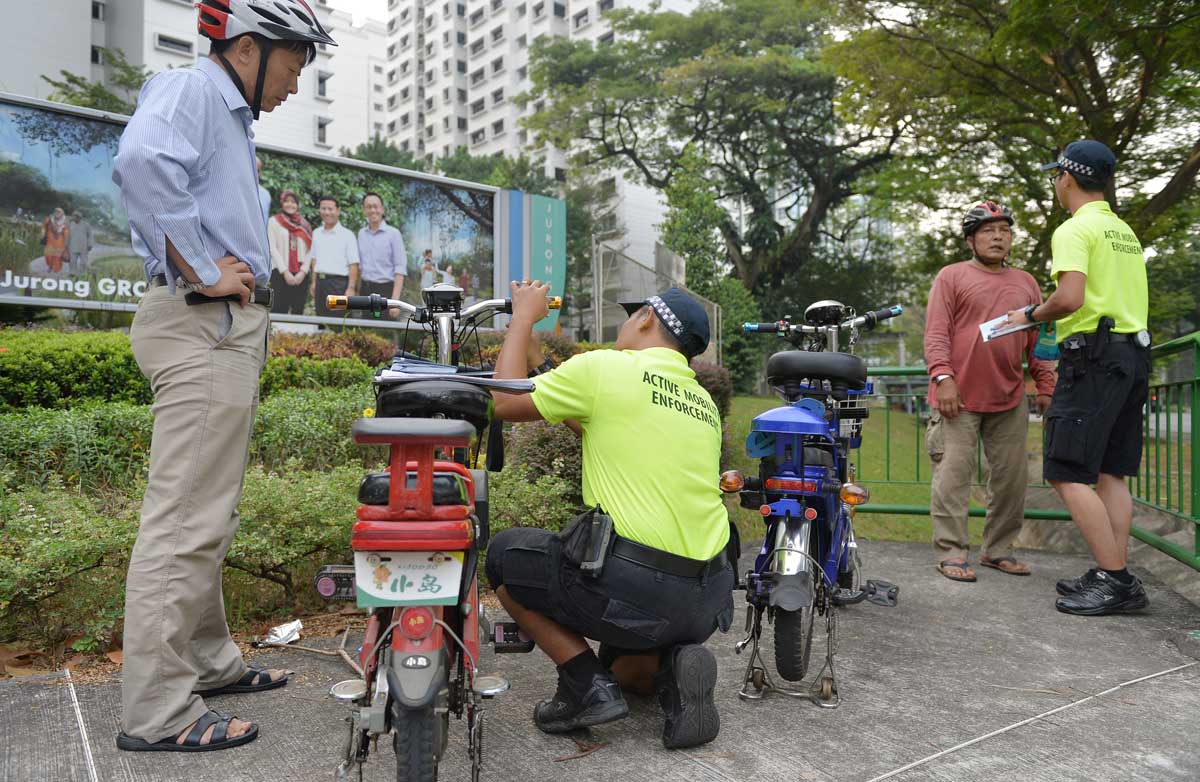
Users of electric scooters, hoverboards and other personal mobility devices (PMDs) who are caught riding recklessly could face stiff penalties of a fine, or a jail sentence, in the future.

A new law is being proposed to govern where and how these devices should be used, and what criteria they must meet, such as weight.

The Active Mobility Bill will cover cyclists and riders of electric-powered bicycles (e-bikes), which are mainly regulated under the Road Traffic Act currently.

The Bill was introduced in Parliament by Transport Minister Khaw Boon Wan yesterday.

If passed into law, it will bring about harsher penalties for sellers of non-compliant e-bikes, such as those which can go faster than 25kmh, for example.

First-time offenders who sell such e-bikes or illegally modify them currently face a fine of up to $2,000 or jail of up to three months, under the Road Traffic Act.

Under the proposed law, which will also apply to sellers of PMDs, the fine will be raised to $5,000.

The Bill’s rules and code of conduct for cyclists and PMD users is based on the recommendations from an expert panel formed to boost the use of bicycles and PMDs.

Read also: 20 e-scooters seized after users caught illegally riding on roads

The guidelines put forward by the Active Mobility Advisory Panel – formulated after a nationwide public consultation – were fully accepted by the Government in April, but have yet to be passed into law.

The guidelines include the different types of devices that are allowed on footpaths, shared paths and cycling paths.

The maximum speeds and criteria for the devices are also laid out. For example, PMDs like electric scooters should not weigh more than 20kg and have a maximum speed of 25kmh.

The recommendations, however, did not spell out any proposed penalties for errant PMD users. These were revealed for the first time yesterday with the Bill’s introduction.

Those who do not stop to render assistance to victims in an accident could face fines of up to $3,000, or a jail term of up to a year, or both. Reckless users can be handed fines of up to $5,000, jailed up to six months, or both.

The Bill also seeks to provide the Land Transport Authority (LTA) and other agencies, such as the National Parks Board, with powers to enforce the new set of rules, such as examining whether PMDs are non- compliant and seizing them if so.

Community volunteers under the Active Mobility Patrol Scheme, who are tasked to educate the public about the safe use of PMDs, will also be empowered under the proposed law to obtain the personal particulars of errant users.

Read also: Two e-scooters seized in clampdown on bad drivers

Mr Sitoh Yih Pin, chairman of the Government Parliamentary Committee for Transport, said the proposed penalties will serve as a “strong deterrent to all riders and users against reckless and irresponsible behaviour”.

On Monday, the LTA said it had seized 20 electric scooters since May, after their owners were found riding on the roads. More than 1,400 notices have also been issued to cyclists for using non-compliant e-bikes between January and September this year, the LTA said.

Last month, two e-bike users were killed after they were hit by a trailer truck.

Transport consultant Gopinath Menon said besides education and mutual understanding between different road users, penalties are necessary to promote the right behaviour. “Without the teeth, you can’t get things done,” he added.

The Active Mobility Bill will likely be debated in Parliament at its next sitting in January.

Read also: Fast e-scooters not rare – but dangerous​

adrianl@sph.com.sg


This article was first published on November 10, 2016.
Get a copy of The Straits Times or go to straitstimes.com for more stories.

Image: 
Category: 
Publication Date: 
Thursday, November 10, 2016 – 13:41
Send to mobile app: 
Source: 


Story Type: 
Others

Source link

Cab passenger pays part of the bill for damage in crash

0

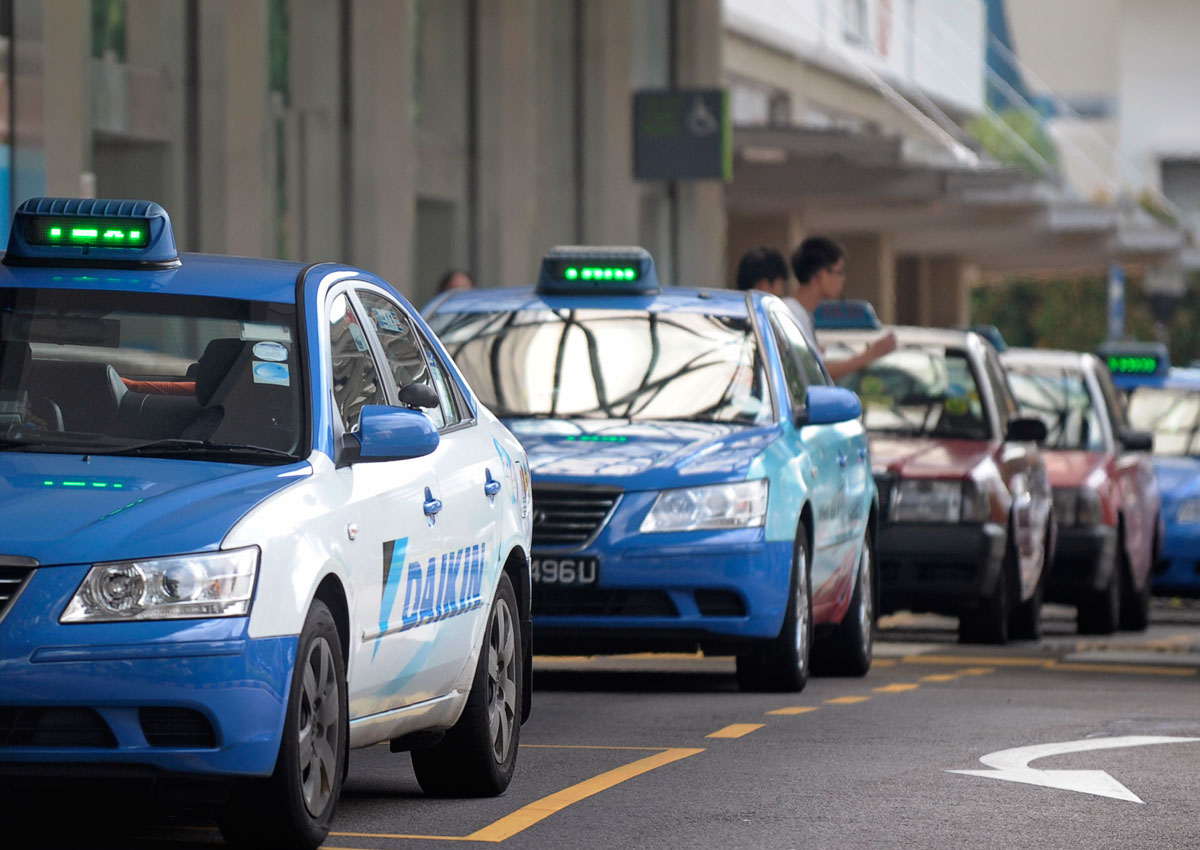
Open the rear door of a cab to alight and it hits another vehicle, and you may have to pay for the damage.

A passenger who got out of a cab in a mall lobby driveway will do just that in a test case settled in the State Courts on Monday between all three parties involved.

In the case, Ms Amanda Tng, 29, had boarded the cab in Killiney Road on April 24, 2014, and was bound for The Furniture Mall in Toh Guan Road.

After cab driver Zailani Hassan, 51, pulled up outside the recessed drop-off point at the mall’s driveway lobby, she opened the door on the right side to get out, not realising a car was passing at that moment.

The collision dislodged the taxi door and left the other car badly damaged with deep scratches and a dent down its entire left side.

Travex, the company which owned the damaged car, sued Mr Zailani through its lawyer Ling Leong Hui for negligence.

His insurers, in turn, represented by lawyer Anthony Wee, named Ms Tng as a third party in the case, seeking to hold her liable for contributory damage payable.

Ms Tng denied the claims in court papers filed, pointing out she did not open the door suddenly and the Travex driver should have seen the cab as he was pulling into the driveway.

All parties appeared before District Judge Koh Juay Kherng on Monday, who is understood to have urged them to arrive at a consensus among themselves.

The three parties agreed to each take some of the blame, with Travex accepting 50 per cent of it. This halved the bill for damage, to be shared between Mr Zailani and Ms Tng, who bore 30 per cent of it.

Her lawyer Tng Kim Choon said the cost of repair was agreed at $5,900 which meant Ms Tng’s contribution was about $2,000. He said the legal costs to the Travex driver and the cab driver added another $3,000, which meant her overall payout totalled $5,000.

He said yesterday: “I hope this case will alert the authorities and members of the public on a matter which may have been overlooked.”

He noted there was case law holding a passenger liable if he were to alight at a traffic junction and cause injury to a third party and the taxi driver was caught unawares.

But Mr Tng said that the past case law had “nothing similar” to that of his client who was held liable, even though the taxi driver had not used the designated passenger drop-off point.

She had to pay almost $5,000 as her contribution for the repair and for legal costs even though there was no trial. “Had this case proceeded to trial, I would have taken it on appeal on a point of public interest whatever the outcome,” he noted.

He explained the issue was whether a cab driver owed a duty of care to his passenger to ensure not only the latter’s safety but also that the passenger is not liable as a third party for damage to the taxi and the plaintiff’s car in a collision.


This article was first published on November 10, 2016.
Get a copy of The Straits Times or go to straitstimes.com for more stories.

Image: 
Category: 
Publication Date: 
Thursday, November 10, 2016 – 16:05
Send to mobile app: 
Source: 


Story Type: 
Others

Source link

Google to launch coding programme for needy students

0

SINGAPORE — As Google expands its headcount in Singapore, the tech giant wants to help develop more young Singaporeans into technologists.

Over the next three years starting January 2017, Google will organise coding classes for 3,000 students, aged between eight and 15, from low-income homes.


Sign-ups will open next month, and each batch of participants and their parents will start off with a visit to the Google office.


This was announced as Google officially opened its new office on Thursday (Nov 10) in Mapletree Business City II, where it occupies two blocks. From just 24 Googlers — as Google employees are called — occupying an office in Collyer Quay in 2007, the company’s head count in the Republic today numbers 1,000, double its 2013 staff strength.

The move provides much-needed room for its “growing engineering team”, said Mr Caesar Sengupta, vice-president of Google’s Next Billion Users team.

(Levitating plant pots like this one greets visitors at the reception area of Google’s new office.)

Explaining the move to launch the Code in the Community programme for needy students, Mr Sengupta said: “We feel like many professions here have a very high level of respectability and we want to make sure technology and the creative industry get to that point where kids, parents, families want their children to grow up to be technologists.”

Google will ensure that at least half of the children who join the programme are girls. “One thing important to us is to make sure there’s diversity. That’s why at the start we want to make sure that all different communities can participate in this programme, also different genders can participate,” he added.

The Code in the Community programme will be held in partnership with four self-help groups — the Chinese Development Assistance Council, Singapore Indian Development Association, the Eurasian Association and Yayasan Mendaki. Classes, run by 21C Girls and Saturday Kids, will be held at four community centres during weekends.


21C Girls is a registered charity that develops and delivers free coding classes to girls in Singapore. Saturday Kids is a programming school for children.


Prime Minister Lee Hsien Loong, who was at the official opening, said: “It’s our programme to make Singapore a smart city – lots of ideas go into that. But we hope that Singapore… will be able to add something to Google, to help Google thrive, and in the process, Singapore thrives as well.”


He added: “Tech is disruptive. Your objective is to disrupt the world. It is so. We expect to be disrupted but at the same time we want to make sure that we come out on the right side of the disruption.”

Source link

Changes to elected presidency: MP Joan Pereira suggests reserving election for Eurasians

0

Eurasians ought to be considered as a separate racial group for the purpose of the elected presidency moving forward, so that elections can be reserved for the community if there has not been a Eurasian president for a period of time, said Ms Joan Pereira (Tanjong Pagar GRC) in Parliament yesterday.

“I strongly believe that we Eurasians, being culturally distinct as Asians with European ancestry and heritage, have a unique perspective to contribute to the office of the elected presidency,” she added.

Currently, Eurasians are considered part of the “Indians and other minorities” group. This means that in a reserved election for the group, Eurasians, Indians or other eligible minorities can take part.

The first-term Eurasian MP said that even though Eurasians have been categorised as “others”, she had never felt excluded nor discriminated against.

Rather, she felt that “by bringing something different to the table, we can help enrich the office of the elected presidency”. “As the embodiment of East-West unions, we are also living testimonies of inter-racial, cultural and religious harmony and unity,” she said.

She also suggested that the Council of Presidential Advisers should include at least a member of each major racial group and at least one woman, adding this will provide a diversity of perspectives.

Supporting the provision to ensure minority representation, she said: “The importance of symbolism… is worth upholding.” Mr Darryl David (Ang Mo Kio GRC),also speaking about the president’s symbolism, said it is undesirable for a particular ethnic group to go for years without a president.

He added that reserved elections do not compromise the values of equality and meritocracy, but are an acknowledgement that the “core Singapore values” of multiracialism and meritocracy can co-exist.

Responding to the suggestion of pulling Eurasians out of the “Indian and others” group, as well as to a query by Dr Fatimah Lateef (Marine Parade GRC) on how individuals of mixed heritage would be classified, Deputy Prime Minister Teo Chee Hean said the classifications would follow the mechanics of the group representation constituency system.

“The framework has worked well,” he said. “Any person who does not fall within one of the three racial groupings may still contest in open elections,” he said.


This article was first published on November 10, 2016.
Get a copy of The Straits Times or go to straitstimes.com for more stories.

Image: 
Category: 
Publication Date: 
Thursday, November 10, 2016 – 16:00
Send to mobile app: 
Source: 


Story Type: 
Others

Source link

Save $25 off at Fairprice Online Store with this promo code (min $200 spend) from 10 Nov – 28 Dec 2016

0

Save $25 off with a min spend of $200 at the Fairprice Online store with Mastercard till 28th Dec. First 1000 redemptions only

Save $25 off at Fairprice Online Store with this promo code (min $200 spend) from 10 Nov – 28 Dec 2016

Get $25 off your total cart value at Fairprice Online when you enter the promo code below. Valid with a minimum purchase of $200 (subtotal amount) and…

Source

Singapore workers to get 2.9% pay raise next year: Survey

0

Workers in Singapore can expect pay rises of about 2.9 per cent next year, once inflation is taken into account, down from last year, according to a survey released yesterday.

The poll noted that bosses are preparing to lift pay by about 4 per cent. However, with “Singapore transitioning from 0.3 per cent deflation this year to 1.1 per cent inflation next year, real wage increases for employees will take a hit”.

The generous 4.3 per cent average real wage increases enjoyed this year will not be seen next year, it added.

“The open, trade-dominated economy of Singapore is withstanding the deceleration of growth in China reasonably well, but is nevertheless experiencing a slowdown itself,” said Mr Lee Quane, director for Asia at human resources firm ECA International, which released the annual survey of about 260 firms including large local companies and multinationals, from 72 countries.

The expected 2.9 per cent average pay rise in Singapore next year would be higher than the estimated average of 2.6 per cent across the rest of the Asia-Pacific region studied by ECA.

Malaysia-based workers should see a similar pattern emerge, said ECA.

The forecast for real wage increases is 2 per cent next year, from 3.1 per cent experienced this year, owing to rising inflation.

Mr Quane said that low unemployment continues to “exert upward pressure” on wages in Malaysia, but as labour costs here are higher than in rival economies, investors tend to move.

The regional economic slowdown is contributing to rising inflation, which is why those in Malaysia will be worse off next year.

After taking inflation into account, the biggest pay rises in the Asia-Pacific are forecast for Vietnam, where companies are expecting 5.4 per cent increases on average.

It is also offering the second- highest global real wage increase next year.

Hong Kongers will see their salaries rise an average of 4 per cent again next year, but after factoring in inflation – tipped at 2.6 per cent in 2017 – they will experience the third-lowest wage rise in the Asia- Pacific, estimated to be a 1.4 per cent increase in real terms.

Mr Quane added that China’s downturn is reducing demand and trade throughout the region and this is affecting places such as Singapore, with rising inflation forecast next year.


This article was first published on November 10, 2016.
Get a copy of The Straits Times or go to straitstimes.com for more stories.

Image: 
Blurb: 
But ECA International adds that real wage increase will take a hit as country moves from deflation to inflation. -ST
Publication Date: 
Thursday, November 10, 2016 – 14:00
Keywords: 
Send to mobile app: 
Source: 


Story Type: 
Others

Source link