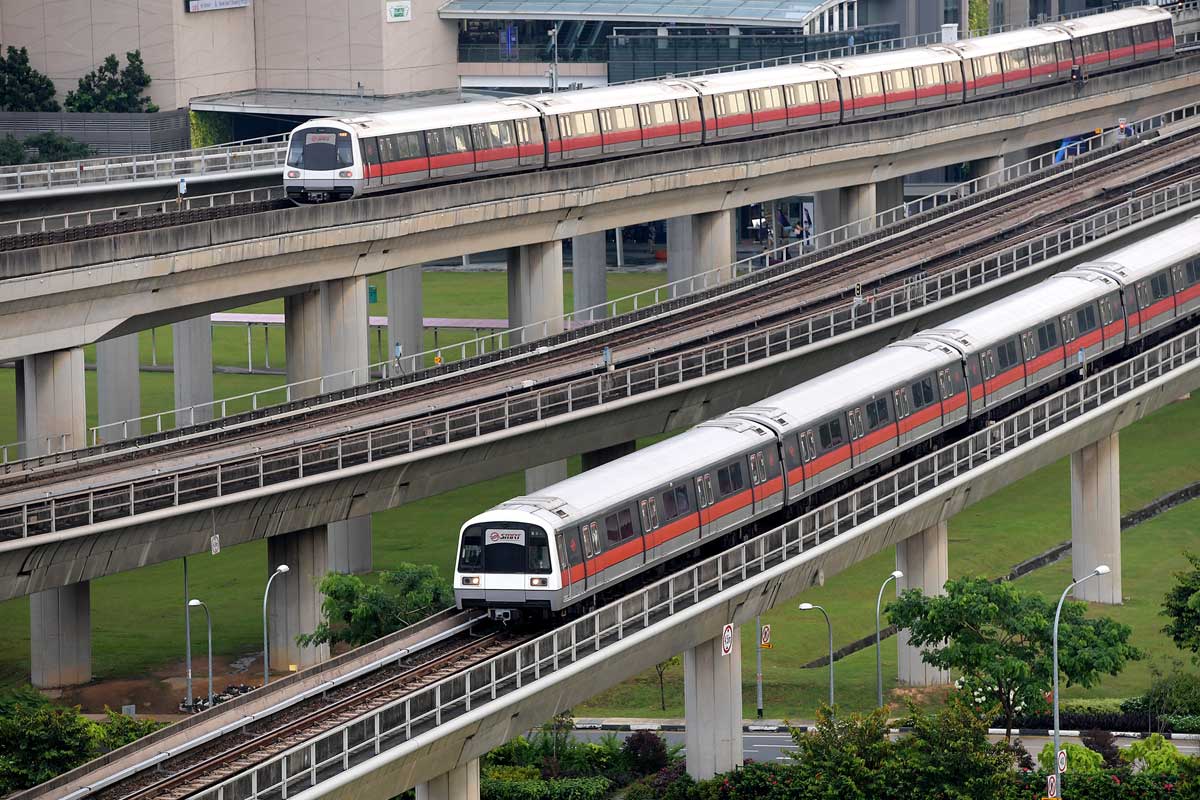
Rail operator SMRT is upgrading a fleet of 20-year-old trains used for the North-South and East-West lines.
The overhaul of the 19 six-car trains will include replacing their traction motors, air conditioning systems and train doors.
When the upgraded trains hit the tracks progressively from the second quarter of next year, commuters will also enjoy a graphical route map information system on board.
The company revealed details of the train upgrading project during a site visit to the Bishan depot yesterday.
The German-made C651 trains are manufactured by Siemens and have been in service since 1996.
With the upgrades, their lifespan will be extended by 15 to 20 years.
“The improvements will reduce the incidence of train faults common to the Siemens C651 fleet, such as its propulsion system and door system faults,” SMRT said yesterday.
The train upgrading project, which is led by Singapore Rail Engineering, a subsidiary of SMRT Corp, is expected to be completed in 2018.
Singapore Airlines (SIA) has shed about 12 per cent of its pilots in the last five years, amid a prolonged business slowdown.
The pool has shrunk from 2,331 pilots in March 2011 to 2,056 at the end of March this year. Some left voluntarily while others were asked to go.
Despite the attrition, SIA still has more captains than it needs, spokesman Nicholas Ionides said, without divulging actual numbers.
This is partly due to first officers being promoted as part of their career development, he told The Straits Times.
The Singapore carrier has moved to reduce its pilot numbers through various initiatives in recent years, after stiff competition from rivals in the long-haul premium sector stunted its growth and expansion.
Its measures included offering voluntary no-pay leave and voluntary movements to subsidiaries such as Scoot and SIA Cargo.
The airline released its pilots who were on expatriate terms which included allowances for housing.
Captains who retire at 62 can be re-employed for just one more year, and provided they take unpaid leave for six months during the period.
Previously, captains could fly until 65.
SIA also froze cadet pilot recruitment for three years from early 2012.
A pilot who declined to be named said: “I think it’s fair to say there has been some unhappiness, which has prompted some pilots who don’t see things getting better any time soon to leave for other airlines.
“And there is no shortage of airlines luring our pilots, especially captains.”
Hainan Airlines, for example, has held several recruitment drives in Singapore, among other markets.
The Straits Times understands that during the latest one held here a few months ago, more than 20 SIA pilots accepted offers from the Chinese airline.
The perks it offered included flexible leave and a monthly pay of about US$25,000 (S$35,500) for captains. In a good month, an SIA captain makes $18,000 to $20,000.
A new method of land reclamation will be adopted at the north-western tip of Pulau Tekong, adding new land the size of two Toa Payoh towns for military training purposes, National Development Minister Lawrence Wong said yesterday.
The empoldering method involves building a dike around the area to be reclaimed and draining water from it, creating a low-lying tract of land below sea level, called a polder.
The polder is buffered from the sea by a dike, and water levels in the polder are controlled by drains and pumps.
The dike will measure 10km long, up to 15m wide at its crest and stand about 6m above sea level.
Compared to the traditional method of infilling with sand, this will reduce the amount of sand needed for reclamation and save on upfront construction costs, said the Housing Board.
It is the agent appointed by the Ministry of National Development to carry out land reclamation works on behalf of the Government.
To ensure that the project is cost-effective, safe and environmentally sensitive, HDB said it is working closely with Kees d’Angremond from the Netherlands – an authority on polder development and longtime adviser to Singapore on reclamation.
While polders may be new to Singapore, Professor d’Angremond said they have been built in the Netherlands for the past 2,000 years.
These polders were primitive ones built by farmers who wanted to protect their land against flooding.
Safety of the polders is ensured through methods such as the building of strong dikes, determining the height of the dike in relation to expected sea levels and wave action, as well as having a grass cover on the inner dike slope to ensure it does not erode, Professor d’Angremond said.
HDB will call for a tender by the end of this year and construction will commence at the end of 2017. The reclamation project is slated for completion in 2022.
Mindef will maintain the 810ha polder land upon its completion.
The drainage system, dike, water pumping stations and canals will be maintained by national water agency PUB.
The reclaimed area on the island will also have 21km of roads – the combined length of East Coast Parkway – and 29km of drains. HDB said an environmental study has been carried out to ensure that there will not be any significant impact on the surrounding marine environment and marine life.
A beauty salon in Jurong East has closed down, leaving its customers with at least $20,000 worth of unused prepaid services.
Bioapex International sent a text message to its customers on Monday saying that it is in financial difficulty and has to “shut down the operation immediately” at its premises on the second floor of Block 135, Jurong Gateway.
Its landlord terminated its tenancy agreement, it added.
The Consumers Association of Singapore (Case) had received 18 complaints yesterday.
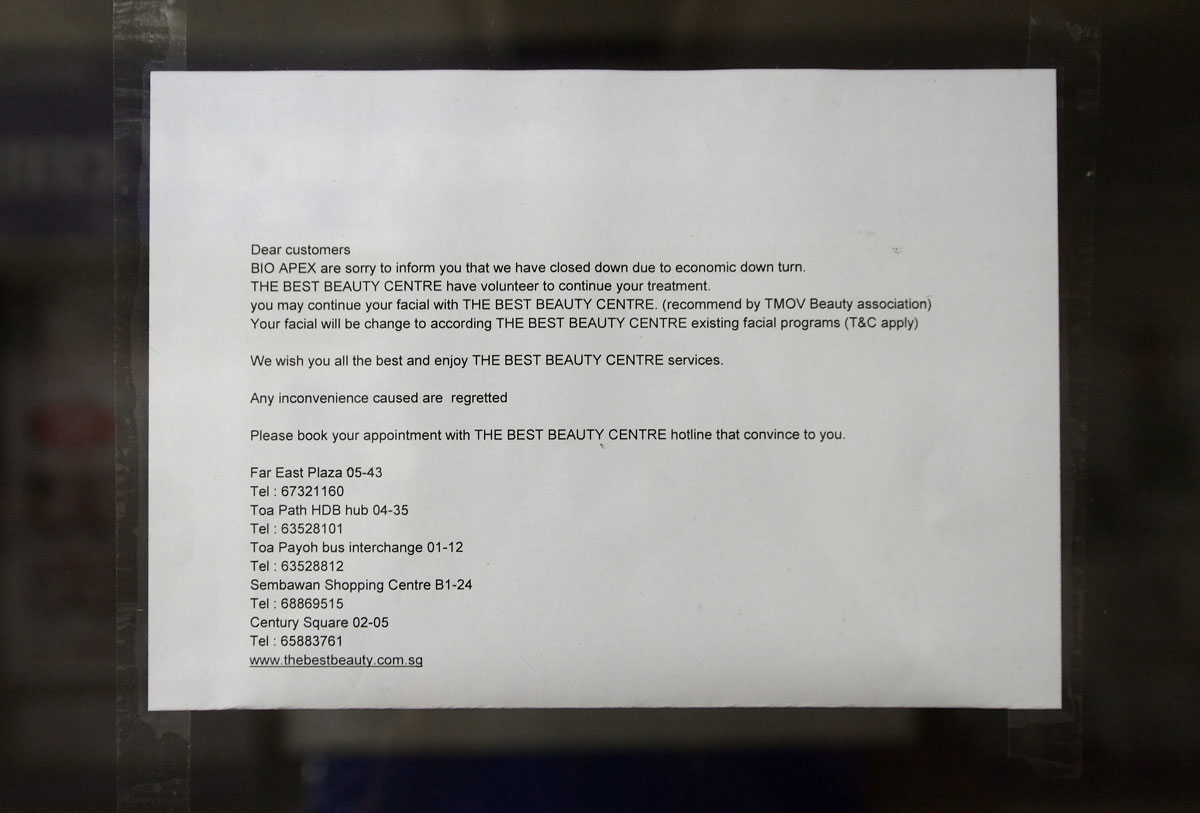
However, unlike in similar previous cases of beauty salons closing down, Bioapex – which had been operating for 15 years – did not leave its customers high and dry.
It has made arrangements for them to continue their packages at another salon, The Best Beauty Centre, without any additional payment.
Case said consumers had unused sessions and estimated them to be worth a total of more than $20,000.
A notice on the doors of the salon to inform customers of the salon’s closing down. Photo: The Straits Times
The consumer watchdog receives more than 1,000 inquiries and complaints about the beauty industry every year.
For the past five years, it has ranked among the top five sectors in terms of complaints.
Cynthia Tee, chief executive of The Best Beauty Centre, said Bioapex International approached her on Tuesday to ask if she could help.
“I agreed to help because I didn’t want the beauty industry to suffer a bad reputation,” she added.
Bioapex had about 1,000 customers, half of whom were active, she noted.
Consumers who buy prepaid packages should be aware of the risks, advised Case executive director Seah Seng Choon.
“Even if they get a judgment against the business, there is no guarantee that their monies can be recovered as the business may not necessarily have the funds to pay,” he said.
NEW DELHI – The extravagant wedding of an Indian politician’s daughter has triggered an uproar in the country amid a cash flow crisis after the Indian government announced that it would scrap 500-rupee and 1,000-rupee notes.
The five-day wedding of Brahmani, the daughter of businessman and former Karnataka State Minister G. Janardhana Reddy, has been estimated to cost about US$74 million (S$104.68 million), with gold-plated invitations and Bollywood stars expected to perform, reported the BBC.
Critics have slammed the “obscene display of wealth” at a time when millions of Indians have been standing in long queues at banks and ATMs to exchange the redundant currency notes or withdraw cash. The ban on 500- and 1,000-rupee notes was intended to crack down on undeclared wealth.
Many have questioned how Mr Reddy – a former member of Prime Minister Narendra Modi’s Bharatiya Janata Party (BJP) who was arrested on September 5, 2011, and spent four years in jail on corruption charges before being released on bail last year – managed to pay for the ostentatious nuptials.
But Mr Reddy has said that he mortgaged properties in Singapore and the Indian city of Bengaluru to raise money for the wedding and that all payments were made six months ago when the planning started.
That did not stop angry Indian netizens from ridiculing the extravagance on social media, while Mr Reddy’s political opponents have questioned whether Prime Minister Modi’s drive against ill-gotten money would include the elite, the BBC reported.
Preparations for the wedding, which is being held at the sprawling Bangalore Palace, began months in advance, with eight Bollywood directors roped in to create sets that resemble ancient Hindu temples where the ceremonies would be conducted.
Luxury bullock carts will be used to ferry guests from the palace gates to the venue. Guests will dine at a village that was specifically created on the grounds for the wedding.
Harry Potter themed wedding looks spellbinding
Click on thumbnail to view photos. Source:
Kelly Clarke
This article was first published on Nov 16, 2016. Get a copy of The Straits Times or go to straitstimes.com for more stories.
LONDON – Legendary Japanese animator Hayao Miyazaki has hinted about a return to feature film-making.
Speaking on an NHK television programme, he talked about turning Boro The Caterpillar (Kemushi No Boro,) a CG short he has been making for the Studio Ghibli museum in Tokyo into a feature film.
He said he has shared a proposal with Toshio Suzuki, veteran producer at Studio Ghibli, which has been his creative home for three decades.
“I haven’t said anything to my wife yet,” Miyazaki confessed. “When I do, though, I’m ready to die in the middle (of production).”
No formal announcement about production or release date has been made.
Now 75, Miyzaki announced his retirement from feature film-making in 2013, following the summer release of his last feature to date, the World War II-themed The Wind Rises.
On the TV programme, Suzuki said Miyazaki has been “battling with CG” in the new project, a departure from the hand-drawn style of animation he used throughout his career.
“Miyazaki is a person who will keep making films until he dies,” Suzuki commented.
“Ghibli will continue as long as Miyazaki continues to make films.”
There was a five-year gap between The Wind Rises and Miyazaki’s previous film as a director, the 2009 Ponyo.
If he and Studio Ghibli work at their regular pace, the new film would appear in 2021, when he turns 80.
Among Miyazaki’s many honours is an Academy Honorary Award for lifetime achievement, presented at the 6th Annual Governors Awards ceremony in 2014.
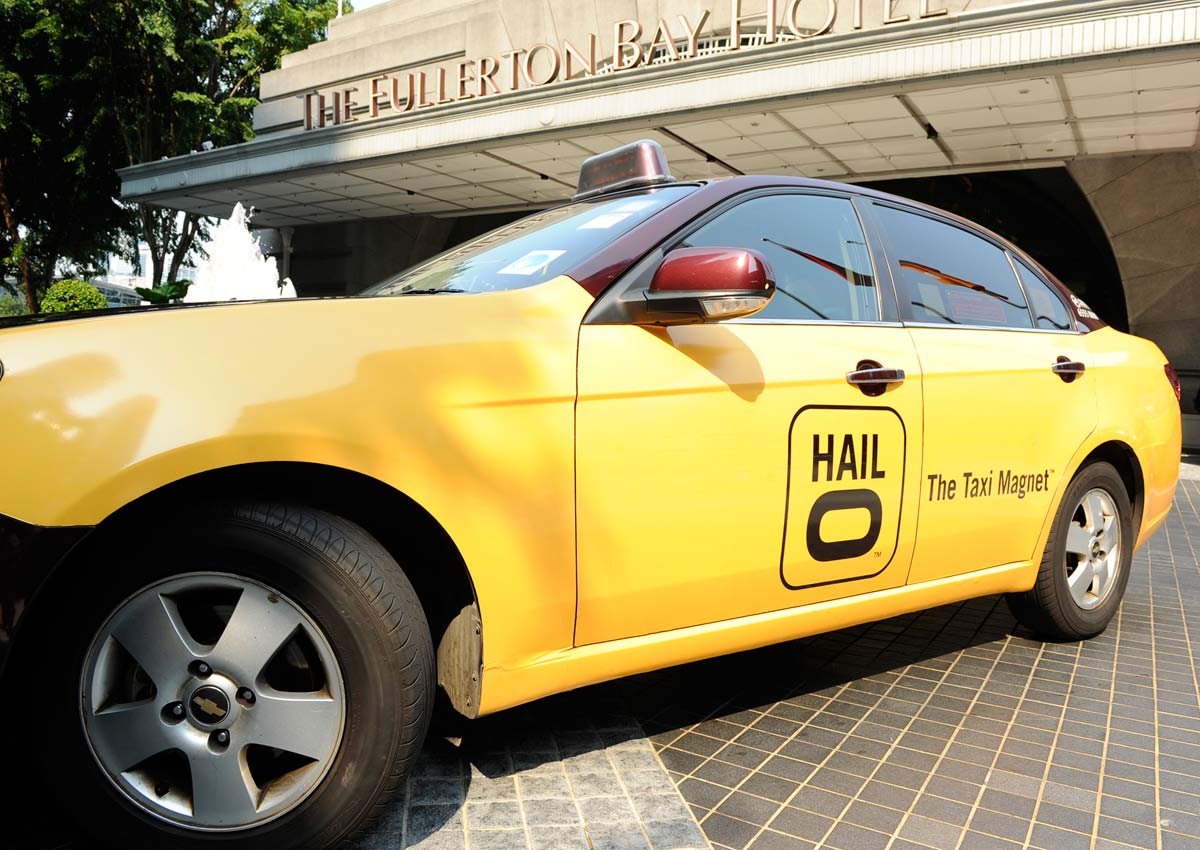
Another taxi-booking app has bitten the dust in Singapore.
After two years in the market, the London-based Hailo stopped operations here on Tuesday, The Straits Times has learnt.
The app was introduced in Singapore in October 2014, under a joint partnership between Hailo and SMRT Roads, pitting itself against rivals such as Uber and Grab, which made their debut earlier.
In a joint statement shared with The Straits Times, SMRT and Hailo confirmed that taxi bookings via the app ceased on Tuesday.
The firms said Hailo had recently completed a merger with another taxi app, My Taxi, and the new joint venture will focus on expanding its presence in Europe.
My Taxi is owned by auto giant Daimler, which purchased a 60 per cent share in Hailo, it was announced in July. My Taxi itself was acquired by Daimler two years ago.
In Singapore, Hailo faced stiff competition from apps such as Grab, Uber and the now-defunct Easy Taxi, when it entered the market two years ago.
But the company said then that it was confident of making its mark. Besides offering cashless payments, the company also touted its app’s “allocation algorithm”.
In Singapore, there are three taxi apps left in the market: Grab, Uber and MoobiTaxi.
BANGALORE, India – A controversial Indian mining tycoon has taken over a royal palace and flown in Brazilian dancers at a reported cost of US$75 million (S$104 million) to celebrate his daughter’s wedding on Wednesday, as the country reels from a cash crisis.
Up to 50,000 people were expected at the sprawling Bangalore Palace, a mock Tudor castle in southern India, to celebrate the wedding of Gali Janardhan Reddy’s daughter, who was married in a Hindu ceremony earlier in the day.
Local media criticised the extravagance at a time when many Indians are struggling to find the cash to buy food following the government’s shock move to pull high-value notes out of circulation in a bid to tackle tax evasion.
But one associate defended the lavish expenditure, saying Reddy wanted people to remember the wedding of his only daughter.
“It is unfortunate that a daughter’s wedding has been made an issue out of envy and rivalry,” Manju Swamy told AFP ahead of the party.
“It’s an important moment for her parents and they wanted to celebrate the event in a way that befits the family’s status in society.” India’s Prime Minister Narendra Modi announced last week that 500 and 1,000 rupee ($7.50, $15) bills – 85 percent of the cash in circulation – would cease to be legal tender.
Indians can change a limited number of old notes for new ones at banks and post offices, but there have been huge queues since they reopened last Thursday after closing for a day following the announcement.
Indians rely heavily on cash for their daily transactions and those living in rural areas or who do not have bank accounts have been particularly hard hit.
The 49-year-old Reddy, a former minister with the ruling Bharatiya Janata Party (BJP) in the southern state of Karnataka, spent three years in jail for his alleged involvement in a mining scam before he was released on bail last year.
Speaking to journalists in his home town last week, he refused to reveal how much he was spending on the celebrations, but said everything would be declared to the tax authorities.
Guests received their invitations on LCD devices and helium balloons featuring images of the Reddy family are reported to be floating above the palace.
While some Bangalore residents were appalled at Reddy’s obscene display of wealth at a time of cash crunch, others were sympathetic.
“What’s wrong in conducting a daughter’s wedding on a grand scale? The rich and wealthy do it regularly,” said Jayaprakash Rao, a retired government official.
” Reddy is spending from his pocket and not public money,” Rao told AFP.
Indian activist T. Narasimha Murthy put the cost of the wedding at five billion rupees (about S$104 million), a figure that tallied with local media reports.
” Reddy has hired about 3,000 bouncers and security guards to prevent media and activists like me from barging into the venue,” said Murthy, adding he had petitioned local tax authorities to investigate.
National Kidney Foundation (NKF) chief executive Edmund Kwok was sacked due to a personal indiscretion involving a male employee, NKF said yesterday.
The employee complained to his supervisor on Monday last week, and the matter was brought up to the human-resources department.
A meeting with the NKF board was held last Friday night and it was decided that Mr Kwok would be sacked, said NKF chairman Koh Poh Tiong at a press conference held hours after the foundation issued a statement announcing the sacking.
A police report was made on Tuesday. Responding to media queries, the police confirmed that a report was lodged and investigations are ongoing.
“We acted immediately. We agreed that there will be no cover-up,” said Mr Koh.
“We want to be upfront with all our stakeholders.”
NKF is operating “as normal” and the incident had nothing to do with the “stewardship of finances”, he added.
Mr Koh said he was disappointed as Mr Kwok was one of the best CEOs he has worked with.
“I feel very disappointed. But, most importantly, I feel extremely sad.
“Edmund was a very good CEO. He was one of the best CEOs I have worked with,” he noted.
NKF board member William Wan, who was also at the press conference, said lawyers advised that the matter be reported to the police.
Dr Wan added: “We decided that it was serious enough to terminate him. The organisation is not about one man.
“We want this organisation not to be affected by one man’s misconduct.”
A timeline of events that led to the sacking of Mr Kwok was given to reporters at the conference yesterday:
Nov 7: The male staff involved complained to his immediate
supervisor.
Nov 9: Human resources
met with Mr Koh.
Nov 11: A board meeting
was fixed.
Nov 13: A hearing was held with Mr Kwok, and he
admitted to the indiscretion.
Nov 14: Mr Kwok was sacked.
The search for a new CEO has started and a few candidates have been identified.
In the interim, a three-member executive committee (Exco) appointed by the board, chaired by Mr Koh and supported by board members Bennett Neo and Johnny Heng, will assume all CEO duties and responsibilities until the middle of December.
Eunice Tay, former CEO of NKF, will then take over the responsibilities of the CEO from the Exco until a new CEO is found.
In a statement earlier in the day, NKF said its services to its 4,000 patients were not affected.
“Our operations are not affected by this matter and our services to patients and beneficiaries continue as per normal.”
Mr Kwok, 58, took up the reins of the NKF in 2013, after serving as chief operating officer under then CEO Mrs Tay.
He was formerly vice-president of oncology at Parkway Healthcare and held positions at Tan Tock Seng Hospital and the Institute of Mental Health.
The NKF was embroiled in a scandal in 2005 when it was revealed that then chief executive T. T. Durai lived a lavish lifestyle using funds raised by the charity.
The foundation pulled the plug on large-scale public fund-raising events after that.
But the NKF has since restructured after the scandal, with better corporate governance.
This article by The Straits Times was published in MyPaper, a free, bilingual newspaper published by Singapore Press Holdings.