27.4 C
Singapore, SG
Wednesday, September 30, 2026
Home Blog Page 2333

Hwee Seng’s warehouse sale offers up to 80% off audio brands from 2 – 4 Dec 2016

0

Hwee Seng’s warehouse sale offers up to 80% off audio brands such as Beats, Onkyo, Paradigm & more! (2 – 4 Dec)

Hwee Seng’s warehouse sale offers up to 80% off audio brands from 2 – 4 Dec 2016

Hwee Seng’s biggest headphone & audio warehouse sale is back! Save up to 80% off top audio brands such as Beats, Onkyo, Paradigm, Jamo, Anthem, gogear & more

Source

Arena’s & Le Coq Sportif’s warehouse sale – Prices start from $7.90 onwards from 24 – 27 Nov 2016

0

Arena’s & Le Coq Sportif’s warehouse sale – Prices start from $7.90 onwards! (24 – 27 Nov)

Arena’s & Le Coq Sportif’s warehouse sale – Prices start from $7.90 onwards from 24 – 27 Nov 2016

Arena and Le Coq Sportif will be having a warehouse sale from 24 November to 27 November 2016. Ladies’ swimsuits – $9.90 onwards, Men’s swim trunks – $9.90 onwards, Boy’s swim shorts – $7.90 onwards, Girls’ swimsuits – $9.90 onwards and many more

Source

Taiwan plans rescue drills in South China Sea end of November

0

TAIPEI – Taiwan’s coastguard has said it plans to hold rescue drills in waters around Taipei’s sole territorial holding in the disputed South China Sea at the end of this month, and that the drills could involve its navy.

The exercises to be held around Itu Aba, known by Taiwan as Taiping, would include drills in rescuing shipwrecked personnel, the coastguard said. More details would be released later, it said in a statement on its website late on Sunday (Nov 20).

“Currently the navy regularly patrols near Taiping Island. We don’t rule out the navy playing a supporting role in future humanitarian rescue drills being held near Taiping,” the Coast Guard Administration said in the statement.

China, the Philippines, Vietnam, Malaysia and Brunei also have overlapping claims in the South China Sea, through which US$5 trillion (S$7.1 trillion) in ship-borne trade passes every year.

Taiwan has largely kept out of disputes between China and its neighbours, but the planned drills would be the first since President Tsai Ing-wen took power in May.

In July, a judgment by an international court classified Itu Aba was a rock and not an island, thereby making it ineligible to own a greater economic zone of resources off its coast.

Taiwan’s coastguard has had direct oversight of Itu Aba since 2000, when it took over from the Taiwanese military. More than 100 coastguard personnel are stationed on Itu Aba.

China distrusts Ms Tsai and her ruling independence-leaning Democratic Progressive Party (DPP), but Beijing has previously maintained that Beijing and Taipei had a common duty to protect Chinese sovereignty in the waterway.

The United States, Taiwan’s only major political ally, criticised former president Ma Ying-jeou for visiting Itu Aba earlier this year because it did not want tensions to escalate in the South China Sea.

Image: 
Category: 
Publication Date: 
Monday, November 21, 2016 – 13:42
Keywords: 
Send to mobile app: 
Source: 


Story Type: 
Others

Source link

Survey: Depression prevalent among transgender people

0

When Ms Amanda Wee, 31, met The Straits Times last Wednesday, she was in a black shift dress, flat pumps and make-up.

But at home, she wears what she calls “boy clothes”.

Her parents know she identifies herself as a woman and intends to live her life that way – Ms Wee was born male – but they disapprove. Her younger sister and friends are supportive, but she has not come out to her Catholic community.

“I would like to express myself the way I am now all the time. But I can’t and have to hide,” said the software designer, whose struggles with accepting herself had, at times, led to her contemplating suicide.

By letting this newspaper publish her picture, she risks their ire, but she is hopeful her coming out can help other transgender people.

Because for transgender women like her, depression and thoughts of suicide are alarmingly common.

A new survey of 41 transgender women here found that nearly half have thought of suicide.

About 15 per cent acted on such thoughts and tried to kill themselves in the past year.

The poll, by transgender shelter T Project and social enterprise B-Change, also found that 78 per cent of respondents felt depressed in the past year.

Ms Wee said: “I hope, even if this story generates pushback, that people will think about the issues we face and be kinder. And transpeople who are struggling with suicide will seek help.”

There could be some 34,000 transgender Singaporeans, based on international studies that estimate that 1 per cent of any population is transgender – meaning they identify with a gender different from the one they were born as.

The summary report was available on the organisers’ websites from yesterday – which was Transgender Remembrance Day, dedicated to those murdered due to transphobia.

Ms Cassandra Thng, 19, is one transgender woman who contemplated suicide. She held two fingers half a centimetre apart: “I came this close this year. I had a fully fleshed out plan.”

The mental health issues are, said transgender woman Jolene Tan, 19, “part and parcel” of being transgender. Family pressure also adds to their struggle with accepting themselves.

Ms Wee said: “I felt unclean and defective, that I was meant to be a boy so I should try harder.”

While the three of them have told their parents about their gender identity, the parents are in varying degrees of acceptance and, sometimes, do not know what to say.

Ms Thng’s mother, for instance, told her daughter that her physique was “too masculine” for hormone replacement therapy to help – an offhand comment that contributed to her suicidal thoughts.

“For some reason, I wanted her acceptance a lot,” said Ms Thng. Fortunately, a friend urged her to try hormone replacement therapy and she is now happier.

Ms Tan, who is waiting to study computer science at the National University of Singapore (NUS) next year, had a run-in with her father recently, during which he said in anger: “Which parent wants his child to be a chao ah gua (a Hokkien pejorative for effeminate men)?”

Yet, these three transgender women – who live with their parents, have access to university education and the support of friends – have it better than some survey respondents.

Others cited employment issues, financial difficulties, and a lack of social support and romantic relationships as causes for their unhappiness.

Nine in 10 surveyed did not seek help for depression or suicidal thoughts – something experts say needs tackling.

“Depression and suicidal tendencies are conditions that can be debilitating and yet treatable at the same time,” said Dr Keng Shian-Ling, assistant professor at the department of psychology at NUS.

“There needs to be more public dialogue and education, involving both the public and the professional community, on transgender issues.”

Mr Leow Yangfa, executive director of lesbian, gay, bisexual and transgender counselling group Oogachaga, thought social and healthcare workers should all have suicide prevention training.

The three transgender women said it will help if healthcare staff used the preferred names and gender pronouns of transgender people, instead of publicly addressing them as “mister”, which would elicit stares and whispers.

They also said that having more transgender people talking about their experiences and representing the group as public figures can help to reduce the stigma.

“But I don’t want to risk making my situation unsafe,” said Ms Thng, fearing the general public may not be as accepting as her friends.

Helplines

Samaritans of Singapore (24-hour hotline): 1800-221-4444

Tinkle Friend: 1800-274-4788

Singapore Association for Mental Health: 1800-283-7019

Care Corner Counselling Centre (in Mandarin): 1800-353-5800

Mental Health Helpline: 6389-2222

Aware helpline: 1800-774-5935

Oogachaga hotline: 6226-2002

WhatsApp: 8592-0609

kxinghui@sph.com.sg


This article was first published on Nov 21, 2016.
Get a copy of The Straits Times or go to straitstimes.com for more stories.

Category: 
Publication Date: 
Monday, November 21, 2016 – 15:00
Send to mobile app: 
Source: 


Story Type: 
Others

Source link

Corporate spat over movie goes public

0

A corporate feud between two of China’s biggest names in the film industry has bubbled to the surface as director Feng Xiaogang posted an open letter to Wang Jianlin, chairman of Wanda Group, on Friday.

In the letter, the top-selling filmmaker accused Wanda, which owns the country’s largest cinema chain, of allocating only 10 per cent of its screens for his new release I Am Not Madame Bovary, while other chains gave it 40 per cent.

The reason, he said, was executive Ye Ning’s job-hopping early this year from Wanda to Huayi, the film company that has produced most of Feng’s films.

Wanda, with 13 per cent of the country’s screens, earlier targeted two other Huayi releases for similar treatment, he said in a later interview.

“The third slap has fallen on my face, and I’m not afraid. Such practices can damage the industry when a corporate feud ends up penalizing the filmmakers.”

In response to Feng’s accusation, Wang Sicong, son of Wang Jianlin and a stockholder in Wanda Cinema Line, mentioned in his blog that there was a noncompete clause in Ye’s contract and, in addition, Wanda has a right to allocate limited screen slots as it chooses based on its expectations of market performance.

Feng, in turn, accused Wang and Wanda of acting irresponsibly for their equity holders because the film exhibition arm of Wanda is a public company.

“With 40 per cent of screens nationwide, our film achieved 62 per cent of total box-office receipts on its opening day. At Wanda, we got 13 per cent of screens, but accounted for 30 per cent of its receipts,” Feng said on Saturday.

What could have been merely a corporate spat spilled from the financial section over to the mainstream, mainly because of the two larger-than-life personalities involved. Feng is known as a loose cannon who targets anything he sees as unfair. (He also said Huayi had apologised to Wanda for the Ye incident, but the latter wasn’t forgiving.)

Wang Sicong is big news online, not only because of his father, one of the wealthiest people in China, but because of his brazenness. The single tweet he sent had “the power of a public relations army”, according to a netizen.

Most netizens sided with Wang because they agreed with him in thinking Feng’s letter was “too acidic and pretentious”.

For his letter, Feng took on the persona of Pan Jinlian, the Madame Bovary equivalent in the title.

The problem is, the female lead spent the whole movie arguing she is not that type of woman.

This made the tie-in with the movie plot a moot point, critics said.

“You say I’m in a position of strength and meddling with a film exhibitor’s work. But I’m the victim here, and Huayi is indeed a small company compared with Wanda,” Feng said.

I Am Not Madame Bovary registered 146 million yuan (S$31 million) in its first two days of release, a significant sum for a drama film with a mostly circular format.

The movie, a gentle satire of the country’s bureaucracy, has been widely lauded as Feng’s best in a decade.

Image: 
Category: 
Publication Date: 
Monday, November 21, 2016 – 13:20
Keywords: 
Send to mobile app: 
Source: 


Story Type: 
Others

Source link

Mass to celebrate restoration of Cathedral of the Good Shepherd

0

The Cathedral of the Good Shepherd was yesterday filled with hymns and music playing from its restored 1912 Bevington and Sons organ, Singapore’s oldest working pipe organ.

The mother church of Singapore’s Roman Catholics hosted its first mass after a three-year, $40 million restoration project.

About 1,000 devotees attended mass at the historic 1843 building, with many spilling into its aisles.

Archbishop William Goh led the mass and acknowledged the contributions of the cathedral’s former rector, Father Adrian Anthony, in his address.

Father Adrian started and led the restoration effort from the get-go but then fell ill. Monsignor Philip Heng officially took over last November.

Archbishop Goh said: “Many people have contributed to restore this church – (the) rich and poor, influential and ordinary people, with all kinds of resources. Indeed, to restore the church was truly a very daunting challenge that we had to face.”

The cathedral initially struggled to raise money for its restoration. Eventually, funds streamed in following efforts from within the archdiocese.

Highlights of the project include a new floor, restored stained glass windows, air-conditioning, and a new foundation for the structure.

Underground works in the vicinity, including the construction of the MRT Circle Line and the Singapore Management University, had caused its original underground boulders to shift.

This led to the uneven settlement of the building, with cracks forming across the national monument.

Archbishop Goh yesterday also placed a time capsule and commemorative stone to mark the success of the restoration project.

The capsule included a book on the cathedral’s history, commemorative SG50 notes and coins, and newspaper articles, including those from The Straits Times on the progress of the restoration and the discovery of its original time capsule, dating back to 1843.

That was the year when the cathedral’s foundation stone was first laid.

The original capsule, possibly the oldest one found in Singapore, held publications such as a prayer booklet, newspapers from 1843 and 24 international 18th- and 19th-century coins and tokens.

It was discovered in January under a column base on a series of granite steps along the cathedral’s Victoria Street facade.

The cathedral’s official consecration will take place on Feb 14.

Devotee Fredrick Gomes, 82, who has been attending the cathedral since he was a child, said the experience has improved. “The music and the choir were especially majestic. It was a wonderful mass.”

Speaking on the cathedral’s immediate future, Archbishop Goh said: “Now that this Cathedral is restored, the more important work is to be done and that is to restore the people of God… The cathedral is only a building; it’s only a means. What is important really, is to build the interior lives of the people of God.”


Read also: Historic Cathedral of Good Shepherd restored for $40m

melodyz@sph.com.sg


This article was first published on Nov 21, 2016.
Get a copy of The Straits Times or go to straitstimes.com for more stories.

Image: 
Category: 
Publication Date: 
Monday, November 21, 2016 – 15:00
Send to mobile app: 
Source: 


Story Type: 
Others

Source link

Dying tongue Kristang gets new lease of life

0

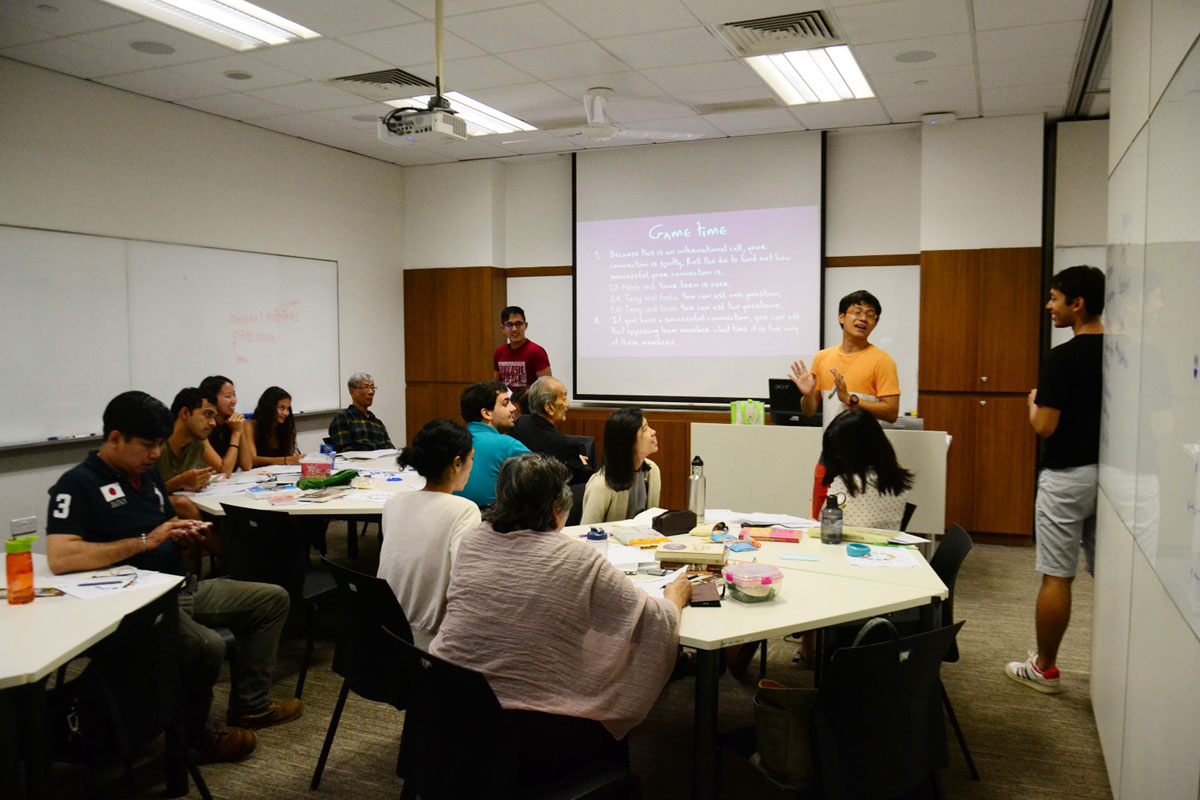
“Champurah”, which sounds like campur or “to mix” in Malay, is part of the dying heritage language of the Portuguese-Eurasian community called Kristang. It is a language spoken by fewer than 500 people across Malacca and Singapore today.

Eurasian-Chinese undergraduate Kevin Martens Wong, 24, has made it his mission to revive the language in Singapore.

After learning it in two months last year from older Kristang speakers, he developed a curriculum and then started running classes for students this year.

It grew from 14 students in the first term in March to 42 in the second term in July. He now has more than 100 for the current term which started last week.

Mr Wong said the unique language “reflects early Singapore history and the interactions we had”, noting that the lexicon of Kristang is mostly from Portuguese while its grammar is largely rooted in Malay. Kristang also evolved to incorporate dialects such as Hokkien, Hakka and Cantonese.

The language was likely borne out of intermarriage between Portuguese colonisers, who settled in Malacca, and local Malay residents.

In Singapore, it was common to hear it spoken in Katong, Frankel Avenue and Joo Chiat. But by the 1930s, use of Kristang had begun to decline as it was perceived by the community as a broken language.

The English language was adopted instead, partly because it was seen as more desirable and useful for employment in the British civil service.

Mr Wong, whose mother is Eurasian, never heard of the language until he stumbled on it while doing research on endangered regional languages for an online linguistics magazine which he helps to run.

“In my household, like many other Portuguese-Eurasian families, the language stopped with my grandmother. I didn’t realise that some of the food names she used or expressions were actually Kristang words,” he said.

For instance, she refers to the Portuguese-Eurasian dish devil curry as kari debal.

Mr Wong runs the classes with retired primary school teacher, Mr Bernard Mesenas, 78, a Kristang consultant.

His students include Eurasians, and students and faculty members from the National University of Singapore (NUS).

Even his grandparents attend the classes. His grandmother, Mrs Maureen Martens, 80, said the classes helped trigger her memory of some of the Kristang words she learnt from her own grandmother.

Each term comprises 10 lessons that span two hours each, and weekly classes are held at NUS and at the Eurasian Association in Ceylon Road. Students learn for free.

The linguistics undergraduate is doing this on his own time and money although he has received two one-off grants from the National Youth Council and The Awesome Foundation, Singapore.

Mr Wong, who is fluent in German, Spanish and Mandarin, has big plans for Kristang.

He has produced a five-phase, 30-year masterplan to revive the language which includes developing a Kristang textbook by 2019.

Undergraduate Joel Joshua Mathias, 23, a Portuguese-Eurasian who attends the classes, said he is learning Kristang in the hopes of passing it down to his family in the future.

He said: “We should take ownership of our language because if not us, then who?”

melodyz@sph.com.sg


This article was first published on Nov 21, 2016.
Get a copy of The Straits Times or go to straitstimes.com for more stories.

Image: 
Category: 
Publication Date: 
Monday, November 21, 2016 – 15:00
Keywords: 
Send to mobile app: 
Source: 


Story Type: 
Others

Source link

No live Christmas trees from Ikea this year

0

For the first time in more than 20 years, Ikea will not be selling live Christmas trees here this year.

“It has been increasingly challenging to guarantee the freshness of the trees through the current means and maintain low prices for our customers at the same time,” a spokesman told The Straits Times.

The furniture store’s Nordmann Fir trees are usually shipped in from Sweden in air-conditioned containers to preserve their freshness. The decision affects stores in Singapore, Malaysia and Thailand.

As an alternative, Ikea has stocked up on more artificial trees this year.

It is also trying to find a solution to the challenges, the spokesman added.

The demand for live trees is on the rise in Singapore.

Last year, 38,800 live pine trees were imported here, up from 28,400 in 2014, said the Agri-Food and Veterinary Authority (AVA). The trees were from Denmark, Sweden and the United States. In 2008, some 7,700 trees were brought in.

The bulk of the trees usually arrive towards the end of November, AVA said.

The increase in the popularity of live trees here is matched by greater demand where they are grown, said Mr Mok Keng Houng, business manager at wholesale florist Ji Mei Flower. It has become more expensive to buy them, but Mr Mok said they cannot increase the price.

He added: “We have to see if the market can handle (any price increase).” His firm gets its Noble, Nordmann and Fraser fir trees from the US.

Floriculture company Far East Flora, which has been accepting pre-orders for its Noble and Nordmann firs since Nov 1, said response has been good so far.

Prices start from $78 for a 1.2m- to 1.5m-tall Noble fir tree for orders made by Nov 30, and go up to $88 after that.

“We have seen a younger crowd and more families making Christmas tree shopping an annual family affair in recent years,” said its sales and marketing director Peter Cheok.

Sing See Soon Floral & Landscape in Punggol East is bringing in 250 trees, just like last year.

They range from 60cm-tall trees for table tops to 3.7m-tall trees for hotels and malls.

Customer service officer Karen Lim-Gallet, 43, who has been buying live trees to celebrate Christmas for the past 15 years, has ordered one from Far East Flora this year.

“The price of the tree has been increasing by about $10 every year. But I really like the smell of pine in the house, and it adds to the festive mood. It has become a tradition for my family,” she said.

mellinjm@sph.com.sg


This article was first published on Nov 21, 2016.
Get a copy of The Straits Times or go to straitstimes.com for more stories.

Image: 
Category: 
Publication Date: 
Monday, November 21, 2016 – 15:00
Keywords: 
Send to mobile app: 
Source: 


Story Type: 
Others

Source link

Getting skin tip-top to win

0

She won’t be leaving anything to chance when it comes to preparing for the international Miss Universe pageant next year.

Lasalle College of the Arts student and Miss Universe Singapore (MUS) 2016 winner Cheryl Chou is already planning to use her $24,000 beauty and wellness services from Beaute Hub, one of the five prizes at this year’s MUS pageant, “as soon as possible”.

“That’s the only way I will be able to look my best (when I go to) the Philippines.”

“(Our skin) needs time to react and reap the benefits of treatments,” the 20-year old told The New Paper.

Officials and organisers of the Miss Universe 2016 competition confirmed on Wednesday the pageant will be held in Manila next January.

With the big day just over a month away, Chou decided on three treatments – Beaute Hub Microdermabrasion, Endermolift Eye Treatment and Healing Face Treatment (Anti Blemish, Healing, Anti Inflammation) – to help kick start her preparation.

Having to juggle the role of Miss Universe Singapore 2016 and a student life has taken a toll on her skin.

“Being a full-time student, I tend to stay up at night as I have to work on my assignments,” said the beauty enthusiast.

“As a result, I have noticed an increase in puffiness around my eye area, especially on days when I have very little sleep.”

While religiously putting on eye masks and applying serum around her eyes to hydrate the skin as part of her daily skincare routine, she’s hoping the treatments can make a difference.

She said: “I know that, generally, eyes are the first to show signs of aging.”

“So I’m excited that this (eye) treatment will not only help reduce my dark eye circles and puffiness, but it will also help me begin my process of lines prevention.”

Chou said it is not perfection she is seeking.

“Women who choose to receive such treatments are not after perfection; it is merely a way for them to enhance their physical wellbeing,” she said.

“In my opinion, it is a good thing for a woman to pay attention and look after her appearance.”

“It is important that a woman takes pride in how she looks, and receiving treatments from places like Beaute Hub will help one put one’s best face forward.”

Determined

Chou’s determination to ensure her skin is in tip-top condition comes from a fear she constantly faced during her teens.

She said: “One of the biggest problems that I faced with my skin is dealing with the occasional breakouts and oily skin. As a teenager, I battled with acne problems and I am still prone to them up to today.”

And she’s hoping that Beaute Hub will eliminate that fear.

“I believe the treatments will significantly improve my current skin condition (because) they not only cater to treating the surface of the skin, but they also emphasise restoring the cells underneath as well.”

“And that is vital to promoting healthy skin from the inside and out.”


This article was first published on November 21, 2016.
Get The New Paper for more stories.

Image: 
Category: 
Publication Date: 
Monday, November 21, 2016 – 21:00
Send to mobile app: 
Source: 


Story Type: 
Others

Source link

They talk to her, give her massages

0

For 25 years, Filipino domestic helper Felicidad Muna Mico, 57, has cared for Madam Dora Sern and her three children. But last month, their roles were reversed.

On Oct 28, Madam Mico suffered a sudden haemorrhagic stroke.

It was the start of a harrowing period for the Singaporean family as they watched their beloved “Felice” hooked to various tubes at Changi General Hospital’s (CGH) intensive care unit (ICU) for a week.

Then came another shock – Madam Mico’s hospital bills will cost an estimated $55,000.

Madam Sern, 57, shared her helper’s plight on crowd-funding site GiveAsia last Wednesday.

So far, she has raised more than $8,000.

The masseuse hopes to raise $86,600. That will also cover the cost of sending Madam Mico home by air, rehabilitation care in the Philippines and basic provisions for her family for a year.

Madam Sern, who renewed Madam Mico’s contract for two years in July, was aware that all foreign domestic workers had to be covered by insurance but she did not know the details of the coverage. (See report on right.)

She found out only later that her insurance plan covers the minimum $15,000 for hospitalisation.

A check online confirmed that her premium costs about $200 for a 26-month policy.

Madam Sern told The New Paper on Friday: “The insurance was paid each time we renewed her contract every two years.

“It has been 25 years since we hired her, and we are no longer in contact with any agents, so we are not aware that we can pay a higher premium for better coverage.”

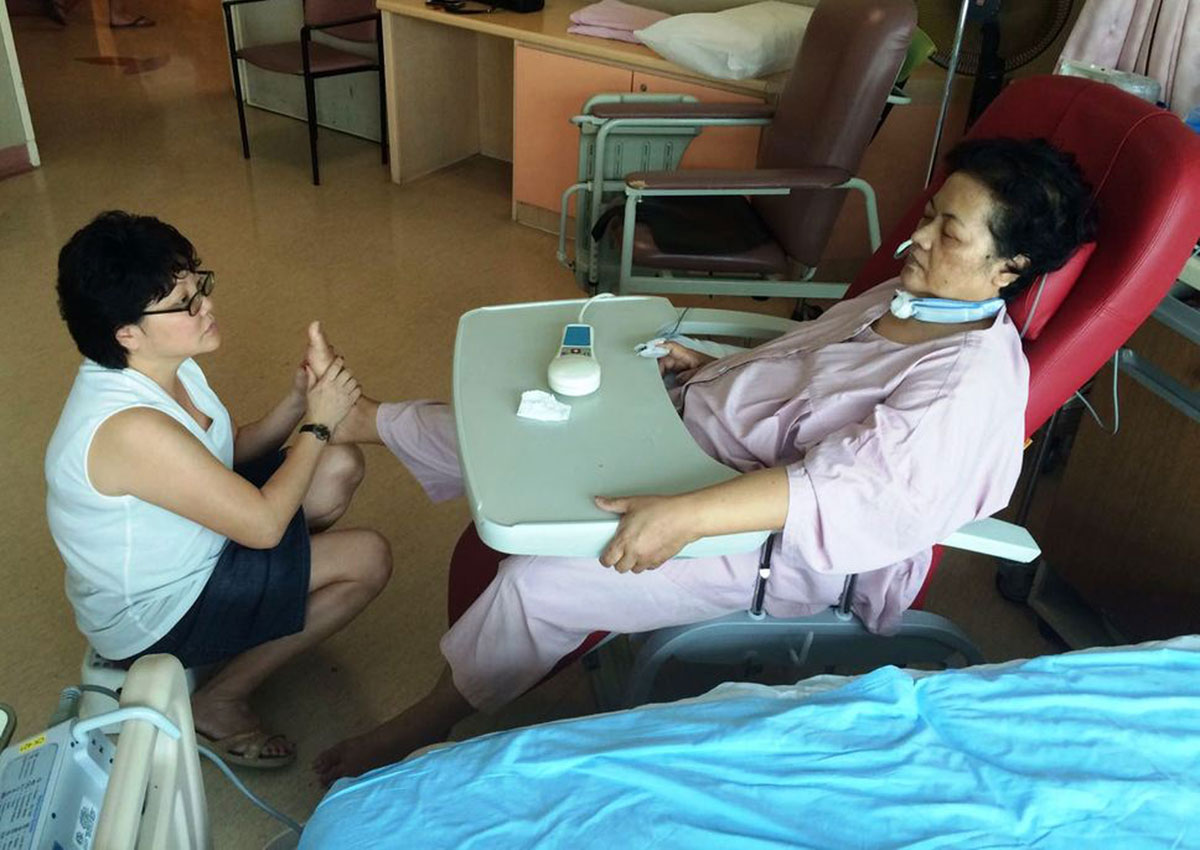
Madam Mico, who has high blood pressure, has recovered significantly since she was rushed to the hospital last month.

The doctor’s diagnosis was initially bleak. The family was told that she might not be able to move the right side of her body and may never speak again because she will need a tracheostomy tube in her windpipe to help her breathe.

Read also: Employer in coma, maid unpaid since October

MOVED

She was later moved to the high dependency ward and eventually to a C Class ward at CGH.

Madam Mico’s recovery has been remarkable over the past few days – her tracheostomy tube was removed, and she can do simple exercises with her right hand.

The doctor decided she was fit to fly, and she left for Manila by air ambulance with a nurse yesterday night.

She will be transferred to a hospital near her hometown, about eight hours away from the capital.

Madam Sern and her children, who are in their early 30s, took turns to keep their helper company at the hospital every day.

They gave her massages and talked to her though she could hardly respond.

Madam Sern said: “My oldest son, Eugene, was the one who discovered her unconscious.

“He thought she was just resting but realised something amiss when he tried to wake her up for dinner.

“I couldn’t stop crying when I saw her in the ICU, and I would break down again every time I was at home.

“I couldn’t cry in front of her because I had to put up a strong front.”

Madam Mico, who earns $600 a month, lives with the family in a five-room flat in Sengkang.

She was an active member of Madam Sern’s church.

Madam Mico had been looking forward to Eugene’s wedding, which was a week after her stroke.

He had planned to serve her tea at the traditional Chinese tea ceremony to thank her for raising him.

Madam Sern added: “My son couldn’t hold back his tears for a few minutes in front of hundreds of people when he was giving his wedding speech in church. He was so worried about her.”

Madam Mico, a grandmother of two, also had plans to return to the Philippines after her two-year contract. Her only child, daughter Izelmae, 26, will then leave the country to make a living.

Madam Sern said: “I told her it was not her time to go yet. She still had to enjoy life on earth.

“She was so good to my family and took care of my children so well. We love her so much.”

Her youngest son, Mr Ervine Wong, 30, who works in the aerospace industry, said: “She is part of my family, and she was like our second mum when our mum was busy working.

“Aunty was the one we interacted with, and we would chat and share about our lives with her every day.”

Read also: Why It Matters: Towards giving maids a voice

Opt for better coverage

Employers need to buy medical insurance with coverage of at least $15,000 a year for hospitalisation fees such as inpatient care and day surgery during their foreign domestic worker’s (FDW) stay here.

This covers 97 per cent of all inpatient and day surgery bills at public hospitals, said Manpower Minister Lim Swee Say in a parliamentary written reply in August.

He was responding to a question posed by Mr Patrick Tay, an MP for West Coast GRC, about the recourse that employers can take if their domestic helper has an underlying mental illness, cancer or critical illness.

Mr Lim added: “For the minority of employers who face genuine difficulties in paying their FDWs’ medical bills, they can seek assistance from medical social workers at the relevant healthcare institutions.”

He also suggested individual employers could voluntarily buy additional insurance for greater coverage, or send their FDWs for more medical examinations before employment to check for pre-existing illnesses.

Most basic plans offered by insurance companies cost under $250 for 26 months of coverage.

On average, a 26-month plan will cost about $100 more if the hospitalisation coverage is doubled from $15,000 to $30,000. The plans also include personal accident insurance with a minimum coverage of $40,000.

FDW employment agencies told The New Paper that they usually advise their clients to choose an insurance plan with higher coverage.

Ms Shirley Ng, director of Orange Employment Agency, said most clients choose the basic plans for younger helpers and are willing to pay a higher premium only if they are hiring a helper above 35 years old.

She said: “The increase in premium is marginal, but it can make a difference because if your helper is unwell, she is your responsibility until the doctor certifies she is fit to fly home.”

Mr Gabriel Ee, director of Island Maids, said: “Some employers do not see the necessity (for a more expensive plan) and will just buy a basic plan because it is rare for medical bills to go beyond $15,000.

“But it can get painful if you are the exception. The extra coverage will buy you peace of mind.”

linheng@sph.com.sg


This article was first published on Nov 21, 2016.
Get The New Paper for more stories.

Image: 
Category: 
Publication Date: 
Monday, November 21, 2016 – 14:00
Keywords: 
Send to mobile app: 
Source: 


Story Type: 
Others

Source link