Home Blog Page 2331

Singapore ‘just an airport’ before F1, sport’s boss says of city’s plan to dump race

0


FORMULA One chief Bernie Ecclestone has hinted at the likelihood that Singapore will stop hosting the Grand Prix after its deal runs out in 2017, and appeared to lash out at the city state for failing to show gratitude.

According to Motorsport.com, Ecclestone said in an interview with German publication Auto Motor Und Sport on Sunday that there was no gratitude in F1, with many of the sport’s organisers dropping their commitments once they have reaped what they came to sow.

He also cast doubt on the future of the sport, reportedly saying it would come as no surprise if some of its current manufacturers, including world champions Mercedes, decides to quit over the next few years.
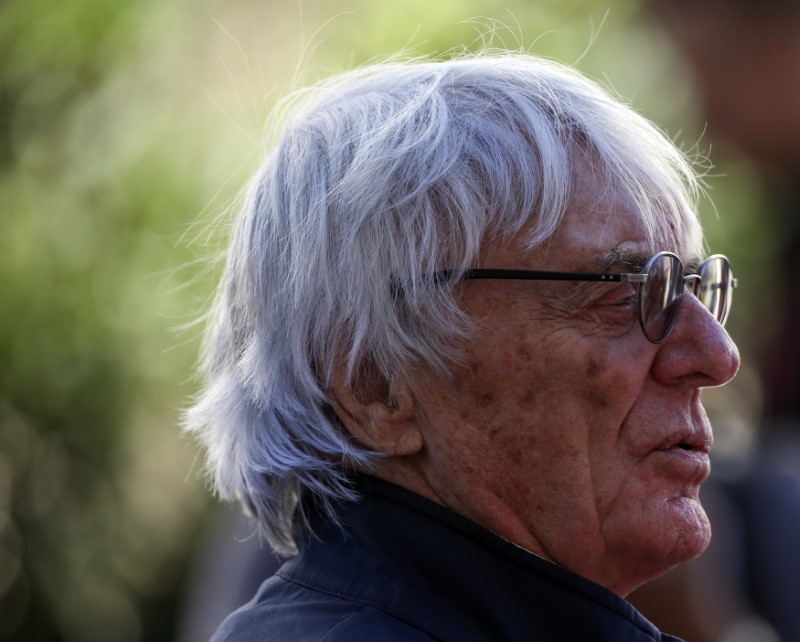
Bernie Ecclestone, Chief Executive of the Formula One Group. Pic: Reuters.

Bernie Ecclestone, Chief Executive of the Formula One Group. Pic: Reuters.

“It could happen to us that Mercedes and Ferrari run away. But honestly, if the races get better, this may not be such a terrible vision.

“We have to expect the manufacturers to leave us anyway. Mercedes will retire on the day when it suits them and it’s something we had before – look at Honda, BMW and Toyota. They go when Formula 1 has done the job for them. There is no gratitude,” he was quoted as saying.

He then picked on Singapore, saying the Grand Prix had greatly benefited the small Southeast Asian nation.

SEE ALSO: Ecclestone gives Bangkok Formula 1 GP the green light

Ecclestone reportedly said after the Grand Prix came to town, the Lion City became more than just a layover for travelers passing through.

“Look at what we have done for Singapore. Yes, the Grand Prix has cost Singapore a lot of money, but we’ve also given them a lot of money.

“Singapore was suddenly more than just an airport to fly to or from somewhere. Now they believe they have reached their goal and they do not want a grand prix anymore.”

The island state first hosted the race in 2008 and renewed its contract by five years in 2012.

A Reuters report said it costs Singapore an estimated SG$150 million (US$105.04 million) each year to organize the F1 race, 60 percent of which is funded by the government.

With Singapore’s impending pullout, however, the future of the sport in Southeast Asia hangs in balance.

This is because Malaysia is also considering dropping the championship after 2018 due to declining ticket sales and TV viewership. Malaysia has been hosting the race in Sepang since 1999.
Source link

More firms allowing flexi-work arrangements, giving greater leave benefits: MOM

0

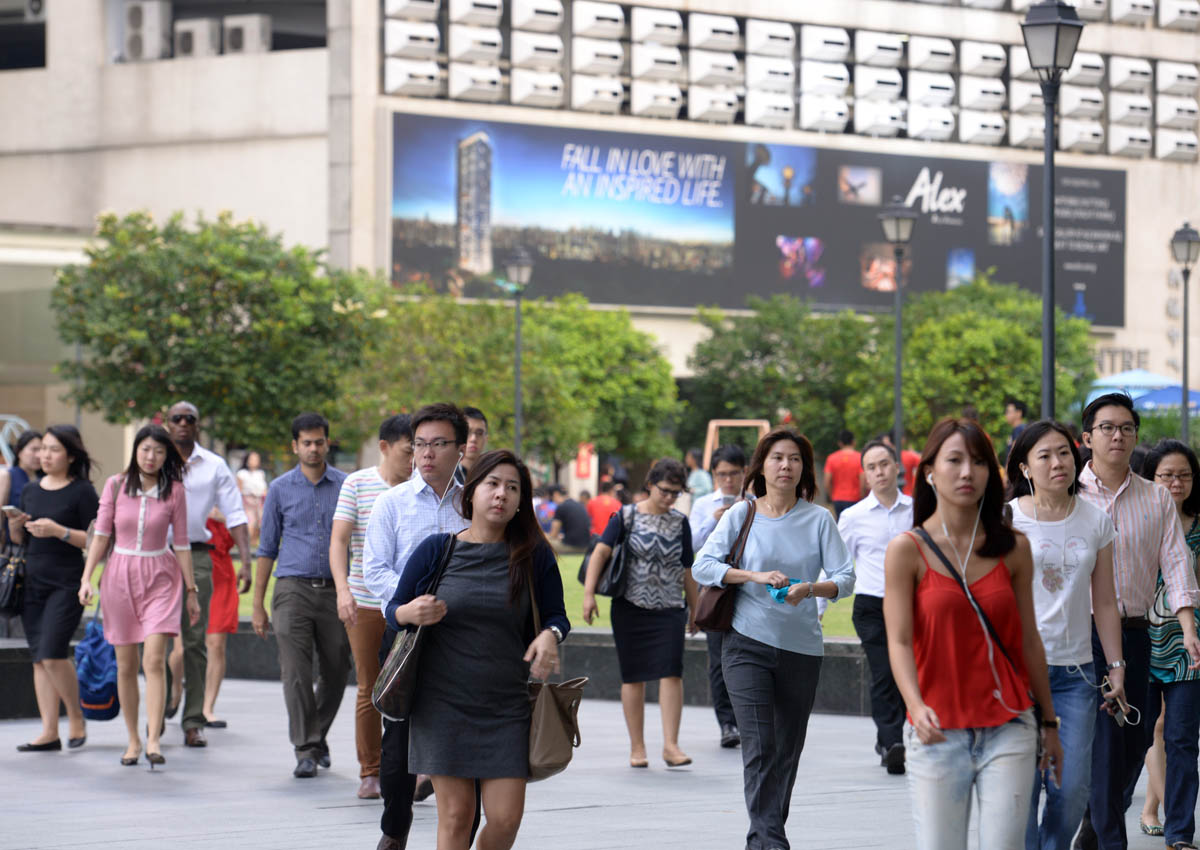
SINGAPORE – It looks like employers in Singapore are finally heeding workers’ clarion call to improve work-life balance.

In the past year a number of surveys have indicated that having good work-life balance is increasingly important in the eyes of employees in Singapore, and that many workers still felt that companies needed to improve on this score.

But according to the Ministry of Manpower (MOM) “Conditions of Employment” report released on Monday (Nov 21), more employers are providing ad-hoc flexible work arrangements and leave benefits to help employees cope with personal and family commitments.

The report was based on results of a survey that covered a total of 3,800 companies that employed over 1.3 million employees.

Here are five key findings from the report:

1. More firms giving unplanned time-off or allowing staff to work remotely on an ad-hoc basis

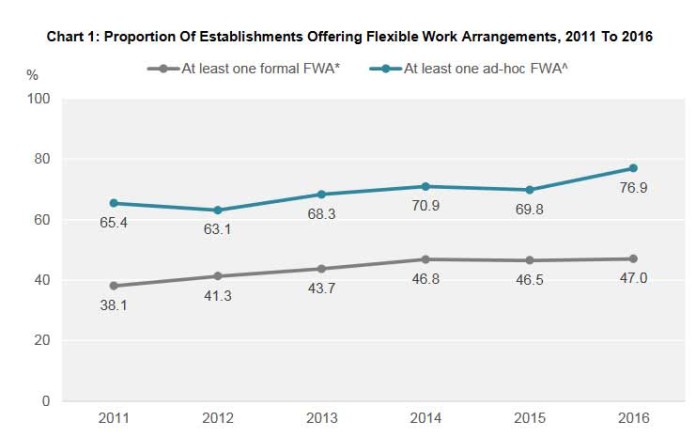
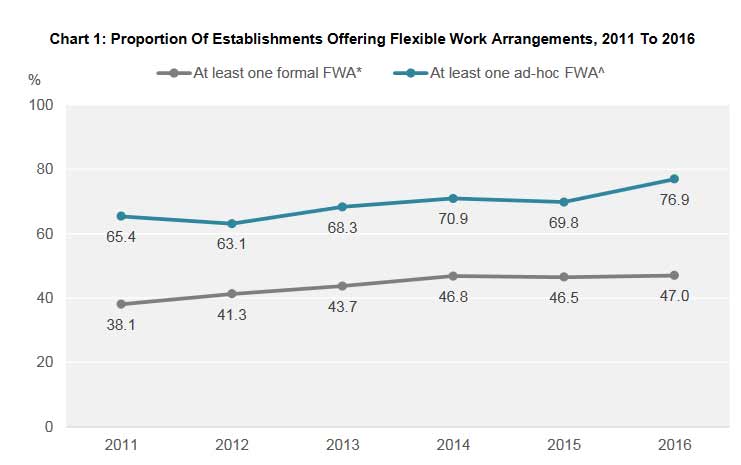
In 2016, 77 per cent, or more than three-quarters of firms surveyed provided unplanned time-off or ad-hoc tele working arrangements for staff to attend to personal matters. This is an increase from 70 per cent last year.

However, just 47 per cent of companies offer at least one formal flexible work arrangement, a rate that is unchanged since 2014.

MOM said that firms were more willing to offering flexible work arrangements on a case-by-case basis as they required fewer adjustments to work arragements.

2. Part-time work still the most common of formal flexible work arragements

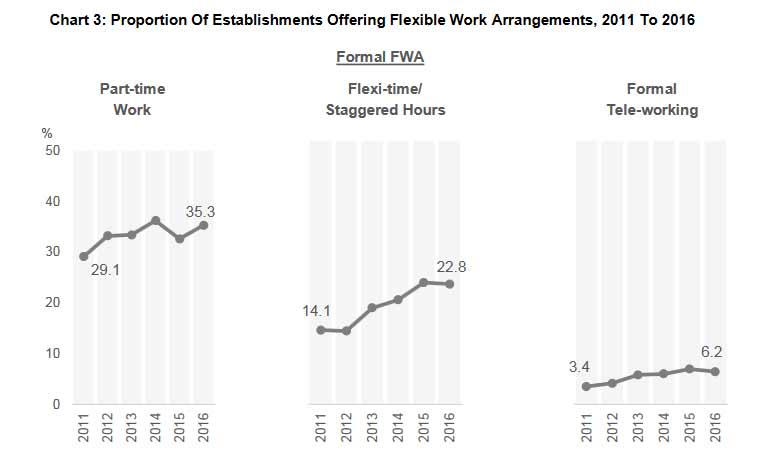
Part-time work was the most common formal flexible work arrangements, with 35 per cent of establishments offering such an arrangement. 23 per cent of firms offer flexi-time arrangements, which allow staff to report earlier or later for work.

Only 6.2 per cent of companies allowed formal tele-working.

3. Firms becoming more generous with leave

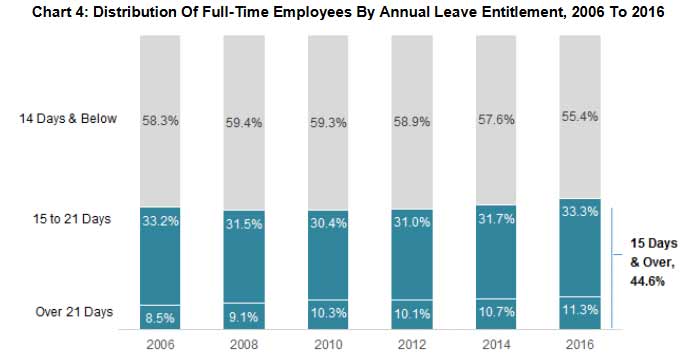
45 per cent of full-time employees now work in companies that gave them at least 15 days of paid annual leave, an increase from 42 per cent in 2016.

But encouragingly, more employers are now offering leave benefits that are not mandated by law to help employees cope with personal and family commitments.

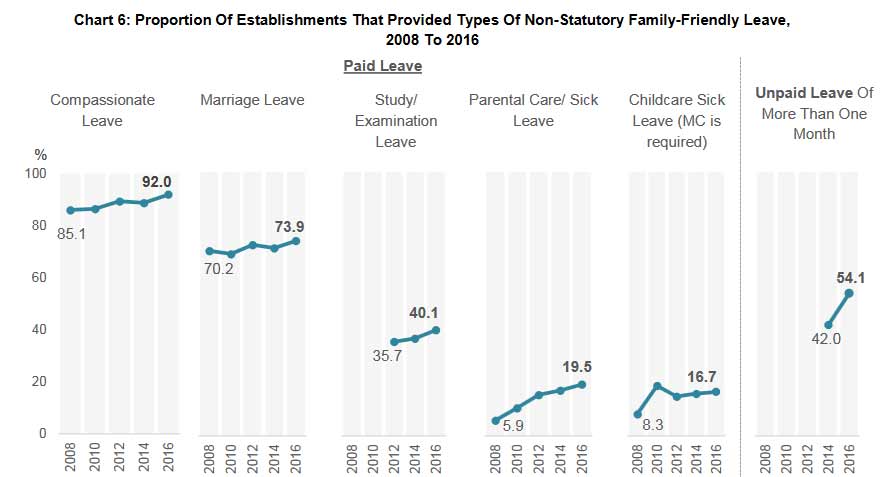
These non-statutory leave benefits include compassionate leave (offered by 92 per cent of employers), marriage leave (74 per cent), study leave (40 per cent), parental care leave (19 per cent) and childcare leave (17 per cent).

More establishments – 54 per cent in 2016 compared to 42 per cent in 2014, also offered unpaid leave of more than one month to staff who wished to pusue personal interest or attend to family matters.

However, the number of employees who took sick leave also rose slightly from 58 per cent in 2013 to 60 per cent in 2015.

4. More employees now working five days a week

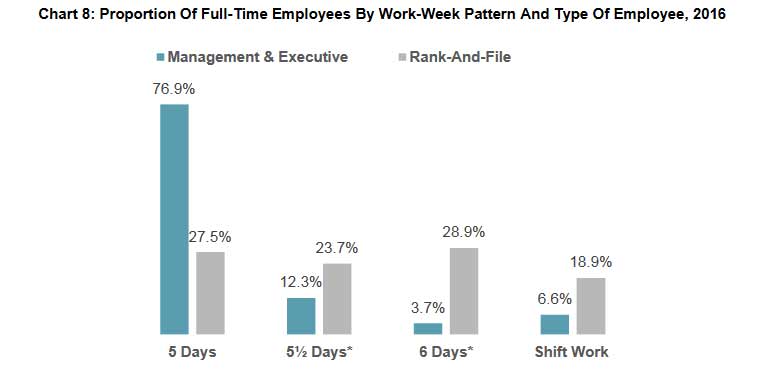
The proportion of full-time employees on a five-day work week rose from 46 per cent in 2014 to 48 per cent today. This also represents an increase from 43 per cent a decade ago.

5. Employees less likely to quit companies that offered more work-life benefits

What is the impact of these work-life initiatives?

The study showed that firms that offered more formal flexi-work arrangements, had more full-time employees on a five-day work week and had more employees with longer annual leave entitlements had lower resignation rates.

seanyap@sph.com.sg

Image: 
Publication Date: 
Monday, November 21, 2016 – 18:11
Send to mobile app: 
Source: 


Story Type: 
Rewritten Story

Source link

Lim Chow Kiat named GIC CEO from Jan 2017

0

SINGAPORE: Mr Lim Chow Kiat will take on the role of GIC’s Chief Executive Officer from Jan 1, 2017, the sovereign wealth fund said in a media release on Monday (Nov 21). 

In the release, GIC said Mr Lim, 46, is currently the company’s Deputy Group President and the Group Chief Investment Officer. 

Group President Lim Siong Guan will retire and be appointed as Advisor to the GIC Group Executive Committee on Jan 1, 2017, GIC said. 

GIC added that from Jan 1 next year, Dr Jeffrey Jaensubhakij will take over as Group Chief Investment Officer, as he relinquishes his current role as Deputy Group Chief Investment Officer and President, Public Markets. 

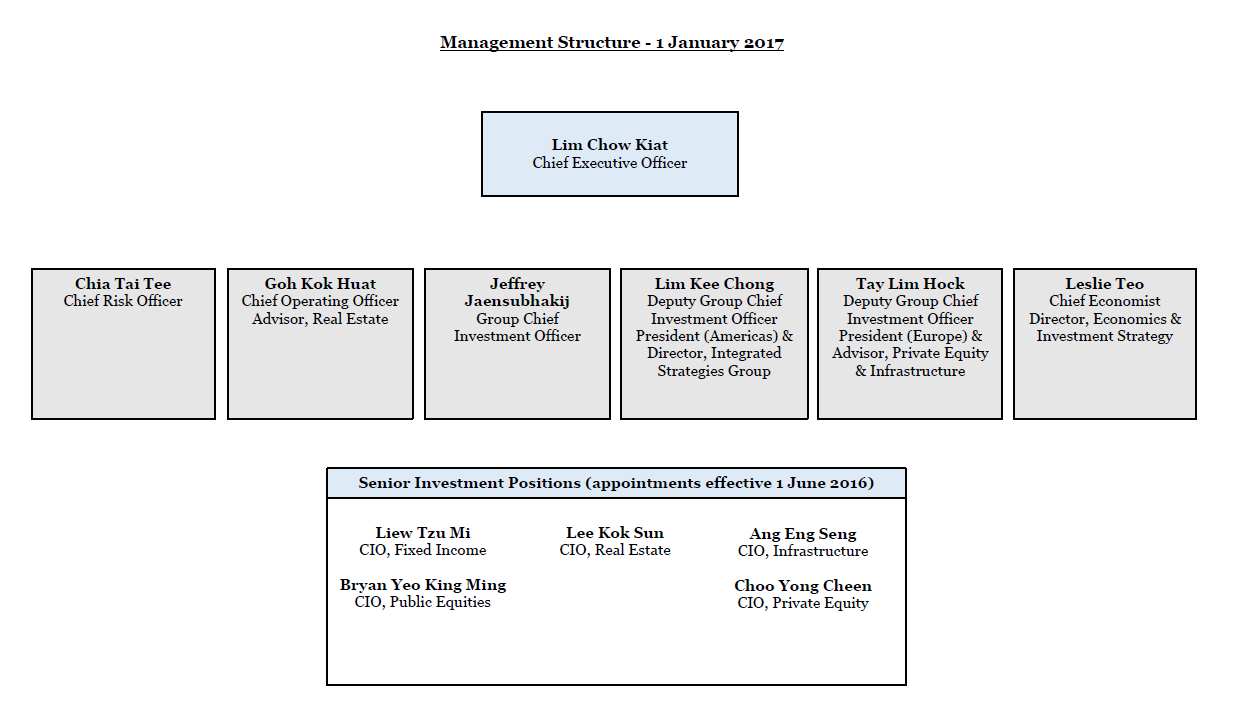
Additional appointments that will take effect from Jan 1, 2017, include Mr Lim Kee Chong, who will take on the appointment of President (Americas), based in New York. He will also remain as Deputy Group Chief Investment Officer and Director, Integrated Strategies Group. 

Mr Tay Lim Hock will be appointed Deputy Group Chief Investment Officer, and take on the concurrent appointment of President (Europe), based in London, GIC said. He will also be Advisor, Private Equity and Infrastructure, and relinquish his current role as President, Private Equity and Infrastructure. 

Additionally, Mr Goh Kok Huat will continue as Chief Operating Officer, with his concurrent appointment as Advisor, Real Estate from Jan 1 next year. He will relinquish his current role as President, Real Estate, GIC said. 

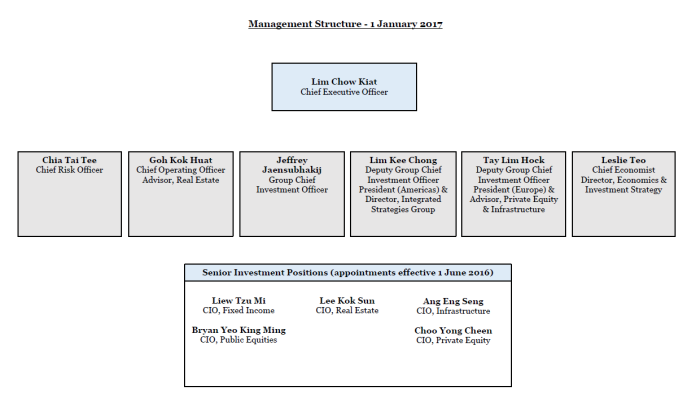
GIC’s Management structure, with effect from Jan 1, 2017. (Chart: GIC)

“The investment functions and responsibilities of Dr Jeffrey Jaensubhakij, Mr Tay Lim Hock and Mr Goh Kok Huat as President of Public Markets, President of Private Equity & Infrastructure, and President of Real Estate respectively will be taken over by the five Chief Investment Officers (appointed since Jun 1, 2016) in their respective areas, namely: Mr Bryan Yeo King Ming for Public Equities, Ms Liew Tzu Mi for Fixed Income, Mr Choo Yong Cheen for Private Equity, Mr Ang Eng Seng for Infrastructure, and Mr Lee Kok Sun for Real Estate,” GIC said in the release. 

“The titles of ‘President of Public Markets’, ‘President of Private Equity & Infrastructure’, and ‘President of Real Estate’ will cease to be used,” GIC added. 

Mr Lim Siong Guan, Group President of GIC, said: “I am happy to be able to hand over the reins of leading GIC to Chow Kiat. Chow Kiat comes with clear investment credentials to take GIC into the future and lead an organisation that is alert to new possibilities, faster in moving on opportunities, and nimble in execution.”

Singapore Prime Minister Lee Hsien Loong, Chairman of GIC, said: “As Group President since 2007, Mr Lim has made enormous contributions to GIC. He groomed a new generation of professional leaders, built up a fit and flexible organisational structure, and imbued the GIC team with sound values and ideals. Mr Lim’s time at GIC coincided with an extremely challenging period for global markets. His leadership enabled GIC to work cohesively towards a shared and worthy goal – to steward and invest our foreign reserves wisely and prudently, for the benefit of present and future generations of Singaporeans.”

“On behalf of the Board, I thank Mr Lim for all that he has done, and wish him all the best for the future. The Board has full confidence in Mr Lim Chow Kiat, who will now become CEO of GIC and will lead it in the next phase.”

Source link

Cambodia charges Australian nurse for running surrogacy clinic

0

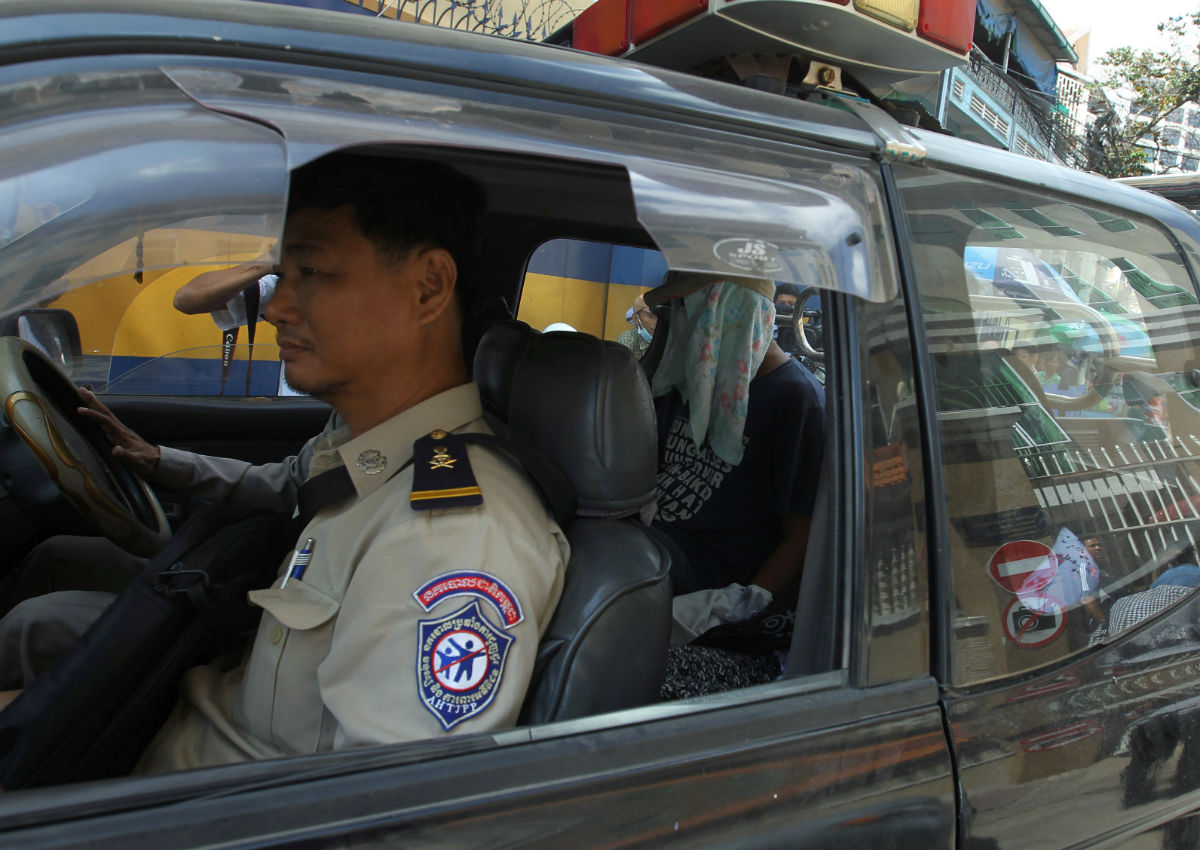
A Cambodian court charged an Australian nurse on Monday for allegedly operating an illegal fertility clinic, police said, weeks after the country declared a ban on commercial surrogacy.

Tammy Davis-Charles, 49, allegedly charged foreign couples $50,000 for surrogacy services and paid Cambodian women between $10,000 to $12,000 to carry babies on their behalf, Police Colonel Keo Thea, director of Phnom Penh’s anti-trafficking bureau, said.

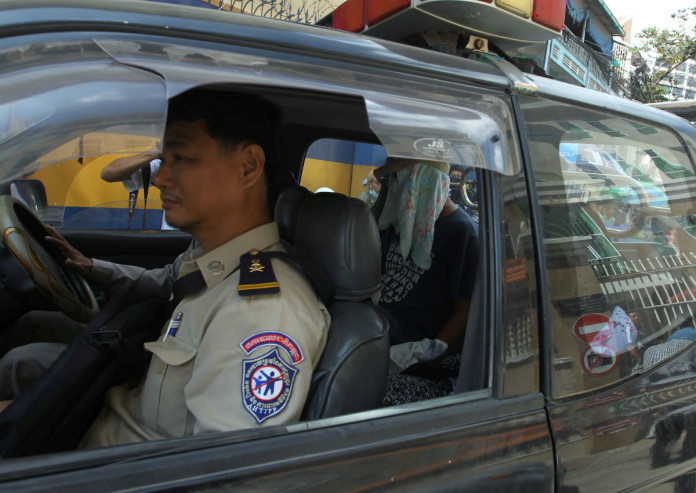
She was detained in the Cambodian capital at the weekend, and charged along with two Cambodian staff, Penh Rithy and Samrithchan Chariya.

“They acted as intermediaries in surrogacy and engaged in falsifying documents,” Keo Thea said.

Davis-Charles was too ill to attend the court on Monday and was charged in absentia, he said.

Cambodia moved to shut down its booming commercial surrogacy industry, which attracted foreign couples seeking to become biological parents, last month after similar bans in Thailand, India and Nepal.

“If we don’t crackdown on this, it will blossom,” Keo Thea said, referring to commercial surrogacy. “We don’t want to become a country that exports humans.”

Keo Thea said that Davis-Charles had moved her business to Cambodia more than a year ago after Thailand closed down its surrogacy clinics in Feb 2015.

Neighbouring Thailand had previously been a top destination for fertility tourism.

Reuters was unable to reach Davis-Charles for comment.

A spokesperson for Australia’s Department of Foreign Affairs and Trade said on Monday that consular assistance was being provided to an Australian woman arrested in Cambodia, without elaborating.

The Australian government has advised its citizens not to visit Cambodia for commercial surrogacy arrangements.

Image: 
Category: 
Publication Date: 
Monday, November 21, 2016 – 17:25
Send to mobile app: 
Source: 


Story Type: 
Others

Source link

Exhume Marcos, Philippine court asked after hero burial

0

MANILA – Campaigners launched legal action Monday to exhume the body of former Philippine dictator Ferdinand Marcos, just three days after his burial in a national heroes’ cemetery triggered street protests.

He was finally laid to rest Friday in a secretive ceremony at the “Cemetery of Heroes” with military honours almost three decades after his death, angering critics who accuse Marcos of massive corruption and human rights abuses.

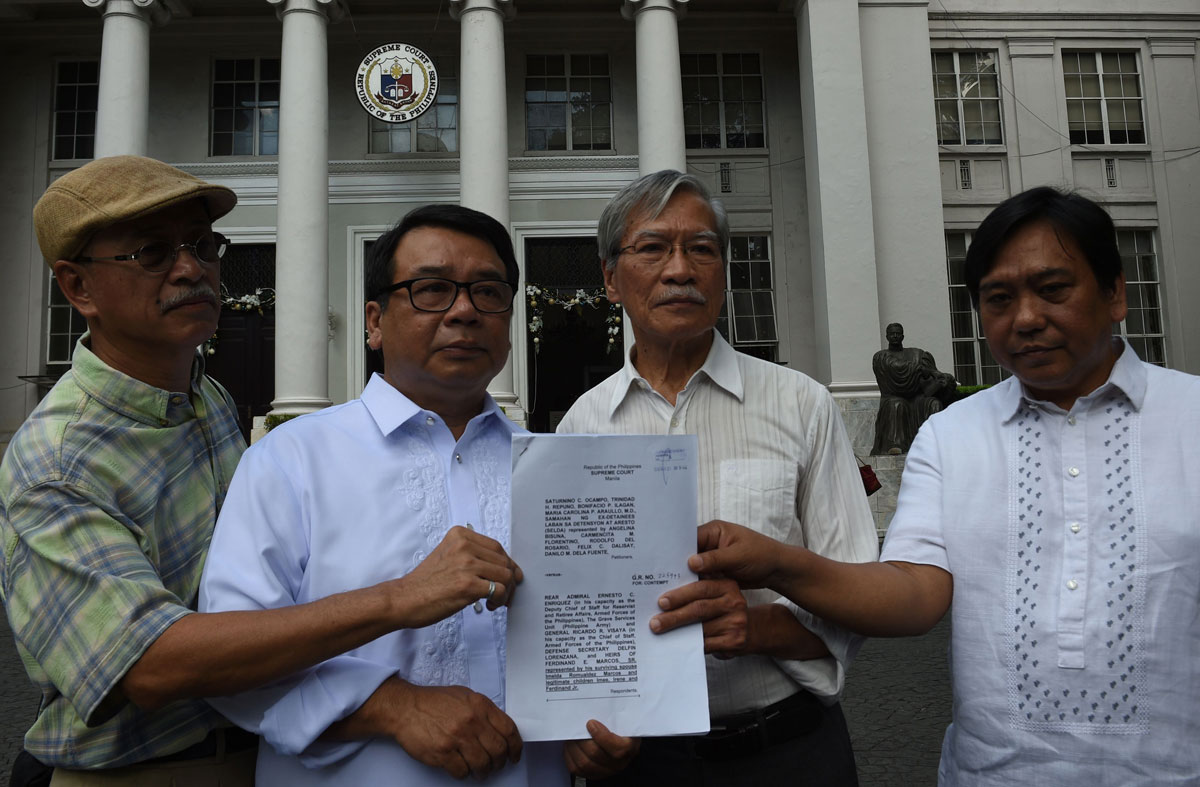
Relatives of victims of his rule asked the Supreme Court Monday to dig up his remains, claiming they had not been given enough time to appeal a ruling allowing his burial in the cemetery.

“How can a plunderer and despot and violator of human rights be given that honour of being buried in the memorial of good men?” said Congressman Edcel Lagman, brother of an abducted anti-Marcos dissident who was never seen again.

Two weeks ago the Supreme Court endorsed a decision by President Rodrigo Duterte to bury the dictator at the heroes’ cemetery.

The Marcos family and government moved quickly after the verdict, secretly flying the embalmed body from their home town in the northern Philippines to the cemetery in Manila on Friday and interring him.

But Lagman, an opposition member of the House of Representatives, filed a “motion for exhumation” Monday arguing the court ruling was not final because opponents were entitled to 15 days to appeal.

“The exhumation is imperative in order not to render moot and academic the petitioners’ forthcoming and seasonable motion/s for reconsideration,” the motion read.

Lagman and another group representing victims of Marcos’ martial law also asked the Supreme Court Monday to cite the Marcos family and the military in contempt of court for organising the burial.

Opponents also announced a major street protest for Friday.

Former president Fidel Ramos, a senior Duterte advisor and former military chief who was among the leaders of the anti-Marcos revolt, criticised the burial.

“It was an insult, it was a trivialisation of the role, the sacrifices of our armed forces…. Of course they (anti-Marcos forces) are entitled to protest,” Ramos told a news conference Monday.

“It is a step backward for this administration in the sense that they are losing support, they are losing friends,” he said, urging the Duterte government to fire military and police officials who helped carry out the burial.

Millions of Filipinos took to the streets in 1986 in a famous “People Power” revolution to oust the then dictator.

Marcos died in exile in Hawaii three years later, and his body was put on public display in his northern home town because previous presidents had refused to allow the dictator to be buried at the heroes’ cemetery.

Read also: Philippine dictator Marcos to be buried at heroes’ cemetery: Police

The former leader, his wife Imelda, 87, and their cronies plundered up to $10 billion from state coffers and plunged the Philippines into crippling debt during his rule, according to government investigators and historians.

The dictator also suppressed dissent, with thousands killed and tortured, previous Philippine governments said.

But his heirs staged a political rehabilitation that saw his wife and their children winning public office.

Their comeback culminated in the election this year of Duterte, a long-time ally of the family.

Duterte has defended the burial, saying laws entitled Marcos to be buried at the heroes’ cemetery as a former president and soldier.

Over the weekend, an emotional widow Imelda said her dead husband was “at peace” there.

“I know Marcos stood for the truth and if you are on the side of truth, God is on your side,” she told supporters at a memorial mass at her late husband’s grave.

Image: 
Category: 
Publication Date: 
Monday, November 21, 2016 – 17:23
Keywords: 
Send to mobile app: 
Source: 


Story Type: 
Others

Source link

South Korea opposition votes to seek Park's impeachment Jung Ha-Won

0

SEOUL – South Korea’s main opposition party voted Monday to seek the impeachment of President Park Geun-Hye after prosecutors named her a criminal suspect in a snowballing corruption case.

But it remains unclear exactly when Park’s opponents will formally try to start the process, a difficult and lengthy one with no guarantee about the outcome.

Members of the Democratic Party voted unanimously in favour of seeking Park’s impeachment and setting up a working group to review related legal issues, its spokesman Ki Dong-Min told reporters.

“We have decided to join efforts with civic groups, other opposition parties and even members of the ruling party who want Park to be impeached,” Ki said.

He said the party would formally begin the process when it sees the “biggest possibility” of parliament approving such a move.

Two smaller opposition parties have already said they will seek to remove Park.

Even some members of the president’s ruling conservative party have come out in favour of impeachment.

But their commitment to the process is unclear for now, partly due to fear of a political backlash if the impeachment bid fails.

A failed attempt in 2004 to impeach then-President Roh Moo-Hyun backfired badly, with two parties that led the bid suffering a devastating defeat in a general election the same year.

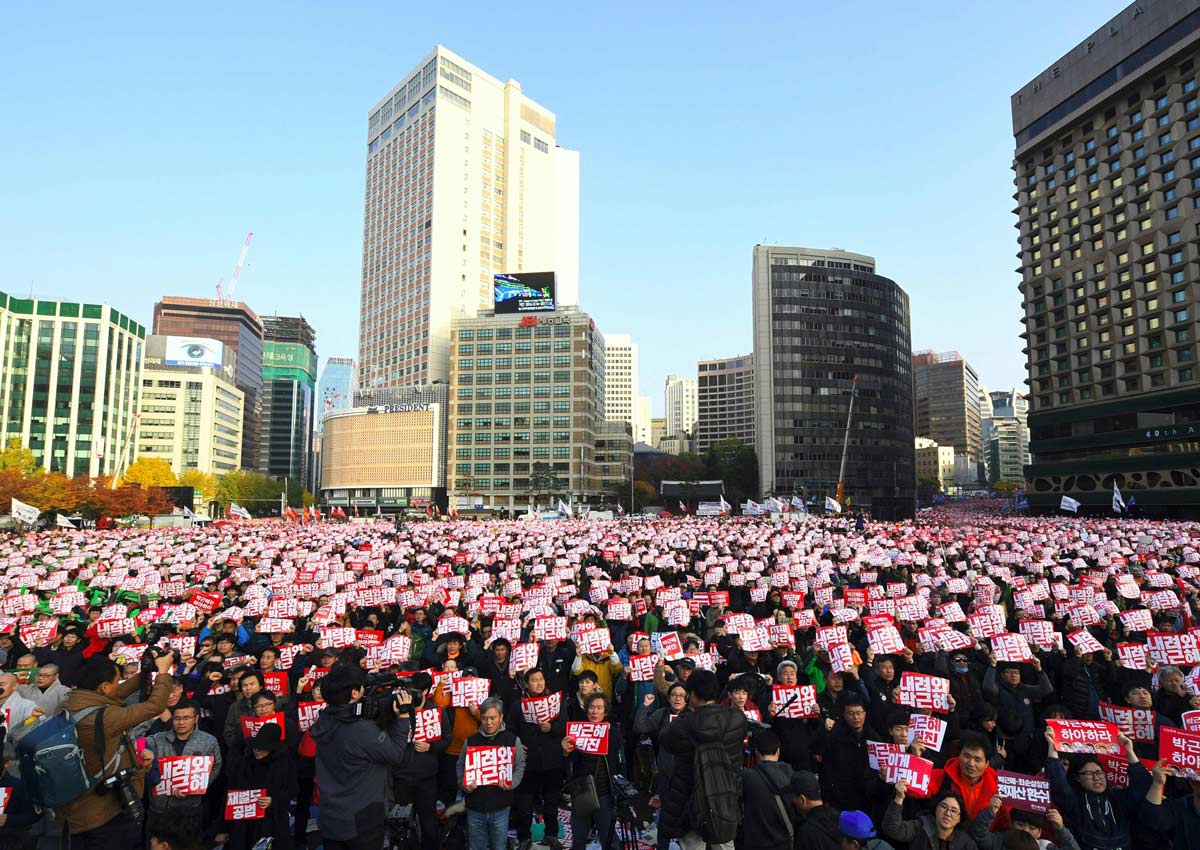
In some ways the opposition has had its hand forced by the huge outpouring of anti-Park sentiment, which has seen hundreds of thousands take to the streets of Seoul in recent weeks demanding she step down.

With Park showing no sign of going voluntarily, the opposition has come under pressure to take a more assertive stance, but is wary of the political dangers involved.

“Even if there is great public anger over Park for now, many lawmakers may be reluctant to take such a big risk by walking into an impeachment minefield,” said political commentator Kim Hong-Guk.

Park has just over a year to run of her single, five-year presidential term, and impeachment could take months, as it requires a two-thirds approval by the national assembly and a similar majority in the Constitutional Court.

There are concerns about a backlash from conservative voters who – while disappointed with Park – would see her impeachment as unwarranted and overly punitive.

On Sunday Seoul prosecutors said Park had colluded with her long-time friend Choi Soon-Sil, who is accused of coercing local firms to donate more than $60 million and of meddling in state affairs.

That made Park the first South Korean president to become a criminal suspect while in office.

Choi and a former Park aide were formally indicted on charges of abuse of power and coercion, while another aide was charged with leaking confidential state documents.

Park had previously said she would submit to prosecutors for questioning, but her lawyer signalled a change Sunday, saying she would only answer to an independent team of investigators which will soon take over the case.

A sitting president cannot be charged with a criminal offence except insurrection or treason, but she can be investigated and potentially charged once her term is over.

The three opposition parties hold a combined 55 per cent of parliamentary seats – short of the two-thirds majority, for which they would require the support of conservative MPs.

The scandal has sent Park’s job approval ratings diving to five per cent, a record low for a South Korean president.

Image: 
Category: 
Publication Date: 
Monday, November 21, 2016 – 17:24
Keywords: 
Send to mobile app: 
Source: 


Story Type: 
Others

Source link

Brandt Year End Sale from 25 – 27 Nov 2016

1

Brandt Year End Sale – up to 80% off washers, ovens & more! (25 – 27 Nov)

Brandt Year End Sale from 25 – 27 Nov 2016

Brandt is back at it again! Save more at the Brandt Year End Sale with massive discounts of up to 80% off! The sale runs from 25th to 27th November 2016 at SAFRA Tampines featuring home appliances such as washing machines, dishwashers, ovens & more

Source

Man charged for possession of Glock air pistol

0

SINGAPORE: A 24-year-old man was charged on Monday (Nov 21) for unlawful possession of a firearm – a Glock 18C air pistol – that he allegedly used to threaten his victim after the two had an argument in the early hours of Nov 19.

The pistol, plastic pellets and a knife were allegedly found on Muhammad Danial Mahmod when he was arrested early on Saturday morning, following a police report lodged by the 24-year-old male victim.

Plastic pellets, accessories allegedly found on Muhammad Danial Mahmod. (Photo: Singapore Police Force)

The victim went to the police at about 6.55am, claiming Muhammad Danial had used a pistol to intimidate him during an argument at a public car park near Block 24 Hougang Avenue 3 before leaving the scene in a car, police said.

Officers arrested Muhammad Danial within an hour of the report, after launching an immediate extensive investigation.

If found guilty, Muhammad Daniel could face life imprisonment and at least six strokes of the cane. His case will next be mentioned on Nov 28.

Source link

F1's South-East Asia future in doubt as Ecclestone says Singapore wants to drop race: Report

0

SINGAPORE – Formula One supremo Bernie Ecclestone has cast doubt over the future of the sport in Southeast Asia by telling a German magazine that Singapore no longer wants to host a grand prix after its current deal expires next year.

With neighbouring Malaysia also considering pulling out of the championship after 2018 because of declining ticket sales and TV viewership, the region could be left without a race for the first time since 1998.

The Singapore race costs some S$150 million ($105.04 million) to put on every year, 60 per cent of which is funded by the government. It was first staged in 2008 and the city-state renewed its contract for another five years in 2012.

Ecclestone’s blunt comments in Auto Motor und Sport, however, suggested negotiations over a further extension have not gone well.

“Look at what we have done for Singapore,” Ecclestone said. “Yes, the grand prix has cost Singapore a lot of money, but we’ve also given them a lot of money. “

Singapore was suddenly more than just an airport to fly to or from somewhere.

Now they believe they have reached their goal and they do not want a grand prix anymore.

” The event is organised in the city-state by Singapore GP, a private company owned by Ong Beng Seng, one of Singapore’s richest men.

A spokeswoman for the company said in an e-mail on Monday: “We don’t comment on ongoing commercial negotiations.”

Ecclestone, 86, is famous for outspoken media interviews during negotiations.

The Briton did not attend this year’s Singapore race as he was held up by negotiations on F1’s takeover by US cable TV mogul John Malone’s Liberty Media .

Formula One announced a record-equalling 21-race provisional calendar for 2017 in September.

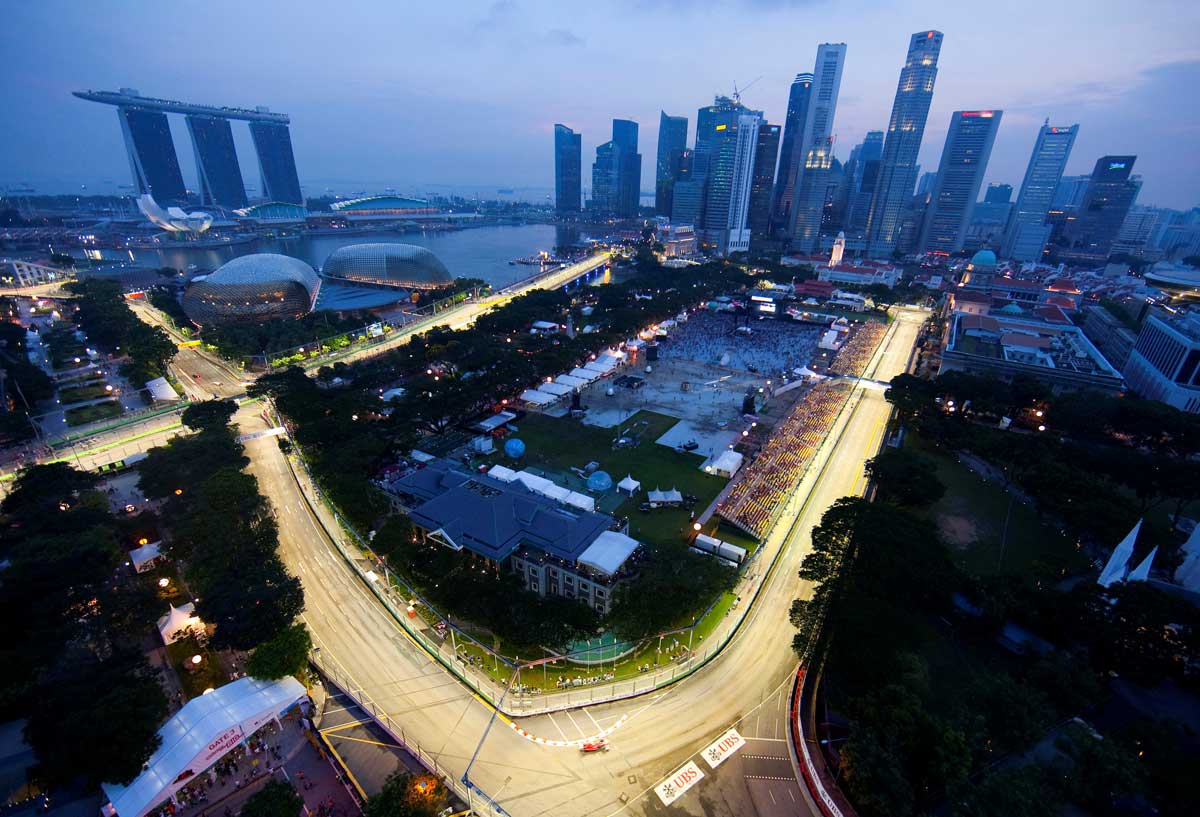
The Singapore race is one of the glamour rounds of the championship, taking place at night on a street circuit with spectators entertained by internationally renowned music acts such as Beyonce and Justin Bieber.

Crowds, which topped 100,000 on all three days in the first year, have declined, however, with this year’s race averaging 73,000 spectators for each day, down from 87,000 in 2015.

STRUCTURAL SHIFT

A decline in ticket sales in Malaysia is also behind the decision by the government and race organisers there to look at bringing an end to their annual round of the championship, which has been held at Sepang since 1999.

The loss of the Singapore round, however, might encourage Malaysia to retain their round and hope to attract some of the 150,000 international visitors who went to the city-state in each of the first four years of the race.

Singapore’s tourist sector is seeing a structural shift away from heavy spenders and towards the emerging middle classes of China, India and Indonesia, analysts say.

Tourist arrivals have been on the rise. In the first eight months of this year, before the F1 race, the number of visitors was up 10.3 per cent from the same period of 2015, at 11.3 million.

Singapore’s tourism receipts in the first half of the year grew 12 per cent to S$11.6 billion ($8.13 billion), driven mainly by shopping, accommodation and food and beverage, which offset a fall in sightseeing, entertainment and gaming.

Trinh Nguyen, a senior economist for emerging-market Asia at French investment bank Natixis SA in Hong Kong, said the recent drop in F1 attendance may be a sign that the novelty of the event is wearing off, and may also be a reflection of weak regional growth.

“It (F1) also comes with costs. Thus, with tourism receipts (from F1) waning the cost benefit calculus is tipping in the other direction,” Nguyen said.

Image: 
Category: 
Publication Date: 
Monday, November 21, 2016 – 16:47
Keywords: 
Send to mobile app: 
Source: 


Story Type: 
Others

Source link

Thailand to begin building late king's funeral pyre next year

0


BANGKOK – Thailand will begin building the funeral pyre for late King Bhumibol Adulyadej, who died last month at the age of 88, next year, the government said on Monday, adding 8,000 people will be involved in the cremation ceremony.

The king, the world’s longest reigning monarch, ruled for seven decades and was seen by many Thais as a stabilizing force through an era of rapid change and social upheaval in the country.

Daily Buddhist funeral rites have been held for the king at the Grand Palace in Bangkok but a royal cremation will not take place for at least another year.

Deputy Prime Minister Thanasak Patimaprakorn said a committee had been set up to oversee construction of the king’s cremation pyre in a public square in front of the palace.

“Building is expected to be completed before September 2017 but it depends on the weather,” Thanasak told reporters, adding that up to 8,000 people will take part in the cremation ceremony.

Prime Minister Prayuth Chan-ocha has made clear that the king’s only son and designated heir, Crown Prince Maha Vajiralongkorn, will inherit the throne, though there is still no date for when he will officially succeed his father.

Image: 
Category: 
Publication Date: 
Monday, November 21, 2016 – 16:35
Send to mobile app: 
Source: 


Story Type: 
Others

Source link