Home Blog Page 2298

OTHER SPONSORED CELEB WEDDINGS

0

It is not unusual for some fans to go to extremes to please their favourite stars.

They shower their idols with lavish gifts, or do everything they can to meet them in person.

But pull sponsors together to pay for a wedding?

Malaysian TV personalities Amyra Rosli, 25, and Amar Baharin, 31, have already held their wedding – twice.

But with effort from some of their fans, they will be celebrating their marriage for a third time on Saturday.

The couple, who first tied the knot on Nov 11, have already held two receptions in Kuala Lumpurfor their families and friends.

The third reception, which will be held here, is for their Singapore fans.

The project was spearheaded by Madam Asliani Abdul Ghani, who heads Amyra’s local fan club, Aamyra Rosli Supporters Singapore,together with local events company FA Event & Entertainment.

The fan club has nearly 29,000 followers on Instagram.

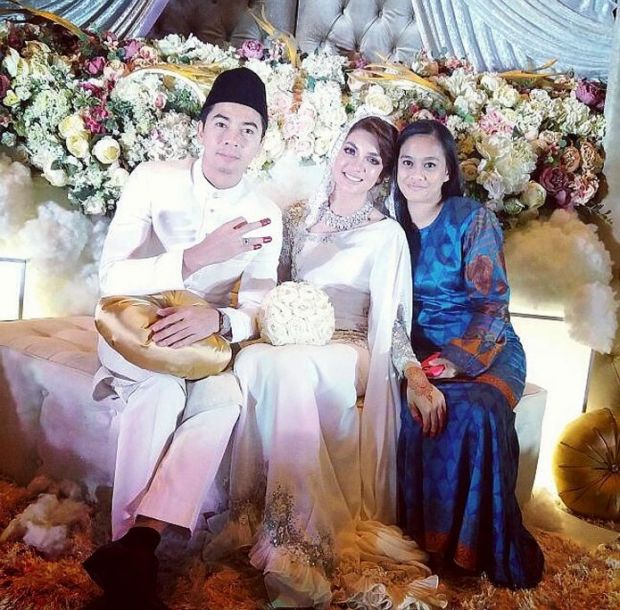
CELEBRATIONS: Madam Asliani Abdul Ghani (right) with celebrity Malaysian couple Amyra Rosli and Amar Baharin at one of their wedding receptions in Kuala Lumpur. Madam Asliani organised the couple’s third reception, which will be held here on Saturday. PHOTO COURTESY OF ASLIANI ABDUL GHANI

News of the third reception, which is estimated to cost more than $50,000, irked some users of social media, with critics calling it a waste of money.

But Madam Asliani, 36, who has been a fan of the couple for four years, feels the effort and money will be worthwhile.

She told The New Paper: “I can understand how disappointed the fans felt when they were unable to travel to attend the wedding.

“This is a present to their fans for their support over the years.”

SPONSORS

Madam Asliani, a logistics officer, set the wheels in motion after attending the couple’s engagement ceremony in July. She also received the go-ahead from Amyra’s mother, who is a close friend.

Within three weeks, she and her team of five secured 22 sponsors for the reception. 

There will be about 300 guests at the event, to be held at The Ballroom at East Coast, which is owned by local radio personality AB Shaik.

Said Madam Asliani: “We gave priority to big fans who were unable to attend past events, those who have paid in the past for their meet-and-greet sessions, and members of the public who have never had a chance to meet the couple.”

Amyra and Amar, who grew close when they co-starred in the 2015 Malaysian TV drama series Suamiku Encik Sotong, were in town on Nov 22 for a wedding photo shoot.

FAMOUS PAIR: Newlyweds Amar Baharin (left) and Amyra Rosli will be having their third wedding reception here, thanks to their fans. PHOTO: FARAH REZAL

Amyra said: “We feel very grateful for our fans here. Singapore is like a second home to us and we are truly touched that the fans have gone out of their way to organise this.”

One sponsor, Mr Zulkeffli Mohamed, director of local bridal company Chantique The Bridal Gallery, told TNP that the couple’s wedding outfits were specially designed for them.

“Amyra prefers something simple yet classy, without too many heavy accessories. She will be wearing a modern traditional songket dress, as well as a white ball gown,” said Mr Zulkeffli, 46.

“I like the couple’s acting. When I met them to discuss the wedding, they were nice.”

Another sponsor, Madam Masturah Mohd Nor, director of decor company SID Events, is looking at a pastel, English-inspired theme for the reception.

Madam Masturah, who is in her 50s, said: “I’m thinking of baby’s breath and hanging vases with candles. But we will let this remain as a surprise for the actual day.”

Netizens reacted with ire to news of the upcoming reception, which was posted on the Berita Mediacorp Facebook page. While it received 1,000 likes, most of the 80 users who commented called it “wasteful” and “stupid”.

CHARITY

Others thought the money should have gone to charity.

But Madam Asliani said: “This is something we do sincerely as fans. This backlash is normal, so we let it be.

“At the end of the day, we know what our intentions are – and that is to give back to their supporters.”

Amar said: “Without our fans, we wouldn’t be here. With regards to the backlash that these fans received, that is merely from keyboard warriors who do not know our true intentions.”

This is something we do sincerely as fans. This backlash is normal, so we let it be.

– Madam Asliani Abdul Ghani, who organised the third wedding, responding to criticism

Source link

You did us proud, Chiew Peng

0

Finding a goalkeeping spot in the national team then was akin to an A-star student securing a place in medical school or the law faculty.

That was how tough it was to become a national goalkeeper in the Seventies because of a plethora of top-notch stars between the posts.

The comparison may sound a slight exaggeration. But you get the drift.

So against a line-up of at least seven goalkeepers, Lim Chiew Peng stood tall.

The highly-talented and acrobatic goalkeeper died of cancer, aged 65, yesterday. He will be remembered as one of the hailed and heroic footballers who brought the Kallang Roar to the old National Stadium.

REST IN PEACE: Lim Chiew Peng, who was always generous with his smiles, (above) keeping out Terengganu’s Nik Ahmad during a Malaysia Cup game at the National Stadium in 1979. ST FILE PHOTO

There was a period when Lim stood first among many equals whose names have been etched in footballing folklore since.

The stylish Eric Paine, who took over from the majestic Wilfred Skinner and agile Ahmad Wartam (father of Fandi Ahmad), was among them but, to be fair, the reliable goalkeeper was preparing to hand over the mantle.

And stepping forward were many Young Turks, who later formed an illustrious list, the who’s who of Singapore football.

Edmund Wee, Brian Rozario, Paul Anthonysamy and Kuah Chui Heong were also already tying their bootlaces and ready to don the long-sleeved national team jerseys.

And waiting in the wings was the precocious David Lee and even an aspiring Richard Chiam.

Against such competition, Lim was imposing, playing in two Malaysia Cup finals in 1976 and 1979 and being in the squad when Singapore won the historic event in 1977 after 12 years.

Quah Kim Lye, 73, of the famous family that contributed eight footballers (five men and three women) to the national team over almost three decades, said Lim’s passing was a sad loss to Singapore football.

Said Quah: “I played so many matches with Lim as our ‘keeper. I went with him and the national team to England in 1972. I played several Malaysia Cup matches and King’s Cup football with Chiew Peng.

“And I think he was one of the best goalkeepers Singapore has produced. His talent was god-given. He was a natural. He was spectacular with high-flying saves.

“Mind you, he was never a glutton for hard training, although under coach ‘Uncle’ Choo Seng Quee, he was made to sweat, and stretch, at training.”

GIVING BACK

Despite that “slight drawback”, Lim gave his life to football. After he retired from the national team, he went out of the way to train and guide young players.

Lim also provided his talent to many clubs, among them Safsa, Tyrwhitt Soccerites and Singapore Pools. And he did yeomen service for Tampines Rovers as goalkeeping coach.

But what struck me most about Lim was his humility.

Just before I wrote the Malaysia Cup book in 1990, I asked him: “Do you think you were among the best goalkeepers for Singapore?”

Ever-smiling, he replied quite dismissively: “Football is a team game, so credit to all.”

“His talent was godgiven. He was a natural. He was spectacular with high-flying saves.”

— Ex-Lion Quah Kim Lye on Lim Chiew Peng

Source link

Courts online 10% to 15% off storewide Cyber Monday online discount coupon promotion codes valid on 28 Nov 2016

0

Courts online 10% to 15% off storewide Cyber Monday online discount coupon promotion codes! Use CYBER15 for 15% off (max discount $60) or THANKYOU10 for 10% off (max discount $80)

Courts online 10% to 15% off storewide Cyber Monday online discount coupon promotion codes valid on 28 Nov 2016

Get 10% to 15% OFF discount off at the Courts online store with a minimum spend of $459. Courts online store at promises the Lowest Prices Guaranteed, 30-Day Hassle-Free Exchange, Cash on Delivery and a Secured Checkout

Source

A Big Walk for all

0


Mr Mohd Esa, 64, lost his right leg in an accident 10 years ago.

But that did not stop the retiree from taking part in The New Paper Courts Big Walk for the first time.

“I decided to join the Big Walk because I wanted to see if I am fit enough to handle the event,” he said.

The retiree, who used to work in the shipping industry, attended the Big Walk with his 40-year-old son-in-law, his 35-year-old daughter and seven-year-old granddaughter.

He followed on his crutches, as the rest of his family walked ahead of him.

He said: “Last year, I walked from Changi Village Bus Terminal to White Sands shopping mall in Pasir Ris and back, and I did this three times.”

Mr Mohd Esa and his family were among the 5,000 at the Big Walk to enjoy some family time.

School canteen operators Terry and Pearly Lim were glad for some quality time together with their son Dominic, nine, who often plays Pokemon Go.

“It’s so hard to have family time these days, so we think that we should take some time out here to look at the animals and have fun.

“I think that time together is very precious,” said Mr Lim, 41.

Asked if they will be playing Pokemon Go during the walk, he said: “No, I really want him (Dominic) to appreciate the scenery and get some good exercise, rather than being glued to the phone. I think this is a habit that all of us should ditch.”

Mr Neo Guo Yong, 33, an IT support specialist, came with his wife, Madam Ang Mei Ling, 33, a cardiac technologist, and their 17-month-old daughter and four-year-old son.

This is not the first time that they are attending the walk. They have been doing so since 2008, when they were dating.

REMINISCE

Mr Neo said: “It’s been quite a while since I have been to the Singapore Zoo, and going for the Big Walk did let me reminisce of the old days with my wife. It’s great that we are attending with our kids now.”

Madam Ang added: “It’s also fun that we get to experience the Night Safari in the day.”

When it started raining, Mr David Tan, 44, and his wife Jane, 33, continued their stroll without an umbrella.

Mrs Tan, a hotelier, said: “The weather was very hot today, and with so many people, it was also humid.

“So when the rain came, we might as well just get wet, and it felt really nice.”

She and her husband of two years, who is a chef, had made it point to participate in marathons and walks every one to three months.

“Attending the Big Walk was (a last-minute decision), but having this target helps keep us healthy,” she said.

Ms Lim Hai Yen, 46, a theatre practitioner, was at the Big Walk to relax with her friend of 20 years, Ms Ong Chim Buan, 48, a teacher.

Ms Lim said: “We wanted to come here as it is not stressful compared to (other events), where you have to compete to see who finishes first.

“The branding for this is also more relaxed, and you can follow your own pace.”

They too were glad when the skies opened up.

Said Ms Ong: “I think it’s good to head back to nature, and we must get used to the wild side, (such as being) in the rain with no shelter.”

Not every participant needed company to enjoy the walk.

Mr Pong Thian Wah, 66, a security guard, has been attending almost every Big Walk on his own.

He said: “I actually bought tickets for my family, but we live too far from the Singapore Zoo, so it’s just me here. My wife is also a little old to walk long distance.

“Even though it’s raining, I still enjoyed myself.”


This article was first published on Nov 27, 2016.
Get The New Paper for more stories.

Image:
Publication Date:
Sunday, November 27, 2016 – 19:38
Keywords:
Send to mobile app:
Source:

Story Type:
Others

Source link

K-pop video director charged in S Korea’s scandal

0


SEOUL – A prominent K-pop music video director was charged Sunday as part of a corruption scandal rocking South Korea and engulfing President Park Geun-Hye.

Cha Eun-Taek, who has worked with “Gangnam Style” star Psy and boy band megastars Big Bang, used his ties to a secret confidante of Park to win lucrative projects from state agencies and private firms, prosecutors say.

That confidante – Choi Soon-Sil – has been labelled Park’s eminence grise, a shadowy figure who is believed to have leveraged her close relationship with the president to extract more than US$60 million (S$85 million) from top firms, including Samsung.

Prosecutors say Park herself ordered her former economic adviser to help Cha pressure officials and private firms so that he would win contracts.

Cha, 46, has been charged with abuse of power, coercion and embezzlement and becomes the latest public figure to be embroiled in the snowballing scandal.

Choi, 60, is accused of meddling in a wide range of state affairs including the country’s preparations for the 2018 Winter Olympics.

Prosecutors last week formally charged her with abuse of power and coercion, saying Park was a “co-culprit” who had colluded with Choi to strongarm top firms into giving cash to non-profit foundations Choi controlled.

Park – now the first South Korean president to become a criminal suspect while in office – has rejected a series of requests from prosecutors to answer their questions.

As a sitting president, Park cannot be charged with a criminal offence except insurrection or treason, but she can be investigated and potentially charged once her term is over.

Park is faced with growing public calls to resign and a push by lawmakers to impeach her, with her job approval ratings diving to record lows of four percent.

Hundreds of thousands have taken to the streets in recent weeks to call for her ouster, with organisers claiming the latest rally on Saturday in Seoul drew 1.5 million people.

Image:
Category:
Publication Date:
Sunday, November 27, 2016 – 19:30
Send to mobile app:
Source:

Hermes ID:
2 771 878
Hermes ID String:
SP_KPOPDIRECTOR
Hermes Author:
SPANAECH
Story Type:
Others

Source link

He wants to change 'cancerous' attitude to PSLE

0

Sam Willows frontman Benjamin Kheng shares personal tragedy and struggle with studies in moving Facebook post that went viral

His mother died two days before the first major examination in his life.

And even though years have passed, those dark days stay deep in the mind of Benjamin Kheng.

The frontman of local band The Sam Willows shared a moving Facebook post of his personal tragedy on Friday afternoon, a day after the Primary School Leaving Examination (PSLE) results were released.

Kheng, 26, wrote: “Principal shows up at the wake, gives me a hug, along with a trail of teachers who sit me in the corner of the room and give me supervised tuition. Dad tells them to pack up and go.

“A week later, I stare at my maths paper without picking up the pencil. I flunk way below expectations but miraculously still get picked up by ACS(I) through DSA, so I swim for them. I rank second last in my cohort academically, doing absolute crap in anything that isn’t art or literature. Worst kid in the worst class.”

He also detailed how he switched schools and spent his “next half a decade fighting to make sense of a system that I know would absolutely cripple a middle-aged, neurotic arts-centric me”. Until one day, “a kind lady offers me a job to speak/write for radio”.

By last night, Kheng’s post amassed more than 9,000 likes on Facebook and was shared over 1,300 times.

He tells The New Paper on Sunday: “I wanted to help change the cancerous attitude towards PSLE results. Hopefully it helps some kid out there find peace in the fact that his path in life is so much more beautiful and fulfilling than numbers on a paper.”

Kheng is pleased that the post has taken off and touched people.

“I am happy it is going round, and people are getting inspired and touched by it. Virality is a beautiful thing when there is good coming from it. Hopefully it stays that way,” he says.

Kheng is not the only personality who took to social media to encourage students.

On Thursday night, criminal lawyer Josephus Tan uploaded a short video on Facebook encouraging pupils as “Uncle Joe”.

In the video caption, Mr Tan said: “Go easy on yourself, and never give up cos’ learning is a lifelong journey and education is truly about having a thirst for knowledge and not grades.”

He posted a similar encouraging message last year, disclosing that his PSLE score was 183.

Minister for Social and Family Development Tan Chuan-Jin also weighed in on Friday.

In the comments’ section of a Facebook post he had made on Thursday, he called for more focus on parenting efforts, rather than exam results.

Read also: The PSLE post that scored with netizens

NO PERFECT SYSTEM

He said: “I think we are on really shaky ground if PSLE is the main determinant of our children having a happy childhood.

“There are no perfect systems out there. PSLE is one point in a long journey. We as parents shape the experience by the way we approach it and the way we set and manage expectations.”

Clinical psychologist Carol Balhetchet says the stress from exams can be good, provided it is a “practised” kind of pressure.

“The stress can be given incrementally and in small doses, like in small daily tests. A healthy kind of stress allows children to develop a fighting spirit,” says Dr Balhetchet, senior director for youth services for Singapore Children’s Society.

She points out how the pressure from PSLE can be harmful to the process of self-discovery in children.

She says: “These children are just discovering themselves and need an environment full of love. When love is given only when good results are achieved, the children stress themselves out.”

She warns that the “humongous drama” over exam results can be detrimental.

“We want children to learn to accept failure and that it is not the end of the world. A lot of failure these days is related to being inadequate, which causes hate, anger and negativity,” she says.

Kheng says: “The impression from PSLE results runs deep.

“It kind of feels like someone tattooing your results on your forehead – you’re forever measured by it academically and even socially.”

Kheng feels that if enough people address the “wall” built by PSLE expectations, the pressure put on students will not be so dire.

He adds: “Just a brick in the wall really, but if we keep telling our stories and changing perceptions, this wall will come down.”

harizbah@sph.com.sg

Read also: PSLE changes: A lesson in engagement


This article was first published on Nov 27, 2016.
Get The New Paper for more stories.

Image: 
Category: 
Publication Date: 
Sunday, November 27, 2016 – 19:00
Keywords: 
Send to mobile app: 
Source: 


Rotator Image: 
Story Type: 
Others

Source link

Singapore family helps bring back centuries-old tradition in Riau islands

0

Words by Mayo Martin / Multimedia by Lam Shushan

Read Part 1 of this series: Watching a way of life vanish

RIAU ISLANDS, Indonesia: The harbour at Belakang Padang island is a fluttering forest of colourful sails, in various shades of orange, red, blue and yellow, with a pier jam-packed with cheerful spectators come to see the action. It mirrors the high spirits of our host, Mazlan Mohd Nasir.

“Welcome to the Olympics – in Riau, not Rio!” the 54-year-old Singaporean quips.

The day is August 17 – Indonesia’s National Day – and we’re about to watch the first of a series of regattas that take place every year in the Riau Islands. It’s the modern-day incarnation of kolek racing, a tradition in the Riau-Singapore-Johor region since the 1800s when these fast, shallow crafts with enormous sails requiring dexterous sailors were common.
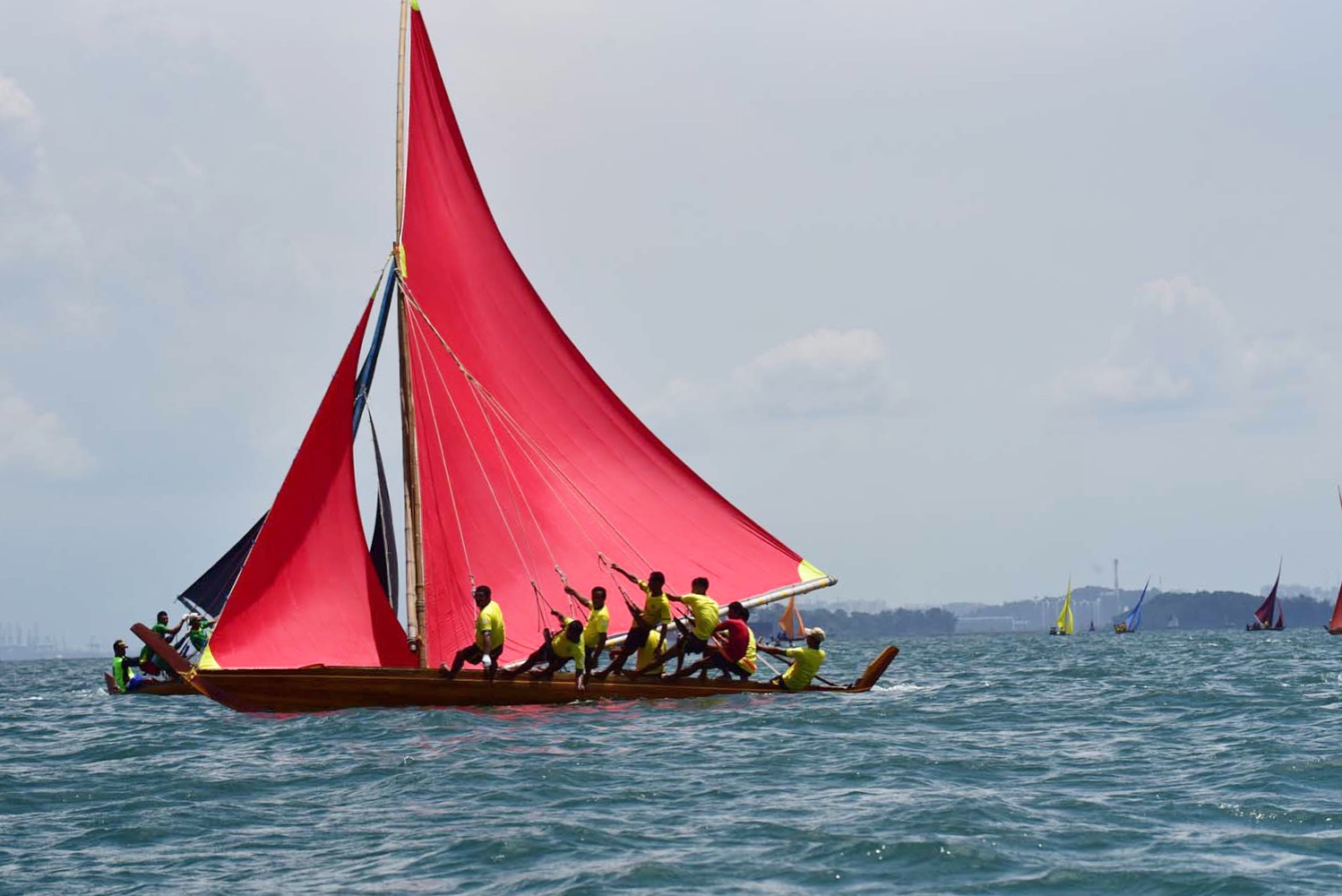
From the harbour, the skyline of Singapore’s Central Business District is visible a mere 15 kilometres away, but it might as well be a different world. Today, the Lion City is a busy port and its shorelines festooned with container ships – but 40 years ago, such kolek regattas would have been common along the coast.

Singapore’s development came with a price: The space to race these graceful, powerful and demanding sailboats that had been a way of life for nearly two centuries.

But here in the Riau Islands, after a period of also fading away, the kolek races have found their way back to popularity. Thanks, in part, to people like Mazlan.
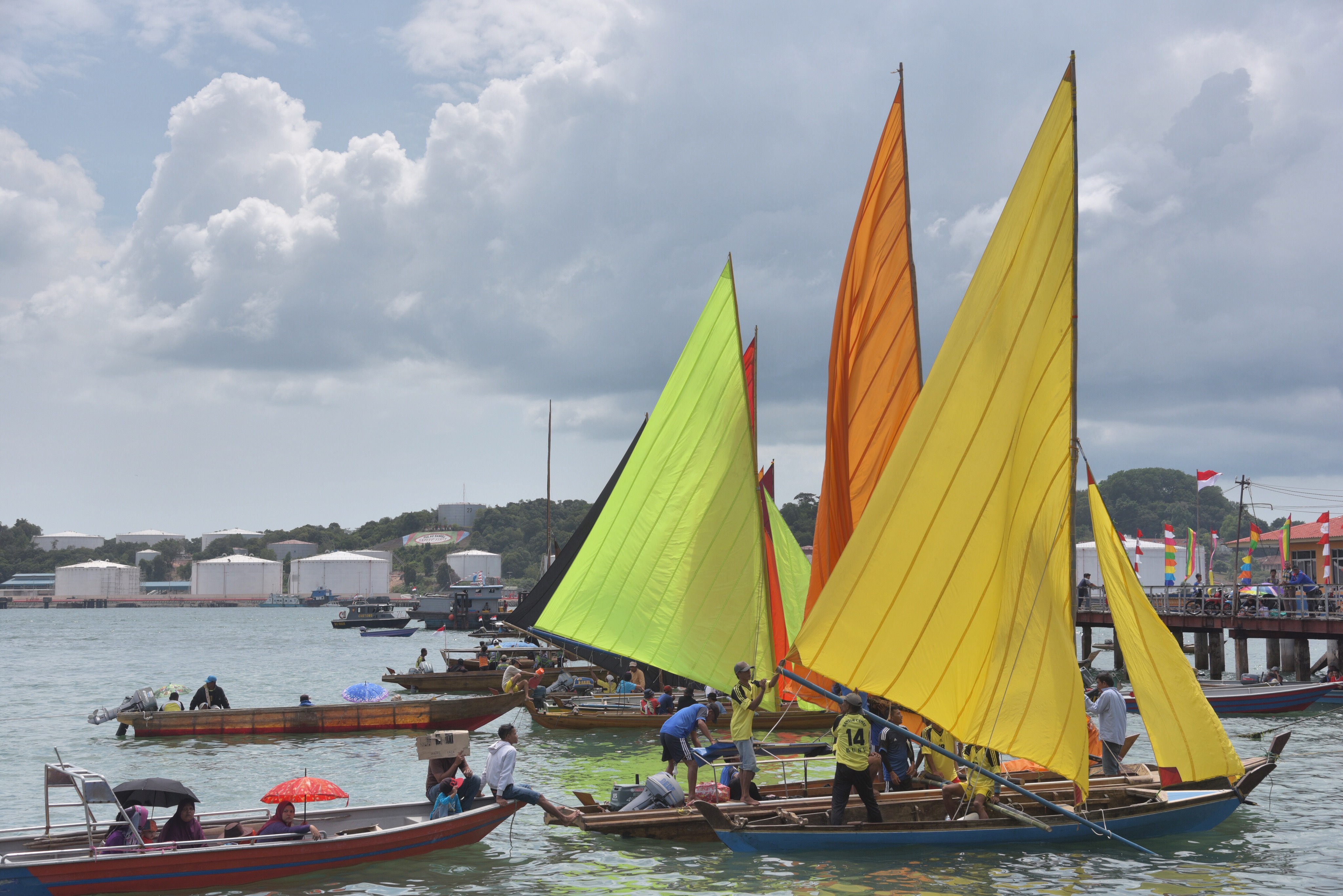
Today, the reason for his good cheer is his family’s Pujangga – a craft with a bright yellow sail and bright orange stripe on the side which is racing.

It’s not the same Pujangga that Mazlan, as a stripling growing up on Lazarus Island in the 1960s, watched compete around the Southern Islands – and which he discovered languishing on Keban in the Riau islands in 1987.

No, it’s a new-generation version, built in 1997. Mazlan has spent many weekends shuttling from Singapore to Keban to supervise its sea trials and to train the nine-men crew tasked with steering Pujangga to victory.

But, we soon find out, simply finishing a race is easier said than done. Barely minutes after the siren to start the race goes off, Mazlan’s kolek capsizes.

Watch: The stomach-twisting moment when things go wrong, in 54 seconds

As the dejected-looking sailors limp back to the dock post-race, the reason is confirmed: Water seeped in, which can happen easily with a shallow boat like the kolek.

While packs of cigarettes are given out to the crew as consolation, we turn to Mazlan to see if he’s disappointed. “There’s another race tomorrow,” he shrugs, as we head to his home-away-from-home in Keban to recharge.

THIS IS RETIREMENT

More than an hour’s ride south from Belakang Padang, past speeding boats, the occasional fishpen, uninhabited mangrove islets and villages on stilts, lies Keban island.

Roughly a quarter the size of Sentosa – a mere kilometre from end to end – it is home to about 200 residents, mostly fishermen. The shoreline is dotted with wooden houses on stilts, and Mazlan’s family compound is one of the rare concrete ones.

As we dock and clamber up a rickety, makeshift jetty, his father welcomes us. A Singapore passport holder, 76-year-old Haji Mohd Nasir Awang, regularly travels back to the city-state, but most of the time he’s here on the island.

Like many of his generation from this part of the Riau Islands, as a boy Cik Nasir was sent to study in Singapore. He served in the pioneer civil service as a teacher and raised his family there, but once he retired, he moved back to the islands where his father and grandfather had served as penghulus.

While not a village headman like them, Cik Nasir is a respected figure in Keban. “I’ve got seven children, 25 grandchildren, and three great-grandchildren. They’re all living in Singapore, but they all spend their holidays here,” says Cik Nasir, who still has the straight posture and build of a sturdy islander, like his son. “And they’re all happy I’m here.”

Aside from Mazlan, also visiting today are his sister Lela, his nephew Firhan (a commercial diver) and two inquisitive younger nephews. Like Mazlan, they also regard Keban as their second home, a getaway from the intense pace of Singapore.

The place lacks some creature comforts (no electricity during the day, a practically non-existent cellphone signal). But on clear nights, Firhan tells us, the sky littered with stars is a sight to behold. A short boat ride away is Sugi island, where the marshes are lit up by countless fireflies.

And then there’s the view from the family verandah.

Entertainment is improvised – two small mirror balls hang attached to the ceiling fan in the living room. Shine a light on them, switch on the fan, turn up the music, and voila – you get instant discotheque, kampong-style, Lela says laughing.

BUILDING A KOLEK HUB

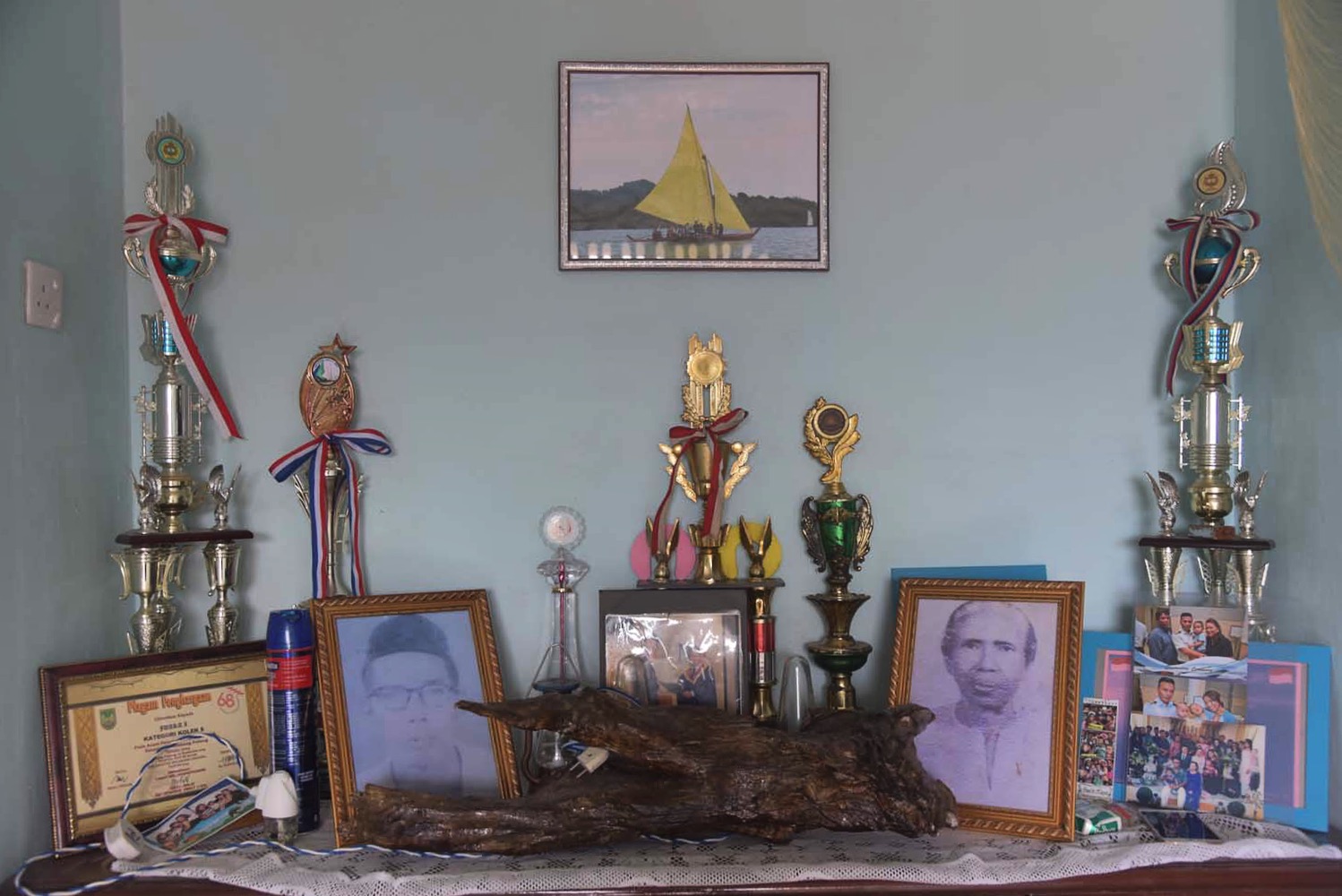
Inside the main house of the family compound is a special “altar” of sorts to their kolek exploits.  Trophies and certificates are placed together with photographs of Mazlan’s grandmother and grandfather, who owned and raced kolek. A photo of the new Pujangga hangs over these.
Cik Nasir, who helps Mazlan supervise their kolek team, keeps an eye on the family’s long-term project in Keban – the construction of a chalet, which they hope will be a place for visitors to stay to learn more about koleks, and maybe even help boost the island’s economy.

It’s part of their long-term plan to create a kind of “kolek hub” in Keban involving the kampung folk.

But Mazlan is aware that they need to get the islanders onboard, which is why they’re taking it slowly. “We don’t want to rush because we don’t want to disturb the environment. We don’t want to shake up the place. It’s not a money-making venture; I look at building up the whole community,” he says.

Watch: How koleks are still made by hand, on Pulau Tjombol (1:43min)

While Mazlan admits that more needs to be done to pass on the knowledge of boat culture to the younger generation in Keban, he is encouraged by the growing interest in kolek racing. “I can see the enthusiasm is now really there. When there is a race, they really prepare for it.”

And of course, at some point, he hopes the enthusiasm can spread all the way to Singapore, too.

“I would love if Singapore had a team, then they participate (in the races). They can even build a kolek, leave it here (in Keban), so whenever there is a race, sailors can come and hop in.

“They can come and do sea trials, train and mix with the sailors down here. We can do a one-time race in Keban, then maybe it will start to grow,” Mazlan enthuses.

But, he adds: “Singapore is not an easy place to do a race anymore. There’s no open sea, and where are the spectators going to watch?”
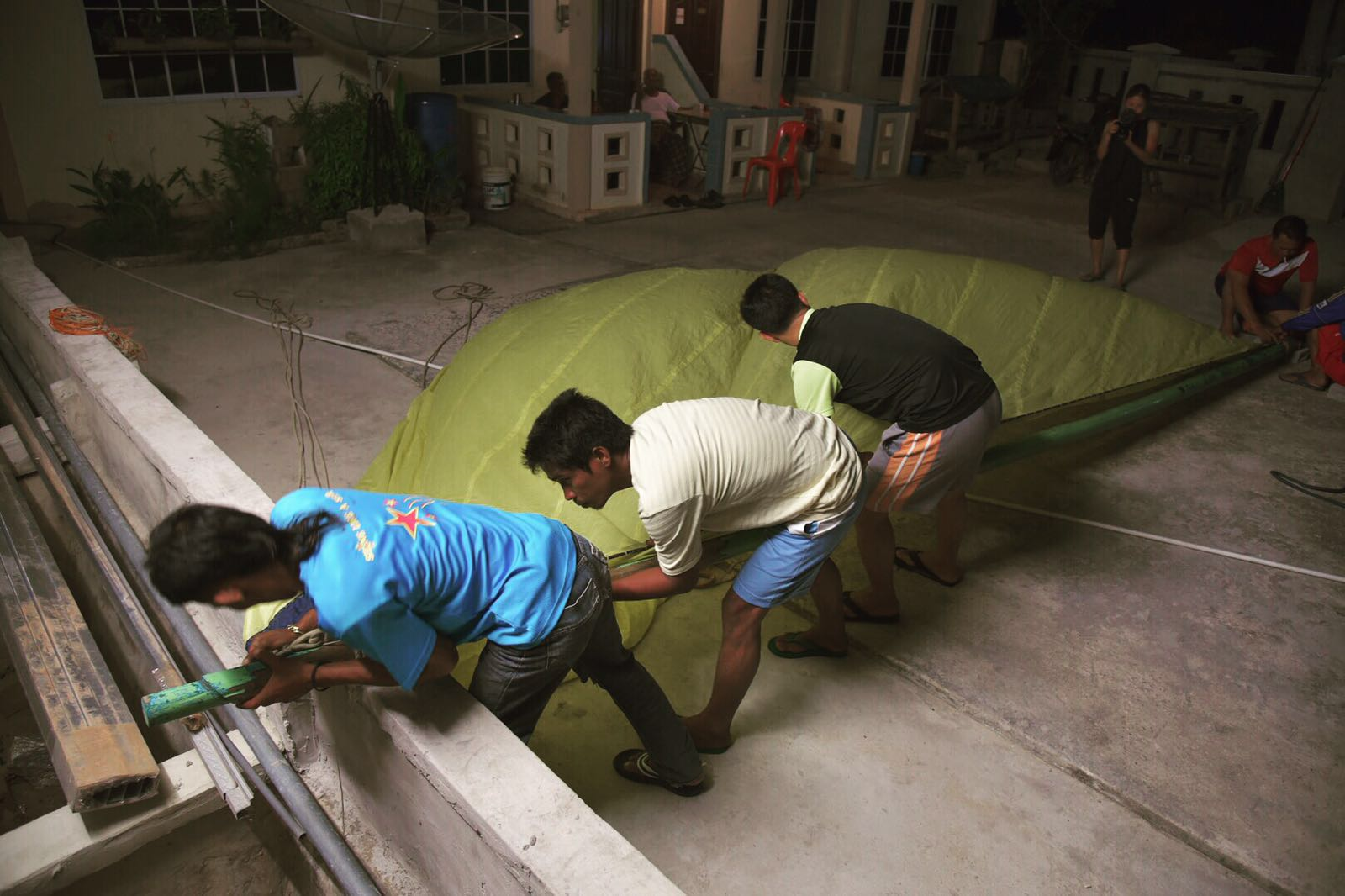
YOUR PASSPORTS, PLEASE

Kolek racing in the Riau islands has seen a revival over the last two decades and more. But in Singapore, once many kampung sailors were resettled into flats in the 1970s and the sport lost headway, it never really caught on in a big way again.

The kolek eventually disappeared.

And even if a race were to be organised in Singapore inviting kolek sailors from Johor or the Riau Islands, it had become quite a hassle. Says Mazlan: “Because of security issues, immigration processes, it became very restricted and (you) couldn’t organise very freely.”

Historically, the waters between Singapore and the Riau islands have been a tricky place ever since the British and the Dutch decided to split up these territories between them in 1824. But that didn’t stop small boats from island-hopping, which was why you once had koleks from the Riau Islands competing in Singapore.
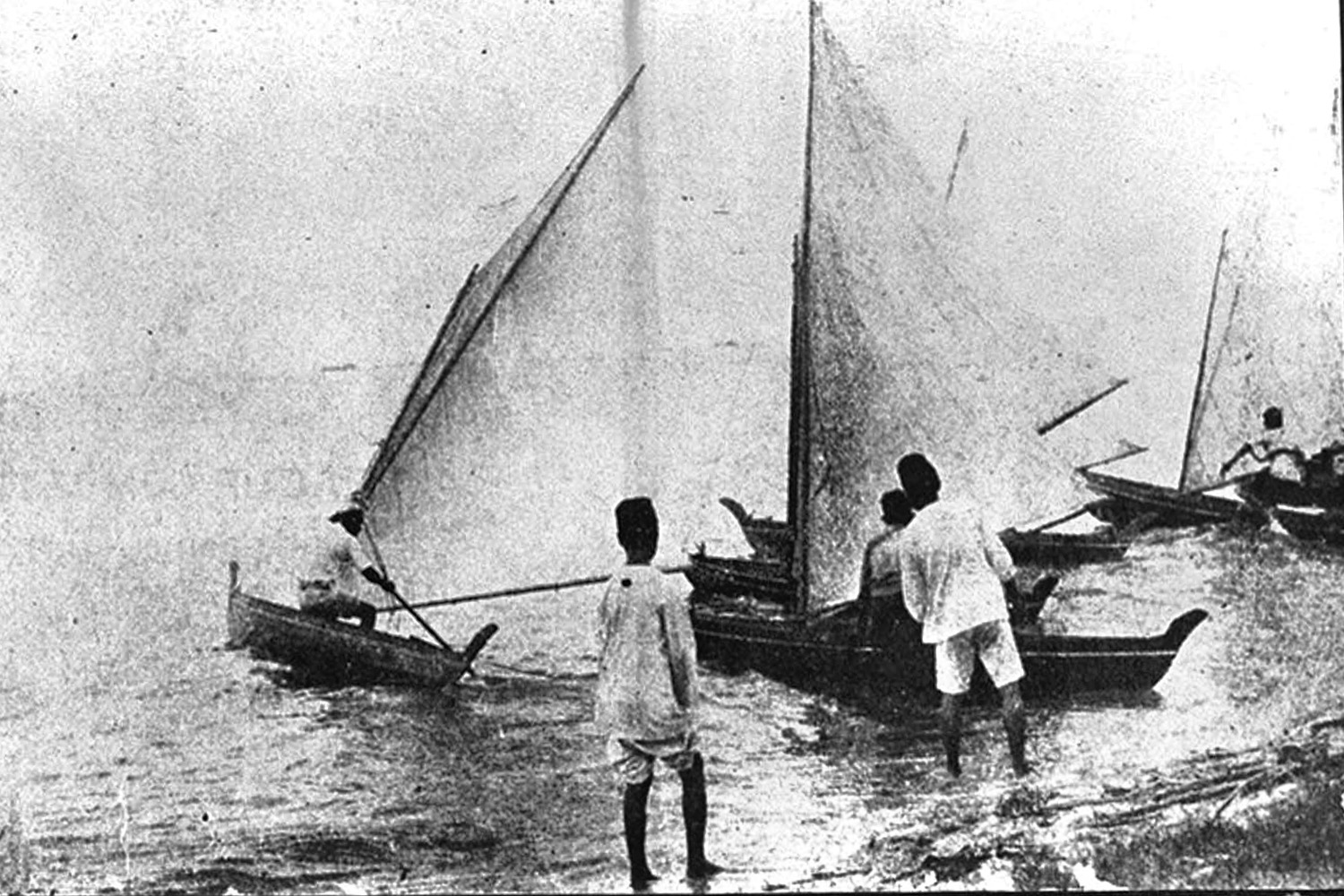
Kolek races held on Singapore’s beaches in 1928. (Photo: Sport Singapore)

However, once Singapore became a nation-state in 1965 and the Riau Islands formally became part of Indonesia, invisible boundaries were drawn on once-open waters, and things got more complicated. On a practical side, immigration rules made it harder and more expensive for Indonesian kolek to simply make a beeline for Singapore.

The last recorded race in Singapore was held at Sentosa’s Siloso Beach in 2001. Mazlan’s Keban crew had actually been among the Indonesian participants. He says his father had to pay for the passports of all the 27 sailors for the three boats they entered; each one cost S$300.

“It’s not like a European type of event where teams have the financial strength and sponsors – these are people from the kampungs and they don’t have such funds,” he explains.

THE ‘RIAU OLYMPICS’, PART 2

So while Singaporeans today are oblivious to the annual races happening just kilometres away, Riau islanders continue to race on.

It’s back to the ‘Riau Olympics’ and we’re there on Day 2 of the races, held in Pulau Buluh, an island just across from one of Batam’s huge shipyards.

On the way there, we pass by toy-sized unmanned boats called jongs racing in open water. These smaller versions of the kolek are popular among both the young and the old.

Just like in Belakang Padang, the atmosphere at Pulau Buluh is electric. The stilt houses facing the sea are packed with people. More are coming in, literally by the boatload, and parking their vessels where there’s space.

And just like at yesterday’s race, the racing boats make for an awesome sight. They’re all bunched together at the “starting line”, their colourful sails slightly tilted forward as if straining to be let loose.

Watch: The atmosphere at the kolek festival, in 1 min

It’s during times like this that Mazlan feels alive. Even though he no longer sails himself, but manages the team, the excitement is still there.  “If there’s a race that I can’t attend, I start to feel uneasy to find out what the result is. It’s something that is very, very deep inside (me),” he says.

It’s a feeling that, unfortunately, his wife and two adult children don’t share. They’re back at home in the family’s Pasir Ris flat. When asked what they think about his kolek activities, Mazlan laughs: “They don’t like it! They think I’m wasting time or money, but I tell them this is my passion, so it’s okay.”

And then we hear shouts in the distance. The boats are off.

Read Part 1 of this story here. In Part 3 tomorrow: How they feast in Keban – and social media lends support.

Watch the CNA Insider short film (7:45 mins):
Source link

Mixed Martial Arts: McGregor relinquishes featherweight belt: UFC

0

UFC’s first dual division champion Conor McGregor has relinquished his featherweight title with Jose Aldo replacing the Irishman as the category’s undisputed champion, officials said on Saturday.

The move was triggered by a sequence of events that followed light-heavyweight champion Daniel Cormier’s withdrawal from his scheduled title defence against Anthony Johnson at UFC 206 on Dec. 10 due to injury.

McGregor, who knocked out Eddie Alvarez this month to claim the lightweight crown and become the first fighter in the promotion’s history to hold two UFC belts simultaneously, had previously said he did not want to give up either title.

He won the featherweight crown by defeating Brazilian Aldo in 13 seconds at UFC 194 last December.

In order to keep a title bout on the UFC 206 card, officials asked McGregor to relinquish his featherweight title so Max Holloway and Anthony Pettis could fight for the interim UFC featherweight championship.

The winner will then face Aldo, who was unbeaten for 10 years and made seven defences of his UFC featherweight title before his loss to McGregor, in 2017 for the unified belt.


Image: 
Category: 
Publication Date: 
Sunday, November 27, 2016 – 17:37
Send to mobile app: 
Source: 


Hermes ID: 
2 771 485
Hermes ID String: 
SP_FEATHERWEIGHT
Hermes Author: 
SPANAECH
Story Type: 
Others

Source link

I wanna eat like you-oo-oo: Thai town lays on monkey banquet

0

LOPBURI, Thailand – It is a feast fit for a monkey king. On Sunday the central Thai town of Lopburi put on a five-star banquet for its hundreds of macaque inhabitants, sparking a mass simian food fight.

Lopburi has been laying on an annual feast – part merit-making tradition and part unabashed tourist attraction – for its monkeys since the late 1980s.

This year’s feast featured a smorgasbord of fruit that was quickly demolished by the hungry guests who squawked and tussled as they gulped down their feast, much to the delight of a horde of distantly related human onlookers armed with cameras.

While Thailand is an overwhelmingly Buddhist nation, it has long assimilated Hindu traditions and lore from its pre-Buddhist era.

As a result monkeys are afforded a special place in Thai hearts thanks to the heroic Hindu monkey god Hanuman, who helped Rama rescue his beloved wife Sita from the clutches of an evil demon king.

But the inhabitants of Lopburi take their love for monkeys to a whole new level.

The festival takes place on the ruins of Phra Prang Sam Yot, an 800-year-old Khmer-era Hindu temple and one of the town’s most striking landmarks.

“It’s pretty awesome to see so many wild monkeys just roaming around the streets,” said Amanda, a tourist from the United States.

“They were eating over there and lots of food to choose from and they were attacking each other and running around and jumping on people,” she told AFP.

The regular feeding has left Lopburi’s monkey population notoriously unafraid of humans.

“The monkeys are crazy,” said Fang Xi, a 36-year-old sales manager from China.

“One of the monkeys wants to steal my hair clip and doesn’t want to get off my shoulder. Two other girls were afraid and ran away.”

Image: 
Category: 
Publication Date: 
Sunday, November 27, 2016 – 17:28
Keywords: 
Send to mobile app: 
Source: 


Hermes ID: 
2 771 468
Hermes ID String: 
SP_MONKEYS
Hermes Author: 
SPANAECH
Story Type: 
Others

Source link

Diversity 101: Let’s talk about social issues

0


Nominated MP Chia Yong Yong made a heartfelt plea during a recent debate on the proposed constitutional amendments to the elected presidency.

She called on Singaporeans to talk about race and religion instead of politicising the issue, following the decision to reserve next year’s polls for Malay candidates.

Minister of State Janil Puthucheary made a similar call in August after an Institute of Policy Studies (IPS) survey showed that half of Singaporeans hold negative stereotypes of other races.

Dr Janil, who is chairman of OnePeople.sg, a national body that promotes racial and religious harmony, said people are hesitant and afraid to discuss race relations because they fear being seen as racist.

In fact, the conversation has already started, with schools and tertiary institutions introducing several initiatives to tackle issues of diversity, identity and inclusion.

For instance, Yale-NUS College started an inter-group dialogue programme last year and Singapore Management University (SMU) initiated a study this year to explore perceptions on these same issues.

“There is definitely a lot more talk (about diversity). We hear it in the classrooms, and students ask us where are the spaces on campus where they can feel safe (to discuss such issues),” said Mr Ho Jack Yong, assistant director of diversity and inclusion at SMU.

WHAT PROMPTED THE CONVERSATION?

Mr Ho said students have become more interested since global conversations about the dangers of Islamophobia, and locally, the debate over the elected presidency and also the difference in rewards for able-bodied and disabled athletes.

SMU’s study aims to gather data on perceptions by students, staff and faculty on issues that include gender and disability. More than 500 people have been interviewed, and their responses are being analysed, said Mr Ho.

SMU said the study will be done regularly for the diversity and inclusion office to track the outcomes of their efforts, and allow them to identify where there may be stronger negative perceptions towards specific groups of people.

t is also considering bringing back the diversity leadership development programme next year. This uses workshops and real-world projects to groom students to be diversity champions on campus.

Ms Sara Pervaiz Amjad, intercultural engagement manager at Yale-NUS, said its intergroup dialogue programme has students discussing issues such as gender identity, ethnicity and nationality, spirituality and religion.

More than 20 faculty and staff members have been trained to facilitate these sessions, and close to 60 students have attended.

Held over eight weeks with an average of 12 students in each group, these sessions introduce the concept of “brave spaces”, which let students go beyond “safe”, or politically correct discussions of issues into areas such as intercultural dating.

Ms Amjad said there are rules, such as ensuring that participants voice their discomfort during the discussion, and use “I” statements that do not attempt to speak for anyone else or an entire group of people. Yale-NUS has about 150 to 200 students in each cohort, and the ratio of local to international students is about 6:4.

WHAT HAVE THE PARTICIPANTS LEARNT?

Fourth-year Yale-NUS student Kei Franklin, who is from the United States, said she realised the ability to conduct intercultural communication is not an inherent personality trait, but rather a set of skills that can be learnt.

“If you can create a common vocabulary for your class where everyone talks about consent in the same way, then presumably you can do that for a whole school and for a whole community, city, or country,” said the 23-year-old.

This conversation is not just limited to tertiary institutions.

OnePeople.sg said it has increased engagement with schools and key agencies following the findings of the IPS survey.

The national body uses dramatised case studies of social issues and invites audiences to participate by coming up with solutions in a forum theatre programme.

OnePeople.sg has taken this theatre programme to more than 11,000 secondary and post-secondary students since it was first started in 2014. It plans to take the series to more institutes of higher learning next year.

While he lauded the initiatives, which he says can boost communication and understanding among students, Dr Yang Peidong, a research fellow at Nanyang Technological University’s sociology department, asked if they can reach “deep and wide” enough to solve the issue in a fundamental way.

Dr Yang, who has written about the alienation that students from China face at universities in Singapore, said students at the local public tertiary institutions prioritise good grades and securing a good job, adding: “The biggest obstacle to better interaction and communication between students of diverse identities and backgrounds is ultimately a lack of interest, compounded by the issues of academic competition and frictions arising from sharing resources and spaces.”

Is racism a problem in Singapore?

Is Singapore a racist country?

That was the title of a blog post penned by Yale-NUS undergraduate Iwani Zoë Mawocha in April which gained much attention here on social media and online news sites.

In the post, the 21-year-old South African detailed her experiences of being subjected to racist remarks or behaviour after arriving in Singapore in 2014 as a foreign student.

This included people who “equated blackness (with) violence, theft, corruption and crude behaviour”, and toddlers that stared at her when she took the MRT.

“For you to be terrified of a stranger, there has to have been the conditioning that dark is bad,” said Ms Iwani.

She said people were surprised when they read the post.

on Facebook

(function(d, s, id) {
var js, fjs = d.getElementsByTagName(s)[0];
if (d.getElementById(id)) return;
js = d.createElement(s); js.id = id;
js.src = “http://connect.facebook.net/en_GB/sdk.js#xfbml=1&version=v2.3”;
fjs.parentNode.insertBefore(js, fjs);
}(document, ‘script’, ‘facebook-jssdk’));

I’ve been asked this question quite a bit recently, and it took me a while to figure out how to address it in a “good”…

Posted by Iwani Zoë Mawocha on Sunday, 10 April 2016

After all, they said, she had grown up in South Africa, where the social policy of apartheid, a system in which black South Africans received fewer social and political rights than white South Africans , only ended in 1994.

Ms Iwani noted: “In South Africa, there was that solidarity and acknowledgement that the problem (of racism) is real.” Singapore people do not recognise racism as easily, she added, because they grew up in a society where racial harmony is one of the central tenets.

Ms Iwani said the topic of racism should be seen as a starting point for discussions about why racist ideas are formed, and on how to understand other cultures better.

“People need to be aware that it doesn’t make you a bad person to have these (prejudiced) thoughts,” said Ms Iwani, who welcomes Yale-NUS’ efforts to start such honest conversations on campus.

The arts and humanities major, who says she “adores” Singapore for its cultural accessibility, hopes that such intercultural discussions might extend beyond the school community.

“With fewer than a thousand students in Yale-NUS, if we keep our intercultural discussions to ourselves, we may quickly run out of insights to give and facts to exchange because we’re all part of a like-minded community anyway.”

yuensin@sph.com.sg


This article was first published on Nov 27, 2016.
Get a copy of The Straits Times or go to straitstimes.com for more stories.

Image:
Category:
Blurb:
<p>Nominated MP Chia Yong Yong made a heartfelt plea during a recent debate on the proposed constitutional amendments to the elected presidency.</p>
Publication Date:
Sunday, November 27, 2016 – 17:00
Send to mobile app:
Source:
Story Type:
Others

Source link