Home Blog Page 2277

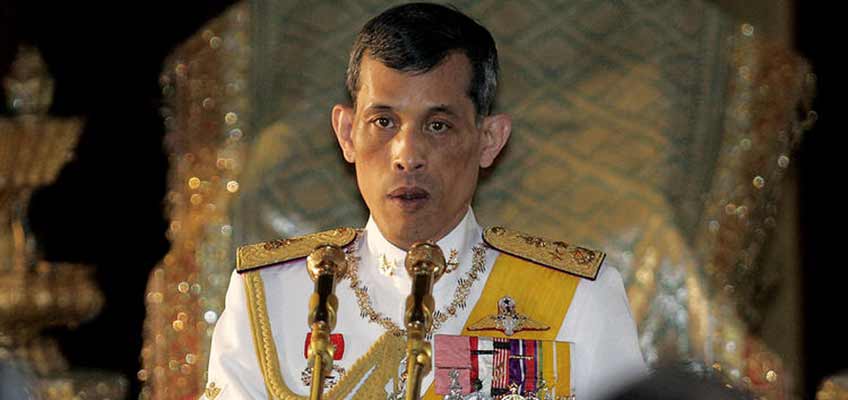
Thailand’s crown prince returns from abroad to become King Rama X

0


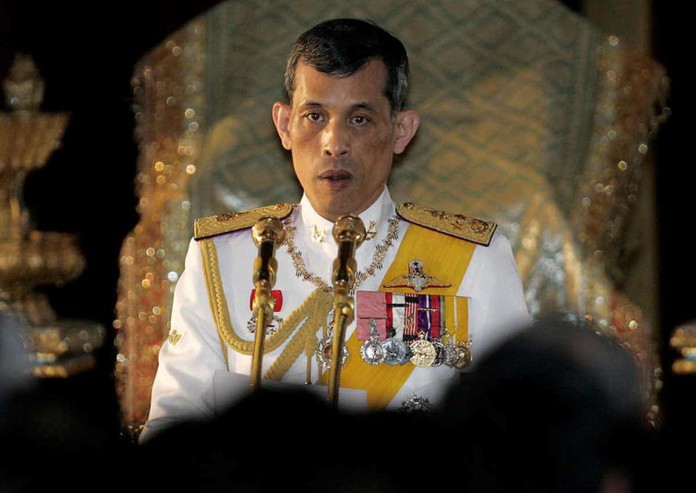
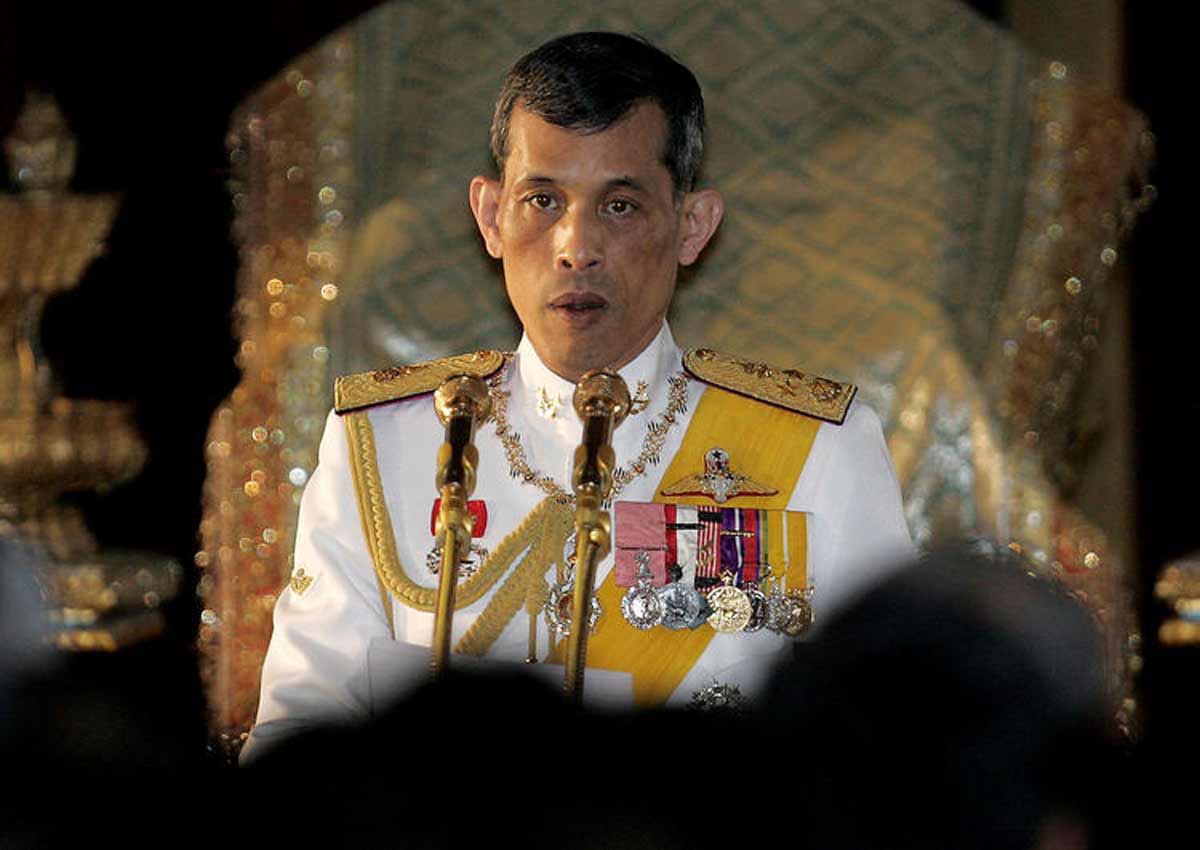
BANGKOK – Thailand’s Crown Prince Maha Vajiralongkorn returned to Bangkok on Thursday, two days after parliament said it would invite him to become the country’s new king following the death of his father, revered King Bhumibol Adulyadej.

The prince will meet with the head of parliament, Pornpetch Wichitcholchai, on Thursday evening following a Buddhist rite marking 50 days since the king’s death. He then is expected to formally accept parliament’s invitation to ascend the throne.

Prime Minister Prayuth Chan-ocha and Prem Tinsulanonda, a former head of the royal advisory council who has been standing in as regent, will also be in attendance, according to a palace schedule.

The prince arrived in Bangkok from Germany, according to two senior military officials with knowledge of the matter. “We can confirm that His Majesty arrived safely this morning,” said a senior military official who asked not to named.

The prince, who will be known as King Rama X, or the 10th king of the 234-year-old Chakri Dynasty, must formally accept the invitation from parliament before he can be proclaimed king.

An official announcement from the royal household is expected to come soon afterward, according to palace protocol.

Thailand has been without a monarch since King Bhumibol died on Oct. 13. The monarchy has been run by 96-year-old regent Prem after the prince asked to delay the succession in order to grieve.

King Bhumibol, who was the longest-serving head of state in the world when he died at the age of 88, was instrumental in reviving the prestige of the monarchy. He was widely seen as a stabilizing force through an era of rapid change and decades of often violent political upheaval.

A Thai lese-majeste, or royal insult, law criminalises anything deemed to be an insult to the monarchy. The law has curtailed public discussion about the succession, the future of the monarchy or criticism about the crown prince, who has spent much of his adult life abroad and does not command the same level of devotion as his father.

Prime Minister Prayuth said on Tuesday a year-long mourning period for King Bhumibol would not affect a general election scheduled for 2017.

Image:
Category:
Publication Date:
Thursday, December 1, 2016 – 11:52
Send to mobile app:
Source:

Rotator Image:
Hermes ID:
2 779 987
Hermes ID String:
SY_THAICROWNPRINCE_1201
Hermes Author:
SEANYAP
Story Type:
Others

Source link

Long John Silver’s releases 17 new discount coupon deals valid from 1 Dec 2016 – 22 Jan 2017

0

JUST IN: Long John Silver’s LATEST coupons valid till 22 Jan 2017 – Save up to $4.60!

Long John Silver’s releases 17 new discount coupon deals valid from 1 Dec 2016 – 22 Jan 2017

Flash any of the coupon images below at any Long John Silver’s outlet and save up to $4.60, valid from 1 Dec 2016 – 22 Jan 2017. Be wowed by the size of the 2pc Battered Pacific Dory and the succulence that is locked within the crispy coat.

Source

Ageing in institutions: Choices and challenges

0

SINGAPORE: The social well-being of elderly residents under institutional care and a lack of alternatives to nursing homes were issues that came into focus recently, when the Ministry of Health (MOH) responded to a report calling for the building of “cookie-cutter mega-nursing homes with multiple-bed dormitories” to stop.

While MOH stood by its position that it would be imprudent to fund the building of single- or double-bedded rooms in nursing homes, it agreed with the report from the Lien Foundation and Khoo Chwee Neo Foundation that more can be done to provide greater choice in aged care services.

About two percent, or 8,800, of elderly residents live in institutions such as old age or nursing homes, according to Singstat. This number is expected to increase, with the Government targeting to have 17,000 nursing home beds by 2020.

Against this backdrop, Channel NewsAsia took stock of the current aged care landscape for seniors with different levels of physical mobility and income, and asked players in the sector how gaps in aged care can be filled.
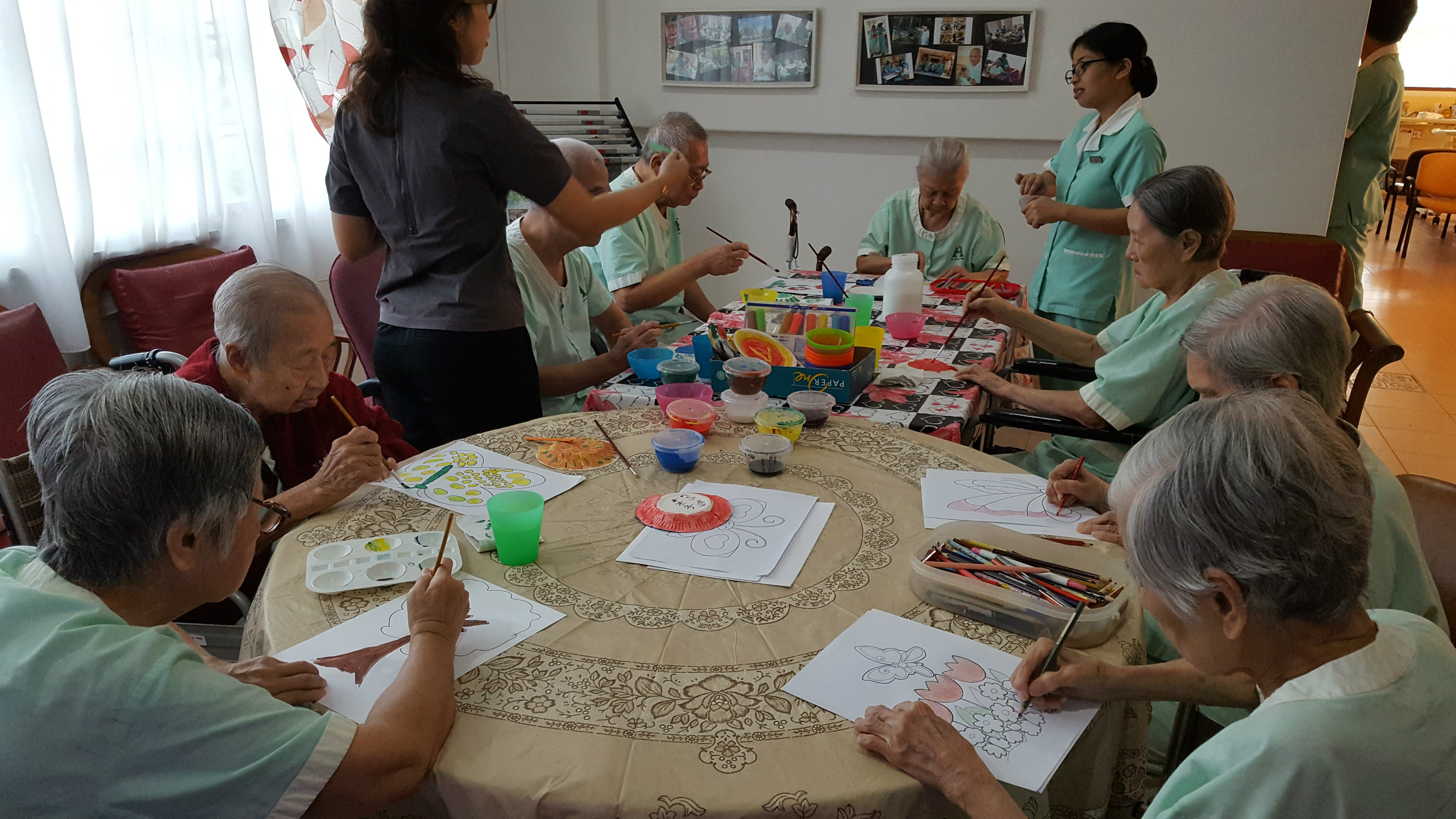
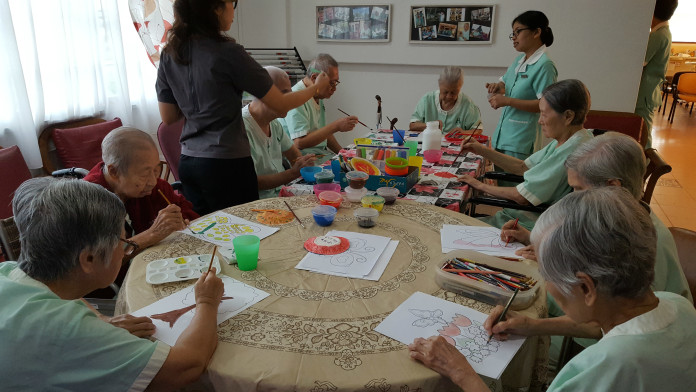
Residents participating in a colouring activity at one of Econ Healthcare’s nursing homes in Singapore. (Photo: Linette Lim)

INSTITUTIONALISATION: FIRST OR LAST RESORT?

To put things into perspective, the vast majority of Singapore’s 460,000 elderly persons – defined as those 65 and above – live at home. Of these, 13 per cent are semi- or non-ambulant, according to 2015 data from Singstat.

This means there are nearly 60,000 bed- or wheelchair- bound elderly residents who are living at home despite potentially qualifying for admission into nursing homes. This is in line with the Government’s vision of having seniors “age in place” in the community.  

“Many seniors tell us that they prefer to age in their own homes. MOH seeks to put in place a suite of care options to enable seniors to achieve their “home first” aspiration, i.e., to help our seniors age in place for as long as possible before considering institutional care,” said an MOH spokesperson in response to queries from Channel NewsAsia.

Institutional care options are largely split into state-subsidised homes run by VWOs (Voluntary Welfare Organisations) and charities and private nursing homes. Those requiring subsidised nursing home care are usually referred to homes by the Agency for Integrated Care (AIC).

“This helps guide patients through the process for their convenience, and optimises capacity across nursing homes. When assigning nursing home placements, AIC will consider patients’ needs and families’ preferences along with the degree of social support,” said the MOH spokesperson. 

WEIGHING THE COSTS

VWO-run homes, which usually feature 6- or 8-bed wards, charge S$1,200 to S$3,500 a month. This cost can be brought down to as low as S$300, as Singapore residents with per capita household incomes of below $3,102 qualify for subsidies of 10 to 75 per cent.

One such home is run by 72-year-old Lai Foong Lian, who agrees that institutional care should be put off for as long as possible.

“The nursing home itself is really very medicalised… and also it’s quite regimented. If there is no one to bring you out, it means you don’t even have the freedom to get out of the home,” said the Jamiyah Nursing Home director in an interview with current affairs programme Talking Point.

Ms Lai, who would not want to live in a nursing home herself, believes this would compromise her freedom. “So I feel that unless and until that time you are bedridden or mentally incapacitated, we should still stay in the community.”

At the other end of the spectrum, private nursing homes cost significantly more, at $3,600 to $$7,000 for a single room. However, this can go down to $740 to $2,150 for a single in a nursing home in Johor Bahru, Malaysia.

According to the Lien Foundation and Khoo Chwee Neo Foundation, homes managed by charities and VWOs account for two-thirds of nursing home beds in Singapore, with private homes making up the rest of the supply.

But 62-year-old Ong Chu Poh, who founded private nursing home operator Econ Healthcare Group, believes this share has shrunk to 25 per cent over the last five years. This is partly due to the Government’s efforts to make state-subsidised nursing home spots available to more Singaporeans, by raising the qualifying income ceiling, he said.

In response to this trend, he says Econ Healthcare has been looking at new areas of growth, including managing a retirement village in China, to developing its home care services in Singapore.

“Where possible, we rehabilitate the seniors that come to us, so that they can go back (home). I think we should avoid putting seniors into institutions, if it is not necessary. We should encourage ageing in place,” said Mr Ong. 

ALTERNATIVES TO INSTITUTIONAL CARE

For many seniors who are less mobile and require assistance with routine daily activities, the most common alternative to institutionalisation is to live at home, with caregiver support from family members and/or foreign domestic helpers. Depending on the intensity of care required, this can cost between S$1,000 to S$3,000 a month.

This “simplistic, two-dimensional approach”, that you choose between living in an institution, or ageing in place – in your existing family home – needs to change, says management consultant Tan Kee Hian.

The 62-year-old is primarily concerned that there are significant numbers of seniors who do not fit into either care arrangement, and are forced into nursing homes due to a lack of “in-between” options. 

This is an issue close to his heart, as he moved back to Asia in 2006 to be near his ageing parents after 35 years abroad. Since then, he has devoted much time to researching and presenting ideas for senior living facilities and retirement villages to policymakers and other healthcare players.

While there are new developments such as eight-room assisted living facility St Bernadette Lifestyle Village in Newton, and The Hillford, a condo development near Bukit Batok marketed as a “retirement resort”, Mr Tan says these do not qualify as self-sustaining retirement villages in the mould of those in Florida in the US, or in Japan.

He estimates that a purpose-built retirement village can be priced affordably, at below S$2,000 a month, if constructed at the right scale, and designed with the cost of shared services – housekeeping for example – split among residents. 

Meanwhile, Ms Lai says she sees the Government already experimenting – perhaps not by building retirement villages from scratch – but by building up health and social support facilities in and around estates and linking seniors up with service providers. 

“But what I’m looking at it is, I’m staying in my own flat, I’m still cognitively, mentally, sound, I wouldn’t mind like paying a fee for a bundled service. For someone to come in, help me in showering or even assist in the manicure, pedicure and even sometimes the cooking,” she said.

Such “in-between” options are almost non-existent, but MOH and the Urban Redevelopment Authority has said it will call for proposals to develop and research solutions for future nursing homes.

Ms Lai added: “The cohort of seniors have been changing (in terms of preference). So are we are we catering to the next cohort or are we still looking at our mother’s time? Are we going to cater something that the next cohort will look forward to?”

This is the first of a two-part series on ageing in Singapore. While the first part focuses on institutional care options, the second will look at daycare and home care options.
Source link

Singapore and Myanmar ties to improve

0


Singapore and Myanmar will begin discussions on a bilateral investment treaty and avoidance of double taxation, in a sign of growing economic ties between the two countries.

This move will send a positive signal to investors and boost economic growth, said Prime Minister Lee Hsien Loong yesterday.

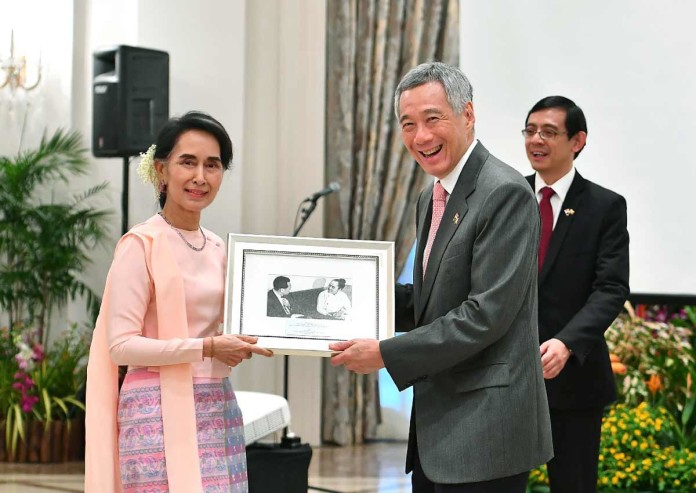
Mr Lee made the announcement at a dinner that he hosted for Myanmar state counsellor Aung San Suu Kyi, who is here on an official visit until tomorrow.

Both leaders, in toast speeches at the official dinner in the Istana’s ballroom, talked about bilateral ties.

Mr Lee said Singapore has been a long-standing and steadfast friend of Myanmar, and is confident of Myanmar’s long-term success.

This confidence can be seen in their strong economic ties and growing trade and investment in Myanmar, he added.

Links between the two countries’ people are also strong and growing, and are set to increase with the mutual lifting of visa requirements today.

Singapore is glad to help Myanmar train its officials, and is also happy to share its experience in building and running hawker centres, said Mr Lee, who visited Myanmar in June.

Myanmar is looking to upgrade its wet markets and build a hawker centre in Yangon, and Ms Suu Kyi will visit a hawker centre here tomorrow.

“We are happy to share our experience and persuade our hawkers to divulge some of their secret recipes of chwee kueh, chye tow kueh, chicken rice and laksa,” Mr Lee said with a laugh.

BUSINESS COMMUNITY

Earlier, Ms Suu Kyi said Myanmar is looking to Singapore and the business community to help the country.

“Politics and business cannot be separated, particularly at this time when we are trying to make our country not just united, but prosperous,” she said.

“Unless we can maintain peace, we cannot maintain prosperity. For that, we look to you to advise us, and to make our country vibrant not just politically but economically.”

In her 10-minute speech, she recounted that at the beginning of Singapore’s independence, Singapore’s former minister mentor Lee Kuan Yew had said that in 20 years’ time, Singapore will have caught up with Myanmar.

“I think we have to change that a bit – in 20 years’ time, Myanmar will have overtaken Singapore,” she said with a smile.

“I hope you will help us to do that, because success in one part of the region, means success throughout the region, and we have never found it difficult to engage with Singapore economically.”

She also thanked Singapore for the “informal education that you have provided for many of our people, who have been working here for the last few decades”.

She added that she was struck by the enthusiasm of the Burmese community here, who went to great lengths to cast their vote in Myanmar.

“It was the sense of responsibility that… pushed them to vote. Working in Singapore seems to have given them a sense of responsibility, and the initiative to get what they want for themselves.”

Image:
Category:
Publication Date:
Thursday, December 1, 2016 – 10:51
Send to mobile app:
Source:
Story Type:
Others

Source link

94 year old takes care of partially paralysed daughter-in-law for 20 years

0

Here’s a story that should warm your heart. A woman who herself is in her 90s has been taking care not of her husband or children but her daughter-in-law and not for one year, two year or even 10 years but for more than two decades.

Sun Yincong, 94, has been named one of the moral citizens in North China’s Shanxi province of the first half of 2016, as she has been caring for her partially paralysed daughter-in-law for nearly 27 years, local newspaper Sanjin City News reported on Tuesday.

Sun from Taian village in Ruicheng county, Yuncheng city in North China’s Shanxi province, has been called the most respected person in the village by locals, who volunteer to celebrate the old woman’s birthday on the eighth day of the seventh month of the lunar calendar.

“Sun has spent 27 years taking care of her paralysed daughter-in-law, and has never left her side. It’s common to see daughters-in-laws looking after mothers-in-law, but Sun’s case is just the opposite,” said a villager, who refused to disclose his or her name.

In November, 1989, Sun’s husband died of illness, while their son died from gas poisoning just 10 days after the father’s death. Ren Caimei, Sun’s daughter-in-law, was so shocked by the tragidies that she got hemiplegia (partial paralysis) due to a cerebral hemorrhage six months later.

Sun decided to take care of Ren wholeheartedly then and there.

“My grandma never leaves my mother aside for a moment and looks after her. Once my mother got such a severe cerebral hemorrhage that doctors were ready to give up. And our relatives and friends also asked my grandma to give up the treatment. However, my grandma insisted on taking my mother to other doctors. Thanks to my kind grandma, my mother is still alive,” said Gao Weidong, the eldest grandson of Sun.

As Sun and Ren grow older and older, Sun couldn’t carry her daughter-in-law. Since 2015, Sun has asked Gao Hongyu, Ren’s daughter, to help put on Ren’s clothes and carry her on the wheelchair each morning and carry her to bed each evening. Gao lives in the same village.

Gao Hongyu said: “Each morning, grandma helps wash mother’s face and comb her hair. Grandma usually takes my mother to enjoy the sunshine when it’s sunny. And grandma is used to preparing meals after asking my mother’s opinions with gestures. When my mother draws a circle with hands, my grandmother will serve her baked pancake, and when my mother draws a long strip with hands, my grandmother will prepare noodles for her.”

Living next to Ren’s room, Sun said: “Thanks to our family’s efforts, our lives are better nowadays. No matter what happens, our family will keep on living full life.”

“Great personality is embodied in everyday life. Sun is also very kind to other villagers. What she did teaches her family members, neighbours and other villagers,” said Zhang Chaoping, head of Taian village.

Image: 
Category: 
Publication Date: 
Thursday, December 1, 2016 – 10:09
Send to mobile app: 
Source: 


Story Type: 
Others

Source link

Orchid hybrid named in honour of Aung San Suu Kyi

0

SINGAPORE: An orchid hybrid was named in honour of Myanmar’s State Counsellor Aung San Suu Kyi at the Singapore Botanic Gardens on Thursday (Dec 1).

Papilionanda Aung San Suu Kyi – a purplish looking variety – joins the more than 200 orchids named after dignitaries to date.

The Nobel laureate is on a three-day visit to Singapore, at the invitation of Prime Minister Lee Hsien Loong. Ms Suu Kyi first visited Singapore in September 2013, when she was the chairperson of Myanmar’s National League for Democracy.

Since 1956, many heads of states who visit Singapore have been presented with orchid hybrids that are named after them. According to NParks, orchid diplomacy “serves as a gesture of friendship to promote goodwill between Singapore and other countries”. It also “plays an important role in building bilateral ties”, it added.

The Papilionanda Aung San Suu Kyi,  a purplish looking variety of the orchid hybrid (Photo: Xabryna Kek) 

Other dignitaries who have had orchids named after them include the Duke and Duchess of Cambridge, Prince William and his wife Kate Middleton, United Nations chief Ban Ki-moon and the late former South African president Nelson Mandela. 

Ms Suu Kyi was earlier hosted to breakfast by ESM Goh Chok Tong at the Shangri-La Hotel on Thursday. She will later call on Acting President J Y Pillay, at the Istana before hosted to lunch by DPM Teo Chee Hean. In the evening, Ms Suu Kyi, alongside Mr Lee, will attend the opening ceremony of ACM’s “Cities and Kings: Ancient Treasures from Myanmar” exhibition.

Source link

This was how Singapore looked like 32 years ago in 1984, according to Google Earth

0

We see it everyday, but don’t really think about it much – Singapore is always in the constant state of change.

It is only when we zoom out to a more macro perspective that the gravity of how much an entire country can change in the span of a short period of time hits us.

Google Earth Timelapse

Since 2013, Google has been releasing timelapses from the satellite views of earth as seen through Google Earth.

Through this, we have had the opportunity to watch the world transform on our screens, all of which have happened while we were growing up, and not knowing what’s happening out in the world.

For the most part, we get to marvel at how fast major cities around the world change and grow throughout the 21st century. Road networks get more complex, bridges are built, and buildings get taller.

This is how much San Francisco has changed in three decades.

Image Credits: Google Earth
Image Credit: Google Earth

Unsurprisingly, the most change tends to come out of Asia. With globalisation as a driving force in modernising the traditional Asian landscape, the tale of backwater villages and towns being turned into mega cities within the last 30 years is a commonly recurring theme.

Here we have a look at how Dalian has transformed.

Image Credits: Google Earth
Image Credit: Google Earth

A Look At Singapore In The Past 22 Years

Unfortunately, Singapore didn’t quite make the cut to be a featured image on Google’s blog post.

But as always, the good thing about Google is that they are not stingy with their maps. On the interactive Google Earth map, you can navigate to any corner of the Earth and watch how the terrain has changed in the last 22 years.

So of course, we turned our sights to Singapore, and this is what we found.

Singapore / via Google Earth

Singapore is a country whose land mass has significantly increased in the last 22 years.

From the island of Pulau Tekong, all the way down the southern shores of Singapore, land reclamation has been profound, and the density of buildings in the country has also increased by a lot.

Look around, though, and you will see that our neighbours Malaysia and Indonesia are pretty much clearing forests all in the name of progress.

This is sadly a common occurrence worldwide, and Google Earth has made it worryingly simple for us to see how the human race has ravaged mother Earth.

Of Climate Change and Deforestation

Looking at how cities change and grow only seeks to deflect the actual problems that we are supposed to deal with in the world.

Our progress has come at a price, and it is one that may soon be irreversible.

Image Credits: Google Earth
Image Credit: Google Earth

Sights like these in Bolivia are very common in developing nations. with entire forests being cleared for the sake of farmland and industrial use.

Image Credits: Google Earth
Image Credit: Google Earth

Popular Science has gone even deeper by seeking out coastal towns and cities on Google Earth and have found that as compared to 22 years ago, the sea levels have been rising, and marshes and swamps are being flooded already.

They also looked at our ice caps, and the findings are quite worrisome, with the glaciers of Alaska showing clear signs of receding.

If you’d like to check out the effects of climate change for yourself, head on over to the Google Earth Engine here, and read up on their blog post while you’re at it.

Image: 
Category: 
Publication Date: 
Thursday, December 1, 2016 – 09:46
Send to mobile app: 
Source: 


Story Type: 
Others

Source link

He is allegedly paid by Zam Zam boss to slash rival

0


The owner of Singapore Zam Zam allegedly hired a secret society headman to slash a rival’s face, a court heard.

Zackeer Abbass Khan, 45, the owner of the well-known murtabak restaurant in North Bridge Road, had been having a dispute with a neighbouring murtabak restaurant.

He allegedly paid $2,000 to his business associate, Anwer Ambiya Kadir Maideen, who is purportedly a headman of the Sio Ang Koon secret society.

Anwer then allegedly told his secret society member, Joshua Navindran Surainthiran, to carry out the vicious assault.

It left the victim, Victory Restaurant supervisor Liakath Ali Mohamed Ibrahim, with a permanent scar.

Mr Liakath had a 7cm cut over his right upper lip, which extended to his right cheek, and a part of the cut went through to the inner surface of the lip.

On Tuesday, Joshua, 23, was sentenced to 6½ years’ jail and six strokes of the cane for the slashing with a knife and other crimes.

He pleaded guilty to five charges – one of causing grievous hurt, two of rioting, and one each of disorderly behaviour and using criminal force against a policewoman.

Five other charges were taken into account in sentencing as part of his plea bargain.

Read also: Murtabak war? Slashing incident involves worker from competing restaurant

A district court heard that on Aug 22 last year, Mr Liakath, 52, stood outside Victory to tout for customers. He had previously worked for Zam Zam from 1985 to 2004.

When a policeman came by at about 6pm, Mr Liakath said he was touting for customers because staff from Zam Zam were doing so.

Zam Zam staff Koleth Navas, 29, overheard this and an argument broke out between him and Mr Liakath.

The policeman told them to stop arguing before leaving.

Shortly after, Zackeer allegedly threatened Mr Liakath in Tamil that he would “do him” within a week, the court heard.

Koleth Navas and Zam Zam’s chef supervisor Koleth Abdul Nasir, 41, both also allegedly threatened Mr Liakath.

Zackeer later contacted Anwer, 46, who owns As-Safeera Restaurant at Block 301, Serangoon Avenue 2, the court heard.

Anwer in turn told Joshua that Zackeer had asked for Mr Liakath’s face to be slashed, in return for $2,000.

Joshua got his older brother Joel Girithiran Surainthiran, 24, allegedly also a Sio Ang Koon secret society member, to help him in the slashing.

Joshua also asked his friend Ramge Visvamnathan, 19, to help him act as a lookout.

Joel, Ramge, Zackeer, Anwer, Koleth Navas and Koleth Abdul Nasir have all been charged with engaging in a conspiracy to cause grievous hurt to Mr Liakath and/or criminal intimidation by threatening to hurt Mr Liakath.

The cases for all six are at a pre-trial stage.

This is not Joshua’s first brush with the law.

He was arrested for gang fight in 2013 and also for assaulting two people in Clarke Quay the same year.

Image:
Publication Date:
Thursday, December 1, 2016 – 09:45
Keywords:
Send to mobile app:
Source:

Rotator Headline:
Secret society member allegedly paid by boss of mutabak restaurant to slash rival
Rotator Image:
Story Type:
Others

Source link

Foreign worker heroes honoured

0

Retiree Connie Tan was reading at her home in Sunset Place, Clementi, when she saw lightning strike outside her window.

When she checked a while later, she realised that a room on the third storey of her house was on fire.

She told The New Paper: “I immediately called 999. Then I tried to use a hose to douse the fire. It was spreading very fast.”

While trying to fight the fire, she heard two foreign workers shout: “Madam, come out.”

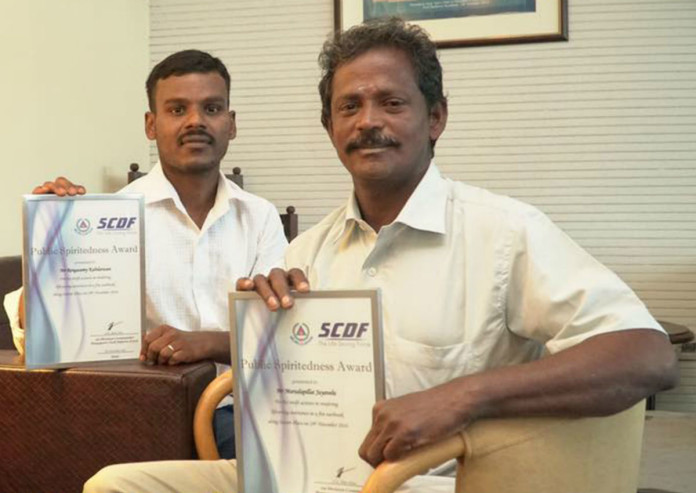
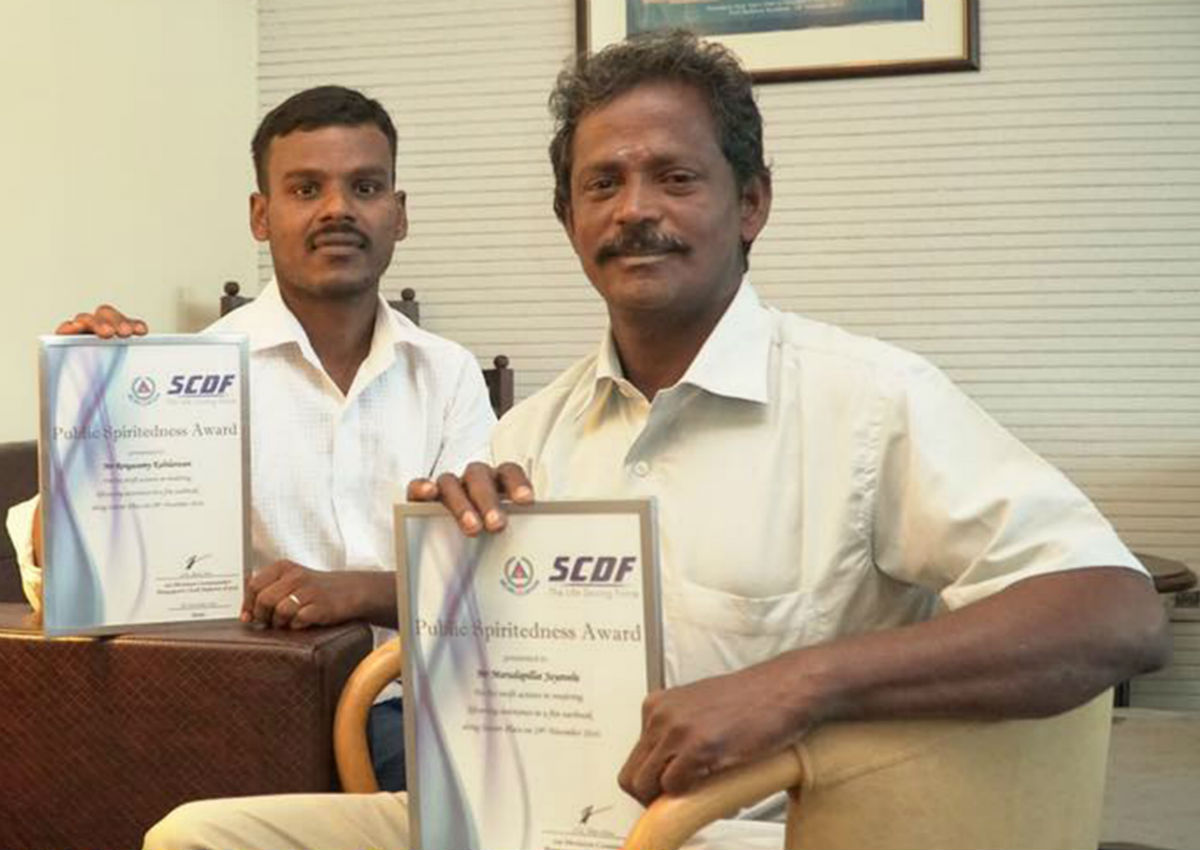
Mr Marudapillai Jayavelu, 46, and Mr Rengasamy Kabilarasan, 26, who were working on the roof of a house on the opposite side of the road, had climbed over the gate to check if there were people stuck inside the burning house.

They entered the house and evacuated the occupants. None of them was injured in the Nov 10 incident.

Mr Jayavelu and Mr Kabilarasan were awarded the SCDF Public Spiritedness Award yesterday for their selfless act.

When TNP informed Mrs Tan about the award, she said: “I’m grateful to them even though I cannot recognise them because everything happened so fast. I wanted to thank them and give them hongbao that day.”

The award was presented by Madam Michelle Liem, chairman of the Bukit Timah Citizens’ Consultative Committee at a ceremony held at First SCDF Division Headquarters.

Mr Jayavelu said: “I feel very happy to be able to receive this award because it is not something that everyone gets.”

Mr Vince Selvam, 22, director of Starlight Building Maintenance Services, the workers’ employer, said: “We feel very proud of them and we will be taking the two of them out for a nice dinner.”

Colonel Alan Chow, commander of First SCDF Division, said: “This is a commendable act. In times of emergency, we need people like that to come forward and render assistance to others.”

Mr Jayavelu said: “We were not scared of the fire. SCDF had already been alerted then, so we just wanted to check if anyone was hurt.”

Image: 
Category: 
Publication Date: 
Thursday, December 1, 2016 – 09:09
Send to mobile app: 
Source: 


Story Type: 
Others

Source link

Football: Sundram rejects defensive tag

0

Lions coach rues missed chances, says he had the best squad available at Suzuki Cup.

His Lions were booted out of the AFF Suzuki Cup at the first hurdle, with a solitary point – and goal.

And V Sundramoorthy has faced much criticism, with many labelling him as too defensive, while others frowned upon his squad selection.

In his first comments since returning from Manila, the coach insisted he would have done nothing differently, and there was little more he could ask from his charges.

“We were attacking the Philippines until the moment we received a harsh red card and, in the next game (against Thailand), your paper highlighted the statistics which showed that we had more shots than Thailand – both in the number of shots as well the number of shots on target,” said Sundram, who has six months left on his year-long contract with the Football Association of Singapore (FAS).

“Every player I picked showed 100 per cent commitment during training and in matches, and all of them definitely gave it their all. As a coach, I could not have asked for more from them in terms of commitment.

“While there are areas for improvement – which I will present in my report to the FAS Council, I am generally pleased with the attitude and dedication of our players.”

In the opening Group A fixture against the Philippines, midfielder Hafiz Abu Sujad was sent off after just 34 minutes for a reckless challenge. The Lions then went into defensive mode and escaped with a 0-0 draw.

In the second match against Thailand, they again set up a defensive wall, only to concede an 89th-minute goal to lose 1-0.

“In our last match, we were 30 minutes away from qualifying for the semi-finals… we should and could have scored more than one goal in the last two matches to secure full points against Thailand and Indonesia, but that’s football,” Sundram conceded.

In the final group match against Indonesia, the Lions led through Khairul Amri’s goal, but conceded twice in the second half to lose 2-1.

Sundram did not want to address the Facebook outburst by veteran defender Baihakki Khaizan, who hit out at the national coaches midway through the group stage after he was dropped from the starting 11, and stated he would have changed little in the personnel he took to Manila.

“This is the best squad available and, considering the likes of Fazrul Nawaz (Tampines Rovers) and Iqbal Hussain (Hougang United) were injured, I’d probably still have selected this team,” he said.

“We have good and capable management and staff at FAS. Thanks to their full support, we prepared our team to the best of our abilities in various areas including training camps, analysis and support staff etc.

“We have to move on now and focus on the Asian Cup 2019 qualification third round which will begin in March.”

Many now believe Singapore football is on a drastic slide but the national coach disagreed.

“I believe the future of Singapore football is promising, especially with technical director Michel Sablon’s youth development plans getting into higher gear. We may only start to reap the benefits in a few years but, if everybody comes on board this vision – from the authorities to corporate organisations – then I’m sure Singapore football will only grow from strength to strength,” said Sundram.

The 51-year-old reiterated his pride at leading his country.

“As a player, you want to wear the national jersey, and I was proud to have that opportunity. Since I hung up my boots, I have never been so proud as when I heard the Majulah Singapura played in the first game,” he said.

“As the coach of the national team, I represent more than five million Singaporeans and it was a huge honour for me, something I will always remember.”


This article was first published on November 30, 2016.
Get The New Paper for more stories.

Image: 
Category: 
Publication Date: 
Thursday, December 1, 2016 – 08:59
Send to mobile app: 
Source: 


Story Type: 
Others

Source link