32.5 C
Singapore, SG
Saturday, September 26, 2026
Home Blog Page 2245

'I did' more than 50 years ago – and today, 'I still do'

0

Six elderly couples who said “I do” more than 50 years ago renewed their vows yesterday in an emotional ceremony at the Registry of Marriages (ROM).

They held hands, looked lovingly into each other’s eyes, expressed their gratitude and promised to continue loving each other.

All this in the presence of relatives, including their children and grandchildren.

The couples also received commemorative items from Minister for Social and Family Development Tan Chuan-Jin.

They had responded to a call by ROM for couples who tied the knot 55 years ago during the first month of its operations in September 1961.

Six elderly couples renewed their vows at ROM yesterday after getting married more than 50 years ago.

It was the first time ROM conducted a wedding vow renewal ceremony. 

Mr Chiang Khee Yan, 80, and Madam Tan Ah Lek, 72, were among the three couples who had registered their marriages then.

They received commemorative marriage certificates.

The other three couples were married around the time of ROM’s first month of operations and were given tokens of appreciation and congratulatory letters.

ROM said it was the first timeit has conducted a wedding vow renewal ceremony.

Finely dressed in matching purple outfits, retired factory worker Chiang and his wife, who knew each other through friends, said compromise was important in keeping their marriage strong.

Former fisherman Lek Long Chua, 82, and his wife, Madam Heng Peng Hway, 76, who used to work as a construction site labourer, have been married for more than 56 years.

When asked for the secret to their long-lasting marriage, Mr Lek replied in Mandarin: “Life was harder then. We lived one day at a time – we had no time to quarrel.”

Mr Tan Peng Yam and Madam Hsu Phillips, both 82, helped solemnise the occasion.They got hitched in 1960.

Mr Tan led the group in reciting their vows.

At one point, he said: “I would like to thank you, for being my partner, loving me, tolerating me, encouraging me, sticking to the oath we made then, accompanying me through good times and adversity, and establishing a happy family together.”

As the vows ended, Madam Tan leaned in, kissed and hugged her husband, while the crowd of about 30 clapped.

Minister Tan said: “I think it’s a testament to their love and their commitment to each other, and hopefully it’s also an inspiration to many of us.”


This article was first published on Dec 07, 2016.
Get a copy of The Straits Times or go to straitstimes.com for more stories.

Image: 
Category: 
Blurb: 
<p>Six elderly couples who said "I do" more than 50 years ago renewed their vows yesterday in an emotional ceremony at the Registry of Marriages (ROM).</p>
Publication Date: 
Wednesday, December 7, 2016 – 16:00
Send to mobile app: 
Source: 


Story Type: 
Others

Source link

11th-hour court appeals now need to be explained

0

Lawyers who submit “last-minute applications” after the appeal process has been completed will now have to explain why they could not raise the arguments during the appeal.

The apex court made this clear last week when it dismissed the applications of four death-row prisoners who challenged key provisions of the Misuse of Drugs Act, saying they were not constitutional.

The Court of Appeal, comprising Chief Justice Sundaresh Menon and Judges of Appeal Chao Hick Tin and Andrew Phang, noted the applications are the “latest in a string” from many offenders who were convicted of capital drug offences but unable to satisfy the prescribed requirements under Section 33B of the Act.

If they satisfy the section’s conditions, the court has the discretion to sentence them to life imprisonment.

The latest ruling follows a Court of Appeal rejection last month of the 11th-hour challenges by drug traffickers Chijioke Stephen Obioha and Devendran Supramaniam to their death sentences. Their separate applications were heard a day before their executions.

The applications of the four offenders centred largely on two key points:

One, whether it was constitutional for the Public Prosecutor to certify the accused person had substantively helped the authorities to disrupt drug trafficking activities.

Two, whether the Public Prosecutor’s decision can be challenged on grounds of bad faith or with malice, or on other grounds as well.

The four are represented by a team of lawyers led by Mr Eugene Thuraisingam. They also want the court to review the constitutionality of the Act’s provisions on punishments.

They argued, among other things, that the provisions were not – under the Constitution – a valid law that can deprive them of their lives.

They want the apex court to issue an order to substitute the death sentence with life imprisonment or that they be re-sentenced after a stay of execution.

All four had been assessed by the Public Prosecutor to have not substantively helped the Central Narcotics Bureau as stated in the Act.

Deputy Public Prosecutor Francis Ng, in contesting their claims, urged the appeal court to “be slow in exercising its discretion to reopen its previous decisions”, among other things.

In giving its decision, the court said the claims of three of the prisoners could have been raised in their earlier appeals “which they failed to do” as there was nothing “new”.

It also reiterated that “no court in the world would allow an applicant to prolong matters ad infinitum through the filing of multiple applications”, a comment it made in an earlier case involving executed murderer Kho Jabing, who killed a constuction worker while robbing him.

“We take exception to such a drip-feeding approach which clearly squanders valuable judicial time,” Judge of Appeal Chao wrote on behalf of the court.

The court noted that one applicant, D. Nagaenthran, had sought a separate judicial review last year of the Public Prosecutor’s decision not to certify that he substantively assisted the authorities.

The case was still pending and the apex court said it was premature for it to consider the issue of the Public Prosecutor’s decision.

The validity of the relevant section made no difference to his sentence at this stage, Judge of Appeal Chao wrote.

Lawyers like Mr Sunil Sudheesan said the court’s move is a signal reminder that counsel are officers of the court and not bound to the client pushing for the delay.

Mr Sunil suggested that “a practical alternative” would be to let the lawyer explain in the application why it was not raised during the appeal, rather than requiring him to give the explanation in a separate affidavit as will be the case now.


This article was first published on Dec 07, 2016.
Get a copy of The Straits Times or go to straitstimes.com for more stories.

Image: 
Category: 
Blurb: 
<p>Lawyers who submit "last-minute applications" after the appeal process has been completed will now have to explain why they could not raise the arguments during the appeal.</p>
Publication Date: 
Wednesday, December 7, 2016 – 16:00
Keywords: 
Send to mobile app: 
Source: 


Story Type: 
Others

Source link

Japan’s ‘practical technology’ offers lessons: President

0


Be it household chores or helping the elderly and disabled to walk, Japan is known for its “practical technology”.

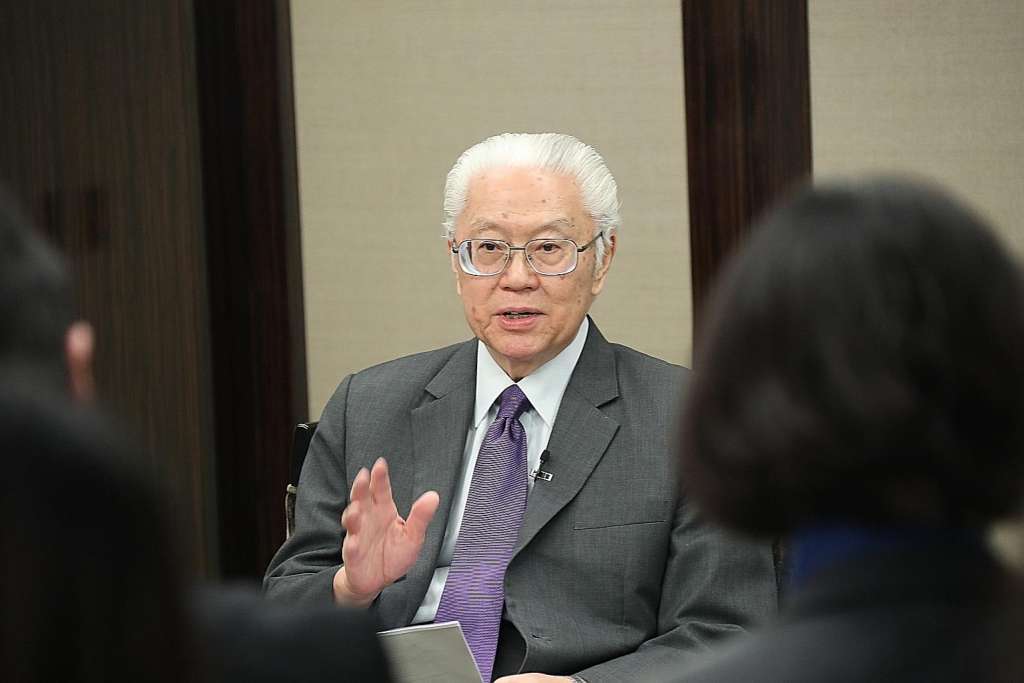
“How technology is used is not something which (should be) abstract, but which helps people in their day-to-day lives,” visiting President Tony Tan Keng Yam told reporters yesterday.

And this is one area where Singapore can look to Japan as it confronts similar issues such as an ageing population, Dr Tan added, at the end of a nine-day state visit to mark 50 years of bilateral ties.

This extends to social causes to promote inclusivity, he added.

Japan’s Superhuman Sports Society, for example, has been modifying on-the-market equipment to make it easier for the elderly and disabled to stay active.

“We hope that we will not only add years to your lives, but we will add life to your years – so that no matter how old you are, you can still make a contribution,” Dr Tan said.

“The point is not to look at ageing as a liability, but as an asset and an opportunity.”

Another technology that Japan is known for is its shinkansen bullet trains, which Dr Tan rode on four times during this trip – to and from Tokyo, Kyoto and Sendai.

He came away impressed by the “very comfortable ride”.

“It was safe, reliable and efficient. The trains arrive and leave precisely on the dot – you can even set your clock or watch by it,” he quipped, adding that punctuality is one of its main selling points.

Japan has its eyes on the Singapore-Kuala Lumpur high-speed rail project, and Dr Tan said it is welcome to put in a strong and competitive bid when an international tender is called.

Technology is but one area which can help spur economic growth, Dr Tan said.

Trade is another, and he stressed that economic growth is not a “zero-sum game” in which the growth of one country will lead to another country losing out.

On this, both Japan and Singapore are on the same page: “The more we can see growth in our own country and in other countries, the better it is for everyone.”

Dr Tan noted how Prime Minister Shinzo Abe, whose country has faced years of slow to no growth, is “trying to stimulate the economy, and encouraging companies to increase salaries to get out of the deflationary trap. This will be good for us as well”.

Both countries, too, have reaffirmed the need to “work together to ensure that this trend of freer trade and liberalisation of our economies is not stalled or reversed”.

Japan and Singapore are members of the United States-led Trans-Pacific Partnership (TPP) and the China-led Regional Comprehensive Economic Partnership (RCEP).

The future of the 12-nation TPP, which covers 40 per cent of the world economy, is uncertain after Mr Donald Trump won the Nov 8 US presidential election.

He has said he will disavow the pact.

Dr Tan said yesterday that Japan and Singapore will ratify the TPP, while also hoping that RCEP negotiations can be concluded.

On the bilateral scale, Singapore is Japan’s first trading partner and their free trade treaty, established in 2002, is currently undergoing its third review to make it more open.

The formation of the Asean Economic Community last year also presents opportunities to Japanese firms, Dr Tan said, urging them to use Singapore as a hub to expand within South-east Asia and beyond.

Japan’s presence in Asean, too, is underpinned by the US-Japan security alliance, and Dr Tan welcomed Japan playing a greater role under this framework.

“We see them as being a contributor in helping to create a climate of stability and peace in this part of the world, and in the resolution of regional difficulties which are bound to arise from time to time.”

Meanwhile, Japan is also looking to Singapore in areas such as its SkillsFuture drive to promote active ageing, and its experience in integrated resorts and casinos.

On the latter, the Lower House passed a Bill to legalise casinos yesterday.

Dr Tan noted the interest among parliamentarians over what Singapore has done to “balance the economic benefits with social issues which could arise”.

President Tan on…

THE TRANS-PACIFIC PARTNERSHIP

Both Japan and Singapore do not see economic growth as a zero-sum game (where) if one country grows, another country will be disadvantaged.

The more we can see growth in our own country and in other countries, the better it is for everyone.

Japanese Prime Minister Shinzo Abe and I reaffirmed the importance of Japan and Singapore working together to ensure that this trend of freer trade and liberalisation of our economies is not stalled or reversed.

It’s happening in some countries and that’s not a good thing for us as a trading nation, for Japan as a trading nation.

Both of us are a little bit worried about the isolationist views which I think will retard the world from growing further, including for Singapore.

ASEAN

It is very important for the United States to be anchored in this part of the world and Japan is one of the main anchors here.

So under the framework of the US-Japan Security Alliance, we encourage Japan to play a greater role with Asean.

Japan is already a strong partner of Asean and we see them as being a contributor in helping to create a climate of stability and peace in this part of the world, and in the resolution of regional difficulties which are bound to arise from time to time.

THE HIGH-SPEED RAIL

I found the (shinkansen) a very comfortable ride. It was safe, reliable and efficient. ​

The trains arrive and leave precisely on the dot – you can even set your clock or watch by it!

The punctuality of the train, I think, is one of the main selling points.

Japan is interested in participating in the Singapore-Kuala Lumpur high-speed rail and we welcome them to put in a strong and competitive bid.

We’ll work with Malaysia – it’s a joint project – to have a process of evaluation which is open, fair and rigorous, and we welcome tenders from other countries as well.

Read also: President Tan urges S’pore firms to make mark in Japan


This article was first published on Dec 07, 2016.
Get a copy of The Straits Times or go to straitstimes.com for more stories.


Image:
Category:
Blurb:
<p>Be it household chores or helping the elderly and disabled to walk, Japan is known for its “practical technology”.</p>
Publication Date:
Wednesday, December 7, 2016 – 16:00
Keywords:
Send to mobile app:
Source:

Story Type:
Others

Source link

Causes Week 2016: A friend in need – even in the afterlife

0

For the past four years, 77-year-old Lim Hang Chung has been a friend to the needy and dying by providing them with free funeral services.

He is the founder of Afterlife Memorial Service (AMS), which organises funeral arrangements for the disadvantaged and befriends the elderly who lack family support.

“I often read about people dying at home without any next of kin to care for them. My heart goes out to them,” said Mr Lim, whose organisation has helped close to 100 people.

Last month, he became a win- ner of the President’s Volunteerism and Philanthropy Awards, which recognises those who have done well in giving back to the community.

AMS receives more than 10 inquiries for funeral services a month, said Mr Lim. About 60 per cent of its cases are ad hoc ones.

Apart from responding to such cases, the group is also helping more than 200 members aged 65 and above, who may have financial difficulty and little to no family support.

“Every year, we spend about $500 to $600 per person, taking them on outings and shopping,” said Mr Lim.

“Many elderly worry that no one will help them with their funeral arrangements after they die. They are less troubled knowing that we are around,” he added.

Mr Lawrence Lim, 55, general secretary of Cheng Hong Welfare Service Society, which handles AMS, said: “The expenses for a simple funeral are not that high.

“Before they leave us, they would be much happier if someone were with them.”

Each funeral procedure costs up to about $3,000.

AMS started in late 2012, after Mr Lim Hang Chung helped with the funeral arrangements of two people – a man in his 80s and a 10-year-old boy.

The elderly man had asked if staff at a temple could handle his last rites if he died one day. Not long after, he was hospitalised after a fall. The man recovered but had mobility issues.

The AMS founder, who had been at the helm of the temple, would occasionally visit him.

Mr Lim recalled: “He took my hand tightly and said I was his only friend. No one visited him besides his nephew and myself.”

“He was discharged from hospital after a while and fell down again at home. We only found out he had fallen and died at his home about two days after it had happened,” added Mr Lim, who carried out the older man’s last wishes.

The other case occurred around Chinese New Year when a man asked for help after his 10-year-old son had died, and he had spent his life savings on the medical bills.

“After these two cases, I told my friends and (Lawrence) that I thought we should do an Afterlife Memorial Service,” he said.

AMS works with around six funeral companies now, taking into consideration the religious requirements and not differentiating between race or age.

Often, Cheng Hong chairman Lim Hang Chung, who is a businessman outside his work, continues to handle inquiries personally.

For some people, such as a 54-year-old man with terminal cancer, a wish in his final days could be as simple as taking a bite of the steamed buns he craved but could not stomach.

Mr Lim bought him the food he liked and continued visiting him in the intensive care unit, feeding him lunch at one point.

Mr Lim said: “He was very moved, but could not continue eating. He said that when he died, he would watch over me from the afterlife.

“It is not about whether he watches over me, but about the emotions that one conveys to another. I cry often when I think about these things.”

AMS hopes to spread word of its services to those elderly who may need it. Every week, it reaches out to residents living in one-room flats, conducting talks and roadshows.

“I want to help people by trying my best to know them and finding out their last wishes,” said Mr Lim. “After we complete the services, I feel satisfied.”

To donate to Cheng Hong, go to https://www.giving.sg/cheng-hong-welfare-service-society


This article was first published on Dec 07, 2016.
Get a copy of The Straits Times or go to straitstimes.com for more stories.
Image: 
Category: 
Blurb: 
<p>For the past four years, 77-year-old Lim Hang Chung has been a friend to the needy and dying by providing them with free funeral services.</p>
Publication Date: 
Wednesday, December 7, 2016 – 16:00
Keywords: 
Send to mobile app: 
Source: 


Story Type: 
Others

Source link

Thailand to investigate BBC over profile of new King Maha Vajiralongkorn

0

Thailand’s defence minister said on Wednesday (Dec 7) authorities will investigate the BBC on suspicion of insulting the monarchy in connection with a Thai-language profile of the new king that has stirred social media anger.

Offending the dignity of a reigning monarch, known by the French term lese majeste, is a serious crime under Thai law and offenders can be punished with up to 15 years in prison.

The constitutional monarchy has been in the international spotlight since King Bhumibol Adulyadej died on Oct 13 at the age of 88, after seven decades on the throne.

His son was proclaimed King Maha Vajiralongkorn Bodindradebayavarangkun on Thursday last week and BBC Thai, the BBC’s Thai-language service, published a profile of him online.

The piece was widely shared on social media and some Thais have said its content was insulting to the new king. “Authorities have to pursue the matter. It is their duty to pursue anything that is against the law,” Defence Minister Prawit Wongsuwan told reporters.

The BBC declined to comment.

The Thai Ministry of Digital Economy blocked a link to the profile on the BBC’s Thai website on Tuesday and it remained blocked on Wednesday. A message on the site said it was blocked for “inappropriate content”.

Anyone can file a lese-majeste complaint against another person and police always investigate such cases, rights groups say.

Plainclothes police and some soldiers in uniform went to the BBC’s office in Bangkok on Tuesday, witnesses said. No BBC staff were there at the time and the officers later left.

The BBC’s television coverage of Thailand has been repeatedly blocked since the death of King Bhumibol.

Police said they would investigate the content of the profile of the new king. “Then we’ll proceed according to the law,” senior police official Chayapon Chatchaidej told reporters.

He said nobody had filed a complaint against the BBC.

Police on Saturday arrested a Thai democracy activist opposed to the military government that has been in power since a 2014 coup for sharing a link to the BBC profile.

He was later released on bail.

The military government has zealously pursued cases of alleged criticism of the monarchy since it took power.

International rights groups say the lese-majeste law leave too much room for interpretation and that the penalties are too severe.


Image: 
Category: 
Publication Date: 
Wednesday, December 7, 2016 – 14:32
Keywords: 
Send to mobile app: 
Source: 


Story Type: 
Others

Source link

Myanmar bans workers going to Malaysia as Rohingya crisis grows

0

Myanmar has banned workers from going to Muslim-majority Malaysia as relations sour between the neighbours over a bloody military crackdown on the Buddhist country’s Rohingya minority.

The move came after Malaysian Prime Minister Najib Razak lashed out at Myanmar’s de facto leader Aung San Suu Kyi for allowing “genocide” on her watch during a rally Sunday in Kuala Lumpur that drew thousands of people.

The crowds were protesting against a military crackdown in Myanmar’s western Rakhine state that has pushed more than 20,000 Rohingya Muslims into Bangladesh.

Survivors have told AFP horrifying stories of gang rape, torture and murder at the hands of Myanmar security forces, while dozens have died trying to cross the river that separates the two countries.

Buddhist-majority Myanmar has long discriminated against the stateless Rohingya and the recent crisis has galvanised protests in Muslim countries around the region, including Malaysia.

“We want to tell Aung San Suu Kyi, enough is enough… We must and we will defend Muslims and Islam,” Najib said at Sunday’s 5,000-strong rally.

“The world cannot sit and watch genocide taking place.” A Malaysian government minister has also called for a review of Myanmar’s membership inside the regional ASEAN bloc.

Myanmar officials have denied the allegations of abuse and Suu Kyi has told the international community to stop stoking the “fires of resentment”.

Late Tuesday Myanmar’s immigration ministry said it had ceased issuing new licences for its nationals to work in wealthier Malaysia – for years a top destination for migrant labour.

“Myanmar has temporarily stopped sending workers to Malaysia from 6/12/2016 because of the current situation in Malaysia,” it said in a statement, without elaborating.

Malaysia already hosts tens of thousands of Myanmar workers, most of whom take on low-paid jobs in factories or in the food and hospitality industries.

According to Malaysia, some 56,000 Rohingya have arrived on its shores in recent years, many taking perilous boat journeys to flee poverty and discrimination in Rakhine state.

But on Tuesday former UN chief Kofi Annan, who heads a commission on troubled Rakhine, told reporters he thought the crisis would not split the region apart.

“I think it can be contained. There is a possibility here to contain what is going on,” he told a news conference in Yangon at the end of a week-long visit.


Image: 
Category: 
Publication Date: 
Wednesday, December 7, 2016 – 14:23
Keywords: 
Send to mobile app: 
Source: 


Story Type: 
Others

Source link

Royal Sporting House mega sports warehouse sale offers up to 80% off discounts from 8 – 11 Dec 2016

0

STARTS TOMORROW: Royal Sporting House mega warehouse sale with up to 80% OFF (8 – 11 Dec)

Royal Sporting House mega sports warehouse sale offers up to 80% off discounts from 8 – 11 Dec 2016

Royal Sporting House will be having a warehouse sale from 8 Dec to 11 Dec 2016, 10am – 7pm (Thur-Sat), 10am – 4pm (Sun) at Wisma Gulab. Apparel, footwear and accessories from over 25 of your favourite sports brands priced to go at up to 80% off

Source

Current, ex-Swiber directors questioned by CAD

0

Several current and former directors of Swiber Holdings have been hauled up for questioning by the Commercial Affairs Department (CAD) and released on bail.

The directors interviewed by Singapore’s white collar-crime unit between Nov 30 and Dec 2 were Swiber executive chairman Raymond Kim Goh; executive director Jean Pers; lead independent director Yeo Jeu Nam; independent director Chia Fook Eng; independent director Oon Thian Seng; ex-vice chairman and ex-executive director Francis Wong Chin Sing; group chief financial officer and ex-executive director Leonard Tay Gim Sin; and ex-executive director Nitish Gupta.

The investigations relate to alleged infringements under Section 199 of the Securities and Futures Act. Section 199 covers the making of false and misleading disclosures.

Former group chief executive officer and ex-executive director Yeo Chee Neng was also interviewed by CAD, but was not placed on bail, Swiber said.

The company said it is assisting CAD in its investigations and will fully co-operate with CAD on this matter.

It added that investigations are ongoing and no formal charges have been brought against those individuals.

Swiber shocked the market in July when it filed a winding-up application amid mounting debt obligations.

It reversed course a few days later to seek judicial management instead, and is currently under the judicial management of KPMG’s Bob Yap, Tay Puay Cheng and Ong Pang Thye.

On Oct 31, SGX found that the company had breached a listing rule, and formally rebuked the company for “failing to provide a balanced and fair announcement” to the market about a US$710 million project award in West Africa.

SGX alleged that Swiber failed to properly disclose that the value of the contract was merely indicative, pending the completion of an engineering design study and the finalisation of a field development plan, when it first announced the deal in 2014.

That fact was also not made clear in 2016, when Swiber announced that the project would be delayed. SGX’s reprimand, however, did not cover the 2016 announcement.

“Swiber presented favourable possibilities as certain, or as more probable than is actually the case,” SGX said in its rebuke. “The (first) announcement failed to disclose the material conditions that are pre-requisites to the progress of the project and recognition of revenue by Swiber.”


This article was first published on December 07, 2016.
Get The Business Times for more stories.

Image: 
Category: 
Publication Date: 
Wednesday, December 7, 2016 – 14:30
Keywords: 
Send to mobile app: 
Source: 


Story Type: 
Others

Source link

Agency closure hits Japan tour group

0

Sky Travel & Tours apparently closed on day their Hokkaido tour group was to depart.

The 68-year-old cleaner had saved up for months and was ready to leave for her week-long Hokkaido tour on Monday night.

The plan was to go to the airport to meet the travel agent who had the air tickets for her group. But hours before the flight, Madam Teo Ino Meo allegedly received a text message from Sky Travel & Tours that it had shuttered and would stop all services immediately.

A visit by The Straits Times at 3.30pm to the company’s office in the basement of People’s Park Centre found the glass doors locked and the lights off.

A note on the door said business would resume on Thursday. It gave an emergency contact number, but calls went unanswered.

To Madam Teo’s knowledge, there were 28 people in her tour group who had made travel arrangements with Sky Travel & Tours. She said she has not been able to get any explanation from the company so far.

Said Madam Teo in Mandarin: “I was so angry. My bags were all packed and I was ready to leave that night.”

The Consumers Association of Singapore (Case) said it had received seven complaints against Sky Travel & Tours since Monday.

Madam Teo, a widow, had booked the tour with a friend in August during a travel fair and had paid $500 as a deposit. About two weeks ago, they went to the agency to pay the balance of $1,900, and were given their itineraries.

“They said that everything had been confirmed,” she added.

Her friend, Madam Beh Choon Ann, 80, said besides the money paid to the company, she had spent close to $300 on winter wear.

“It would have been our first time seeing snow,” she said.

The two women have filed claims with the Small Claims Tribunals and have made police reports. They claimed they met others who had done the same.

Case executive director Seah Seng Choon advised affected customers to try to contact the agency regarding the status of their tour packages, and those who had bought travel insurance, to contact their providers.

Speaking in general, he also said travel agents should protect customers’ interests by purchasing insurance for prepayments.

“We advise consumers to engage CaseTrust-Natas accredited travel agencies as they are committed to fair trading and transparency towards consumers,” he said.


This article was first published on Dec 7, 2016.
Get a copy of The Straits Times or go to straitstimes.com for more stories.
Image: 
Category: 
Publication Date: 
Wednesday, December 7, 2016 – 14:00
Send to mobile app: 
Source: 


Rotator Headline: 
Travel agency shuts on the day tour group was to depart for Hokkaido
Story Type: 
Others

Source link

Singapore students showing skills as problem solvers

0

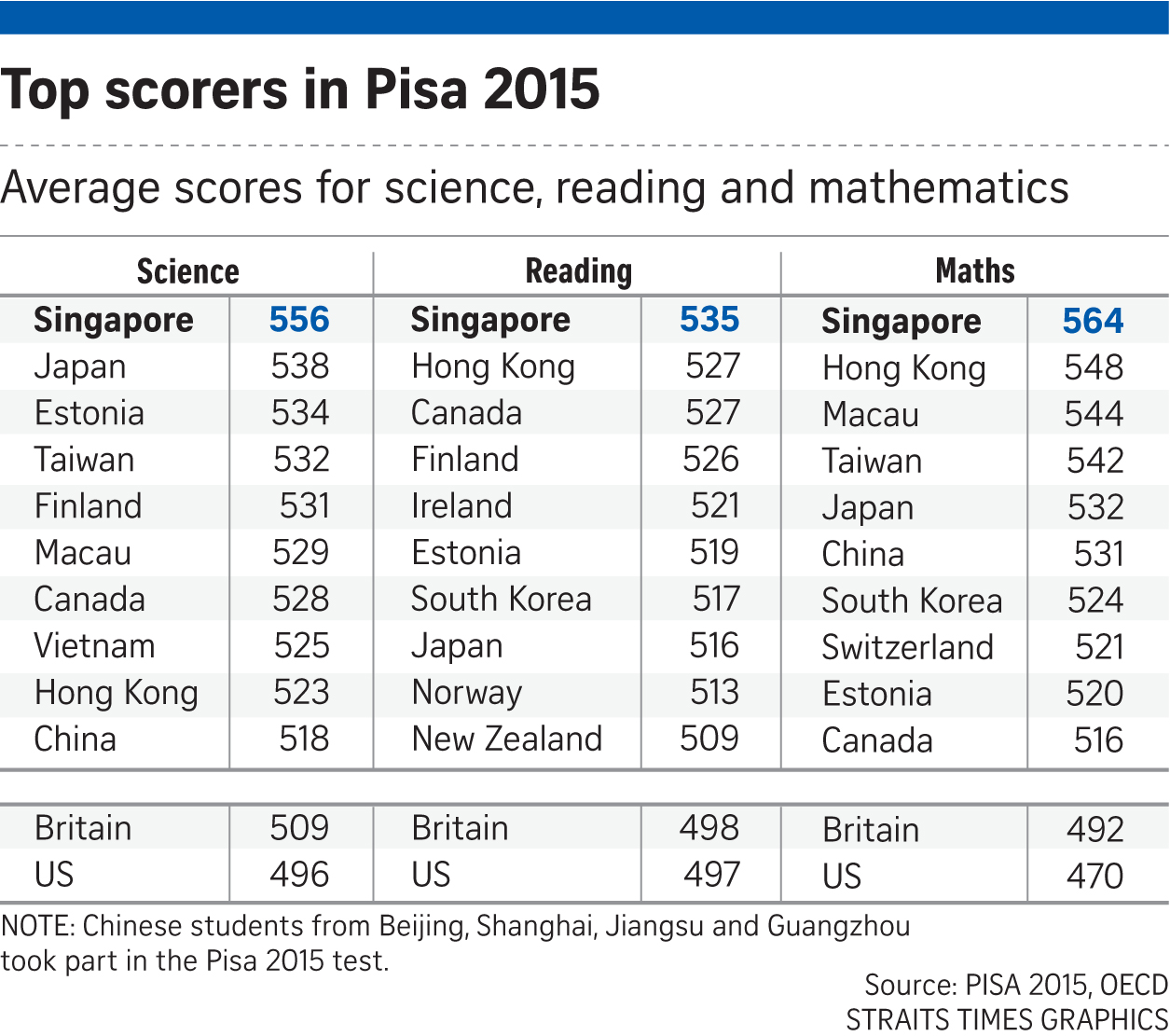
Singapore’s educators deserve applause for the Republic’s showing in the latest international benchmarking test conducted by the Organisation for Economic Cooperation and Development (OECD).

Singapore’s 15-year-olds took top place, outperforming their peers from 71 other countries and economies in using science, mathematics and reading skills to solve problems.

It shows that the deliberate curricular shifts Singapore has made over the years to emphasise higher-order critical thinking skills have worked in moving our students beyond mastering content knowledge to become problem solvers.

But beyond this, what we need to look out for is Singapore’s placing in another Pisa 2015 test result that will be out by the middle of next year.

Besides assessing students’ strengths in mathematics, science and reading, Pisa 2015 also assessed students on an important 21st century skill – collaborative problem solving.

It was part of the move in recent years by the OECD to broaden the test to measure other skills that are becoming increasingly crucial to thrive in the workplace.

To assess collaborative problem solving, students were asked to tackle a problem by collaborating with a partner, in this case, a software programme.

Students had to use their interpersonal and communication skills to engage the programme and pool knowledge and skills to complete a task.

Read Also: Singapore students top global achievement test in mathematics and science

As the OECD explained, the ability to collaborate is a vital skill as much of the problem solving work done in the world today is performed by teams in an increasingly global and computerised economy.

A University of Phoenix Research Institute study has also identified virtual collaboration as one of 10 key skills for the future workforce.

The OECD is looking at testing other skills as well. The next round of Pisa tests, in 2018, is likely to include a new measurement of global competence, which will look at how well students can navigate an increasingly diverse world, with an awareness of different cultures and beliefs.

Broadly defined as the ability to critically analyse global and intercultural issues to aid social cohesion, global competence is a game changer, according to Dr Andreas Schleicher, the education and skills director of OECD.

Writing in the media earlier this year, he said that increasingly, schools also have to ensure that children develop “the navigation skills and the character qualities that will help them find their own way through an uncertain, volatile and ambiguous world”.

To assess global competence, students will be tested on their comprehension of a range of global and intercultural issues such as the environment, poverty, economic integration, inequalities and migration.

Read Also: Singapore students top ranks of best-performing students in the world

The test details have yet to be confirmed, but students may be asked how much they know about these topics and then given some source material to exercise their critical and analytical skills, for example, opinions on whether the sources are reliable.

When asked how the OECD picks which skills to test, Dr Schleicher said that the people who design the test look very carefully at the evolution of skills demanded in our societies.

Many of the skills that schools have traditionally emphasised, requiring students to master content, are becoming less important for success in the real world, he noted.

Read Also: Young Singaporeans top competency rankings while older citizens lag behind, study finds

In contrast, creative thinking, teamwork and social skills are becoming more important.

The OECD looks at how the world and the skills that people need are changing, and then tries to reflect that in its measures.


This article was first published on December 7, 2016.
Get a copy of The Straits Times or go to straitstimes.com for more stories.
Here are the answers to the first graphic above:

Answer for meteoroid question: The meteoroid is attracted to the mass of Earth.

Answer for Mt Fuji question: 11am

Answers for Alan’s Birthday Party question:

There are 12 possible correct solutions (6 solutions, each with a corresponding mirror image solution)

  • Alan-Amy-Emily-Brad-Beth-Charles-Debbie-Frances (and its mirror).

  • Alan-Amy-Emily-Brad-Beth-Frances-Debbie-Charles (and its mirror).
  • Alan-Amy-Frances-Debbie-Brad-Beth-Emily-Charles (and its mirror).
  • Alan-Amy-Frances-Debbie-Beth-Brad-Emily-Charles (and its mirror).
  • Alan-Amy-Debbie-Frances-Beth-Brad-Emily-Charles (and its mirror).
  • Alan-Amy-Emily-Charles-Beth-Brad-Debbie-Frances (and its mirror).
Image: 
Category: 
Publication Date: 
Wednesday, December 7, 2016 – 14:50
Send to mobile app: 
Source: 


Story Type: 
Others

Source link