29.6 C
Singapore, SG
Thursday, September 24, 2026
Home Blog Page 2205

Singaporean is girl group S.H.E's labelmate

0

Accountancy graduate Boon Hui Lu, 23, says she was euphoric when her compositions were picked to be featured on Taiwanese singer Hebe Tien’s latest album, Day By Day.

Now that joy is multiplied after becoming labelmates with Tien of mega girl group S.H.E.

“It was like striking the top prize in 4D when my songs were chosen. It came as a bonus surprise when I caught the label’s attention with the demos I sang.”

She also received an autographed album and a thank-you note from Tien for penning upbeat electro tune Every Day Is A Miracle and the ethereal-sounding Your Body Speaks.

The musician, who plays the guitar and keyboard, signed on with Taiwanese record label HIM International Music in April. She flew to Taiwan in August for two months of training, working on her vocals, body language and songwriting.

She is back here to star in the musical Crescendo, which opens tomorrow. Based on the Channel 8 xinyao-themed drama of the same name, she will be playing the role of Deng Xueli, an aspiring teen singer who becomes a jaded, has-been xinyao crooner.

Boon says she can empathise with her character. “She is a singer, which is what I aspire to be. I do think about what will happen if a singer’s dreams aren’t realised or if things do not go smoothly,” says the singer, who has loved performing since she was young and had her first taste of acting in a bit role in the local movie Homerun (2003).

She went on to star in Chinese dramas Rhapsody In Blue (2006), Served Hot (2014) and Crescendo (2015).

She is giving her music dreams her best shot.

Boon, who graduated from Nanyang Technological University last year, turned down a job offer from a big accounting firm. She had studied accountancy because her parents – a self-employed courier service provider, 57, and a housewife, 50 – wanted her to be equipped with practical skills.

Her star seems to be on the rise and she has garnered overseas fans on YouTube. Netizens fell in love with her bubbly rendition of Mayday’s rock anthem, Party Animal, and it also caught the attention of a Taiwanese television station.

After the news segment about her was aired in July, her followers went from about 7,000 to more than 47,000. The Party Animal cover has more than two million views to date.

“When I performed at a songwriting contest in Taiwan, people came up to me asking for photos. They told me they enjoyed listening to my covers,” says Boon, who has three sisters aged between 18 and 24.

She returns to Taiwan for training after the musical and will be back here to perform at a solo show next year. In the meantime, she will work on melodies and lyrics for her album.

Perhaps singer Tien will grant her wish and feature in her upcoming album. “I would love to work with Hebe,” she says. “She sang my songs. She is my idol and I really love her singing style, which is a breath of fresh air in the industry.”

BOOK IT / CRESCENDO THE MUSICAL

WHERE: Kallang Theatre, 1 Stadium Walk

WHEN: 8pm (tomorrow), 3 and 8pm (Saturday) and 3pm (Sunday)

ADMISSION: $48, $68, $88, $108 and $128 from Sistic (call 6348-5555 or go to www.sistic.com.sg)



This article was first published on Dec 15, 2016.
Get a copy of The Straits Times or go to straitstimes.com for more stories.


Image: 
Category: 
Publication Date: 
Thursday, December 15, 2016 – 17:00
Send to mobile app: 
Source: 


Story Type: 
Others

Source link

16-member medical team in China helps 140kg woman deliver baby

0


On Tuesday afternoon (Dec 13) at the delivery room of Hunan Provincial People’s Hospital in Changsha, came a touching moment: A pregnant woman with unusual weight successfully delivered a baby with the help of 16 medical staff members.

The woman, who weighed 140kg with the baby, suffers from several diseases, including pre-eclampsia, gestational diabetes, pulmonary hypertension, making the delivery difficult.

The team comprising obstetricians, anesthetists, pediatricians, midwives and nurses, spent two hours assisting the woman. This is the second time she has become a mother.

One of the medical staff members was praised by internet users as “most beautiful angels in white” for he kept sucking out mucous from the newborn who had difficulty in breathing.

Publication Date:
Thursday, December 15, 2016 – 14:23
Send to mobile app:
Source:

Story Type:
Others

Source link

Seniors roped in to share stories about Whampoa

0

Project aims at encouraging active ageing among the elderly

Late pioneer and influential tycoon Hoo Ah Kay was better known as Whampoa because his family came from that district in Guangzhou, China, and ran a food supply company under that name.

So it is apt that the estate named after him is known for its good food. It is also known for a three-storey Chinese dragon fountain, built in 1973, that stretches towards the sky.

Now, about 25 elderly residents are being trained as curators to tell such stories about Whampoa, as well as their own personal accounts and more, as part of Curating Whampoa, a new two-year project by the Tsao Foundation.

It is one of the first major projects by a voluntary welfare organisation (VWO) aimed at encouraging active ageing by equipping the elderly with heritage curation skills and handing them the reins to shape their “living museum” across the heartland.

The project is divided into four areas. The first two involve documenting stories and photos. The third focuses on recording the seniors’ important and historically significant mementoes and matching some of them with collectors and historians. In the fourth area, students will do their own contemporary interpretations of the elderly’s presentations.

Associate Professor Thomas Kong from the School of the Art Institute of Chicago, who ran a similar project in Beppu, Japan about five years ago, is helping the VWO.

In Whampoa, Prof Kong and his team discovered residents with collections of old Chinese opera newspapers and movie magazines. He told The Straits Times: “To age actively is a holistic experience and the arts can play an important role.”

Ms Susana Concordo Harding, director of Tsao’s International Longevity Centre, agreed. She said the VWO started operating there in 2013 and is piloting the project in an effort to go beyond traditional activities such as line dancing.

If it succeeds, the foundation hopes to inspire other VWOs to roll out similar heritage-related programmes in other estates.

Ms Harding said: “We want to set up the infrastructure and support active ageing on-site, in their living spaces. We decided to launch this project to give more visibility to residents and develop a more positive image of the elderly as contributing members of the community.”

She added that she believes the project is a good fit because it taps into the psycho-social and emotional sides of growing old and finding a purpose in life.

“The elderly embody history and can share this wisdom with the young in Whampoa to craft a future together,” she said.

One of the curators, Madam Balbir Kaur, 67, will be presenting stories about her life in Upper Boon Keng Road for the project’s roving exhibition next year.

She will tell her story through objects such as a pestle and mortar, and her mother’s Singer sewing machine which she has kept in a corner of her flat.

She said: “My mum would sew most of our clothes… Nobody had asked me about the stories behind these objects until now. I’ve been storing them in the house for years. I feel very proud to share about my treasures.”

melodyz@sph.com.sg


This article was first published on Dec 15, 2016.
Get a copy of The Straits Times or go to straitstimes.com for more stories.

Image: 
Category: 
Publication Date: 
Thursday, December 15, 2016 – 17:00
Send to mobile app: 
Source: 


Story Type: 
Others

Source link

Thailand’s troubled Dhammakaya Temple urges police to withdraw complaint

0


Ongart Thamnita, the spokesman for followers of Dhammakaya Temple, yesterday urged the Department of Special Investigation (DSI) to withdraw its police complaint against him and other temple adherents rather than “impose fear upon people”.

In the announcement via Facebook Live, Ongart said he had not intended to make public statements that incited disaffection in a manner likely to cause a disturbance, as specified by Section 116.

He added that he was ready to prove his innocence in the judicial process.

Ongart said his statement on Sunday, which precipitated the DSI complaint, simply conveyed facts to the media and stated principles to enable authorities to understand how temple supporters thought and felt so they could resolve the problem peacefully.

He said the DSI should listen to public opinion about how the agency could improve rather than fight with people such as his group, which had expressed opinions and suggestions to the DSI.

The temple’s founder and former abbot, Phra Dhammachayo, faces arrest warrants relating to the Klongchan Credit Union Cooperative embezzlement case and a separate allegation of land encroachment.

The fugitive monk is believed to be at the Pathum Thani-based Dhammakaya Temple, while the DSI and police are planning an operation to arrest him.

The DSI cancelled an operation that was scheduled for last Tuesday, which was backed by a warrant that expires tomorrow.

It was aborted due to a “lack of preparedness”, authorities said, adding that a new search warrant was being sought to allow a continuous search for four days.

Dhammakaya Temple yesterday cleared containers and foundation pillars that had blocked the temple’s fourth gate and removed CCTV cameras from a bridge over a canal leading to the temple.

Plastic net sheeting was still in place on the bridge, from where temple monks have been seen observing police checkpoints.

Police had set up seven checkpoints around the temple to prevent the possibility of trouble caused by unidentified third parties, authorities said.

Meanwhile, the former deputy director-general for the Forestry Department and expert court witness on aerial photography, Withoon Chalaiyonnawin, has filed a libel complaint against Ongart at Pathum Thani’s Klong Luang Police Station.

Previously Ongart had said that Withoon was an “unreliable witness” in the case against Phra Dhammachayo involving forest encroachment.

Withoon said he had given his opinion in the land encroachment case in line with his professional expertise and that his status as a court expert was still valid.

He added that he was in the process of appealing his recent dismissal from the Forestry Department, which he claimed stemmed from internal conflicts within the organisation.

Read also: Thai prosecutors charge influential Buddhist monk over money laundering

Image:
Category:
Publication Date:
Thursday, December 15, 2016 – 14:01
Send to mobile app:
Source:

Story Type:
Others

Source link

Group helps women drug addicts on road to recovery

0

It also gives awards to those who have not relapsed for two years

Eleven months after her second child was born, Ms Kay Lee saw little of the boy. She was in prison for taking ketamine.

Ms Lee, now 36, said her drug habit started young and, by 18, she was already hooked on designer drugs. During the three years she was in Changi Women’s Prison, Ms Lee could see and bond with her newborn only through a glass pane.

“When my younger son called me ‘mama’ for the first time, I was so sad,” said Ms Lee, who is now a property agent. “At first, I wanted to give up caring for my children. I felt distant from them in jail.”

Ms Lee doesn’t want to make the same mistake again.

She has stayed away from drugs for nine years and works hard to be a good mother to her boys, now aged 15 and 12.

She has since told them about her past as well: “I use it to educate them to be good people.”

Ms Lee, who was introduced to the Women in Recovery Association (Wira) before she was released from prison, hopes to start volunteering with it soon.

Wira was set up in 2006 to support women recovering from drug abuse. The idea came about after recovering female drug users approached a trainer running a programme in a halfway house. They flagged their concerns and the need to help other women in the community.

Ms Lee was one of 20 women who received an award from Wira last month for her efforts in staying drug-free.

The award is given to members who have not relapsed for at least two years. Some have been drug-free for 15 years. It was Wira’s first time giving out these awards.

Wira president Ang Poh Wah hopes the awards will give its members confidence and encouragement.

The non-profit group has about 600 members and over 40 per cent of them are single mothers like Ms Lee.

Last year, women accounted for about 8 per cent of all prison inmates, but in the Drug Rehabilitation Centre they accounted for about 20 per cent of all those incarcerated for drug offences.

“When female inmates are released, they are often overwhelmed by family concerns,” said Ms Ang. These responsibilities may deter them from seeking help.

She said that is why Wira has befriending services and home visits for those who cannot step forward.

She plans to train members to help other women and eventually raise enough funds for a residential home with children’s facilities to help single mothers reconcile with their families.

The group also provides services such as counselling, casework and help on how to hone parenting skills.

But recovering from drug addiction is still an uphill battle for these women.

Jenny (not her real name), 51, has been incarcerated eight times because of drug-related offences.

Although 18 months have passed since her last jail stint, the mother of five said she has replaced drugs with alcohol, drinking up to six bottles of beer each day.

That’s the only way she knows how to fight her craving for heroin and need for anti-depressants.

She said: “I tried going to the Institute of Mental Health to deal with my alcohol addiction. I also visited a family service centre.

“I’m reducing my intake slowly, but on bad days I drink a lot. I live alone… My husband is behind bars because of drug use.”

Ms Ang said women often fall into drugs because of influence from their partners or spouses.

Jenny said the support group sessions she attends at Wira allow her to air her worries and help her feel less troubled.

But recovering addicts also need family support. In fact, Ms Lee said it was crucial in helping her recover and rebuild her relationship with her sons.

While she was in prison, her ex-husband or parents would take her younger son to see her every month. As for her elder boy, she would chat with him via video calls at the Prison Link Centre.

“I feel like because I could make it, others should be able to as well,” said Ms Lee.

byseow@sph.com.sg


This article was first published on Dec 15, 2016.
Get a copy of The Straits Times or go to straitstimes.com for more stories.

Image: 
Category: 
Publication Date: 
Thursday, December 15, 2016 – 17:00
Keywords: 
Send to mobile app: 
Source: 


Story Type: 
Others

Source link

Japan's pudgy pop stars take aim at obesity prejudice

0

Competition is cutthroat among Japan’s thousands of pop idol wannabes, but a unique concept is winning fame for a band of “chubby” girls deploying their cheeky cuteness to combat prejudices against obesity.

Despite one of the lowest rates of obesity in the developed world, Japan has a growing number of underweight young women, who rely on excessive dieting to satisfy society’s emphasis on being slim.

Heavy people are the frequent target of jokes in the media and use of the derogatory “debu,” or “fatso,” remains common.

Enter “Pottya”, a pop group named after a slang word for chubby and consisting of four young women who are not especially hefty to Western eyes, but well above average weight in Japan.

“People assume that being chubby is a sign of laziness or lack of self-discipline,” said Michiko Ohashi, the group’s heaviest member at 87 kg (192 lb) and a height of 167 cm (5.5 ft).

“I became an idol with the hope of changing that image. If they see us working to make our dreams come true, we can show that chubby people can work hard.”

First treated as a quirky joke at its debut in 2015, the group’s image is changing, with the release of two albums and a growing roster of live concerts and television appearances.

Members range in weight from 63 kg (139 lb) to 87 kg (192 lb) for the 26-year-old Ohashi, and their average of 76 kg (168 lb) is about 26 kg (57 lb) over the Japanese average for women aged 13 to 18, according to the Health Ministry.

Their body mass index, which compares weight to height, ranges from 27.4 to 31.2. Doctors consider an individual with a BMI above 25 to be overweight, and one above 31 obese.

“We’re really heavy but we want to use that to shake up the idol world,” Ohashi said.

Pottya has passionate devotees, both male and female, many of whom describe themselves as overweight.

Fans gather to meet Pottya members for a high-calorie lunch each month, with the menu of one recent meal featuring rice, noodles, chicken and potatoes — all fried.

“I was quite attracted and overwhelmed with how lively their plus-size bodies move and dance,” said Tabo, a 36-year-old man who gave only his fan nickname.

The group was an inspiration, said Miho Kishi, who was bullied about her weight as a child.

“They’ve come out and are actually selling themselves as chubby, which has given us chubby women a lot of hope and courage,” said the 25-year-old.

Image: 
Category: 
Publication Date: 
Thursday, December 15, 2016 – 14:09
Keywords: 
Send to mobile app: 
Source: 


Story Type: 
Others

Source link

Singapore rises to world's 16th costliest city for expats

0

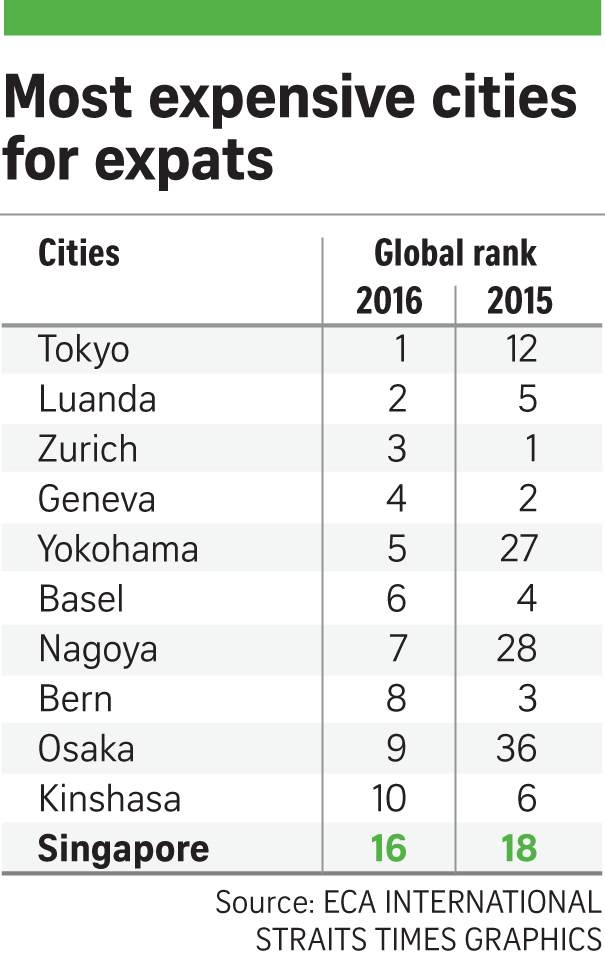
Singapore is the 16th most expensive city in the world for expatriates – a rise of two places from a year ago.

This move up has brought Singapore closer to Hong Kong, which fell two places to 11th.

“Singapore’s cost of living hasn’t risen much in Singapore dollar terms,” said Mr Quane Lee, regional director for Asia at ECA International, which conducted the survey.

“Our survey recorded inflation of less than 1 per cent. The reason for Singapore’s rise… was due to the strength of the Singapore dollar, making goods and services more expensive when converted into other currencies even though they have not changed in Sing dollar terms.”

ECA International, which conducts two cost of living surveys a year, said Tokyo retook the global top spot for the first time since 2012, leapfrogging 11 places over the past year. It was followed by Luanda in Angola and Zurich.

The survey compares a basket of like-for-like consumer goods and services commonly purchased by expats in over 450 locations, but excludes costs such as rent, utilities, car purchases and school fees as these are usually covered by separate allowances.

The rankings reflect differences in inflation and exchange rate movements between the employee’s home and host countries.

“The Singapore dollar has appreciated against most major currencies in the months leading up to our survey,” Mr Lee noted.

“Despite low price rises, the impact of the stronger currency means that where companies provide cost of living allowances to executives assigned to Singapore, these will likely need to be raised to ensure that purchasing power is maintained.”

Singapore has continued to rise in the global rankings. It was No. 33 in 2011. In Asia, it is the 10th costliest, down from eighth last year.

Hong Kong’s ranking has also generally risen. It was No. 60 in 2011.

In Asia, it is at No. 5, with only Japanese cities ranking higher.

The relative strength of the yen in the survey period pushed all Japanese cities above Hong Kong in the rankings, ECA said.

Mr Lee added: “For companies bringing talent into Japan, the cost will increase as higher allowances are required to maintain purchasing power.

“On the other hand, companies sending employees out of Japan can pay lower allowances and still maintain their standard of living.”

A weaker pound after Brexit pushed London out of the top 100 costliest cities for the first time since ECA’s survey began in 2004.

“The weakened pound means that UK businesses are paying more when sending staff overseas, although it is cheaper to bring staff to the UK,” said Mr Steven Kilfedder, production manager at ECA International. “London is now cheaper than Paris, Berlin and Brussels, thanks to the weak pound.”

gleong@sph.com.sg


This article was first published on December 15, 2016.
Get a copy of The Straits Times or go to straitstimes.com for more stories.

Image: 
Category: 
Publication Date: 
Thursday, December 15, 2016 – 15:00
Keywords: 
Send to mobile app: 
Source: 


Story Type: 
Others

Source link

Goh and Yip have Asian para games in their sight

0


There were doubts on whether they would continue competing after reaching the heights of success at the Rio de Janeiro Paralympics.

Those uncertainties, however, were dispelled last night, when both Theresa Goh and Yip Pin Xiu revealed that they will continue to swim competitively for at least another two years, up to the 2018 Asian Para Games.

Yip, 24, also confirmed that once she completes her final semester of studies at the Singapore Management University next year, she will be training full-time.

She said: “I can really feel the difference between the time when I was 16 and now.

Read Also: Paralympics: Theresa Goh bags Singapore’s 2nd medal at Rio Games with bronze

“When I was 16, I had more energy and I could go from my training session to school and back to another training session without much rest in between.

“But right now, I need to factor in more time to rest and recover (from competitions and training sessions).

“And if I don’t have enough rest, I wouldn’t have that much energy to be able to compete as a good elite athlete and to remain at that level.

“Besides going for training sessions in the pool, I have to visit the physiotherapist and nutritionist as well. All these take up a lot of time, and so I have to go full-time.”

Goh, 29, added: “I felt like I had so many options and choices, but I wasn’t sure if it was time to stop now.

“I feel like I still can commit and be able to give 100 per cent.”

While the pair remain undecided if they will try to qualify for the 2020 Tokyo Paralympics, their achievements at September’s Rio Games were honoured last night at the Athletes’ Achievement Awards (AAA) reception at Suntec City.

Yip was awarded $400,000 – $200,000 for each gold medal – for her triumph in the 50m and 100m backstroke S2 events. She also smashed two world records in the process.

Goh received $50,000 for earning her first Paralympic medal – a bronze in the 100m breaststroke SB4 competition – in her fourth Games.

Read Also: Yip Pin Xiu clinches Singapore’s second gold medal at Paralympics

The AAA is funded by the Tote Board.

For the para-athletes, the monetary awards they have received, of which 20 per cent will be given back to the Singapore Disability Sports Council (SDSC) to be used to develop the next generation of para-athletes, is a recognition of the increasing support they have received in their sporting journey.

Goh and Yip received their cheques in front of close to 100 guests.

Among those present at the dinner were Minister for Culture, Community and Youth Grace Fu, their fellow class of 2016 Paralympians, as well as sponsors.

Yip said: “Throughout our journey, apart from the achievements we’ve had, one thing that I’ve been honoured is to be part of this Paralympic movement in Singapore, where more and more people recognise and see the value of this.”

Goh added: “It’s a nice thing to witness the growth of para-sports in Singapore – from not being even considered a real sport when I started, to being pretty much on par with the able-bodied athletes – is something that I’m really proud to be a witness to.”

chiazya@sph.com.sg


This article was first published on December 15, 2016.
Get a copy of The Straits Times or go to straitstimes.com for more stories.

Image:
Category:
Publication Date:
Thursday, December 15, 2016 – 15:00
Send to mobile app:
Source:

Story Type:
Others

Source link

I'm not a cheat, says renovation contractor

0

Several flat owners have claimed that they paid thousands of dollars for their new homes to be renovated, only to have the contractor go missing before the works were done.

But the contractor in question has come out to say that he intends to honour the contracts, and insists he is not a cheat.

About 10 people who bought flats in the Greenforest estate in Tampines Avenue 8 and Vine Grove estate in Yishun Avenue 4 have filed police reports, Shin Min Daily News reported on Tuesday.

Some 15 home owners, who paid more than $170,000 in total for renovations, have formed a Whatsapp group.

They shared similar stories: Mr John Yong of B Z Interior had approached them when they were collecting the keys to their newly completed Build-To-Order flats.

To convince them to hire him, he invited them to view a flat in the same estate that he had renovated.

  • Sector has drawn over 1,200 complaints this year

  • It is an industry that attracts a lot of complaints.

    So far this year, consumers have filed a total of 1,268 complaints against home renovation contractors with the Consumers Association of Singapore (Case).

    Last year, too, the sector ranked fourth in terms of the number of complaints made against it, trailing only the vehicle, electrical and electronics, and beauty industries.

    Last year, there were 1,447 complaints against contractors, down from 1,462 in 2014, and 1,779 in 2013.

    The most common complaints pertained to unsatisfactory services. There have been cases of contractors disappearing with customers’ monies.

    In May, a couple lodged a police report after a renovation firm they hired, Sense Ideas Design, became uncontactable.

    They had paid the firm $63,000 in advance for works which included installing kitchen and bathroom fittings.

    Last year, customers of D’Concept Design made at least 11 police reports against the firm.

  • They also lodged at least 14 complaints with Case, mostly about multiple delays despite payments being made to the firm.


But after the home owners paid him the bulk of the costs – in some cases, the full payment – he did not pick up their calls, or, if he did, he often gave excuses as to why he could not complete the works.

A number of them said Mr Yong borrowed money from them.

Financial consultant Kwok Ming Hui, 28, told The Straits Times that she and her husband paid B Z Interior $36,000 – the full amount – for renovations for her Tampines home that should have been completed in October.

She said only 70 per cent of the renovation has been done. Among other issues, her kitchen cabinets lack a top, her wardrobe does not have hanger rods installed, and some plumbing and electrical works have not been done.

The couple made an initial payment of $10,000, but gradually forked out more money as Mr Yong claimed he had cash-flow problems and could not buy the materials that he needed, said Ms Kwok.

“We thought it’s okay, we’ll pay him in advance to help him since we’ll have to pay him the money in the end anyway,” she said.

“But after that, nothing was done. He would pick up our calls only once in a while, say he will call us back, but did not.”

The couple have hired another contractor to complete the renovations.

Mr Ab Razak Abdul Rahman, 57, paid a $5,000 deposit for Mr Yong to do up his Yishun flat.

While his cabinet base, washing machine base and cornices have been put up, his ceiling lights and built-in cabinets have not been installed.

He has been unable to contact Mr Yong for the past two weeks, and has made a police report.

“I called and called, I texted him many times, until I gave up,” Mr Ab Razak, a driver, said.

But Mr Yong, 65, told ST over the phone and in person: “I am not a cheat.”

He explained that the works were delayed as he had cash-flow problems. “The owners of two of the homes I renovated have not paid me their instalments. As a result, I cannot pay my workers until they pay up,” he said in Mandarin.

He also fobbed off allegations that he “went missing” and said he had simply gone to Thailand for a few days last month without informing his customers.

He acknowledged that he borrowed money from his customers, but said he will pay them back.

His explanation did little to appease his customers.

Said Mr Ab Razak: “That’s his problem. He should let us know. If he tells us about his problems, maybe we can meet and discuss. But because of him, we cannot move into our new homes as planned.”


This article was first published on December 15, 2016.
Get a copy of The Straits Times or go to straitstimes.com for more stories.

Image: 
Category: 
Blurb: 
<p>Several flat owners have claimed that they paid thousands of dollars for their new homes to be renovated, only to have the contractor go missing before the works were done.</p>
Publication Date: 
Thursday, December 15, 2016 – 14:00
Send to mobile app: 
Source: 


Story Type: 
Others

Source link

Singapore-KL high-speed rail deadline 'ambitious but achievable'

0

The high-speed rail (HSR) line between Singapore and Malaysia has an ambitious 10-year deadline to get the system up and running by Dec 31, 2026.

But experts told The Straits Times yesterday it was achievable as long as construction starts by 2021, at the latest.

What is tougher, they said, is drafting the tender documents and contracts before 2021.

And even more challenging is finalising the alignment of the 350km route, much of which is in Malaysia, they added.

Professor Lee Der Horng, a transport researcher at the National University of Singapore, said drafting the tender documents for a rail system like the HSR would be time- consuming as the project is new to both governments.

“Once the tender is awarded, the actual system construction can be done very quickly,” he said.

He foresees the construction taking around three years.

Another one to two years would be spent on testing the line and ironing out any bugs and kinks, he said.

Prime Minister Lee Hsien Loong and his Malaysian counterpart Najib Razak witnessed the signing of a historic bilateral agreement to build a high-speed rail line between the two countries on Dec 13, 2016.

Related Story:KL, Singapore sign deal for high-speed rail; service slated to start by Dec 31, 2026

From Singapore to KL in 90min by train

Related Story

10 things to know about the Singapore-Kuala Lumpur high-speed rail

  Related Story

Singapore-KL high-speed rail: Bridge over Johor Strait more cost-effective option, say experts

  Related Story

Singapore-KL high-speed rail project will open new landscape in ties: Najib

The HSR agreement, signed by both governments in Putrajaya on Tuesday, would cut travel time between Singapore and Kuala Lumpur to 90 minutes, compared with four hours by car.

It has been called a “marquee project” by Prime Minister Lee Hsien Loong, who witnessed the signing with his Malaysian counterpart Najib Razak.

The ball will start rolling early next year when both countries award a tender jointly for a development partner to give operational, technical and procurement advice.

Another tender will be called in the fourth quarter of next year for a company to design, build, finance and maintain rail assets and trains.

Prof Lee, explaining why the construction would be relatively faster, said the HSR was unlike similar systems in Japan and Taiwan, where they had to be engineered to withstand natural disasters like earthquakes or typhoons.

So, in terms of engineering complexity, “the HSR will be relatively simple”, he said.

In turn, the engineering design and construction will be simpler as well, he added.

Finalising the line’s alignment in Malaysia will be the biggest challenge, the experts said.

SIM University economist Walter Theseira noted the alignment in Malaysia has not been finalised yet.

“We don’t know much about any potential risks, for example, from environmental concerns, land acquisitions and so on,” he said.

If the issues create strong opposition to the project in Malaysia, it could delay the HSR, he added.

SIM University senior lecturer Park Byung Joon said if minor construction works do not begin in two years, it could be a sign the “planning process is not going too smoothly”.

But if plans and designs for the lines are finalised quickly, the HSR could be built in as little as two years.

“The 10-year schedule is ambitious but achievable,” he said.

About 335km of the HSR line will be in Malaysia, with the remaining 15km in Singapore.

The line will be linked across the Johor Strait by a 25m-high bridge near the Second Link.

Another bridge near the Causeway will be built for a separate Rapid Transit System (RTS), which will connect the Thomson-East Coast MRT line (TEL) to Johor Baru.

Political observers said the HSR and RTS projects reflect the extent to which Singapore-Malaysia ties have overcome their rocky past.

“The Najib Razak-Lee Hsien Loong period can be described as the golden years of bilateral relations so far,” said ISEAS – Yusof Ishak Institute research fellow Norshahril Saat.

The 1990 Points of Agreement to move Malayan Railway’s station from Tanjong Pagar to Woodlands, for example, was held up for 20 years until a landmark swop deal between Mr Lee and Datuk Seri Najib broke the impasse in 2010.

Dr Norshahril said: “Singapore- Malaysia relations today are not about rivalry, enmity and hostility, but more on cooperation and mutual benefit.”

Added Singapore Management University law don Eugene Tan, a former Nominated MP: “Both governments have to ensure the political will on both sides is durable so that even with leadership changes, the tight deadline will be met.”

•Additional reporting by Adrian Lim


This article was first published on December 15, 2016.
Get a copy of The Straits Times or go to straitstimes.com for more stories.
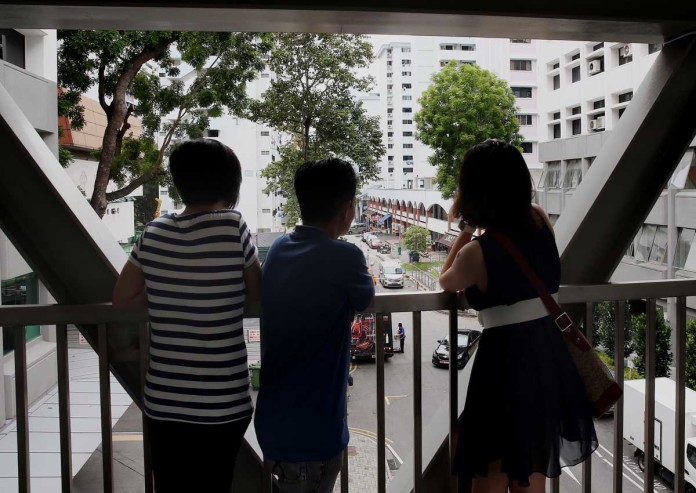
Image: 
Category: 
Blurb: 
<p>The high-speed rail (HSR) line between Singapore and Malaysia has an ambitious 10-year deadline to get the system up and running by Dec 31, 2026. But experts told The Straits Times yesterday it was achievable as long as construction starts by 2021, at the latest.</p>
Publication Date: 
Thursday, December 15, 2016 – 14:00
Keywords: 
Send to mobile app: 
Source: 


Story Type: 
Others

Source link