Four Singapore-bound flights were diverted to the Indonesian island of Batam on Thursday due to inclement weather in the city state.
One of the most dramatic involved a Singapore Airlines (SIA) flight from Tokyo which landed at Changi Airport on Thursday evening, more than five hours behind schedule.
The flight, which was scheduled to land at Changi Airport at 3.25pm, eventually arrived at 8.50pm.
It was the last of the four to land.
SQ631, which departed from Tokyo’s Haneda Airport at 7.46am Singapore time, made three attempted landings at Changi Airport before diverting to Hang Nadim airport in Batam to refuel, SIA said in response to queries.
Civil servant Mohammad Ismail, who was on board with his family, including two children aged five and 10, said the failed landing attempts had caused concern, though passengers remained calm.
There were 259 passengers on board.
PAYA LEBAR OPTION NOT POSSIBLE
“The first attempt almost touched the runway, then it ascended like a take off and we shot up past the clouds,” said Mr Ismail, 35. “Through the window you could see the dark clouds, rainwater and flashes of lightning.”
After circling and making two more attempts, the pilot announced that they would be trying to land at Paya Lebar Air Base due to the bad weather, though this too was called off as conditions there were no better.
The plane then headed for Batam, landing at about 2.50pm local time before waiting three hours for a parking bay, the SIA spokesman said.
The wait in Batam was tedious, and passengers were left hungry as only drinks were served, but “but we passed around some biscuits that were souvenirs from Japan”, said Mr Ismail.
The airline crew did their best and handled the situation professionally, he added.
The other diverted flights were a Tigerair flight from Hong Kong, an SIA flight from Brisbane and a SilkAir flight from Siem Reap.
They arrived in Batam before the SQ631 flight, according to local authority BP Batam. All passengers stayed on the planes at Hang Nadim airport while waiting out the bad weather in Changi, it said.
A Changi Airport Group spokesman said decisions regarding flight diversions and landings are left to the sole discretion of the pilot and his airline.
Dynasty Travel’s director of marketing communications, Ms Alicia Seah, said flight delays are common during the year-end holiday season because of weather conditions and an increased number of flights.
“Safety is the priority. At the end of the day, if it’s not safe to land, it’s better not to,” she said.
This article was first published on Dec 24, 2016. Get a copy of The Straits Times or go to straitstimes.com for more stories.
Trains can stall in a tunnel for several reasons, including power faults and signalling issues.
If power from the tracks is disrupted, there is a backup battery on the train which can last for 60 minutes. The battery keeps lights and the ventilation system going.
If train service cannot be restored, detrainment should occur within 30 minutes of an incident, if it is safe to do so.
During detrainment, power along the rail tracks is shut down for safety reasons. The Singapore Civil Defence Force will also be on site to assist passengers to walk to the nearest MRT station via the tracks.
Detrainment, however, is not always the best option.
Depending on which section of the tracks the train stalls at, it could mean a considerable walk to the nearest MRT station.
It would thus be preferable to ferry commuters to the nearest station, for example, by either driving the problematic train manually (if the train is driverless), or doing a push-out, which is to use another train to push the stalled train to the nearest station.
adrianl@sph.com.sg
This article was first published on Dec 24, 2016. Get a copy of The Straits Times or go to straitstimes.com for more stories.
The Ministry of Defence (Mindef) said yesterday that a formal representation was made to Hong Kong three weeks ago regarding the seizure of nine Singapore infantry carrier vehicles.
Mindef is still waiting for the matter to be fully resolved.
“Over the past three weeks, the Singapore Government has communicated its formal position to the Government of the Hong Kong Special Administrative Region (SAR) on the detention of SAF Terrex Infantry Carrier Vehicles and associated equipment by the Hong Kong Customs and Excise Department,” Mindef said in a statement.
“We await a full resolution of this matter and return of our property by the Hong Kong SAR government.”
The nine Terrex vehicles and equipment, which were used in a Singapore Armed Forces (SAF) military exercise in Taiwan, were detained in Hong Kong a month ago.
They were on the way back to Singapore on board a container ship that was in transit in Hong Kong. The vessel belongs to shipping company APL.
The South China Morning Post reported earlier this month that Hong Kong Customs impounded the shipment because APL failed to provide appropriate permits for the vehicles.
319743
2016-07-01 15:01:52
Photo Gallery
SAF will overcome manpower issues through technology: Defence Minister
APL has since met Hong Kong Customs on three occasions between Nov 29 and Dec 6, but has yet to receive formal reasons for the seizure.
Following the last meeting, the SAF said that it had advised APL officials to continue to cooperate fully with Hong Kong Customs, to hasten the return of the Terrex vehicles.
China’s Foreign Ministry said on Nov 28 that it had made representations to Singapore over the vehicles’ seizure, voicing unhappiness over the incident.
This article was first published on Dec 24, 2016. Get a copy of The Straits Times or go to straitstimes.com for more stories.
SINGPAPORE – “Cry ‘Havoc’,” insisted Mark Antony in the play Julius Caesar, and no one has taken that more seriously in 2016 than athletes. No profession has been so committed to skilful agitations and sweaty unrest as these folk in shorts and swimsuits. They disrupted plans and tactics, shook up reigns and confidence, and turned form upside down. Or as Joseph Schooling did, they disrupted the destiny of the greatest Olympic champion, Michael Phelps, by becoming one themselves. The goldfish had devoured the shark.
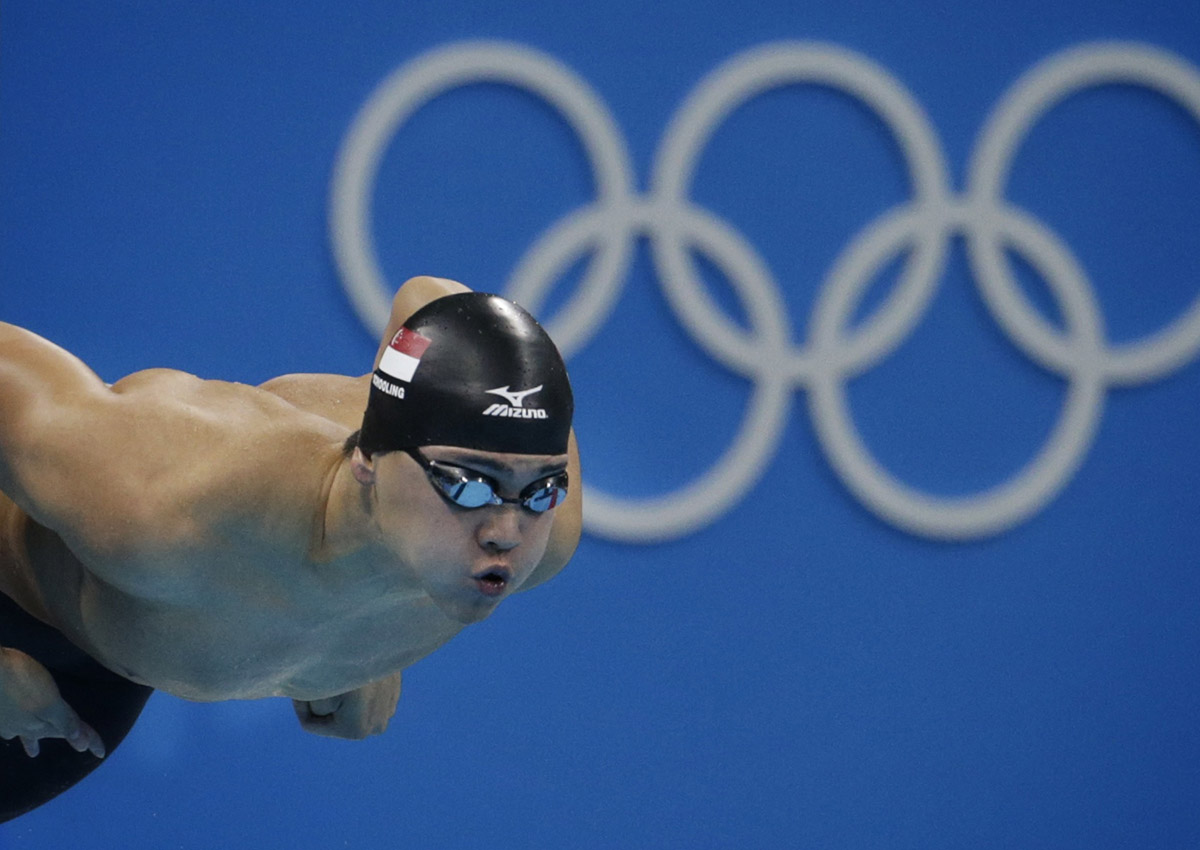
In Fortune magazine, CNN, The Telegraph, the Bangkok Post, The New York Times, Time magazine, the same August word appeared in headlines: Singapore. One young man took 50.39 seconds over 100m to make the world look to us.
Schooling brings home Singapore’s first Olympic Gold
Singaporeans used to wonder: We can be sporting champions? The world inquisitively asked: Singapore is more than academia? Kindly remove those question marks.
Sport is unique for it is happily devoted to disorder. Look up the many definitions of “disrupt” and they fit perfectly. To play havoc with: As tennis player Angelique Kerber charmingly did in women’s tennis with her coup d’Serena. To cause confusion: As the Singapore Table Tennis Association did by dispensing with the services of world No.6 Feng Tianwei. To interfere with: As the Rio crowd did by cruelly booing French pole vaulter Renaud Lavillenie when he duelled with a Brazilian competitor at the Olympics.
To advance, the athlete must be disruptive, he must interrupt a rival’s progress as tennis star Andy Murray did by seizing the No.1 position from Novak Djokovic. By year’s end, Djokovic had parted with his coach Boris Becker and was partly advised by a Spaniard named Pepe Imaz, who reportedly dispenses lengthy hugs as part of his teachings. An entire way of learning was being temporarily disrupted.
Sport, like life, embraces contradiction. Athletes relish routine and yet look to create turmoil. Coaches crave discipline and yet seek to cause chaos. They look at footballer Lionel Messi, basketballer Stephen Curry, Formula One driver Lewis Hamilton in rival teams and find ways to impede their genius. Push them, mark them, disrupt them.
No one did this more serenely all year than Leicester manager Claudio Ranieri, who tastefully disrupted our notion of what the football coach should be. Star coaches looked like they feed on pomposity, but he ordered pizzas; they give us sneers and sarcasm, but he laughed and offered us quotes like “dilly ding, dilly dong”. Then he rang everyone’s bell in the English Premier League.
Ranieri and Leicester won the Premier League and reminded us of an ancient lesson: We know little about sport. We examine talent, debate it, decide who will win and then teams make a mess of our predictions. This is disruption, too. Like the Cleveland Cavaliers, who trailed the Golden State Warriors 1-3 in the National Basketball Association Finals, a deficit no team had ever overturned, and still triumphed, leading that weighty philosopher, the 110kg LeBron James, to say: “The game always gives back to people that are true to the game.”
Leicester City wins English Premier League championship for the first time
If domination is the intent of sport, then disrupting it is essential to evening out the balance. We wish to watch greatness achieved and yet also to see the great humbled. So it was joyous to watch rugby’s All Blacks win a record 18 straight matches yet wondrous when Ireland beat them to overturn a 111-year losing streak against them.
Everything holy was disrupted here, history, form and the colour of a river. Irish captain Rory Best asked that Chicago – site of his team’s famous rugby victory – dye its river green, just like it had been coloured blue when the Chicago Cubs won the baseball World Series after 108 years. Entire centuries of loss and superstition were being overturned here, and what a lovely interruption this was.
But disruption in sport is acutely double-edged: If it is joyous to be the disrupter, then it is heartbreaking to be the disrupted. Wrestler Saori Yoshida lost her bid for a fourth successive Olympic gold and wept for an hour. Jordan Burroughs, trying to defend his 74kg wrestling title from London 2012, also fell, and his words echoed the agony of those whose dreams had been left in a shambles.
“I missed a lot of important milestones in my children’s lives to pursue this sport,” Burroughs told American newspapers. “I didn’t see my son walk for the first time. I’ve left my wife at home with two kids in Nebraska for long periods of time to go to training camps and tournaments in foreign countries… Now, I feel like I let my family down.”
The more we journey through the year, the more we appreciate that sport is essentially anarchic, a turbulent place not just full of contesting talents, but also competing beliefs. Athletes astonished us not merely with singular feats but with the strength of their conviction. Occasionally, they disrupted the very idea of what we think sport is for.
When Colin Kaepernick, the National Football League quarterback, knelt during the US national anthem in protest against the treatment of African Americans, he threw sport into intriguing disarray. Why do we have anthems at events not involving nations? Is protest a part of patriotism? Are sporting fields places to fight injustice in?
Irrespective of your beliefs, Kaepernick made us think. So did a group of athletes who marched into the opening ceremony at the Rio Olympics behind a sign that said Time Olimpico de Refugiados.
These were refugees from various lands who had come together because war had disrupted their worlds. They had left their homelands to escape violence and to chase their dreams, and in doing so had forced us to challenge an ancient assumption.
The Olympics often appear as a grand nationalistic affair, a parade of flags and anthems, but sport does not belong to nations but in fact to every individual. To play, said these brilliant disruptors, did not require a passport or a nation. It was simply their right as humans.
rohitb@sph.com.sg
Since Mr Zainudin Nordin’s departure, the FAS has been without a permanent president.Photo: The Straits Times
Local football takes a tumble
For the country’s No. 1 sport – football – 2016 was a rock-bottom year.
As the Football Association of Singapore (FAS) wobbles into the new year, the governing body has yet to find a new permanent president and a permanent national head coach.
Funding from the Tote Board for the association’s expenditure and the S-League season, to the tune of roughly $36 million, has yet to be secured, while the Lions and its age-group teams continue to take a battering on the pitch at a time when swimming, bowling, para-sports and a host of other sports scaled new summits.
The sheer extent of the damage done by the FAS’ recent policies was apparent during last month’s ASEAN Football Federation Suzuki Cup campaign as caretaker coach V. Sundramoorthy’s team returned from Manila with its worst-ever display of zero wins, a goalless draw and two losses in the group stage.
Previous setbacks such as the 4-0 mauling by Malaysia in 2002 saw Singapore bounce back to win the 2004 tournament, but the year of horror experienced by local football looks set for a prolonged slump.
The decision in 2011 to form the LionsXII, essentially the country’s Under-23 team boosted by senior national players, robbed the S-League of its elite.
Add to that the Young Lions, a team of the best Under-21s, playing in the domestic scene, it is no wonder the clubs have found little incentive to continue grooming youngsters because they are cherry- picked for these developmental squads. The result: A staggering record of 39 defeats and 10 wins in 62 games over the past two years for Singapore’s youth teams from U-14s to U-23s.
Off the pitch, there is also uncertainty at the FAS’ Jalan Besar office. Although the FAS managed to amend its Constitution to align with Fifa’s statutes of having an elected president, the year will end without the fraternity going to the polls.
Out went Mr Zainudin Nordin, whose term expired on Nov 15, as lawyer Lim Kia Tong took on an interim role with the mission to conduct an election by next May. While Mr Lim has announced his intention to contest the polls, the identities of the other candidates are still shrouded in mystery amid calls for change bubbling on the ground.
Another puzzling episode took place outside the country when Mr Zainudin attended September’s Asian Football Confederation (AFC) extraordinary congress in Goa, India.
Forty-two of the 44 members who had voting rights at the meeting raised a “no” card when AFC president Sheikh Salman Ebrahim Al Khalifa called for the agenda of the meeting to be passed.
The “no” vote was a gesture of Asian solidarity against Fifa, which had banned Qatari Saoud Al-Mohannadi from standing for election.
While one AFC member abstained, another voted “yes”. This lone voice that was out of sync with the rest of its AFC colleagues was… the FAS.
Football fans in Singapore live on a staple diet of the English Premier League, while connoisseurs critique the Spanish and German leagues as works of fine art. The local game, sadly, is still an acquired taste.
The Lions had their worst-ever display of zero wins at last month’s AFF Suzuki Cup.Photo: AFP
YOUTH TEAMS SUFFER BATTERING
Singapore’s youth teams from U-14s to U-23s have fared badly over the past two years.
Matches played in total: 62
Matches lost: 39
Matches won: 10
meng@sph.com.sg
Paddler Feng Tianwei was abruptly dropped from the national team.Photo: The Straits Times
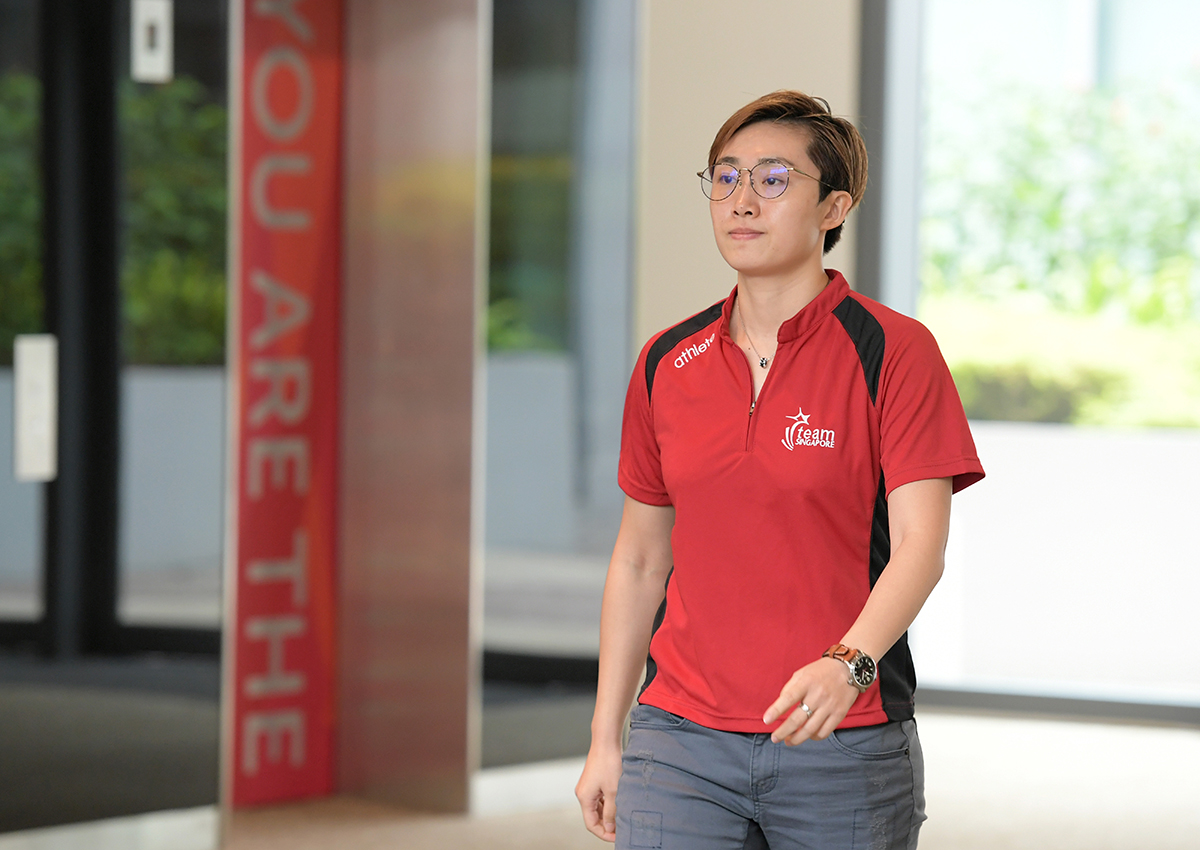
STTA’s axing of Feng stuns sports scene
The year 2016 in Singapore sports was a season of bountiful harvests, with tireless toil giving way to the sweetness of success that was most celebrated at the Rio Olympics and Paralympics.
So the unwelcome episode surrounding the Singapore Table Tennis Association (STTA) and paddler Feng Tianwei that soon followed proved a rude shock.
The STTA’s move to axe Feng from the national table tennis team stunned Singapore sports as well as several overseas rivals and observers.
Feng had been struggling with form and, as team captain, had just led the women’s team to a barren run at the Rio Olympics – the first time in three Games they had returned empty-handed.
But Feng, ranked world No. 6 then and now, is still the best paddler by far within the Singapore stable, and had stated her intention to make a run for the 2020 Olympics in Tokyo.
The 30-year-old was widely expected to continue leading the women’s team for at least another Olympic cycle. Her sudden exclusion threw plans into disarray.
The manner in which she was dismissed by the STTA, as well as the reason the sport’s local governing body used to substantiate its decision, also proved baffling to many.
It was supposed to be a contemplative period for the sport, a time for studying how to regroup after a disappointing Olympics. Instead, the affairs of the STTA and the relationship between its management and athletes became a hot topic for public scrutiny.
Some disapproved of the way the STTA gave the boot to its most accomplished athlete – Feng is a triple Olympic medallist and member of the 2010 World Championship-winning team. The STTA said it severed ties with her as she “does not fit” into the association’s plans for rejuvenation.
Others were confused because dropping the team’s most valuable asset seemed counter-intuitive if the ambition was for Singapore table tennis to rediscover success on the world stage.
More discord followed when Feng’s character was brought into question. She went from being recognised as the heroine of most of Singapore’s table tennis success in recent years to seeing allegations of indiscipline and a lack of respect for authority appear in the media.
For Feng, who had hoped to get back into the momentum of competition and begin yet another four- year campaign as soon as possible after Rio, the development was an unwelcome interruption.
She intends to continue playing for Singapore, although she is no longer under the STTA’s auspices when it comes to training and competition. She will now have to assemble a support system herself.
This includes getting her own coach and sparring partners, and also taking care of her own travelling and administrative logistics.
After Feng suffered an early exit at the International Table Tennis Federation’s year-end season finale earlier this month, she admitted that being an independent player was a steep learning curve.
The STTA’s ambition to “rejuvenate” and focus on “youth development” means it will now have to cope without Feng’s leadership, experience and technical abilities, including at team events, because the association had also said that her inclusion would be “tricky”.
But if the association’s ambition to wean itself from its reliance on imported talent comes to pass, the move does open up a path for younger, local-born players to consolidate a place in the team, as the association seeks to groom the next generation of leading paddlers.
The exclusion of Feng from the national set-up by no means ends Singapore table tennis’ successful run on the international stage.
After all, she continues to play for the nation – recently defeating world No. 1 and Olympic champion Ding Ning – and the women’s team still comprises talented players.
But it was certainly a disruption Singapore sport could have done without.
maychen@sph.com.sg
This article was first published on Dec 24, 2016. Get a copy of The Straits Times or go to straitstimes.com for more stories.
Jacques Volcouve was a little boy when he first heard ‘A Hard Day’s Night’.
Now aged 60 and a self-styled “Beatles historian”, he is preparing to auction off a collection of 15,000 items he has amassed on the legendary band over half a century.
“Starting from 1967, I gave myself an absolutely impossible mission: own everything concerning the Beatles,” said Volcouve, whose trove will go on sale on March 18 at auction house Drouot in Paris.
“Everything that I could find – even when I would see a newspaper with three lines on the Beatles, I would buy the newspaper,” he said.
Statuettes of the Fab Four, a metallic John Lennon figurine, rare album editions and black and white photos are among the objects he has accumulated, in addition to books, photographs, clippings, compact and laser discs, tapes and other memorabilia.
AC Milan celebrated wildly after beating Juventus to win the Italian Super Cup in a penalty shoot-out to win their first trophy since 2011 on Friday.
Mario Pasilic blasted home the final spot kick to give AC Milan a 4-3 victory on penalties after a hard fought match was locked at 1-1 on 90 minutes and after extra time in Doha.
Mario Mandzukic and Paulo Dybala missed their spot kicks for Juventus, with Gianluca Lapadula the only Milan player not to convert his penalty.
It is the second time Milan have beaten Juventus, who lead Serie A by four points, this season.
In October, they won 1-0 in the San Siro.
A delighted Milan coach Vincenzo Montella said he hoped the victory would serve as a springboard for his side.
“I would like to think that this match is the beginning of a new era, we would like to consider it a starting point,” he said.
“I am sure that this win will give us confidence.” The victory was just about merited by Milan who responded well after early Juventus dominance.
Juve, Italian league and cup double winners last season, had taken the lead in 18th minute after Giorgio Chiellini flicked home a Miralem Pjanic corner.
At that stage it was all Juventus and it was not until the 36th minute that Milan had their first shot on target, a tame effort from midfielder Juraj Kucka.
But they drew level just before half-time when Giacomo Bonaventura beautifully glanced home a Fernandez Suso cross.
Suso was a constant irritant to the Juve defence and set up several fine chances including an 83rd minute header for Carlos Bacca, who was denied by a great save by evergreen Gianluigi Buffon, making his 600th appearance for Juventus.
Romagnoli also went close, hitting the bar with a header.
Juventus also had their chances, most notably in extra time.
In the 111th minute Patrice Evra put the ball in the net only to be ruled offside, then Dybala missed a great chance, spooning a shot over when unmarked from just eight yards with only four minutes remaining.
A “very angry” Juventus coach Massimiliano Allegri said he was upset at the way his team had lost control of the game and become nervous.
“The match started well for us, the first 30 minutes Juventus were at their best,” he said.
“We should have been more focused.” Chiellini echoed his coach.
“The first 20 minutes we played well and we had two further chances of scoring,” said the defender.
“But after 20 minutes we played badly, we made many mistakes and gave too much space to Milan.” The match, the second time the Super Cup has been played in Qatar, was watched by a near capacity crowd of 11,356.
Hollywood star Carrie Fisher was fighting for her life Friday after suffering a massive heart attack on a flight, emergency workers and witnesses said.
The 60-year-old “Star Wars” actress was flying from London to Los Angeles when she suffered cardiac arrest, and was given cardiopulmonary resuscitation by an emergency responder on board.
Fisher collapsed 15 minutes before the plane landed at LAX, according to celebrity news website TMZ, and was rushed to UCLA Medical Center on a ventilator.
TMZ, citing witnesses, said the actress’s eyes were closed and she appeared unconscious as she was rushed through the terminal, where paramedics worked for 15 minutes before they could get a pulse.
The Los Angeles Times said her condition was critical, quoting an unnamed source who said the actress was “in a lot of distress on the flight.”
The Los Angeles Fire Department (LAFD) did not refer to the actress by name but confirmed it had responded to an alert just after midday over “a patient on an inbound flight in cardiac arrest.”
“LAFD firefighter paramedics were standing by and provided immediate advanced life support and aggressively treated and transported the patient to a local hospital,” spokesman Erik Scott told AFP.
United Airlines said medical personnel met Flight 935 from London upon arrival after the crew reported that a passenger was unresponsive.
Fisher was catapulted to worldwide stardom as the rebel warrior Princess Leia in the original “Star Wars” trilogy, which has been a cultural phenomenon since the release of the films from 1977 to 1983.
Steeped in Hollywood excess from an early age, she was the product of the four-year marriage of movie star Debbie Reynolds, best-known for her role in “Singin’ In The Rain,” and singer Eddie Fisher.
The relationship, and the happy home in Beverly Hills, came to an end when Fisher left Reynolds for her close friend, the actress Elizabeth Taylor.
Fisher’s co-stars led tributes as Hollywood reacted with shock to news of her collapse.
“As if 2016 couldn’t get any worse… sending all our love to @carrieffisher” tweeted Mark Hamill, who plays her on-screen twin Luke Skywalker in the “Star Wars” saga.
The American actress has talked and written frequently about her years of drug addiction and mental illness.
Fisher is known for her searingly honest semi-autobiographical novels, including her best-selling debut “Postcards from the Edge” which she turned into a film of the same name in 1990.
She has given various interviews over the years about her diagnosis of bipolar disorder and addiction to prescription drugs and cocaine, which she admitted using on the set of “The Empire Strikes Back” (1980).
She has also discussed being treated with electroconvulsive therapy, in which small electric currents are passed through the brain, to trigger brief seizures.
Writer and actress Anna Akana, who said she was on board Fisher’s flight, described the mid-air drama in a series of tweets, voicing her “shock and sadness.”
“Don’t know how else to process this but Carrie Fisher stopped breathing on the flight home. Hope she’s gonna be OK,” she said.
“So many thanks to the United flight crew who jumped into action, and the awesome doctor and nurse passengers who helped. Feel weird even tweeting about it but I JUST finished her book and was fangirling out over seeing her dog Gary in person.” Fisher’s famous “Star Wars” character features as part of the storyline to spin-off “Rogue One,” which is currently riding high in box offices around the globe, although the actress is understood not to have been involved in the production.
“The whole world is sending you so much love! Sending you the universe’s most powerful Force,” tweeted English actress Gwendoline Christie, who played the warrior Brienne of Tarth in HBO’s “Game of Thrones” and Captain Phasma in Fisher’s most recent “Star Wars” episode, “The Force Awakens.”
You could say that Christmas this year came early for Mr Boo Balan John Smith.
The retired police officer was re-acquainted with an “old friend” he had not seen in 10 years, after he left the police force and decided to live in Perak, Malaysia.
The person who “arranged” the meeting in October was his son, Mr Abraham Muralli, 42.
So at a multi-storey carpark in Beo Crescent, Mr Balan lifted the canvas of a motorcycle and was surprised to see that his “old friend”, a 44-year-old classic Honda CL175 K3 dirt bike, was restored to its former glory.
Well, at least close to its former glory.
Mr Balan, 67, told The New Paper via text messaging: “When I saw the bike again, I felt rejuvenated and wanted to ride it… I feel that he (Mr Abraham) has done a great job.”
For the next 10 minutes, Mr Balan’s smile spoke volumes.
He didn’t say much, having suffered a minor stroke in February, which robbed him of his speech.
IS IT YOU, OLD FRIEND?
Mr Balan inspected every piece of the machine – he tugged at the front forks and brushed his wrinkled hands on the metal fuel tank – bought in the early 70s for about $3,000.
And then he sat on the scrambler, which once took a painful 17-hour journey from Singapore with his pregnant wife on Malaysian trunk roads to Teluk Anson in Perak.
Mr Balan, with his trademark cowboy hat, had previously taken jumps on the Honda as captured in old photographs.
Observing his father’s every move, Mr Abraham said he felt it was worth every painful moment sourcing for parts.
Said Mr Abraham, a workshop foreman at Harley-Davidson Singapore: “I’ve received several generous offers for the Honda, but I will never sell it. There is simply too much of my father’s memories in that bike.”
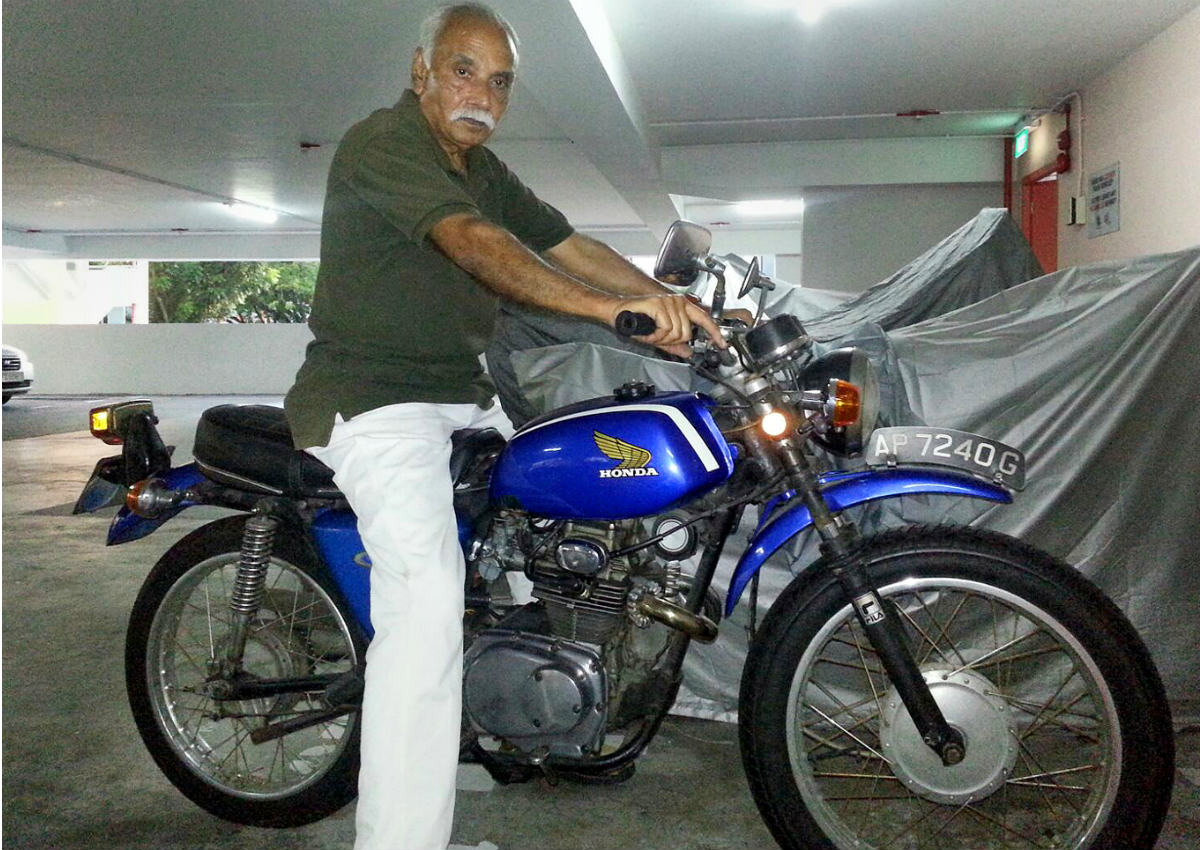
Boo Balan John Smith in an old photo from the 1970s where he is seated on his workhorse Honda CL 175 K3. Photo Credits: Abraham Murali
The scrambler, which makes at most 20hp, was his father’s workhorse and “buddy”.
As a constable earning about $250 in the 1970s, it took Mr Balan nearly six months of saving up and paying little by little before he could take the Honda out of the showroom.
Mr Abraham holds strong memories of the Honda.
He still remembers the daily rides to primary school and the grocery trips, which even included a sack of durians mounted on the Honda’s fuel tank.
Added Mr Abraham, who is an only child: “When I used to live in Morse Road (off Keppel Road), I would hear the distinct exhaust sound, and I knew my father was home from work.”
When Mr Abraham kickstarted the roadworthy Honda on Wednesday, the parallel twin came to life effortlessly, belching a unique tune similar to that of post-war Triumphs and Nortons.
“I am glad my dad was pleased,” said Mr Abraham, who owns a handful of motorcycles.
“But it is still a work in progress because I need original mirrors and handlebars.”
While Mr Abraham keeps spares such as engine gaskets and drum brake shoes, he searched on eBay and relied on friends for the restoration work, which started four years ago.
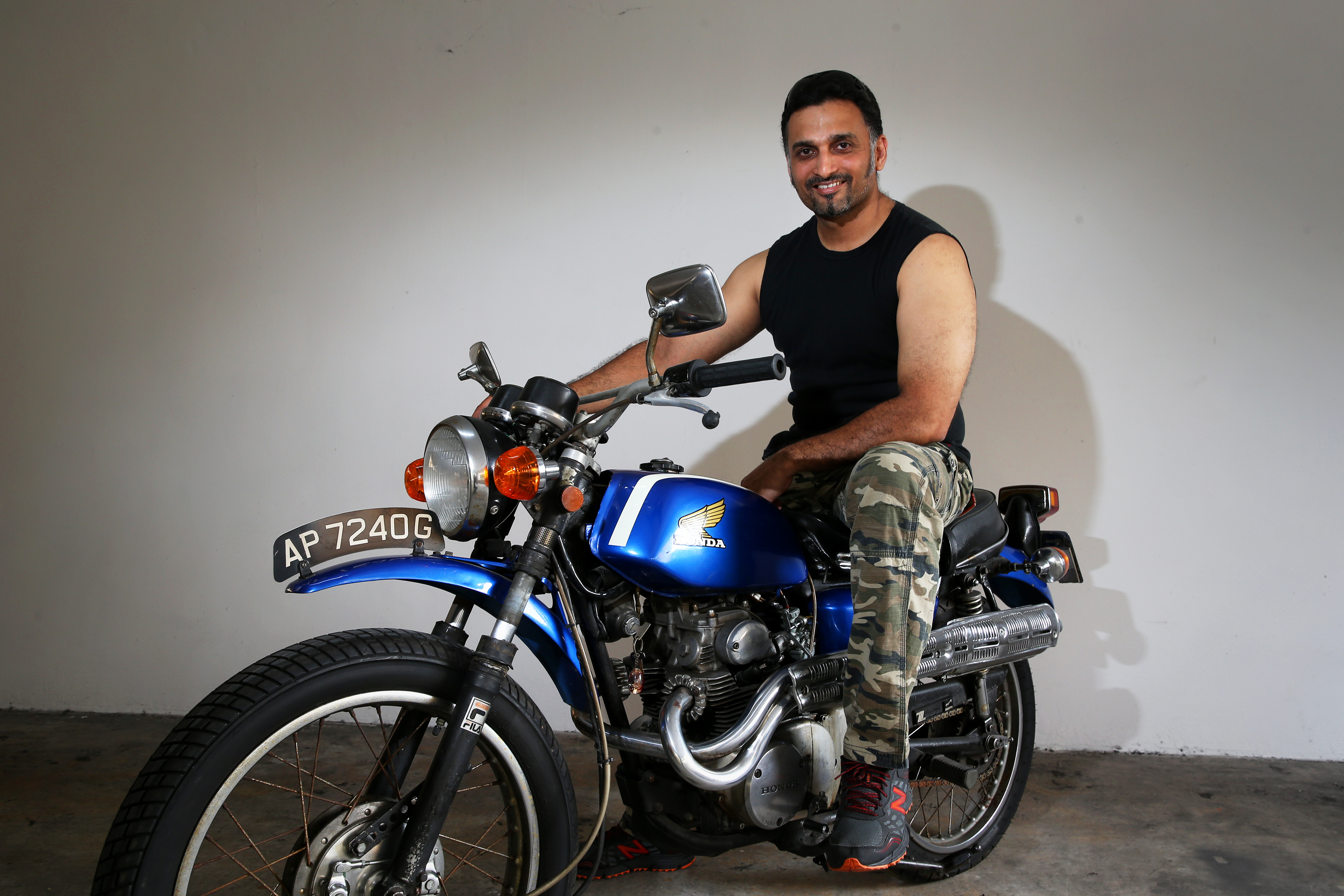
Mr Abraham Muralli, 42, proudly sits on a Honda CL175 K3, a dirtbike from the 1970s which was previously his father’s workhorse and buddy. Four years ago, Mr Abraham embarked ona restoration project to restore the motorcycle but kept the engine untouched. Photo Credits: The New Paper
His mother had accidentally thrown away the original handlebars during spring cleaning.
Even in its present state, the Honda is a sight to behold. Its bent two-into-one exhaust has a long ventilated heat shield.
The rear seat pops up like the hood of a car and there is also a steering cone adjuster in case you feel your fork needs to be adjusted after an off-road run.
What the bike needs now is a new coat of paint.
Ultimately, the Honda was not relegated to the scrapyard because Mr Abraham wanted to thank his father for instilling in him a sense of adventure.
He said: “I kept and restored the Honda as my way to say, ‘I love you, dad.'”
zaihan@sph.com.sg
This article was first published on December 24, 2016. Get The New Paper for more stories.
SINGAPORE: Prior to the 17th edition of the World Pencak Silat Championships in Bali about three weeks ago, Singapore’s two-time silat world champion Sheik Farhan Sheik Alau’ddin spent close to a year adding to his repertoire of in-ring fight skills.
Thanks to the guidance of his coach, as well as his father Sheik Alau’ddin – a well-known former Silat world champion himself – the 19-year-old Sheik Farhan successfully learnt new techniques which helped him prevail.
Said Sheik Alau’ddin, on his son’s progress: “My team of coaches and I have been working hard to build up (Shaik Farhan’s) abilities earlier this year.”
He added: “He’s since improved three of his techniques, which makes us happy. It’s really heartening to see his desire to try, and that is very important. I can see the confidence in him, and that he clearly knows what he is doing.”
Earlier this month, the Nanyang Polytechnic student beat Mach Quoc Hung of Vietnam 5-0 in the title-deciding bout to retain his Class J world crown he won in 2015.
Class J world champion Sheik Farhan, together with his father and Singapore Silat Federation CEO Sheik Alau’ddin. (Photo: Singapore Silat Federation)
Recounting his son’s progress, Sheik Alau’ddin said: “(Prior to his first title in 2015), Farhan used to ask a lot of questions in training. This time round, he left it to his coach to advise him on what’s best.
“He tends to focus on just a few techniques, but what I hope to see is for him to learn even more.”
Sheik Alau’ddin, a four-time SEA Games champion, added that his son still has some way to go. “Fights tend to be unpredictable, as opposed to being choreographed. Opponents can vary their styles at different stages, so Farhan still needs to know it all, whilst focusing on his specialities.”
Having faced Mach back in 2015 in the same tournament, Shaik Farhan said his previous experience going up against Vietnamese fighter that helped him win. “For me, (the win) was due to the experience from everything – from sheer training, as well as from fighting different types of opponents. It also wasn’t just the experience of fighting him before, but also the knowledge from competing in other competitions, of knowing what to do in different situations.”
He added: “I also don’t really think about what these opponents did before. For me, it’s more about focusing on myself and to just listen to what the coaches have observed on the sidelines.”
Even though his father is a silat icon, Sheik Farhan insists there is no special treatment. “I just treat him as another coach, and I think that’s best. During training, he doesn’t give me special attention.
“Sometimes I feel like I get scolded more, actually. Everyone knows he’s my dad, but he doesn’t give me special attention and I like it to be that way.”
A GUIDING ROLE
It was not too long ago that Shaik Farhan’s senior team-mate Shakir Juanda won his first ever World Championship Final in the Class I category back in 2012.
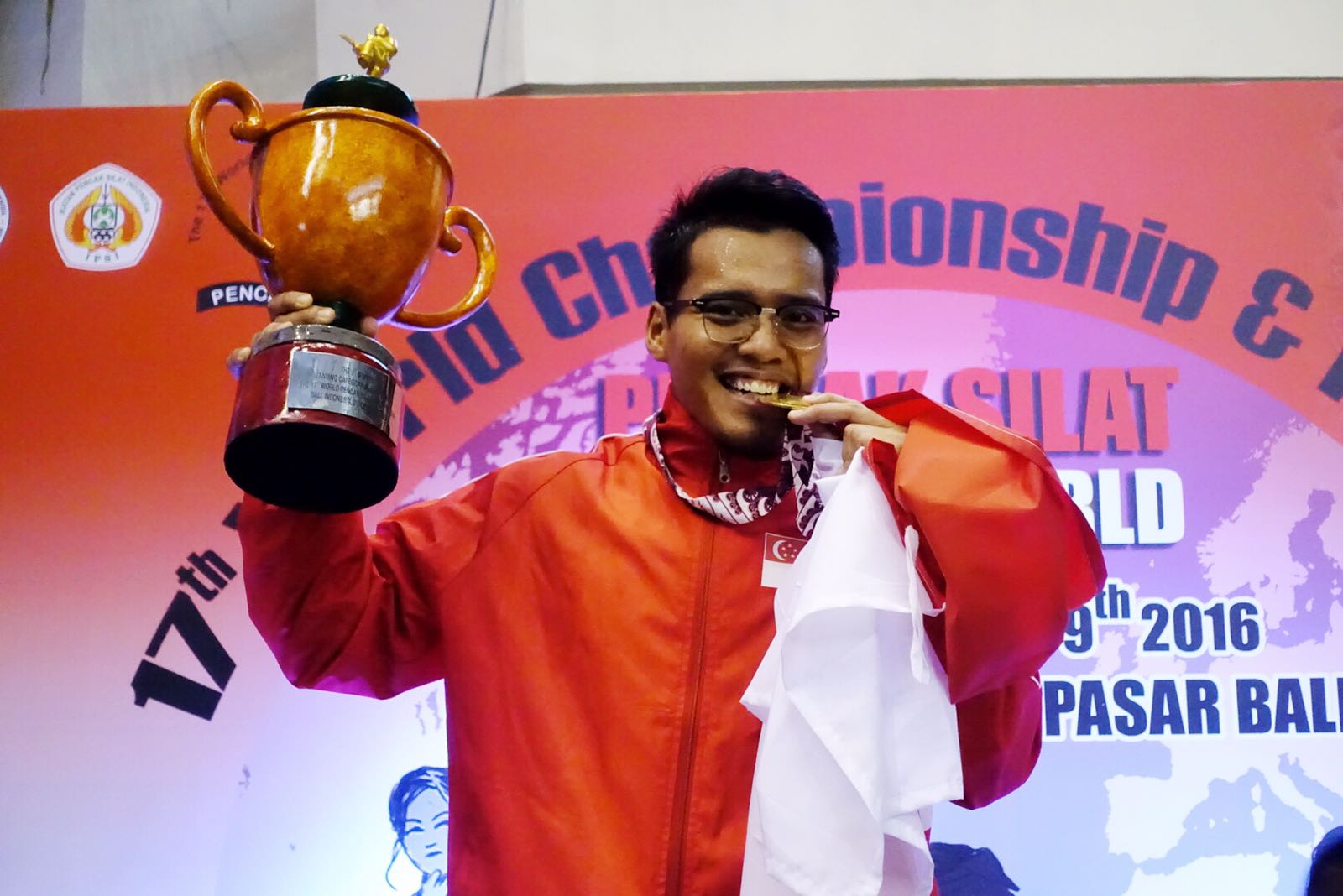
Repeating the feat once again in Bali, Shakir went on to beat Indonesia’s Firdhana Wahyu Putra in the 2016 Final to became a two-time World Champion, just like his Class J compatriot.
Team Singapore’s Shakir Juanda, who won the Class I world title on Dec 8. (Photo: Singapore Silat Federation)
Acknowledging his young team-mate’s precocious talent, Shakir said: “Shaik Farhan belongs to a new breed of champions. How they think is different from us (senior athletes), as their drive to succeed is very high. Our juniors have a lot of talent in them, but they’d have to be properly nurtured so that once they transition into the senior squad, they’ll be well-prepared to compete at a high level.
“For myself, I’m a late bloomer as I only tasted success at 24. But now, we have guys who start winning at 17 or 18. I definitely think we have a good bunch of talents waiting in the wings that just need continued guidance,” said the 28-year-old, who had to compete in the Artistic competition instead in the 2015 SEA Games, due to a previous injury.
Accepting his role as the senior member of the national squad, Shakir says he now mentors his younger counterparts on how to deal with pre-match nerves. “I do indeed give encouragement to them as most are new, and they do not know what to expect.
“I told some of them: ‘Hey, you may be a newbie but feel free to go all out, as people don’t have any expectations of you. There’s nothing to be afraid of.’”
He added: “On my end, I give them moral support and motivation so that they’d have the self-belief to give their 100 per cent. I think it’s normal for one to be nervous right before a match, as it’s the body’s way of telling itself to get ready.
“But too much nervousness is not good as well, as it will affect your warm-up and when you’re too hyped up, you tend to lose your composure and so on.”
INSPIRING THE NEXT GENERATION OF CHAMPIONS
With both Shaik Farhan and Shakir Juanda’s wins at the recently concluded World Championships in Bali, Singapore Silat’s Shaik Alau’ddin hopes that it’ll inspire more youths to join the national team. “In Farhan’s case, he made a mark at the age of 17 as he won the 2015 world title. His achievement shows that anyone out there can be a champion at 17.
“This helps me convince parents who send their juniors to train with the national team, that their kids too, can be a world champion like Farhan. So that’s a good thing.”
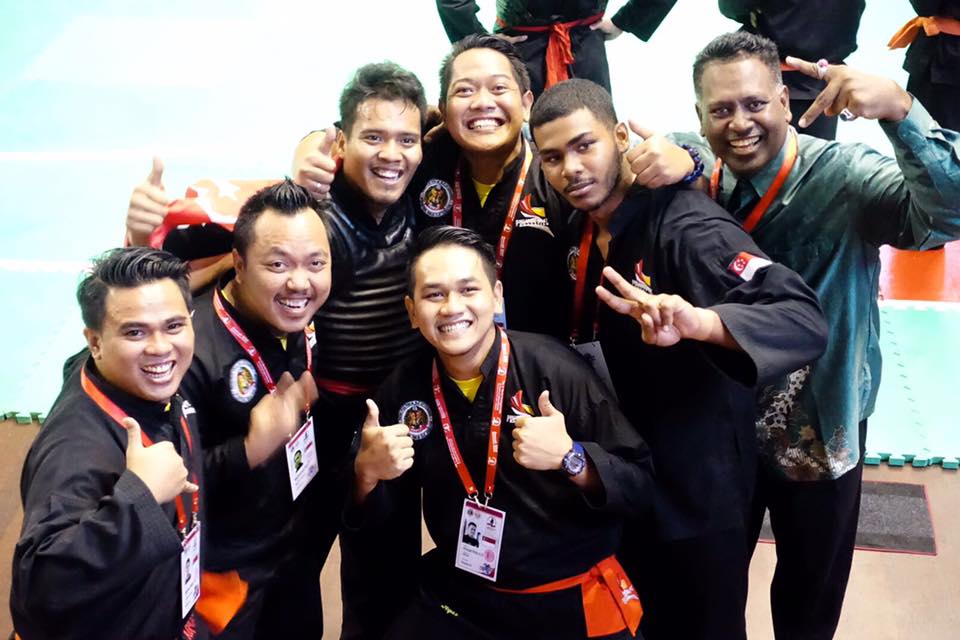
The Singapore silat exponents at the World Pencak Silat Championships in Bali. (Photo: Singapore Silat Federation/Facebook)
“We have only one veteran in the squad, Shakir (Juanda). He’s there to show that one can have a long competitive journey in silat, to even beyond their late 20s,” he said.
“I think with these two guys, their age will help me open doors and persuade more young athletes, and even their parents and clubs, that every single one of them is important to the national cause.”
Hinting at future plans to promote the sport further, the Silat Federation CEO said: “For 2017 we’d like to explore publicising the sport through mainstream and social media. We want more people to aware that we are recruiting new athletes regardless of their age – from the age of 3 to young adults at 17 – as long as they have the desire to work hard.
“It doesn’t matter if they don’t yet know how to kick, as we will train them. We want to invest time for them to be ready for a major championship.”