Home Blog Page 2142

Islamic religious teachers must be registered with Muis from January 2017

0

SINGAPORE — With the Asatizah Recognition Scheme (ARS) to be made compulsory on Sunday (Jan 1), religious teachers, or asatizah, who are not registered under the scheme would have a three-month grace period to do so, the Islamic Religious Council of Singapore (Muis) said on Thursday (Dec 29).  

Announcing details to ease religious teachers and organisations into the scheme, Muis said that a grace period of up to three years would also be granted to those who do not meet the academic qualification requirement now. 

In the interim, these teachers could be granted provisional recognition under the scheme that allows them to teach basic subjects such as Quranic literacy and basic Islamic rituals. 

Islamic education centres and providers will have to register with Muis and employ only asatizah recognised under the scheme. Those that do not meet the requirements will be given a one-year grace period to make the necessary adjustments, including hiring new asatizah under the scheme, or acquire provisional ARS licences for asatizah not registered with it, or tweaking their curriculum. Islamic education centres and providers refer to those who provide religious instruction to non-family members regularly on their own premises or otherwise. These include running classes at mosques, private Islamic education centres, and residences. 

The move towards mandatory ARS — first announced on the sidelines of this year’s National Day Rally by Minister-in-charge of Muslim Affairs Yaacob Ibrahim — comes at a time when there is “growing religious consciousness” among the Muslim community here, Muis said. 

Mr Abdul Razak Hassan Maricar, chief executive officer of Muis, said that the scheme has particular importance in today’s context. “There is a need to present contextualised teaching and guard against extreme and exclusive teachings, and of course, problematic teachers.” 

“It gives some assurance to the community that they will get reliable and appropriate religious guidance, only from recognised asatizah,” he added.  

The ARS is voluntary for now, with 2,500 asatizah — or the majority of all Islamic teachers in the Islamic education sector. 

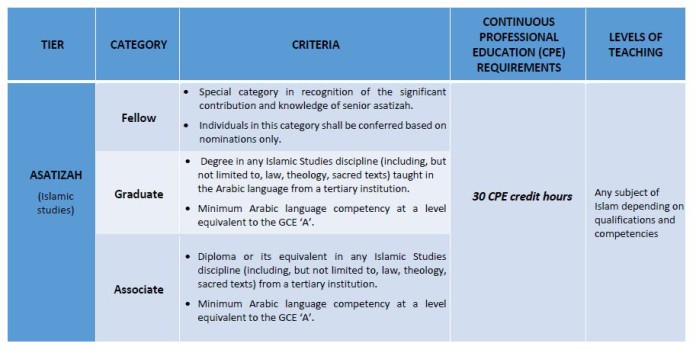
The scheme, which started in 2005, is administered by Muis and the Singapore Islamic Scholars and Religious Teachers Association (Pergas). It recognises teachers and scholars who meet the minimum standards of qualification to preach and teach Islamic religious knowledge. 

Under these standards — split into two tiers, one for asatizah and another for Quranic teachers — asatizah will need to undergo at least 30 credit hours of continuous professional education (CPE) modules in three years. These include skills-based courses such as counselling, as well as content-based modules such as sociology of religion. Quranic teachers will need to undergo at least 10 credit hours of CPE over the same period of time. 

The ARS also contains a code of ethics, for registered asatizah to follow. These include what not to teach — advocating political ideas that may encourage extremism, for example — as well as a code of conduct. 

Any asatizah and/or Islamic education centres and providers flouting the rules may have their recognition status suspended or cancelled by Muis. Nevertheless, the council stressed that remedial measures, including counselling, will be the first resort.  

On the matter of enforcing the scheme, particularly on home-based teachers, Mr Abdul Razak said that “residents and neighbours are encouraged to approach their mosques to find out which are the asatizah approved to teach”.

He added: “We do think that those who are teaching at home are (mostly) under the scheme.” 

ARS will not apply to foreign religious speakers as they are regulated under the Manpower Ministry’s Miscellaneous Work Pass scheme. Singapore sponsors of these speakers have to ensure that the speakers possess formal religious training before applying for the work pass. 

Muis said: “We have to ensure that the standards we apply to local teachers also have to apply to foreign teachers, just by a different mechanism.” 

At the National Day Rally this year, Dr Yaacob told reporters that some 20 per cent of asatizah in Singapore are not under the ARS. Since that announcement, Muis has said that “more than 100” asatizah not under the scheme have registered with it.

Source link

Singapore GDP in Q4 likely to show economy dodging recession, analysts say

0


SINGAPORE –

Singapore’s economy is expected to grow in the fourth quarter to avoid a recession, but the outlook is affected by the uncertainty surrounding the global trade from the Trump government.

Gross domestic product (GDP) for the October-December quarter is forecast to grow by 3.7% year-on-year, supported by a rise in factory production in November, according to a median Reuters poll.

While this would be an improvement seen from the contraction of 2.0% in the third quarter, analysts were cautious about the outlook for Singapore’s trade-dependent economy.

The government’s estimate of fourth-quarter gross domestic product is expected to be 8 am local time (0000 GMT) on January 3. “Look at the number of downside risks we face globally,” said Nomura economist Brian Tan. “You obviously have Trump, and what protectionist measures he can take.

China’s economic slowdown, the UK back to Europe and European elections also bring risks, while the domestic labor market is showing signs of weakness, Tan 2017 GDP growth of 0.7%.

In a recent central bank survey, the median forecast for economists was a 1.5 per cent rise in gross domestic product in 2017.

The government’s forecast for growth for the full year is 1.0 to 1.5 per cent, putting the economy on track for the weakest performance since 2009, when GDP shrank by 0.6 per cent.

The median forecast for 11 economists in the Reuters poll is that the fourth-quarter gross domestic product grew 0.6 percent from a year earlier and grew 1.1 percent in the third quarter.

Analysts said the government’s budget and the recommendations from the Economic Commission for the future, is expected in the first quarter, are not likely to contain measures to stimulate the short-term growth to a large extent. “It’s just possible … to provide some mitigation for the corporate sector, it will not significantly change the dial on the headline GDP growth,” said Selena Ling, director of fund research and strategy at OCBC Bank.

The Commission is responsible for finding strategies to maintain Singapore’s economic competitiveness and identify growth areas.

While most analysts believe the Monetary Authority of Singapore (MAS) kept its exchange rate policy unchanged in April, some expect the central bank to ease as growth prospects are poor.

NatWest Markets Asian economist Vaninder Singh said in a recent research report that the fourth quarter, an increase of less than 1%, will promote the April monetary easing. “If we get such a figure, it will strengthen our confidence and call for a 1% reduction in repositioning,” Singh said. “Singapore’s major monetary mechanism is Singapore’s nominal effective exchange rate (NEER) policy band.

Such an up-to-date figure will provide more room for the Singapore dollar NEER to weaken the current policy context.

At its most recent meeting in October, MAS kept the policy unchanged. It relaxed its policy in April, since January 2015 since the third easing.

Image:

Publication Date:
Thursday, December 29, 2016 – 16:39
Send to mobile app:
Source:

Story Type:
Others

Source link

Growing problem for local seagrass

0


Most Singapore seagrasses have not been sexually propagated for at least three to four years, and the scientists concerned are trying to figure out what is wrong.

The lack of sexual reproduction – the creation of new plants through flowers and seeds – may lead to a decline in the genetic diversity of seagrass populations, making them more susceptible to mass mortality.

This will harm the environment in many ways because seagrass meadows store up to 30 times more efficiently than rainforests and are key breeding grounds for marine animals such as dugongs in Singapore waters.

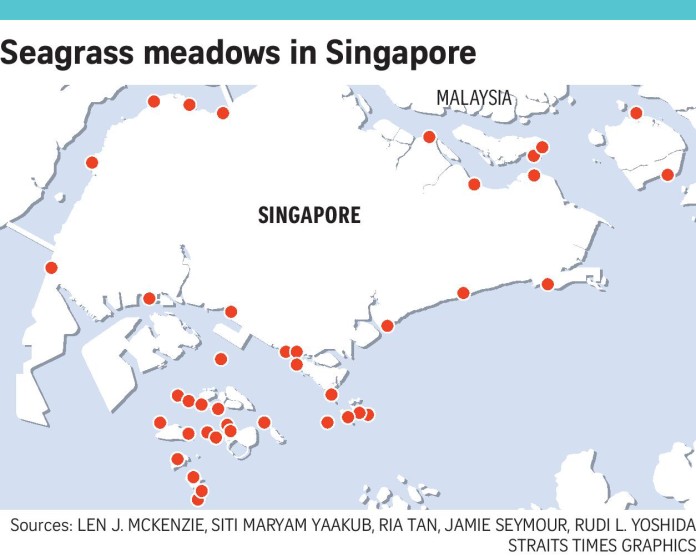
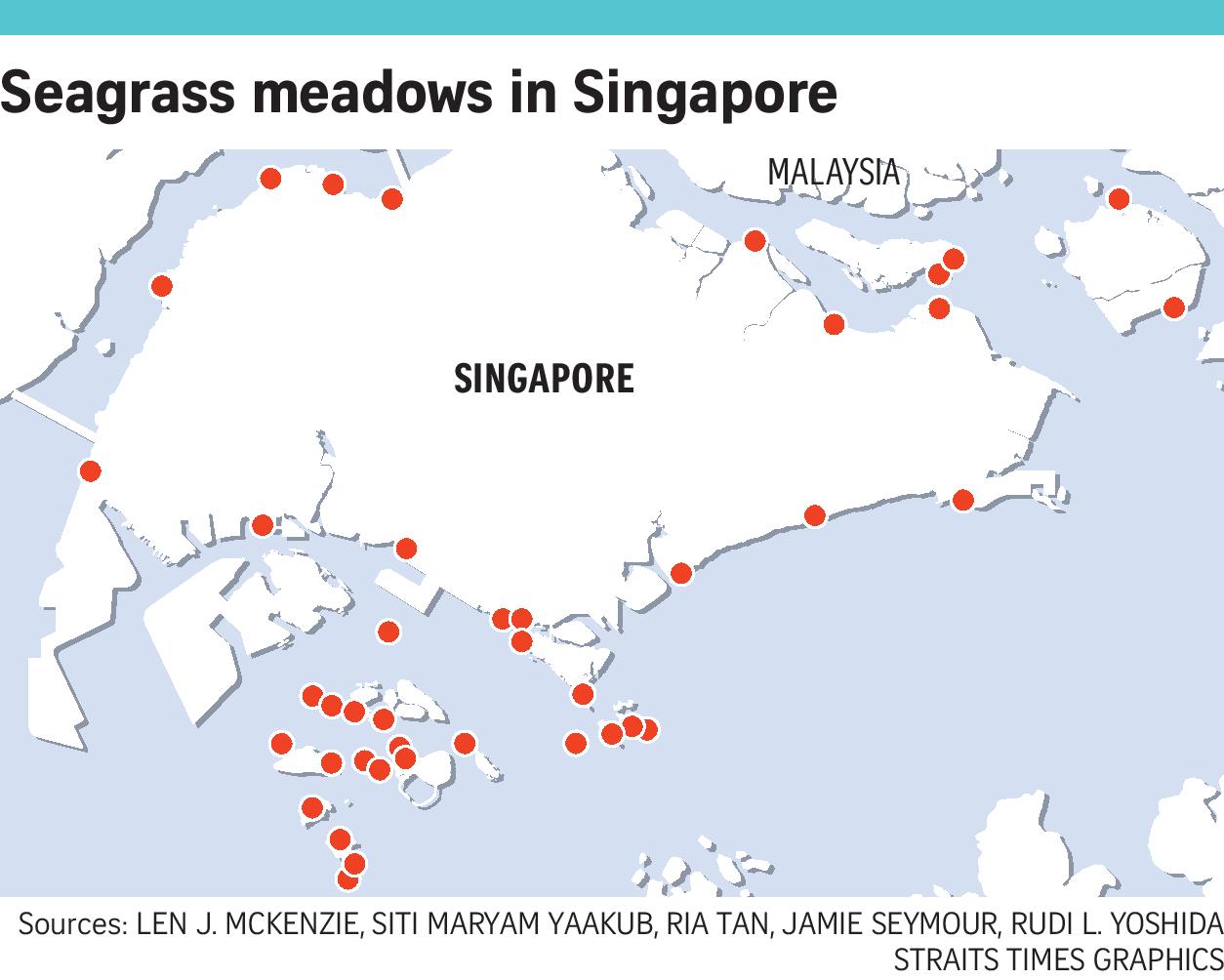
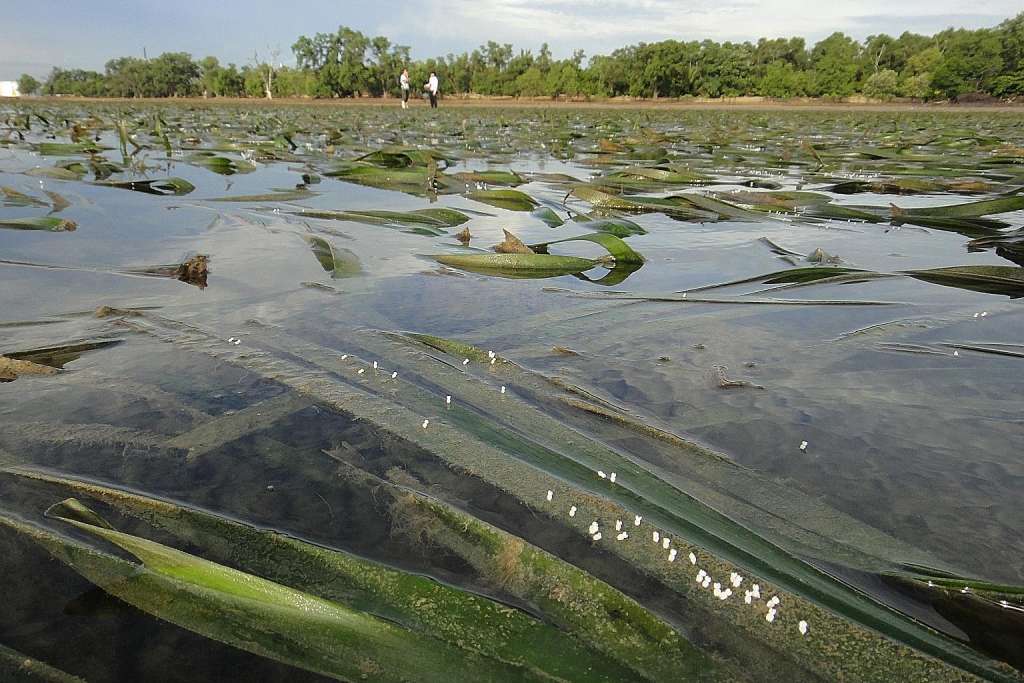
Hidden in the waves, often covered by more colored coral reefs, seagrass meadows dot the coast and ocean all over the country (see map).

Like most of the country’s natural heritage, they have been declining for decades, with about 40 per cent of the original cover lost to coastal development.

According to the National Parks Commission (NParks), Singapore has 12 seagrass varieties, 23 in the Indian Pacific region.

Since 2007, scientists and volunteers regularly monitor their health status.

In addition to their actual investigative work, they often see seagrass producing fruits and flowers.

Dr. Siti Maryam Yaakub, 35, has led a number of trips and said that because Singapore is a tropical country, seagrass should blossom and bear fruit throughout the year.

“We want to see them at almost every low tide.

But about three to four years ago, senior marine ecologists at DHI’s Department of Water and Environment began to notice that most of the flowers and fruits had ceased to exist.

Seagrass populations can grow by cloning themselves, and long-term surveys do see an increase in the size of some grasslands, such as those in Chek Jawa in the Ugan Group.

But Dr. Siti said the clonal growth – if Singapore ‘s seaweed is indeed being done, could mean that all new seagrasses are equally susceptible to stress factors such as disease, making it easier for the entire new population to die at the same time.

In addition, no seeds lying in the environment, new plants more difficult to come back.

Samantha Lai, PhD candidate at the National Laboratory for Marine Ecology at the National University of Singapore (NUS), says there is already one such case in Semakau Island.

In 2009, the island ‘s seagrass meadow suddenly died, and in addition to some of the scattered seaweed, the area was still barren, she said.

Dr Lai said environmental factors were also the culprit, but added that one of the consequences of not having enough sex was “not enough seedlings or seeds to help Semakau recover.”

Dr. Siti described the seagrass research as “very nascent” and acknowledged that there are a lot of researchers who do not understand but they “work hard to fill many of these gaps.”

This is the purpose of their current research, involving NParks in collaboration with the National University and DHI.

Dr. Karenne Tun, Director of NParks National Center for Biodiversity (Coastal and Marine), said that the three-year research project, by mid-2018, aims to better understand the segregation patterns of seagrass and assess how to restore them. For a variety of pressures.

“By assessing the status, connectivity and productivity of seagrass meadows in Singapore, we will be able to develop measures to protect seagrass, including restoration of their habitat.

“We’re just understanding the behavior of the seagrass ticks,” Dr. Siti said.

“Filling these gaps in our knowledge is the best chance for us to ensure that they continue to survive.

josehong@sph.com.sg


This article was first published on Dec 29, 2016.
Get a copy of The Straits Times or go to straitstimes.com for more stories.

Image:
Category:
Blurb:
Publication Date:
Thursday, December 29, 2016 – 17:00
Send to mobile app:
Source:

Story Type:
Others

Source link

Philippines Duterte says China’s manmade islands not a problem

0


Philippine President Rodrigo Duttett said Thursday that the United States can not obstruct China’s island construction in the South China Sea, indicating that there is no serious concern about its militarization or reclamation work. The leaders reiterated that he wanted to avoid a confrontation with China and felt that there was no need to forcefully compel it to abide by an international tribunal ruling in July that it favored the Philippines in the South China Sea.

When asked about the TV interview, Duterte said it would be “in my time” but he was not yet ready to discuss the ruling of the PCA in The Hague, nor of China.

He said he did not intend to actively pursue the Philippine maritime claims and occupation of China, the only power to do so is the United States.

He told CNN the Philippines, referring to a ruling rejecting China’s extensive claims in the South China Sea, “I can not let go of being adopted and neglected.” But are you ready to talk to me? Because if you are not, I’m not ready, “he said, referring to China.

Duterte made a stunning turn on foreign policy a few months ago when he made suggestions to long-term rivals China and started the traditional allies of the United States. He had previously defeated the arbitration case, saying in October he was “behind” in his talks in China.

He often praises China and says he wants China to play a prominent role in its economy. Duttle also expressed concern that China is militarizing the South China Sea, and its clean-up work and construction activities on the reef undisturbed performance, including a few in the exclusive economic zone of Manila (EEZ).

Asked if he was worried, he said. “No, because if it’s really a serious problem, then

United States should lead the way and stop it. “I said, right at the beginning, when the first spray of soil was tossed out to the area they (China) reclaimed, why did their (US) think-tank not think?”

Duterte said the one situation where he would take a stand against China was if it were to start exploiting natural resources within Philippine sovereign territory. He likened it to children bickering over inheritance.

The Philippines has within its EEZ deposits of oil and gas but lacks the expertise to exploit them. It has also been complicated by China laying claim to the same waters. “When the minerals are already being siphoned out,” he said when asked under what condition he would challenge China.

“(It’s a) question of money. ‘Wait a minute, I thought we’re friends’,” he said. “The wealth that comes out there, it is like inheritance when your father and mother dies, that is a mess.”

Image:
Category:
Publication Date:
Thursday, December 29, 2016 – 16:22
Send to mobile app:
Source:

Hermes ID:
2 838 668
Hermes ID String:
AS1229-DUTERTE-SCS
Hermes Author:
SSANDREA
Story Type:
Others

Source link

Philippine leader Duterte says he once threw man from helicopter, would do it again

0


MANILA –

Filipino President Rodríguez Dutett threatened to embezzle government officials who could be thrown out of a helicopter over the air, warning him to have done it before, without questioning again.

The ebullient former prosecutor said he had a Chinese suspected of rape and murder helicopters. “If you’re corrupt, I’ll take you to Manila with a helicopter and I’ll throw you out, I’ve done it before, why do not I do it again?” Duterte said during a speech on Tuesday’s typhoon victims, Video feed in the presidential office.

Duterte’s latest threat was only a few weeks later, he admitted killing the man in his 22 years as mayor of Davao, and sometimes riding a motorcycle looking for “encounter murder.”

He said the killings were part of a legitimate police operation, including hostage incidents. Some senators have warned Duterte that he could play over his comments.

Duterte also said six people were arrested last week, more than half a ton of methamphetamine, locally known as the “shabu shabu”, fortunately he left the city in the capital. “They were lucky that I was not in Manila’s time, and if I knew there were so many shabu-shabu in the house, I would definitely kill you,” he said. “Let’s not do any drama, if no one else will do it, I’ll knock you down … Helicopter incident Duterte The time or place where the talk took place was not clear.” His spokesman Ernesto Abella suggested that this might not have happened. We just said, ‘City Legend’, “Abela told reporters, without elaborating.

Duterte responded to the school last week by calling him “stupid”, “idiot” and “son of a bitch”, the UN’s top human rights envoy called for an investigation into Duttle’s murder.

Image:
Category:
Publication Date:
Thursday, December 29, 2016 – 15:39
Send to mobile app:
Source:

Hermes ID:
2 838 493
Hermes ID String:
AS1229-DUTERTE1
Hermes Author:
SSANDREA
Story Type:
Others

Source link

I won’t replace humans with a machine, says food entrepreneur Daniel Tay

0

SINGAPORE: The cheesecake, with its soft filling and crusty bottom, is a dessert synonymous with New York. But homegrown food entrepreneur Daniel Tay is hoping his Asian twists on it will soon make it a uniquely Singaporean product abroad.

With cheesecake variants like yuzu and lychee, the Singapore-inspired Milo Dinosaur and durian, the French-trained award-winning pastry chef wants to excite consumers in the United States and Australia.

“I think they will love it. I think some flavours which they have never tasted before, they would say, ‘Wow this is Singapore. Singaporeans can really make great cakes’,” said Mr Tay, 46, during an interview at his 14,000 sq ft central kitchen in Kampong Ampat.

Foodgnostic’s Daniel Tay is hoping his ‘mao shan wang’ durian cheesecake will catch in China. (Photo: Cat And The Fiddle)

The kitchen is home to his wholesale manufacturing and baked goods supplying company Foodgnostic, and its sister company Cat And The Fiddle, the online retail arm of his cheesecake business.

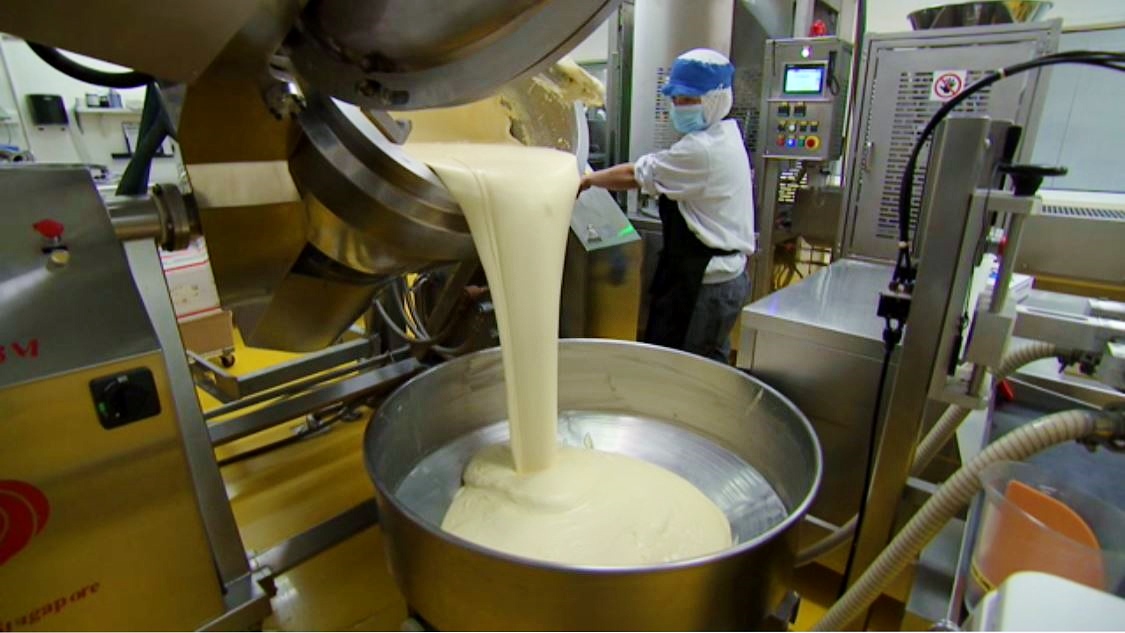
Within its walls lies the technology that has enabled him to produce his cheesecakes in enough quantity and consistency to supply to regional markets. Since April, Mr Tay has been testing the China market, sending samples to restaurants and hotels there.

“We’re taking things slow in China. Our strawberry and coffee-flavoured cheesecakes are doing well. We have one restaurant ready to deal with us. Things are too early to tell, but if they (the consumers) like it, it will be massive,” he said.

Foodgnostic also has a factory in Malaysia which produces halal cakes under the Cat And The Fiddle brand. It’s still at the stage of “testing the waters” of the Malaysian market and studying the logistical challenges.

Mr Tay says he is also looking to produce cheesecakes for markets in Myanmar, Cambodia and Vietnam. 

Watch: The story behind Daniel Tay’s global ambition

With 500 to 1,000 cheesecakes being produced a day from his Foodgnostic kitchen floor, Mr Tay said: “We are trying to ramp it up to 2,000 or 3,000 in the next year, and hopefully when we get our new line, we maybe (could bake) 10,000 a day.”

This year alone, “S$600,000 to S$700,000” has been invested in Foodgnostic’s technology as he seeks to innovate and leverage on robotics, he revealed at a recent panel discussion for Channel NewsAsia’s year-end special, Singapore Review 2016 (which airs Friday, Dec 30, at 8pm).

Mr Tay established his name on the local culinary scene when he founded patisserie-café chain Bakerzin in 1998, after a stint as pastry chef at French restaurant Les Amis. He sold off Bakerzin in 2007 and resigned as its chief executive in 2013 to start Foodgnostic.

STILL A JOB FOR HUMANS

But Mr Tay’s investment in kitchen automation at Foodgnostic has been viewed by some with jaundiced eyes.

“There are times when I talk about robotics, there are some negative comments, like, ‘Oh, so you are not paying, so you are retrenching people’, he said.

“I said, ‘No, we never retrench unless someone did something very bad to the company. We never ask people to leave. And we would not replace humans with machines. We will never, never replace.’”

He added: “This company is definitely not buying a machine and saying, ‘Hey, I think you do not have a job.’ That’s definitely a no-no.”

Rather, he said, he embraces technology with the aim of improving the productivity and efficiency of each worker. “It is just an addition for them to produce more.

“If I buy the machine with the same amount of staff that I have, (the question is) how much more can I produce? Can I produce three times more, four times more, and still sell?

“A reduction of staff and an increase in productivity are two different things. We have to make it clear that buying machines is not to replace humans. It is to make our employees more productive.”

IF HAAGEN-DAZS CAN DO IT…

And he’s pushing ahead with the confidence that there will be a receptive international market for his uniquely-flavoured cheesecakes.

“It is like if Häagen-Dazs can ship their ice cream all over the world and sell their brand, then it is the same thing that I want to do. I want to sell the Singapore taste,” he said.

“I believe we can now use the ‘Made In Singapore’ brand… because we are popular enough to sell our local-flavoured cheesecake overseas and educate (others) about our country’s unique flavours.”

Although, he admits that Americans might not be quite ready for durian cheesecake yet. But, “Milo Dinosaur, that is very Asian. So we are going to make it a little bit louder, a little bit bolder and tell them, ‘Hey this is our cheesecake, try it’.”

Singapore Review 2016 looks at the economic challenges and opportunities for entrepreneurs. It premieres Dec 30, at 8pm (SG/HK), with an encore telecast on Dec 31, 6pm.

Source link

Looking forward to 2017: Greener rides on track

0

Green will be the colour for 2017 in the land transport sector.

Several changes and developments will pave the way for a more environmentally sustainable way of travel, starting with the opening of Downtown Line 3.

When this 21km MRT line stretching from River Valley to Expo opens by the second half of the year, it will encourage more people to leave their cars at home and take the train.

It will complete a 42km line that links the east of the island to the city centre and the north-west.

Hence, its full potential as a pan-island transit project will be realised.

Trains will not only reach new catchment areas, such as Jalan Besar, Kaki Bukit and Upper Changi, but also provide more convenient options to commuters who may not have to make transfers to complete a journey.

And if a breakdown occurs, say, on the East-West Line, commuters do not have to go far to get onto another line.

Meanwhile, people working in Tuas will get to ride a new line earlier.

The Tuas West Extension – a 7.5km line that goes west from Joo Koon station on the East-West Line – will open in the second quarter.

The extension, which was originally slated to open by the end of this year, will be a boon to those who work or have business operations in the Tuas district.

Despite its vastness, the area is not well served by public transport.

Those who have no choice but to drive today will have an alternative when the line opens.

The two new MRT lines will help boost daily rail ridership towards the 3.5 million mark, up from just more than three million today.

This, in turn, will potentially reduce car usage. The annual mileage clocked on average here has already dropped to 17,500km – down from 21,075km in 2006.

National University of Singapore transport researcher Lee Der Horng said: “In recent years, the bus contracting model, bus enhancement programme, bus service reliability framework, new rail financing framework, upgrade and renewal of train systems, all have contributed to make Singapore’s public transport system the preferred mode of travel.”

Elsewhere, a review of the annual growth rate cap on the vehicle population is on the cards next year .

Currently at 0.25 per cent, it could be cut to zero when the new certificate of entitlement quota starts in February 2018.

In line with its aim to make Singapore “car-lite”, the Government has already hinted strongly at a zero growth rate.

Prof Lee said this might prove to be “a culture shock” to people “who have long recognised driving as the most convenient mode of travel”.

“To a large extent, the city was designed to serve motorised vehicles,” he added.

For a successful shift from private to public transport, Prof Lee said a fine balance between “push and pull measures” must be in place.

In this vein, a national electric vehicle sharing scheme slated to be plugged in – possibly by the third quarter – might come in handy.

Of course, questions remain – such as how economically viable the scheme is without subsidies, and how practical it is for families to squeeze into the small bubble-shaped hatchbacks to be used.

But if the scheme takes off, it will contribute in a small way to cleaner air in the city.

So will two other changes slated for 2017 – implementation of Euro 6 emission standards for petrol vehicles in September, and a review of the current Carbon Emissions- based Vehicle Scheme (CEVS) by June.

Euro 6 is the strictest emission standard in Europe today. It stipulates a significant reduction in noxious tailpipe emissions, in particular nitrogen oxides and fine particulate matter.

Singapore currently enforces the Euro 4 standard for petrol vehicles and Euro 5 for diesel models.

By 2018, diesel vehicles here will have to conform to Euro 6 too.

Just as significant will be a revision to CEVS.

The current scheme, slated to run out by the end of June next year, dishes out tax rebates and surcharges according to how much carbon dioxide a car produces.

The revision is likely to also take into account other pollutants and, as a result, possibly be kinder to electric vehicles.

“We are heading in the right direction,” Prof Lee noted.

christan@sph.com.sg


This article was first published on Dec 29, 2016.
Get a copy of The Straits Times or go to straitstimes.com for more stories.

Image: 
Category: 
Publication Date: 
Thursday, December 29, 2016 – 17:00
Send to mobile app: 
Source: 


Story Type: 
Others

Source link

South Korea prosecutor seeks arrest warrant for pension fund chief

0

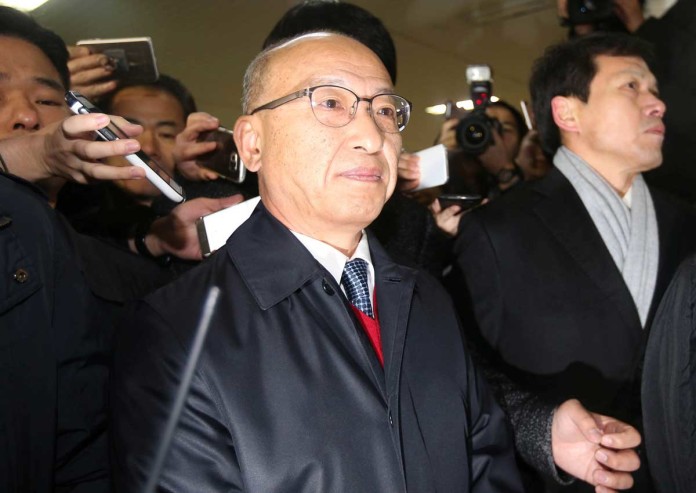
SEOUL – South Korean prosecutors investigating an influence-peddling scandal that has engulfed President Park Geun-hye said on Thursday they are seeking a warrant to arrest the head of the national pension fund, the world’s third-largest.

National Pension Service (NPS) Chairman Moon Hyung-pyo acknowledged that he had pressured the fund to approve an US$8 billion (S$11.6 billion) merger between two Samsung Group units last year while he was head of the health ministry, the special prosecutor’s office told a media briefing.

Moon had denied during a parliamentary hearing in November that he had exerted pressure on the NPS, which is run by the health ministry, to back the merger as a major shareholder.

The merger last year of Samsung Group affiliates Cheil Industries Inc and Samsung C&T Corp has become central to the investigation of the scandal that led parliament to vote this month to impeach Park.

The special prosecutor said it had applied to a court for a warrant to arrest Moon, who has been under emergency detention since early Wednesday, on charges of abuse of power and giving false testimony. “What we can say is former minister Moon initially denied the charge (of pressuring NPS) but acknowledged that he ordered NPS to vote for the merger at the time when he was the minister,” said Lee Kyu-chul, spokesman for the special prosecution team.

Lee declined to provide further details on why Moon had ordered the NPS to support the merger.

The NPS declined to comment.

Investigators are also examining whether Samsung’s support for a business and foundations backed by the president’s friend, Choi Soon-sil, who is at the centre of the influence-peddling scandal, may have been connected to NPS support for the merger, a prosecution official told Reuters last week.

Park is accused of colluding with Choi, who has been indicted and is in custody, to pressure big businesses to make contributions to non-profit foundations backing presidential initiatives.

Park has denied wrongdoing but apologised for carelessness in her ties with Choi, a friend for four decades, who has also denied wrongdoing.

Choi is in detention pending trial. She has also denied wrongdoing.

Parliament voted to impeach Park over the scandal on Dec. 9, a decision that must be upheld or overturned by the Constitutional Court within 180 days.

Image: 
Category: 
Publication Date: 
Thursday, December 29, 2016 – 15:09
Send to mobile app: 
Source: 


Hermes ID: 
2 838 302
Hermes ID String: 
AS1229-SKOREA-ARREST
Hermes Author: 
SSANDREA
Story Type: 
Others

Source link

S'pore must adapt to survive: Chan Chun Sing

0

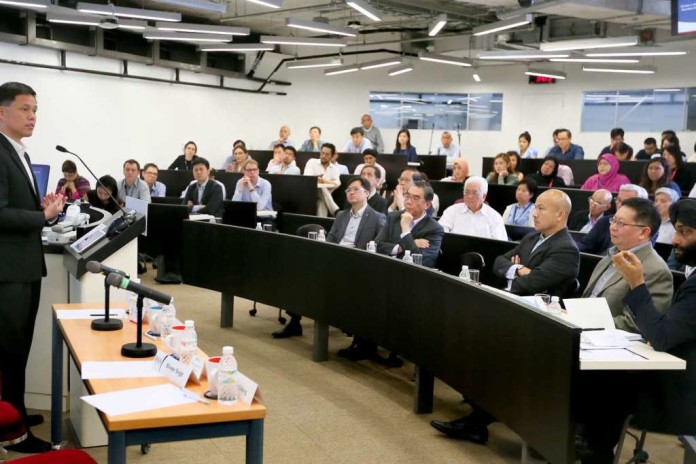
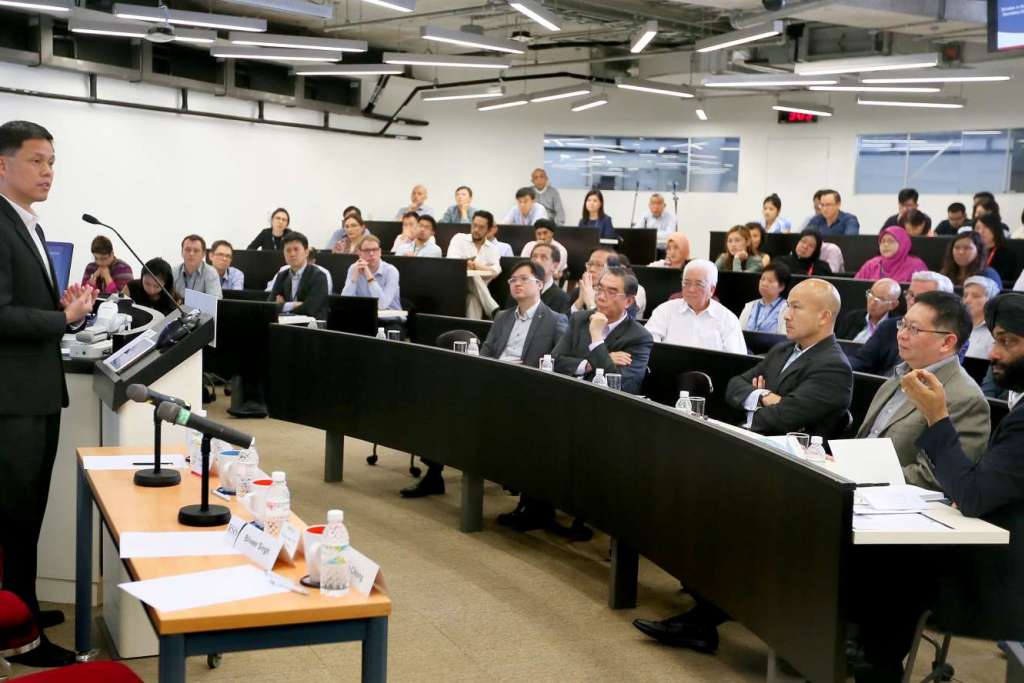
There is a lesson buried in the past of small countries with long histories, said Minister in the Prime Minister’s Office Chan Chun Sing yesterday.

They lasted because they could “read the winds and ride the waves” of change in their environment and adjust to keep afloat.

The need to do it deftly is all the more important as Singapore lies in a region where, historically, small countries do not exist for very long, Mr Chan said in a speech at the launch of a book to mark the 20th anniversary of the S. Rajaratnam School of International Studies.

He called on the school to continue its work in identifying key regional trends and forces so that Singapore can anticipate the ever- changing nature of geopolitics in South-east Asia and make the right moves. “That is the only way small city states like us can survive to defy the odds of history,” he said.

In 1996, Mr Chan was assigned as an army officer to help founding director S R Nathan set up the Institute of Defence and Strategic Studies, which was renamed the S. Rajaratnam School of International Studies (RSIS) in 2007.

Unlike the Institute of Policy Studies and ISEAS – Yusof Ishak Institute, RSIS was never a pure academic institution, noted Mr Chan, who is also secretary-general of the National Trades Union Congress.

It is a place where officials from government agencies with international dealings, such as the Ministry of Defence and Ministry of Foreign Affairs, can take time off from their day-to-day work and think deeper about their fields, he said.

RSIS therefore produces research by individuals with a solid grounding in policymaking, he added.

He suggested using a simple measure to define RSIS’ success – whether it continues to help advance Singapore’s interest as an independent, sovereign country.

The book that was launched is titled Forward Engagement: RSIS As A Think Tank Of International Studies And Security In The Asia-Pacific. Edited by RSIS Associate Professor Alan Chong, it has 18 essays contributed by 23 of the think-tank’s academics and appointment holders.

Their essays, based on research done in the past 20 years, range from cyber security and religion to Singapore’s regional diplomacy.

In one chapter, RSIS professor of security studies Rohan Gunaratna recounts a briefing he gave, during which he told then Senior Minister Lee Kuan Yew that terrorists were targeting bars and restaurants in the region. Just days later, in 2002, bombs struck popular nightclubs in Bali, killing more than 200 people.

Prof Chong, who also spoke at the launch, said RSIS continues to pride itself as a research entity with close links to policymakers.

“The academic mission is qualified with policy needs in mind… RSIS not only provides research papers to government bodies, it assists them with the clout to convene gatherings of experts from Singapore and abroad to share knowledge and trigger productive debates on a variety of issues,” he said.

For instance, RSIS helps to disseminate information on how to counter the radical ideology that terrorists use in their propaganda to recruit fighters.

Forward Engagement is published by World Scientific and available at www.worldscientific.com for $168. It is sold online only.


This article was first published on Dec 29, 2016.
Get a copy of The Straits Times or go to straitstimes.com for more stories.

Image: 
Category: 
Blurb: 
Publication Date: 
Thursday, December 29, 2016 – 16:00
Keywords: 
Send to mobile app: 
Source: 


Story Type: 
Others

Source link

Traffic system for drones?

0

Drones used by companies and government agencies to take photographs and conduct land surveys and inspections are crowding the skies, prompting an urgent need to prevent them from crashing into one another and possibly hurting people as they fall to the ground.

The situation has led researchers of Nanyang Technological University (NTU) to undertake a study to enable hundreds of these drones to fly safely and efficiently in Singapore’s urban airspace.

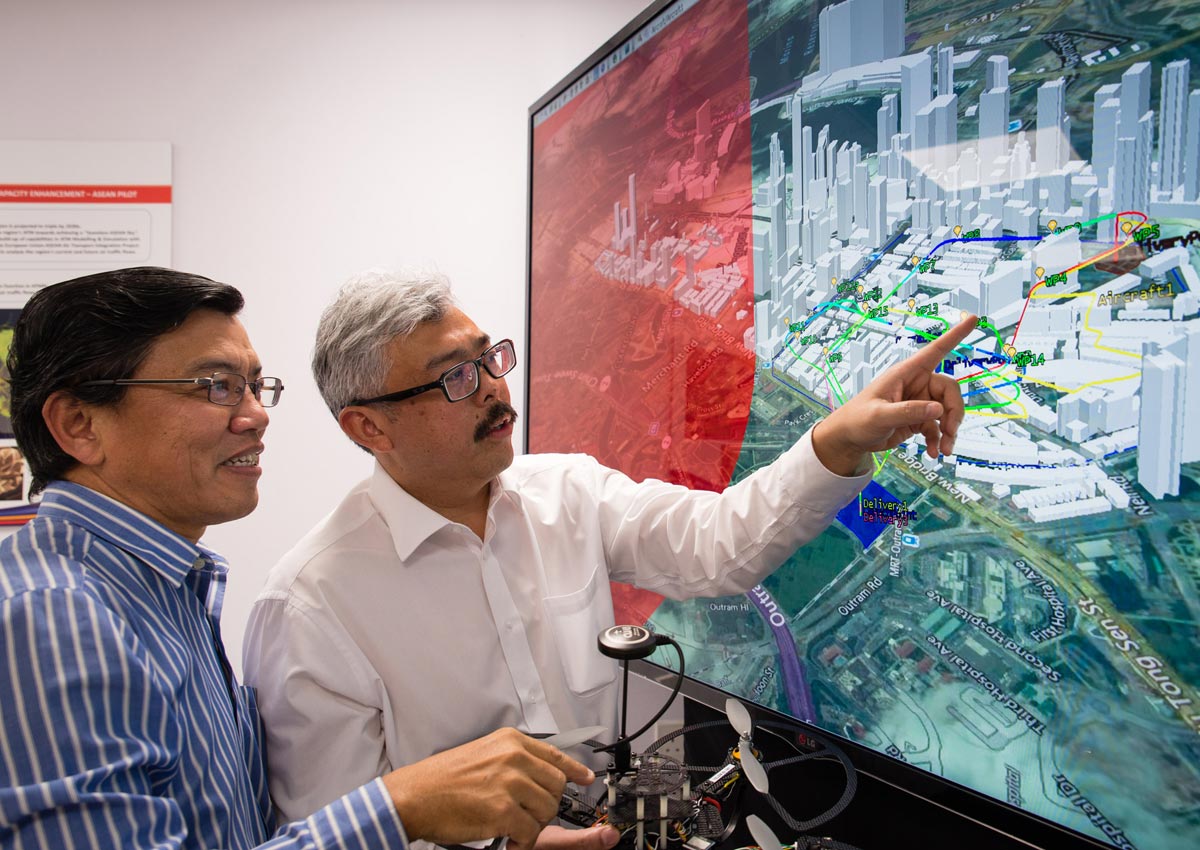
Essentially, they want to come up with a traffic management system for drones, much like how cars on the road have established traffic rules and infrastructure.

“Like our land and sea, the urban airspace is also a finite resource. With so many airspace users, there is a need to manage this urban airspace,” said Mr Mohamed Faisal Salleh, a senior research fellow at NTU’s Air Traffic Management Research Institute.

The institute was set up jointly with the Civil Aviation Authority of Singapore (CAAS) in 2013.

The project is likely to take up to four years to complete, and is led by Professor Low Kin Huat from the School of Mechanical and Aerospace Engineering.

The ideas are currently undergoing conceptual design and tested using computer simulations.

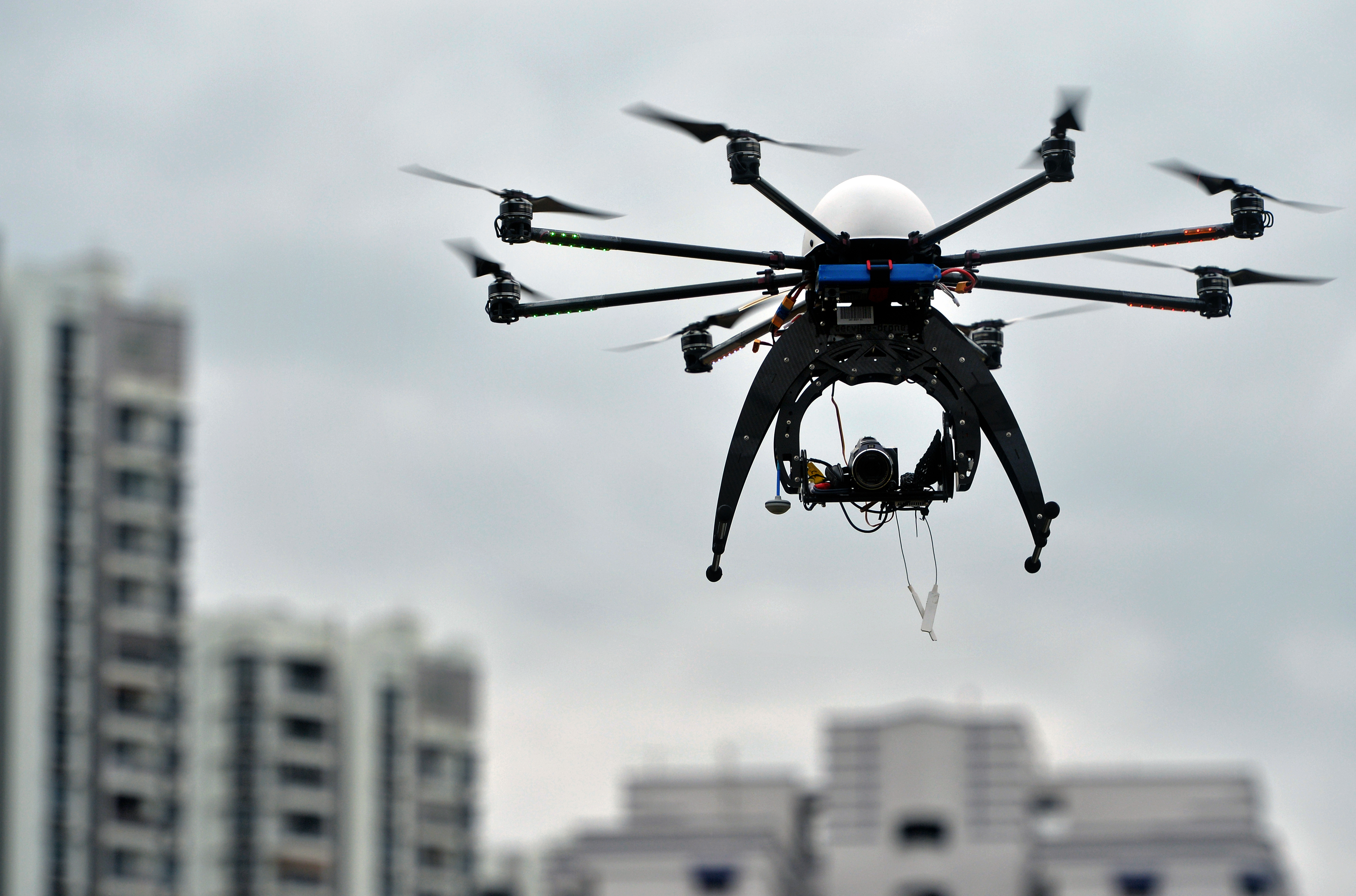
Drone use is increasing among both hobbyists and commercial entities.Photo: The Straits Times

They will be tested in the open skies in 2018 in places like Tuas, away from crowded public areas but with sufficient building density to be a good test-bed.

The focus on drones for commercial and industrial use means hobbyists are unlikely to be affected by the programme, the researchers said.

In airspace management, a key part is to divide the space into air blocks – areas similar to lanes on a road – within which drones can be programmed to fly.

The researchers will also explore the feasibility of designated landing or take-off areas, and how existing infrastructure like roofs of high-rise buildings can be used as emergency landing sites to minimise the risk of injuring people.

One concept being tested is geofencing, in which virtual fences are set up around restricted areas so drones cannot fly over them.

Another is collision detection, which will help drones detect and avoid nearby drones.

Also being tested is the setting up of control stations across the island to track the number of drones in the air, their traffic flow, speed and how far apart they are from one another.

The study comes at a time when drone use is increasing among both hobbyists and commercial entities.

The CAAS, which regulates the commercial use of drones, has received more than 1,300 applications for operator and activity permits since June last year, when a revamped regulatory framework took effect.

It has also received about 1,000 activity permit applications, it said.

Of these, 87 per cent are for aerial photography, videography, surveillance or inspection.

lesterh@sph.com.sg


This article was first published on December 29, 2016.
Get a copy of The Straits Times or go to straitstimes.com for more stories.

Image: 
Category: 
Publication Date: 
Thursday, December 29, 2016 – 15:00
Keywords: 
Send to mobile app: 
Source: 


Story Type: 
Others

Source link