Home Blog Page 1830

SAF in 'preliminary talks' with NZ on training pilots there

0

Singapore is exploring the possibility of deploying fighter jets in New Zealand for pilot training – a move which would deepen the defence ties between both countries.

The Singapore Armed Forces (SAF) is now conducting “preliminary discussions and feasibility studies” with the New Zealand Defence Force on the possible move, Singapore’s Ministry of Defence (Mindef) told The Straits Times yesterday.

It could entail deploying a squadron of the Republic of Singapore Air Force’s (RSAF) F-15 fighters at the Ohakea air base in Manawatu, in the North Island, according to New Zealand media reports.

Up to 500 people could be stationed at the base, or in the region, along with the detachment, reported The New Zealand Herald on Saturday.

New Zealand Defence Minister Gerry Brownlee said in the same report that besides enhancing the strategic alliance with Singapore, there could be economic benefits for the local community with the RSAF deployment.

Mr Brownlee added that he expects the deployment to take a few years to be established if it is given the green light.

When asked about the deployment, a Mindef spokesman told ST: “Overseas flying training in New Zealand will provide opportunities for both sides to enhance defence co-operation and people-to-people ties between our militaries.”

The spokesman added that both countries are “close defence partners, and share a long history of operational and training co-operation”.

Since 1997, the SAF has been sending artillery units annually to New Zealand to conduct live-firing exercises.

The 20th Exercise Thunder Warrior was held last month in the Waiouru Training Area, in North Island, and visited by Defence Minister Ng Eng Hen.

Mindef said that as Singapore is a small country with limited airspace, it will always need overseas training space to maintain its operational readiness.

Singapore has a detachment of F-15s based at the Mountain Home Air Force Base in Idaho, US.

In August last year, it was revealed that the RSAF was looking into conducting fighter training in Guam, an island in the Pacific Ocean, and even setting up a training facility there.

adrianl@sph.com.sg


This article was first published on February 28, 2017.
Get a copy of The Straits Times or go to straitstimes.com for more stories.

Image: 
Category: 
Publication Date: 
Tuesday, February 28, 2017 – 16:00
Send to mobile app: 
Source: 


Story Type: 
Others

Source link

Pizza Hut 1-for-1 mains lunch deals (pizzas, pastas, entrees & more) on weekdays

0

Pizza Hut 1-for-1 mains satisfying lunch deals (pizzas, pastas, entrees & baked rice) on weekdays, 11am to 5pm

Pizza Hut 1-for-1 mains lunch deals (pizzas, pastas, entrees & more) on weekdays

Order a main course and enjoy a second pizza, pasta or entree on the house, all swiftly served for instant happiness. Valid on weekdays from 11am to 5pm, excluding eves of, on public holidays and special occasions.

Source

COEs extended for record number of vehicles

0

Certificates of entitlement (COE) for a record 44,303 vehicles were revalidated last year, with cars making up the bulk of the extensions.

The latest data released by the Land Transport Authority (LTA) showed 29,531 car COEs, 8,850 commercial vehicle COEs and 5,922 motorcycle COEs were revalidated last year.

This exceeded the previous record in 2007, when COEs for 33,339 vehicles – close to 90 per cent being commercial vehicles – were revalidated.

That phenomenon followed a crash in commercial vehicle COE premiums when the market was not ready for a new emission standard and sales plunged.

Fleet owners rushed to revalidate their COEs when the premium hit $1 for six consecutive tenders in early 2007.

Last year’s record was partly fuelled, ironically, by high COE prices. Mr Ron Lim, general manager of Nissan agent Tan Chong Motor, said: “Car owners were expecting COE prices to come down, and they were buying time.”

Read also: COEs end slightly lower for second bidding exercise in Jan 2017 

Indeed, the LTA figures showed that more than three-quarters of car COE revalidations were for five-year periods.

COE revalidations can be done for either five or 10 years. For cars, five-year revalidations cannot be further extended, but those for 10 years can.

Mr Lim noted: “Most of the revalidations happened in the first half, before the car loan restrictions were relaxed.”

The Monetary Authority of Singapore eased car loan curbs in May.

Last year’s record figure – representing nearly one-third of vehicles which had turned 10 years old in 2016 – dovetails with an ageing vehicle population.

Motorists are keeping their cars a lot longer than before. Today, 44 per cent of cars are between seven and 10 years old, versus merely 2 per cent a decade ago.

Observers see the trend continuing. Car dealers pointed to models which qualified for the Green Vehicle Rebate and the Carbon Emissions-based Vehicle Scheme as prime candidates for revalidation.

These cars will have low or negligible scrap rebate.

“The opportunity cost for owners who are considering revalidation will be low,” noted Mr Lim.

Mr Norman Lee, honorary general secretary of the Singapore Motorcycle Trade Association, said the recently announced tiered taxation for big motorbikes will also fuel revalidation.

Read also: First COE bidding exercise for 2017 ends predominantly higher

Motorcycles are not entitled to a scrap rebate, so Mr Lee said owners of big motorbikes will definitely be more inclined to renew COEs to keep their far costlier rides for a longer period.

Motorists are more open to keeping their cars beyond the 10th year today than before.

Pilot Alex Puah, 39, said he is considering revalidating the COE for his Toyota Sienta when it expires next year.

“It is a lower cost than buying a new car,” he said. “If the COE drops to $40,000 or less, I will renew.”

Mr Puah said the cost of revalidation has to be reasonably low, so as to offset the higher cost of keeping a car beyond 10 years.

“Maintenance, road tax and even insurance will be higher,” he reasoned.

Business owner Andy Goh, 48, who runs an electrical consultancy, is, on the other hand, hoping commercial vehicle COE premiums will plunge this year. “If they do, I will scrap my high-COE van and get a new one,” he said.

The COEs of more than 13,000 commercial vehicles will be expiring by next month.

Mr Lim of Tan Chong said: “Even if one-third are scrapped, it will result in 4,000 fresh COEs coming back into the system. That is four times the current supply. It will be interesting to see what happens.”

Read also: Bigger COE supply fuels hope of lower premiums

christan@sph.com.sg


This article was first published on Feb 28, 2017.
Get a copy of The Straits Times or go to straitstimes.com for more stories.

Image: 
Category: 
Blurb: 
Publication Date: 
Tuesday, February 28, 2017 – 13:00
Keywords: 
Send to mobile app: 
Source: 


Story Type: 
Others

Source link

PM maps out way ahead for S'pore in tech, trade and trust between people

0

Some 100 innovators from around the Asia-Pacific sought Prime Minister Lee Hsien Loong’s views on issues ranging from leadership and governance to change management during a question-and-answer session at last Friday’s Camp Sequoia, an annual tech summit organised by Sequoia Capital India.

Q: I know technology is close to your heart. Could you share how you see that play a role for Singapore in the future? How would you like for it to evolve?

A: I think it is a natural area where we do have an advantage because we are a city, we are compact and we are wired up. It is economical for us to provide very high-quality infrastructure, and we have people who take to it naturally.

Individually, they know how to operate their phones or play Starcraft, Warcraft.

But also, I think as a nation, our ethos is one where we are rationalist.

If it makes sense, if it can be done more efficiently, if I can short-circuit the process and cut out the to-ing and fro-ing, I will want to do that. People will support that.

That is why we pay attention to encouraging start-ups, using tech, having what we call a Smart Nation initiative.

We have set up a Smart Nation Programme Office in the Government, in the Prime Minister’s Office, to oversee this exercise and get significant projects moving.

I think personally that for all our pushing, we really are not going as fast we ought to.

We are looking at major projects which will make a big difference to the way Singapore is able to operate.

For example, a national sensor network which is linked together and integrated.

Whether it is a Traffic Police network, or whether it is police cameras or the water authority cameras tracking drains or cameras in our housing estates watching lifts and security, you can pull all of the pictures together and get one integrated data source for the whole country.

We are thinking about a national identity system. We have one for the government services, SingPass, but it really does not do all the things we need it to do and it does not extend to private sector services.

It does not even extend to hospitals which are restructured, semi-privatised.

We need a good digital identification service which is reliable, which everybody can rely on.

I can sign, I can identify myself, I can access services securely; and I can transact services online.

The Estonians have this; there is no reason why we should not have it.

I need a good electronic payment system.

I have got banks which offer automated teller machines.

In the old days, they considered that a great step forward.

They have presence on the Internet.

It works, not badly, some even win prizes.

But actually from the point of view of users, and if you compare with other countries, there is a lot more we have to learn.

We have not gone as far as we need in order to do cashless payments in hawker centres, in shops, between people.

I was complaining to my permanent secretaries the other day.

The ministers have lunch once a week together, we pay for our own lunch and there is one minister in charge of making a collection.

We made a great step forward when he said: “I do not want to receive cash anymore, please write me cheques.”

The permanent secretaries told me they are one step ahead, they use PayLah, which is a DBS application.

But it shows how non-pervasive it is and what the potential is if we can get it through.

We can use information technology, data and the whole system to apply that intelligence to our transport system – to be responsive, to adapt to demand, to cut down on empty routes and unnecessary services.

We have not done that enough; the incentives have not been brought together.

There are big things which we need to do and many small things which we ought to do better.

Every time I go on to a government website, if for some reason I have to transact a service and I cannot find the link, I tell them, please put this link in.

Because if I cannot find it, I think there are a lot of people who will have the same problem as me.

Actually I have in mind to have a competition, to do it the way (American computer scientist) Donald Knuth does for his code.

He puts his code up. Then he says anybody who finds a bug, 10 cents for the first finder.

After two weeks, he says 20 cents for the first finder.

The bugs gradually go down.

Finally, $256 for the first finder.

I think we need that kind of involvement from people, in order to get the system responsive, in order to get people focused on it, in order for us to be at that edge.

So I think that there are a lot of things that we can do individually, as a government, as a nation, and also for companies.

To be participating, to come here, set up and use Singapore as a place to start up.

Singapore companies, we have some starting up and we know that there are quite a number which come from the region to Singapore to take advantage of our incubators, our environment and our access to the region in order to make their base here.

Q: Let me switch topics. There is a veil of protectionism around the world, with Brexit, with the United States. In this new and different world, what approach will Singapore be taking?

A: It is understandable the sentiments which have come to the surface, but it is very worrying.

I was reading (President Donald Trump’s chief strategist) Steve Bannon this morning and he talks about economic nationalism as being one of the Trump administration’s priorities.

What does it mean, economic nationalism? In a way it is protectionism by a better name.

In another way it is an approach to say: I am now no longer going to take a broad view of the benefits of trade.

I want to make every deal win.

Maybe make every deal win-win, but at least every deal win.

I can understand the motive for that.

But when you are a big country and you take that approach, I think you lose on the broad benefits of an open system where everybody is able to trade and do business together, that is of great advantage to a country like the United States.

It is not just the tech industry which thinks that, but everybody who studies economics comes to that conclusion very early in the process.

And in fact, a big chunk of the population of the United States depends on this integration and multilateral trade.

So if it goes a different way, there will be a pain, there will be consequences and hopefully after some time, lessons will be learnt.

But it is very difficult for a country like Singapore.

There is no alternative, we have to connect to the world.

Why not build a wall around Singapore?

It will be cheaper than a wall along the southern border of the United States but it would be more disastrous for us.

What do we do? We will starve to death.

We are walling ourselves in. So we have to be open.

The Trans-Pacific Partnership is off. It is a great pity and it is a setback.

We have to continue to pursue free trade with the other partners, which we will.

And we hope that America even under this administration will, in its own way, seek to deepen its links with Asia, Europe and China.

And in time, the mood in America will change, become again more confident and more open.

We will not go back to where we were but I hope we will go on to a more positive path again, one day.

Q In the last 40 years, Singapore’s per capita gross domestic product(GDP) has increased more than tenfold; the country has changed tremendously since the 1970s.

What do you think the country will look like 20 years from now? How do you envision the future?

A This is the most difficult question to answer because when we were a developing country, we could say that in 10 years’ time, I will have doubled or tripled my GDP per capita, my growth will be that size and my towns will be up.

Now that we are at the leading edge, there is no model to follow.

What we do know is that on the physical side, there is a lot of potential for us to change and rebuild.

For example, if you fly over the island, it looks like it is all built up and there is nothing more to be done.

But we are moving our port out of its traditional place, which is on the southern shore of the island, right to the south-western side and it is going to free up an entire space, which is six or seven times the size of this Marina Bay area and we can develop a new city there.

On the eastern side, we have an airbase which is in the middle of the land, and the airbase takes up space.

The flight paths in and out constrain developments and, in fact, constrain developments all the way down to the Marina Bay.

We are going to move that airbase to Changi and the airbase area will be opened up.

It is probably the size of two or three new towns and the whole of the eastern half of Singapore can be redeveloped.

It will not look like Manhattan’s density but it means that I can redo the island all over again.

In terms of society, in 20 years’ time, the population will be completely post-independence.

For them, if we are lucky and we have peace, the experience will have been stability and progress for all of their lives.

The challenge would be for them to still have that drive to want to make things better, to want to be at the leading edge.

You can be sure that 20 years from now, if you look at London or New York or San Francisco or Sydney, they will be different from today.

Different in ethos, different in issues which they are dealing with, the businesses which are thriving.

We want to be like them, but like them in Asia.

An Asian society, which is with it, but remembering where we came from. I think that if we can do that, then you can ask this question again, or your children, 20 years from now of my successors.

Q: (from Sequoia senior partner who runs their China business) What advice would you give to Chinese leaders about governance, about running countries?

A: I will have to think very carefully whether to give any advice.

But I would say (Chinese President) Xi Jinping made a very good speech in Davos.

You may have read it. I am not sure if it was published in full in China, which I found interesting.

I think it was reported but it was not quite published.

But that is his line – that he believes in openness, he believes in competition, he believes in free trade, he believes in globalisation; and closing ourselves up leads nowhere.

I think that if they actually follow through on that and operate the system in that way, in that spirit, that will make a big difference. In every country, between the rhetoric and the implementation, there is a certain slippage.

But in China particularly, because it is such a big country, between what the centre’s message is and what actually happens on the ground, the slippage is perhaps a bit bigger than in other countries.

If they can do what he said in Davos, I think that would be a great service to China and to the world.

Q: Prime Minister Lee, we are all dreamers and we work every day to achieve these dreams. I would love to understand from you, what you want to see more from all of us here in the room?

A: I hope you succeed in your dreams to change the world.

You do not know who will succeed.

It may be to a greater or lesser degree but collectively, the ferment, the effervescence, the ingenuity and brilliance which has gone into the tech scene has already made a big change in the world.

Some of it, a lot for the better, and the downsides, we are having to learn to live with.

I think the way has to be forward and not backward.

We can have driverless vehicles. We need driverless vehicles.

It will make a difference to human beings, to the human condition.

If we can have personalised medicine, I think we should go for personalised medicine, and we will be able to treat human beings better and improve their lives.

To go the other way is completely a dead end.

I went to Cuba once. I was a student at the Kennedy School in Harvard on the Mason Programme and we had to vote where to go for Easter break in order to learn about economic development.

I voted for Mexico but I was out-voted.

The students in 1980 believed that in Cuba there was some magic about economic development.

We went there, we spent a week.

They lectured us, they brought their planners, their officials.

They were not unintelligent people but they were operating that system.

And one of them told me something which left an indelible impression.

He said, “If ever somebody invents a machine which will save manpower and then become more efficient, and I do not need all these people whom I am hiring, then I will take him and the machine and throw him into the deep blue sea”.

That was their philosophy of creating jobs and spreading well-being among the population.

It was a total dead end.

I went to buy an ice-cream in the park. I queued up five times.

First, you get a coupon.

Then, you present the coupon.

Then, they prepared the ice-cream.

Then, when the ice-cream is ready you go somewhere else and you pay.

After that, you come back and you collect the ice-cream.

They were putting this philosophy into action – or inaction.

Look where it has led them. In the end, you have no choice.

You have to open up. And I think for humankind too, the way forward is with technology.

Use it, master it, and make life better for people.

Q: Asian society is known for having a lot of mistrust among people who are from different racial backgrounds. Singapore has achieved a great amount of trust among citizens and therefore the economic progress is natural. What advice would you give to businesses in how to create trust and make commerce easier to do, for a mistrusting society, let us say India, where every transaction has a lot of mistrust behind it?

A: I do not know what the solution is. Technology to work in a situation where you do not have trust, I think I can imagine that.

All the sharing economy apps, the Uber, the Lyft, the Airbnb, you establish mutual rankings, assessments, and then you more or less know whether the other person is reliable or not.

That sort of thing, I think you can do.

To change your society, I think that is much harder.

You say that in Singapore, we have growth because we have trust.

But actually it also works the other way around.

We have trust because the growth has benefited most people and people accept that this is something which is for them. It is going to be harder now because the growth will be slower and we have to convince people, let us work together, at least we get this 2-3 per cent growth, it is good by any international standard.

If you did not work together and you were at odds and you split – either regionally, like in India, with race and religion and caste, and geography on top of that, or in America, between the coasts and the centre, between the red and the blue states – I think Singapore would become a very unhappy and much, much less successful place.

It is our responsibility as a government to have policies which will not let that happen.


This article was first published on February 28, 2017.
Get a copy of The Straits Times or go to straitstimes.com for more stories.

Image: 
Category: 
Publication Date: 
Tuesday, February 28, 2017 – 16:00
Send to mobile app: 
Source: 


Story Type: 
Others

Source link

Singapore defence minister praises SAF medics for saving contractor's life on Pulau Tekong

0

Their job is to nurse sick and injured soldiers back to health, but they went beyond their call of duty to save the life of a civilian recently.

Medics of the Singapore Armed Forces promptly attended to contractor Phua Yong Teck, 55, after he suffered a heart attack while working on Pulau Teckong on Jan 6.

He was rushed to the island’s Rocky Hill Medical Centre where a doctor and his medic team gave him emergency resuscitation. Another team then transported him to the Singapore General Hospital (SGH ) on the mainland.

In a Facebook post yesterday (Feb 27), Defence Minister Ng Eng Hen praised the men for their quick response which helped to save Mr Phua’s life.

He wrote: “Mr Phua survived, although the first week in ICU was touch and go. Today, Mr Phua is recuperating at home and thankful to the medical team at Pulau Tekong who saved his life.”

on Facebook

<<Pulau Tekong Medics save a life>>

On 6 January, 55-year-old contractor, Mr Phua Yong Teck collapsed after a cardiac…

Posted by Ng Eng Hen on Sunday, 26 February 2017

Mr Phua with Mrs Phua and their son, Jordan.Photo: Dr Ng Eng Hen’s Facebook page

In the post, the minister named members of the team who performed emergency resuscitation: LTA (Dr) Yap Guan Hui and his medics, 3SG Muhamad Nur Yassin Bin Mohamed Hanif, CPL Muhammad Zakaria Bin Mohd Zaid and LCP Karuppiah Adiram. He also mentioned the 1 Medical Squadron which transported Mr Phua to to SGH.

From left, LTA (Dr) Yap Guan Hui, 3SG Muhamad Nur Yassin Bin Mohamed Hanif, CPL Muhammad Zakaria Bin Mohd Zaid, LCP Karuppiah Adiram from Rocky Hill Medical Centre responded to the medical emergency.Photo: Dr Ng Hen Hen’s Facebook page

Dr Ng, who was a consultant surgeon at SGH in the mid-1990s, also posted photos of the two teams while visiting Mr Phua at his home.

He penned: “Doctors had told Mr Phua that he was very fortunate to have received prompt medical attention from the SAF medical teams when he suffered the cardiac arrest. Mrs Phua and their son, Jordan Phua, said that the first four days when Mr Phua was in ICU was torturous for them, as doctors were afraid that Mr Phua may never fully recover and may risk brain damage.

“Fortunately, Mr Phua pulled through and is on the way to full recovery.”

Training and regular practice drill sessions with a simulated casualty enables the medics and medical officers to respond quickly when a real incident occurs.Photo: Dr Ng Eng Hen’s Facebook page

Another photo posted by the minister shows how the medics hone their skills at training and practice drill sessions using a simulated casualty.

Such session enables the medics and medical officers “to respond quickly when a real incident occurs”.

As of noon today, the minister’s post garnered nearly 900 responses and 100 shares.

chenj@sph.com.sg

Facebook users have praises for the medics too.
Photo: Dr Ng Eng Hen’s Facebook page

Read also:

What to do when one has a heart attack

How the community can help with heart attacks in their neighbourhood

Image: 
Category: 
Publication Date: 
Tuesday, February 28, 2017 – 11:58
Send to mobile app: 
Source: 


Rotator Image: 
Story Type: 
Rewritten Story

Source link

Deported Singaporean woman vows to fight on in bid to return to Britain

0

SINGAPORE – The fight to return to her family’s side is not yet over for Singaporean Irene Clennell, despite her deportation from Britain on Sunday (Feb 27).

The 52-year-old grandmother, who has a husband and two sons in Britain, arrived back in Singapore at around 3pm on Monday after she was suddenly removed from Dungavel Immigration Removal Centre in Scotland, where she was held since Jan 20.

Even though she now faces a 10-year travel ban back to Britain, Mrs Clennell said she will continue to appeal the decision and reach out to the European Court of Justice (ECJ) for help.

The ECJ, which is the highest court in the European Union (EU), had previously ruled in favour of the free movement of non-EU family members.

Read also: Singaporean granny deported from UK with only $20 on her

Speaking to the Straits Times at Changi Airport, she accused the UK authorities of denying her due process.

Mrs Clennell said she was under the impression that her case was still being looked at by her legal representatives and the day for her to leave would not be soon.

Said Mrs Clennell: “They brought me to a room surrounded by officers from Dungavel and the UK Home Office. There were around 12 other detainees, and they told us to call our solicitors, if we had any.

“But it was a Sunday, and I only had my lawyer’s office number.”

Her belongings are still in her UK home and she only carried £25 (S$43.60), which are her earnings from working at the detention centre’s laundromat, she told ST.

Under flight escort by four officers with the British authorities, she was sent on a long flight back to Singapore, with a stopover in Doha, Qatar. Two of her three sisters, Lily and Juspin Anthony, met her at the arrival gate.

Said Ms Lily Anthony, 54, a financial accountant: “It was so sudden. None of us had any idea it was going to happen.”

Read also: Singaporean married to Briton faces deportation although she has lived in UK for 27 years

Mrs Irene Clennell with her sisters, Lily Anthony (middle) and Juspin Anthony (left) at Changi Airport.Photo: The Straits Times

Her case is a longstanding one spanning more than two decades.

She was first granted an Indefinite Leave to Remain (ILR) – which is typically given to foreign spouses of British citizens – when she married Mr John Clennell in 1990, after they met in a London pub. An ILR allows a person to stay in Britain without time restrictions.

In 1992, she moved back to Singapore with her husband. She stayed here as her mother was sick. When her mother died in 1999, she found that her ILR had lapsed as a clause in it says she cannot live outside Britain for more than two years. Her husband and their sons returned to Britain in 1998.

Her numerous applications for another ILR have been rejected.

Her case has caught the attention of the British press and pro-migrant advocacy groups in the past month. British MPs also weighed in on her plight, calling for the authorities to reconsider her deportation.

“Britain is her home, and there can be no justification for forcing her to leave,” Mrs Clennell’s MP, Mr Kevan Jones told BuzzFeed UK.

A Home Office spokesman said: “All applications for leave to remain in the UK are considered on their individual merits and in line with the immigration rules. We expect those with no legal right to remain in the country to leave.”


This article was first published on February 28, 2016.
Get a copy of The Straits Times or go to straitstimes.com for more stories.

Image: 
Publication Date: 
Tuesday, February 28, 2017 – 11:46
Send to mobile app: 
Source: 


Rotator Image: 
video embed code: 
<iframe width="100%" height="355" src="https://www.youtube.com/embed/x7YbASPn7wU" frameborder="0" allowfullscreen></iframe>
Video Media: 
Other Video Media
Story Type: 
Others

Source link

Sembawang Hot Spring area to become a park

0

There were mixed reactions from visitors to Sembawang Hot Spring when told that the area will be turned into a park as soon as next year.

Some people who have been visiting it for years were cold to the prospect and expressed dismay, while others were warm to the idea of redeveloping the area, which sits in a military camp.

Photo: The Straits Times

Earlier this month, the National Parks Board (NParks) said on government procurement website GeBiz that it was looking for “multi-disciplinary consultancy services” for the development of a park, which includes the hot spring, along Gambas Avenue.

The new park will occupy around 1ha, Ms Kartini Omar, group director of parks development and Jurong Lake Gardens at NParks, told The Straits Times. “Development of the park will start by end-2017, and is expected to be completed by end-2018.”

Apart from design and implementation, the consulting team “will also be required to provide a comprehensive report on the hydrogeological study of the site”, she said.

The hot spring sits in a military camp but the land will be returned to the state. Senior Minister of State for National Development Desmond Lee said the area must retain its rustic character if it is developed.Photo: The Straits Times

Retired contractor Lim Yok Toh, 76, was one of those who prefer it as it is – tranquil, quiet, rustic and surrounded by nature.

Mr Lim, who visits about once a week, said: “Once you build a park, people will come and bring their children along and then it will be noisy. I prefer it like this – where you can see the trees and hear the birds chirping.”

But people like Mr Gui Kim Toon, 74, who see the benefits of development, disagree.

“It would be nice if we had some shelter to protect us from the sun and rain,” said Mr Gui, who visits it two to three times a week. “It can also get very messy now – sometimes people wash their clothes here and hang them up to dry.”

Regular visitors even padlock their buckets – or in one case, a metal bathtub – to the chain link fence enclosing the spring.

Ms Lee Bee Wah, who is MP for the area, said that the comments she has heard so far are positive.

“Of course, there are people who want to keep the area as it is. I think we can strike a balance between the two – build facilities that help people enjoy the hot springs, like toilets and water basins.”

In April last year, Mr Ong Ye Kung – who was then Senior Minister of State for Defence – said that the Defence Ministry will return the land that the hot spring is on to the state.

Senior Minister of State for National Development Desmond Lee has saidthat the area must retain its rustic character if it is developed.

linettel@sph.com.sg

Read also: Mindef returning Sembawang Hot Spring land to the state: Ong Ye Kung


This article was first published on Feb 28, 2017.
Get a copy of The Straits Times or go to straitstimes.com for more stories.

Image: 
Category: 
Publication Date: 
Tuesday, February 28, 2017 – 15:00
Send to mobile app: 
Source: 


Story Type: 
Others

Source link

Singaporean loses fight to stay in UK with her family

0

Mrs Irene Clennell looked lost when she stepped into Changi Airport’s Terminal 3 arrival hall yesterday, clad in a black fur coat ill-suited for the local weather.

The Singaporean had been wearing that thick coat when she was first detained in wintry England on Jan 20 for allegedly breaching British immigration rules.

And it has now travelled with her to sunny Singapore, barely 36 hours after she was informed she would be separated from her family in Britain and deported immediately.

In an interview at Changi Airport yesterday, Mrs Clennell, 52, broke down as she recalled her last meeting with her husband John Clennell last Friday.

Mrs Clennell with her sister, Ms Lily Anthony, at Changi Airport yesterday. She will be staying at her sister’s rented apartment temporarily, and said she intends to work if she can find a job.Photo: The Straits Times

The former gas mains layer suffers from health and mobility problems and Mrs Clennell was his sole caregiver.

“It took him four hours to travel to the centre to meet me, and I could see he was hiding the pain. We didn’t know they were going to deport me days later,” she said.

She also now faces a 10-year travel ban to Britain as she was removed from the country at the public’s expense.

Mrs Clennell’s case has caught the attention of the British press and pro-migrant advocacy groups amid the complex immigration situation in Europe.

Read also: Singaporean granny deported from UK to Singapore has only $20 with her

The couple married 27 years ago and have two sons, aged 27 and 25, and a granddaughter, who is less than a year old.

Mrs Clennell was initially granted a spousal permit to reside in Britain – an Indefinite Leave to Remain (ILR), which states that the holder cannot live outside the country for more than two years.

The ILR was voided when she lived in Singapore from 1992 to look after her sick mother, who died in 1999.

All her repeated applications for another ILR have failed since. She was allowed back into Britain in 2013 to make another application, which failed too.

Mrs Clennell had hoped for good news when she was summoned at Dungavel Immigration Removal Centre on Sunday at about 10am (6pm Singapore time).

Instead, she was told she would be deported to Singapore immediately.

She accused the British authorities of tearing her family apart and denying her due process, as she believed that her case was still being looked at by her legal representatives, she told The Straits Times.

But these efforts seem fruitless: Mrs Clennell was put on a plane to Singapore. Upon landing here, she was quizzed for almost an hour by immigration officers on her situation and her future plans.

At around 3.30pm, she met two of her three sisters – Ms Lily Anthony and Ms Juspin Anthony – at the arrival gate.

Her belongings are still in her home in County Durham and she carried only £25 (S$43) – her earnings from working at the detention centre’s laundromat.

The British Home Office, which is responsible for immigration, told ST that applications for an ILR are “considered on their individual merits and in line with the immigration rules”.

The British Home Office, which is responsible for immigration, told ST that applications for an ILR are “considered on their individual merits and in line with the immigration rules”.

The spokesman added that “we expect those with no legal right to remain in the country to leave”.

Mrs Clennell said she will appeal against the decision and reach out to the European Court of Justice for help.

Meanwhile, she will be putting up at Ms Lily Anthony’s rented apartment, though the arrangement is only temporary as her sister’s tenancy agreement does not allow long-term guests.

Mrs Clennell intends to work if someone is willing to hire her.

Said Ms Anthony, 54, a financial accountant: “My sister is a very strong person and she will find a way, somehow.”

Read also: Singaporean married to Briton faces deportation although she has lived in UK for 27 years

ngjunsen@sph.com.sg


This article was first published on Feb 28, 2017.
Get a copy of The Straits Times or go to straitstimes.com for more stories.

Image: 
Publication Date: 
Tuesday, February 28, 2017 – 13:00
Send to mobile app: 
Source: 


video embed code: 
<iframe width="100%" height="355" src="https://www.youtube.com/embed/x7YbASPn7wU" frameborder="0" allowfullscreen></iframe>
Video Media: 
Other Video Media
Story Type: 
Others

Source link

Toddlers fall to their deaths in China mall when mother loses grip near balcony

0

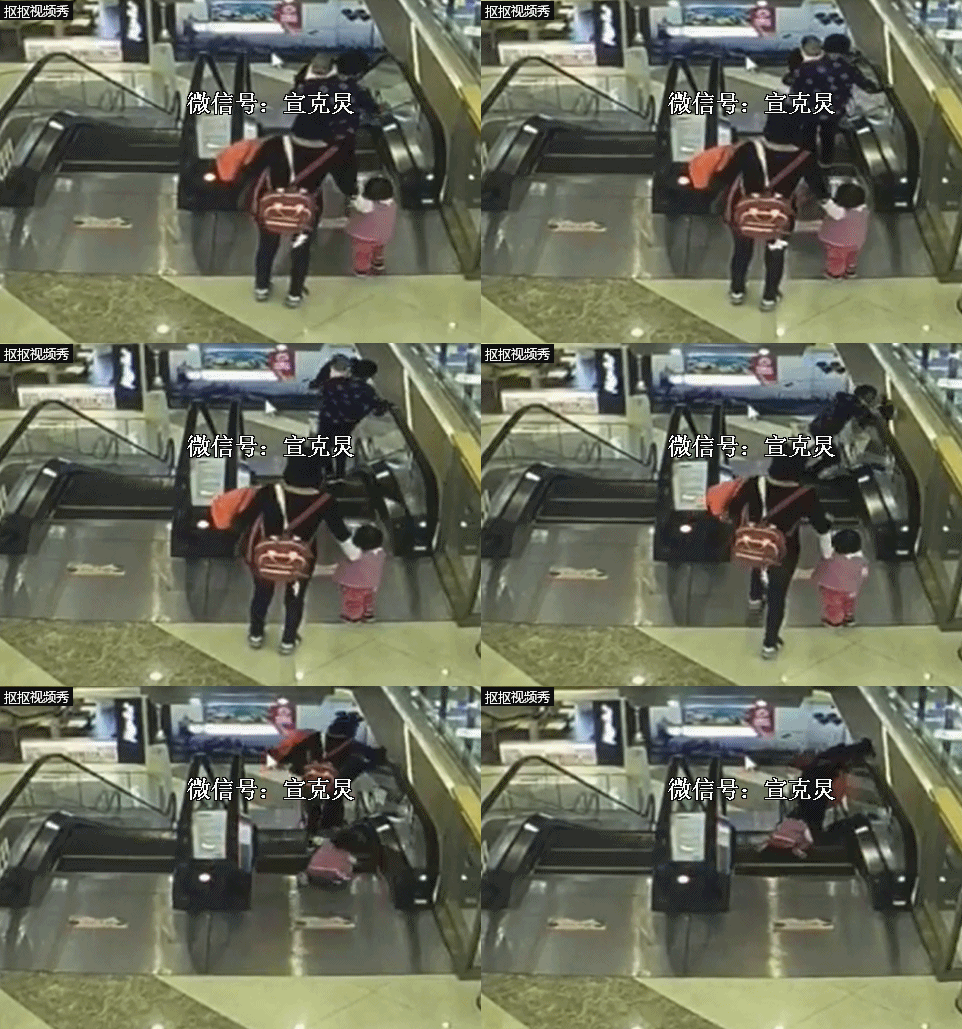
Two toddlers, aged two and three, have died after plunging four storeys at a shopping mall in Tianjin, China on Monday night (Feb 27).

Chinese media reported that their mother had been holding them near a glass balcony when she lost her grip on them. The children – a boy and a girl – fell to the ground on the first floor and died instantly, Sina reported.

Video footage which purportedly shows the children’s kin kneeling near their bodies and wailing in grief, has been shared on Chinese social media sites.

Photo: Video screengrabs

In a similar incident in Uzbekistan this month, a young mother accidentally dropped her baby off the side of the escalator when her dress got caught, and her body jerked forward as a result.

Last year, a four-month-old baby also died when his grandmother lost her balance in a Shanghai mall, and dropped him off the side of an escalator. He plummeted three floors down.

Gif: Sina Weibo


Read also: Video captures young girl’s death fall from Kunming mall’s escalator

ljessica@sph.com.sg


Image: 
Category: 
Publication Date: 
Tuesday, February 28, 2017 – 11:27
Keywords: 
Send to mobile app: 
Source: 


Story Type: 
Others

Source link

Oscars show photo of wrong woman during 'In Memoriam' segment

0

Washington – The shocking best picture mix-up wasn’t the only Oscars night flub.

During the event’s “In Memoriam” segment honoring film industry figures who died over the past year, the show’s producers mistakenly flashed a photo of a woman who is still alive.

Janet Patterson, an Australian costume designer who died in October, was shown not with her picture but with that of the well-known Australian producer Jan Chapman.

“I was devastated by the use of my image in place of my great friend and longtime collaborator Janet Patterson,” Chapman told industry publication Variety.

“I had urged her agency to check any photograph which might be used and understand that they were told that the academy had it covered. Janet was a great beauty and four-time Oscar nominee and it is very disappointing that the error was not picked up,” she added.

“I am alive and well and an active producer.”

Patterson and Chapman worked together on the 1993 film “The Piano,” which won three Academy Awards.
Chapman is also known for “The Last Days of Chez Nous” (1992).

Image: 
Category: 
Publication Date: 
Tuesday, February 28, 2017 – 11:24
Keywords: 
Send to mobile app: 
Source: 


Hermes ID: 
2 972 526
Hermes ID String: 
SY_OSCARSINMEMORIAM_0228
Hermes Author: 
SEANYAP
Story Type: 
Others

Source link
