LOS ANGELES – Beyonce, Eminem and The Weeknd will lend star power to Coachella, promoters announced, marking the first time that no rock act will be among the main attractions.
Coachella, which has turned into one of the world’s most lucrative and influential festivals since its debut in 1999, takes place in the desert of southern California over two successive weekends in April with identical line-ups for each.
The festival – April 13-15 and April 20-22 – marks the first concert scheduled by Beyonce since the pop superstar had twins in June with her husband, rap mogul Jay-Z.
She was due to headline Coachella last year but was replaced with Lady Gaga after doctors advised her not to perform so late in her pregnancy.
Coachella is also the first full concert on the books for Eminem since the top-selling rapper in history released his latest album, Revival, last month.
The Weeknd, the Toronto R&B singer whose profile has quickly grown in the past few years with hits such as Can’t Feel My Face and I Feel It Coming, has performed previously at Coachella but never as a headliner.
The Coachella announcement comes amid growing signs that traditional rock bands are losing their cultural dominance in the United States. Hip-hop for the first time made up the majority of nominations for Album of the Year in the latest Grammys.
However, Coachella at other set-times will still feature plenty of rock acts, mostly with an indie bent, including The War On Drugs, alt-J, Haim and Portugal. The Man.
A man whose parcel containing an iPhone 7 went missing, has gotten a full compensation for his lost item and postage fees from SingPost.
Denny had shared his predicament with Stomp, who then contacted SingPost on his behalf.
The Stomp contributor, who is based in Hong Kong, first left Singapore on Nov 5, 2017.
Upon realising he had forgotten to bring his phone, Denny got in contact with his family and his mother subsequently engaged SingPost’s Speedpost Priority service on Nov 7 to deliver a parcel containing his phone to Hong Kong.
Denny said that his mother was told that it would take three days.
However, when he did not receive the parcel after the fourth day, Denny decided to check on his parcel via the online tracking service, which showed that the parcel was still in Singapore.
Next, he called the customer service hotline to ask if about the parcel and was told that ‘it should be in Hong Kong’.
However, he never received it.
Over the next two weeks, Denny made repeated calls to the customer service hotline and was left dismayed by the non-replies he supposedly got.
Despite asking for an incident report from SingPost several times, he did not receive it.
On Nov 21, Denny’s wife, who was in Singapore handling the case on his behalf, was informed by SingPost that the parcel had indeed gone missing.
She subsequently received a claims form via her email, which she filled up.
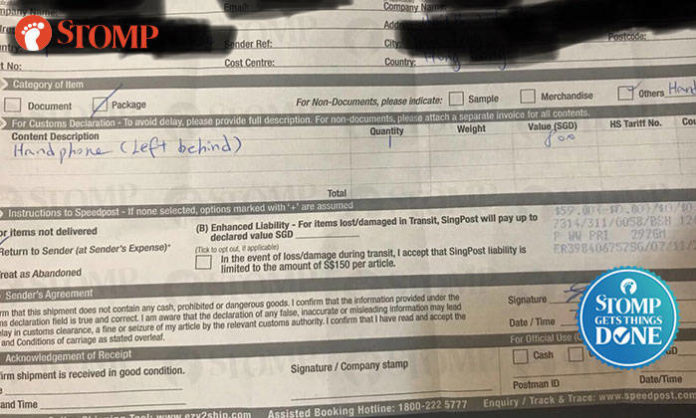
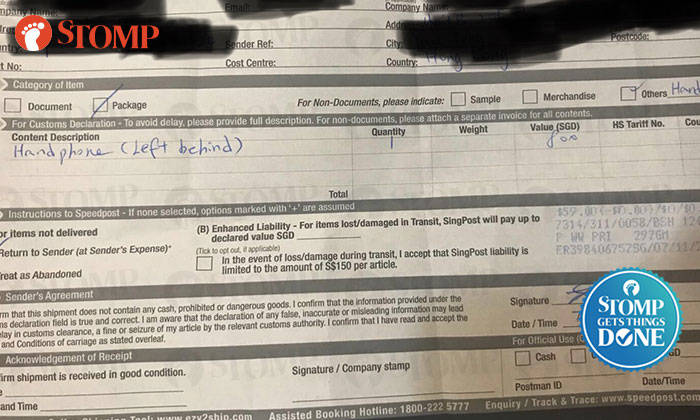
According to Denny, under the value of the goods lost, his wife had filled in $800, plus an additional $59 for the cost of the Speedpost service that was used. This amounted to a total of $859.
However, the couple were later told that the postage was non-refundable and that the claims for the goods lost was capped at $150.
After a few calls to the customer service hotline, Denny discovered that his mother did not purchase the insurance for the package. As such, the compensation was capped at $150.
However, Denny said that his mother was not told about the insurance or the maximum amount claimable without it.
On Dec 22, after repeated rounds of talks, Denny was told that the postage fee would be refunded, but compensation would still be capped at $150, as his mother did not indicate that she had wanted to buy insurance for the parcel.
When Denny dropped SingPost a message on their Facebook page regarding the matter, he was told that his claims had been processed, even though he did not want to accept the $150 compensation.
In response to a Stomp query, a SingPost spokesman said: “We are sorry about Mr Denny Ho’s parcel which was lost in transit. Out of goodwill, we have provided him with full compensation and this has been accepted as satisfactory resolution.
“Our Terms and Conditions of service state that our liability of carriage is limited to S$150. This may be referenced on our website at http://www.speedpost.com.sg/customer-care/enhancedliability.html. We urge customers shipping high value items to purchase insurance to safeguard their interests.
“We are looking into the Facebook post cited by Mr Ho. As part of our social media policy, we do not hide or remove any posts unless the language used is profane or of a defamatory nature.”
New Zealand singer Lorde has been called a “bigot” by an organisation run by a well-known American rabbi after she cancelled a concert in Israel.
Rabbi Shmuley Boteach’s The World Values Network placed a full-page ad in The Washington Post on Sunday stating: “21 is young to become a bigot,” underneath a picture of the singer superimposed on a backdrop of what appears to be a war-torn city.
The headline read: “Lorde and New Zealand ignore Syria to attack Israel.”
The singer cancelled a concert scheduled for Tel Aviv in June, according to a BBC report, after criticism from activists and two fans who urged her to “join the artistic boycott of Israel.” The New Zealand-based fans, who are Palestinian and Jewish, campaign against Israel’s occupation of Palestine and wrote: “Playing in Tel Aviv will be seen as giving support to the policies of the Israeli government, even if you make no comment on the political situation.”
Lorde responded on Twitter last month: “Noted! Been speaking w(ith) many people about this and considering all options. Thank (yo)u for educating me I am learning all the time too.”
But the black-and-white ad by The World Values Network questioned her decision to cancel the Tel Aviv performance but not one in Russia, with text below the image stating: “Lorde joined a global anti-Semitic boycott of Israel but will perform in Russia, despite Putin’s support for Assad’s genocide in Syria.”
The World Values Network states its mission is to disseminate Jewish values to the US, and its ad in The Washington Post is likely to have cost thousands of dollars. A full-page colour ad in its Sunday edition is listed as costing $13,457 on its advertising rate card, although the cost for a black-and-white version is not listed.
Boteach, who styles himself on his website as “America’s rabbi,” has been a guest on “The Oprah Winfrey Show.”
The World Values Network, Universal Music (the parent company of Lorde’s record label Republic Records) and the New Zealand government had not responded to CNBC’s requests for comment at the time of publication.
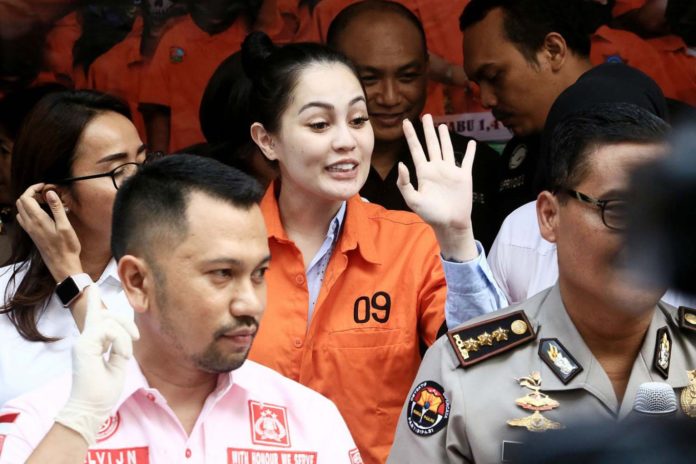
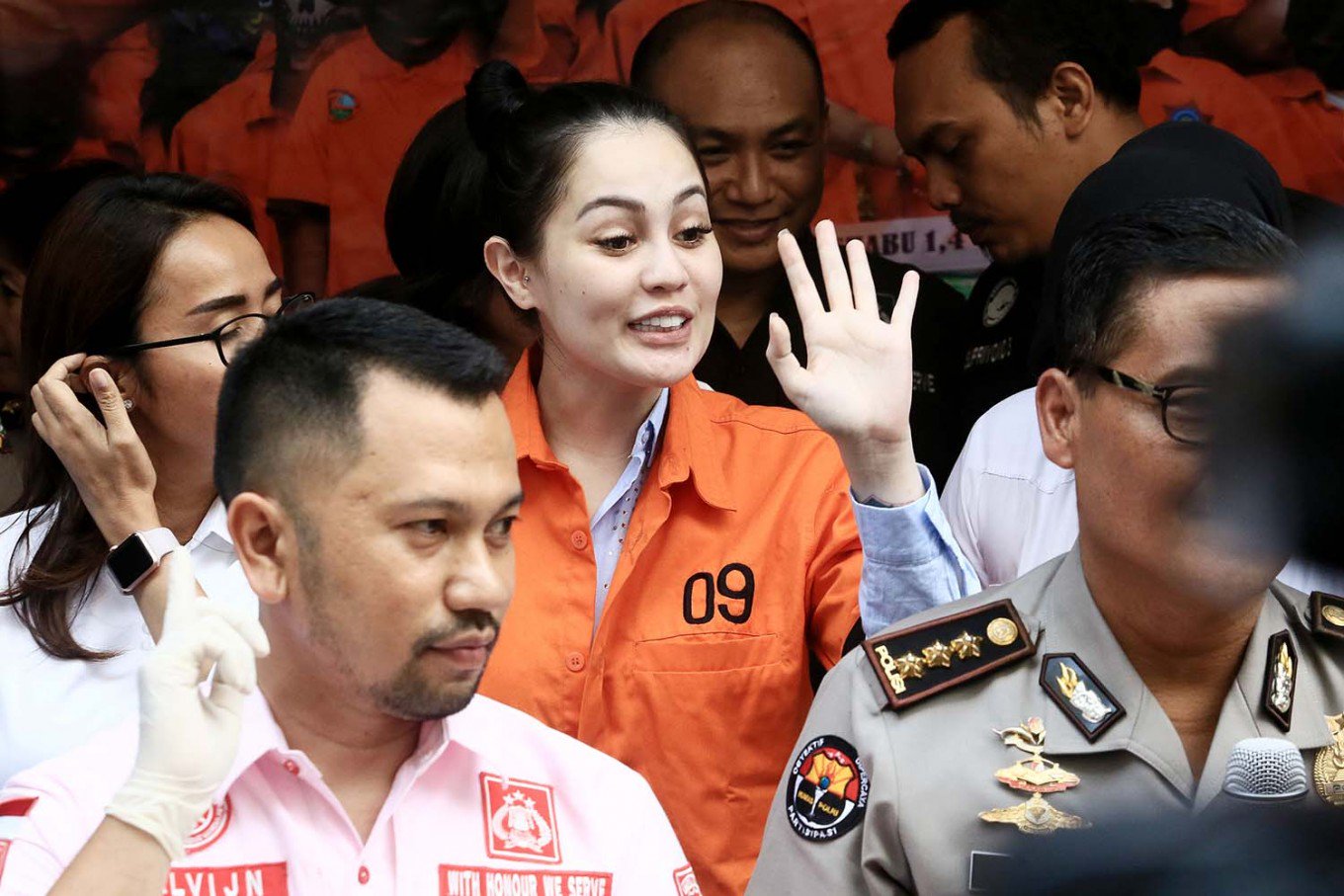
The Jakarta Police have arrested celebrity Jennifer Dunn at her house in Pasar Minggu, South Jakarta.
The celebrity, who previously earned infamy for having an illicit affair, was reportedly caught consuming crystal methamphetamine with an alleged drug dealer, FS, who was also arrested after a failed attempt to flee the scene.
The police’s narcotics unit head, Adj. Sr. Comr. Jean Calvin Simanjuntak, said Jennifer had purchased drugs from FS several times.
“According to FS, she had consumed meth 10 times prior to her arrest,” he said during a press conference on Tuesday. He alleged that Jennifer’s most recent drug transaction occurred on Saturday morning at a fast food restaurant in Kemang, South Jakarta, when she reportedly bought a gram of meth from FS.
After receiving reports from Jennifer’s neighbours, the narcotics unit searched her house at 3 p.m. on Sunday and confiscated 0.6 grams of methamphetamine hidden in an empty cigarette box. The police also confiscated two cell phones and a small plastic pipe containing traces of meth.
Both Jennifer and FS have been charged under the 2009 Narcotics Law, which carries a maximum sentence of 20 years in prison and a Rp 10 billion (S$98,570) fine.
The Jakarta Police refused to speculate on whether the suspects could be instructed to undergo rehabilitation instead of face prosecution.
Jennifer was also arrested in 2005 and 2009 for organising drug parties.
New York – Pop superstar Justin Timberlake on Tuesday announced his first album in nearly five years, promising more “personal” songwriting inspired by his home and family.
The 36-year-old singer and actor said that Man Of The Woods, his fifth solo studio album, will come out on February 2 – two days before he headlines entertainment during the Super Bowl, generally the most watched television event of the year in the United States.
He unveiled the album with a short video on social media that, true to the album’s title, shows him walking reflectively in scenes of nature from a snowy forest to a sunny corn field.
“This album is really inspired by my son, my wife, my family, but – more so than any other album I’ve ever written – where I’m from,” Timberlake says in the video.
“And it’s personal.”
Timberlake – who had a son in 2015 with his wife, actress Jessica Biel – grew up near Memphis, Tennessee, one of the capitals of blues and soul music as well as rural-rooted country.
The video features snippets of acoustic guitar, but closes with Timberlake in the studio with pop producing star Pharrell Williams.
Timberlake, one of the top-selling artists of the 21st century both as a solo artist and with boy band *NSYNC, rose to fame with an electronic pop sound before finding a new voice with R&B, notably on his 2006 album FutureSex/LoveSounds.
He has been offering hints about his upcoming album for years. In a 2016 interview with the BBC, he declined to describe it as a country album but acknowledged the influence. “I really did grow up in a place in America where I was like two hours from the country music capital of the world (Nashville), home of the blues, birthplace of American rock ‘n’ roll,” he said.
He last released full albums in 2013, putting out The 20/20 Experience and The 20/20 Experience – 2 Of 2 in quick succession. Even without albums, he has kept putting out music, scoring a mega-hit in 2016 with Can’t Stop The Feeling!, a giddy summer song that appeared in the animated film Trolls.
But he has focused increasingly on acting rather than music for several years, most recently starring as a bookish and seductive lifeguard in Woody Allen’s Wonder Wheel.
SINCE Islamic State-inspired militants laid siege to the southern Philippine city of Marawi earlier this year, the terrorism threat to Southeast Asia has reached its highest level since the turn of the century.
The dual risk of online radicalisation inspiring home-grown jihadis, alongside IS fighters returning from Marawi, Syria and Iraq to launch attacks on their native countries, has provoked widespread concern in Southeast Asia’s two largest Muslim-majority states, Indonesia and Malaysia.
Yet the wealthy city-state of Singapore – nestled between its two larger neighbours – is also on a state of heightened alert. Despite a series of Islamic State attacks which have slipped through the net across the region in the last two years, Singapore has so-far avoided suffering the same fate.
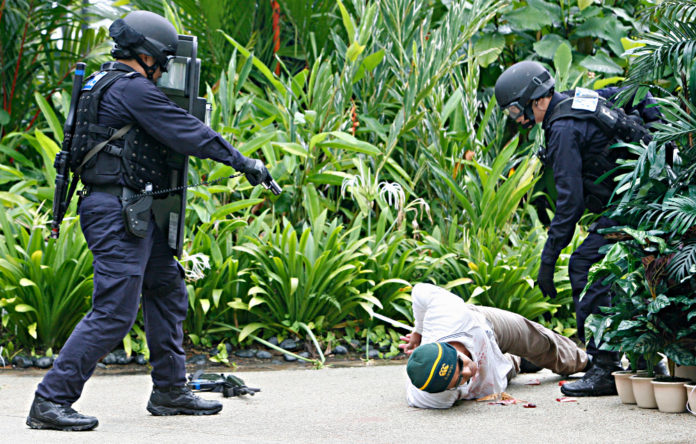
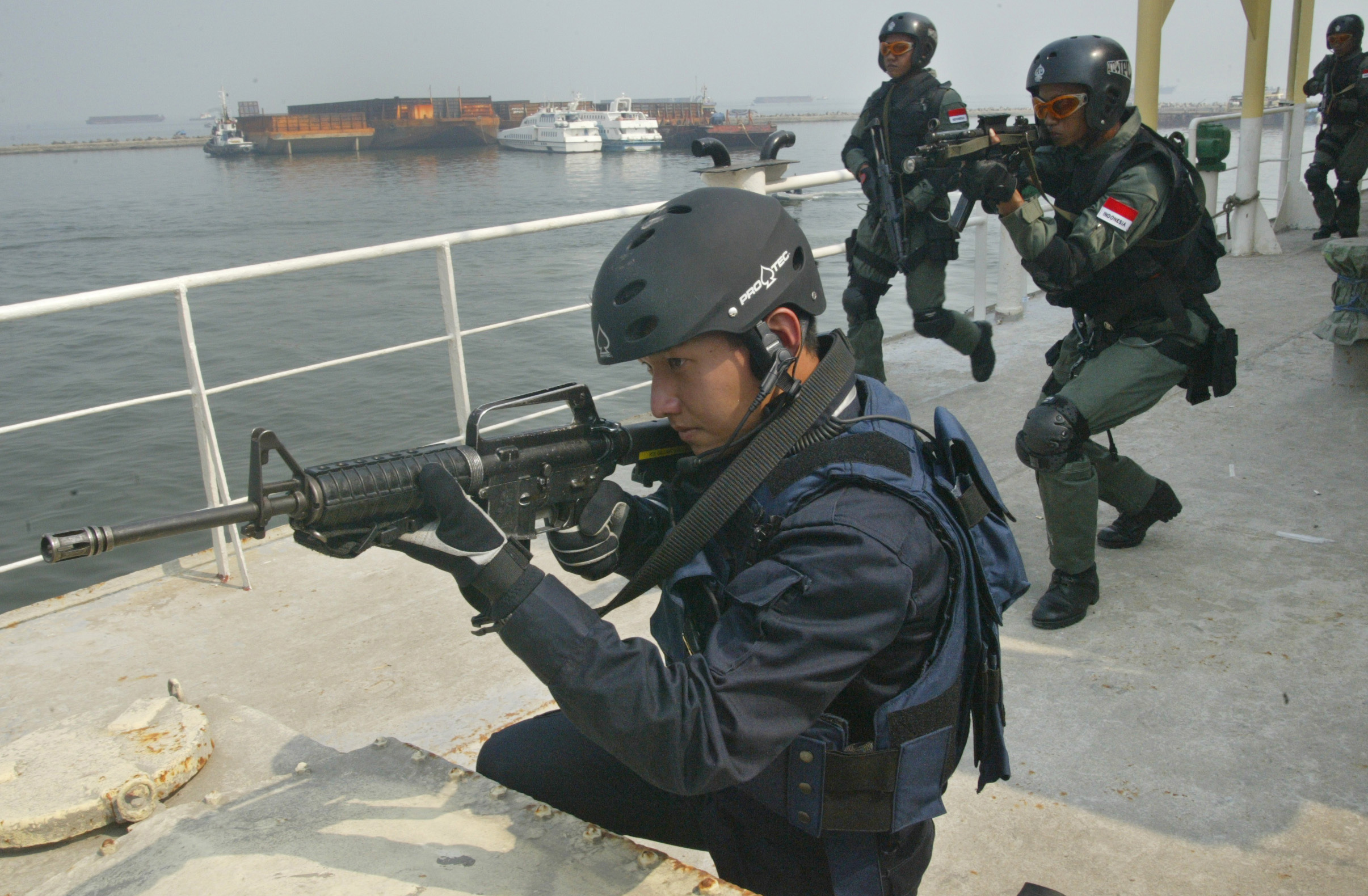
Singapore police officers arrest a mock terrorist during a terrorism exercise in Singapore. Source: AP
Singapore’s military and law enforcement authorities have staged a series of high-profile counter-terror drills in recent months, and have announced the deployment of rapid-reaction teams over the holiday period to reassure the public. But just how prepared is Singapore to combat the threat?
In June, the government released its first annual Terrorism Threat Assessment Report. It confirmed the terror threat to Singapore is at its ‘‘highest level in recent years’’ given the widening global reach of the Islamic State group; especially in light of its brazen attempt to branch out into Southeast Asia.
The report highlighted the risk of fighters returning from Marawi, and noted the increasing number of terror arrests and disrupted Islamist plots across the region. Malaysian police disrupted seven plots and made 119 arrests last year, in comparison to just four plots and 85 arrests in 2015. Indonesian authorities disrupted 15 plots and arrested 150 militants, compared to only nine plots and 65 arrests the previous year. The figures suggest a sharp rise in regional militant activity.
Meanwhile in September, IS’s Al-Hayat media centre released a propaganda video featuring a Singaporean jihadist based in Syria – Megat Shahdan Abdul Samad – urging jihadist sympathisers in Southeast Asia to join the struggle in Marawi or launch attacks in their home countries. The video raised alarm in Singapore, acting as evidence that the city-state is now firmly in the sights of extremists.
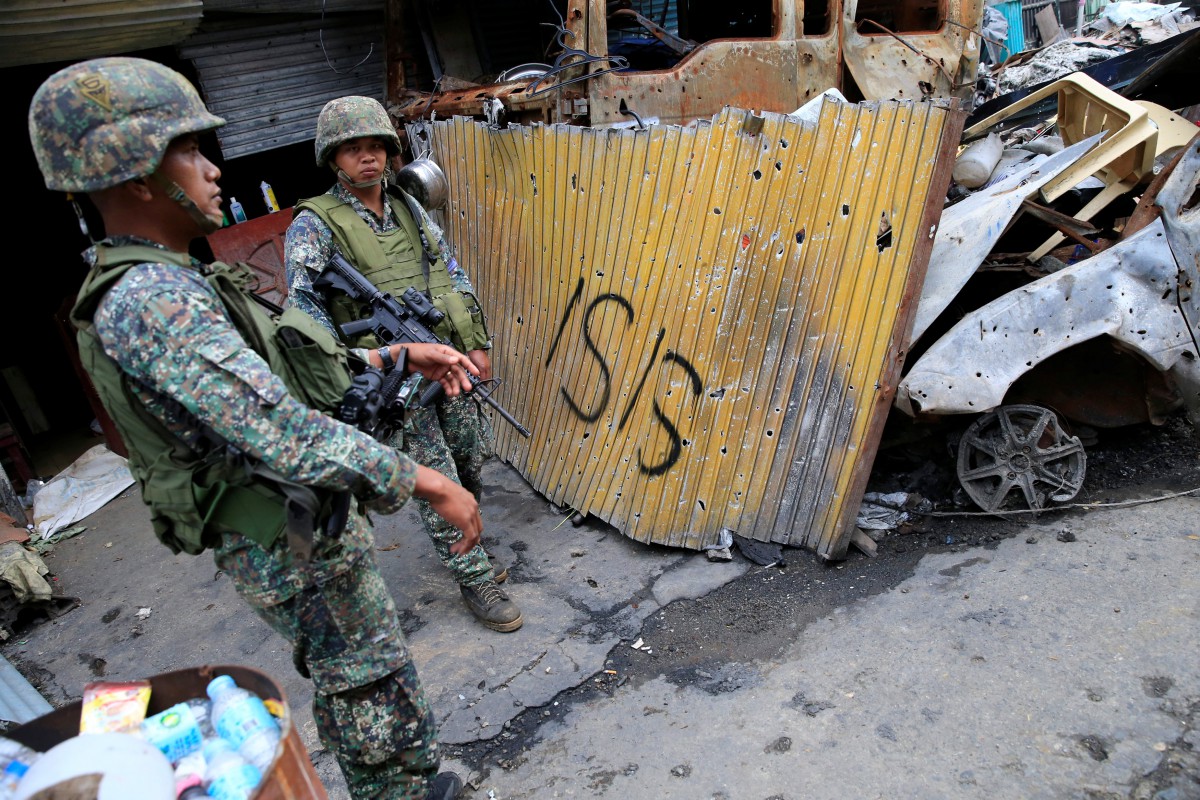
Government soldiers stand on guard in front of damaged buildings as troops continue their assault on its 105th day of clearing operations against pro-IS militants who have seized control of large parts of Marawi City, Philippines, on Sept 4, 2017. Source: Reuters/Romeo Ranoco
Singapore has in fact long been a target for Islamist terrorists, making it all the more remarkable that an attack has so far been avoided. Singapore’s role as a major global hub for aviation, finance, trade and tourism makes it a high-profile target for attention-grabbing transnational jihadi groups. In addition, Singapore is a close ally of the United States and is part of the international coalition taking on ISIS in Syria and Iraq. Several other coalition members – including the US, UK, France, Germany and Belgium – have all fallen victim to deadly terror attacks in recent years.Islamic State has already tried to target Singapore on at least two previous occasions. A plot targeting well-known landmarks was foiled by the authorities in the first half of 2016. Then in August last year, Indonesian security forces disrupted an ambitious plot by militants located across the Singapore Strait in Batam, to launch a rocket attack targeting the Marina Bay Sands resort.
What the authorities fear most however, is the threat of lone-wolf attacks perpetrated by radicalised individuals, using unsophisticated weapons such as knives or vehicles. This type of attack requires little planning and therefore is more difficult for intelligence agencies to prevent, posing a nightmare scenario for the security services.
In response to the threat, Singapore’s government has been proactive. Home Affairs Minister K Shanmugam has already announced a major revamp of the country’s counter-terrorism strategy, detailing new measures to be put in place over the next four years. Last year Mr Shanmugam described Singapore as ‘‘an oasis of calm’’ within the region, making it ‘‘a prime target’’ for terrorists. He added that ISIS poses ‘‘a far graver threat than Al-Qaeda’’ ever did in the 2000s.
As part of the new measures, CCTV coverage is set to expand across the city, with additional cameras being installed around government buildings, transport hubs, entertainment venues and shopping malls. CCTV data is also set to become more rapidly accessible to police, whilst the public has been encouraged to submit images and videos of suspicious activity to the authorities.
New construction laws and building regulations aim to enhance security around major tourist attractions and public areas with heavy footfall. In October, parliament passed the Infrastructure Protection Bill, requiring developers to add enhanced security measures at the design stage; whilst pre-existing buildings can now be forced to install high-tech CCTV systems and vehicle barriers.
Singapore’s police force has also upgraded its capabilities through the formation of new highly-trained Emergency Response Teams (ERTs), designed to arrive rapidly at the scene of an ongoing attack and quickly overpower the assailants. The officers that make-up these units are specially trained in urban assault skills, and will have access to greater firepower than regular recruits.
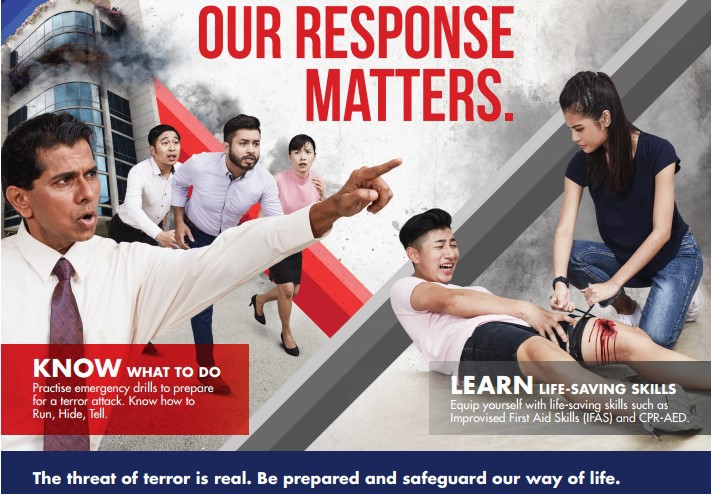
A Singapore government poster urges citizens to prepare to respond in case of a terror attack. Source: SG Secure
Singapore has also launched a large-scale public initiative – “SG Secure” – aimed at increasing threat awareness among the population and seeking to forge a collective response in the wake of an attack. The Home Affairs Minister, Mr Shanmugam, said the initiative would mobilise citizens to exercise continual vigilance, and help forge community resilience in the aftermath of an incident.
Since the new measures were first introduced, Singapore has continued its preparations through holding a succession of counter-terrorism drills. Most recently on Oct 17, a multi-agency drill was held at Changi Airport, as part of a large-scale annual anti-terrorism operation labelled Exercise Northstar. This year’s exercise tested responses to simulated vehicle, bomb and gun attacks in crowded public spaces, and involved more than 500 personnel from ten government agencies.
In addition to tightening domestic security, Singapore has also played a key role in enhancing regional co-operation. On 28 November, Singapore’s military leaders conducted a high-level meeting with their Indonesian counterparts to discuss responses to a range of possible scenarios. Earlier in December, a contingent of Singapore Armed Forces (SAF) soldiers completed a two-week urban warfare training exercise alongside Philippine troops, fresh from the battle in Marawi.
The absence of a major attack in Singapore since Islamic State burst on to the global stage four years ago, shows that the counter-terrorism measures put in place have so-far worked effectively.
However, the current threat environment – in which the fear of online recruitment runs alongside the possibility of battle-hardened ISIS fighters returning to the region – means the risk is higher than ever before. Singapore’s leaders have said it is now likely a question of “when”, not “if”, an attack will take place. The threat from lone-wolves operating under-the-radar, making use of easily-obtainable weapons in spontaneous attacks which require little planning, is especially hard to prevent.
Yet given the extent and depth of its counter-terrorism strategy, Singapore has a higher chance of avoiding the type of large-scale mass-casualty attacks witnessed in other global cities. And amid an increasingly volatile regional climate, Singapore is arguably better-prepared than any other nation in Southeast Asia to respond effectively and quickly, should the worst-case scenario occur.
SINGAPORE: Thirty-five-year-old Ms Pearlyn Cheok is childless, but her love for children has brought her into contact with more than 14 babies over the past two years. Since then, she has spent more time with new families in Singapore than at home in Kulai, Johor with her husband.
Hers is one of more than 4,000 Malaysian work permit applications which the Singapore authorities receive each year for employment as a confinement lady – a woman hired to provide care and guidance for a new mother and her newborn.
They are usually hired as live-in help for 28 days, and are paid between S$2,500 and S$4,000 for their work. They are also given a red packet at the start and end of their stint for well wishes.
“So far, this work feels the most right to me. It’s hard work but also ‘heart’ work, meaning it requires a lot of love and care,” she said.
Ms Cheok is not your typical confinement lady, who is usually a woman in her 40s and 50s. She joined the vocation after stints as a consultant, clerk, salesperson and promoter in her early adult life.
Confinement ladies and agencies Channel NewsAsia spoke with say the workforce is ageing, and there is diminishing desire from young women like Ms Cheok to work as a confinement lady, especially Singaporeans.
Madam Peh Ah Moy, 59, a retired confinement lady, said that women generally do not want to leave their families and move in with another to work almost 24 hours a day. This is more so if they have little ones.
The work is even less inviting for a young woman because experience is highly valued in this occupation.
“There is demand for women like us, but it is hard to find because there are no standards to go by. You know how good a confinement nanny is through recommendations and testimonials, rather than going by a resume,” she said.
Compared to 16 years ago when she first started, Mdm Peh said the salary has grown from about S$1,700 to more than S$3,000 now.
Most confinement nannies who work in Singapore are from Malaysia. While there are Singaporean nannies, they are far and few in between. Madam Dorothy Tan, 41, left her job 10 years ago to join the profession and said that Singaporean nannies like her are rare and in demand. They are usually booked up months before the baby’s arrival.
“There are [Singaporeans], I know of a few but they take overseas assignments. You hardly find them. They’re all taken up at a very early stage [of the pregnancy],” said Mdm Tan.
SKILLS UPGRADE
While there have been courses and programmes made available by various organisations, there are no set standards agreed across the industry. However, some agencies have introduced various training programmes to create a baseline for their work.
For Ms Cheok, she wanted to become a confinement nanny after knowing that she could go for training and obtain certification.
“It’s better to have skills and know-how in one thing, because then you can use that to ensure better employment,” she said.
She joined a training programme jointly awarded by Thomson Medical Hospital’s Thomson Parentcraft and confinement nanny agency, Confinement Angels. As part of the programme, Ms Cheok had to undergo five days of coursework and a week of practical training which included baby care, hygiene standards, confinement meal planning, an understanding of traditional Chinese medicine and breastfeeding.
The training held by Confinement Angels uses the Thomson Parentcraft syllabus. Potential confinement nannies come from all over Malaysia to Kluang, Johor for about two weeks to live and learn together. (Photo: Fann Sim)
The training programme is one of the few available for women keen on learning about confinement work or receiving an audit on their existing skills.
The other, organised by the Women’s Initiative for Ageing Successfully (WINGS), targets women above 40 years old who are seeking nanny skills to assist their children who are expecting a new child, or to work as confinement nannies to supplement their family’s income.
WINGS told Channel NewsAsia that more than 400 Singaporean women and permanent residents have gone through the training programme, which involves trainers from Thomson Medical Hospital and KK Hospital, since its launch in 2009.
“We have seen a gradual increase over the years with the programme gaining more popularity,” said Ms May Tan, programme organiser at WINGS.
Mr Gilbert Tan from Confinement Angels said he has seen demand for confinement nannies go up, especially with shrinking family size in Singapore.
“Most families only have one or two children and they want to give their baby the best. Some mothers may not know how to care for infants so we see more and more asking for such services,” said Mr Tan.
The training programme also allowed Ms Cheok to better understand the needs of a Singaporean family, which is starkly different from what she is used to in Malaysia.
“If I had carried out the confinement nanny work in Singapore like I did in Malaysia, it wouldn’t work out. I’ll definitely fail,” she said.
“In Malaysia, more attention is being paid to confinement foods rather than the mother and baby. This is because families and extended families tend to live close to each other and can help out,” she said.
“In Singapore, caring for the baby is our topmost priority. Like feeding the baby during day feeds and night feeds, changing their diapers, and supporting the mother when they have problems breastfeeding,” she added.
RISING THROUGH THE RANKS
Ms Rachel Ang, 39, was promoted to be a trainer after working as a confinement nanny for almost two years.
She was picked based on her personality, experience and customer feedback to attend a one-week training session with a Thomson Parentcraft Educator.
“Apart from the regular confinement nanny training, I also learnt how to manage a class and how to use positive reinforcement to encourage these women,” said Ms Ang.
“For some of them, this is the first time they are leaving home. So it’s important to manage this as well,” she added.
The confinement nannies are also trained to take a more formal caregiving role, which includes responsibilities like jotting down information that may be useful for the parents and paediatricians.
Some confinement nannies have also been trained by their agency to keep records such as feeding times, bowel movement and nappy changes. (Photo: Rachel Scully)
Some agencies have given nannies a health booklet to record the feeding times, bowel movements, nappy changes and body temperature of the babies. The booklet also acts as a guide for parents after the nanny leaves the household.
One parent Ms Rachel Scully, who had a nanny from PEM Confinement Nanny, said that this proved to be important right from the very beginning.
“On the day I came home from the hospital, my baby had not pooped or peed at all and I had actually forgotten because I hardly slept in the hospital,” she said.
“So (it was) lucky when the nanny came, she checked it out. She said: ‘I’ve been in your home for a few hours and there have been no diaper changes.’ It just dawned on me and my husband. Then she said that it could be a sign of dehydration,” Ms Scully added.
The nanny suggested to try giving her baby formula milk just for one night, which solved the problem.
BOOMING MARKET GLOBALLY
Largely engaged by Chinese families, agencies and confinement nannies have started to see non-Chinese families engage them for their services.
Freelancer Nancy Tan has done confinement work for a German family, Chinese families in Perth, Australia and Indonesian-Muslim families.
She said she was recommended by an Indonesian family after she did confinement work for them and grew her clientele from there.
Another freelance confinement nanny, Madam Phua, 53, said clients abroad usually pay more. For example, performing confinement work for an Australian household can net her an extra S$500.
The demand for postpartum nannies and professionalisation of the trade is not restricted to Singapore. In China, confinement nannies are regulated and state-certified. Some nannies are paid even better than mid-level executives, with some clients willing to pay up to S$36,000 a month, according to a New York Times report in 2015.
SINGAPORE: It was all fun and games in the first two hours of school, until parents had to leave.
Then the bawling started.
This is what separation anxiety looks like at the start of every school year, and the scene at the new Fern Green Primary was no different on Tuesday (Jan 2).
After all, entering primary school marks one of the first rites of independence.
Homemaker Farhana Zeyaulhaq said she initially felt emotional about seeing her firstborn Mohammad Salman starting primary 1.
“But I also feel happy that he is going through another milestone, so he will be more independent in time to come,” she added.
Another parent, Jessica Matthias, said her son Matthias Gunaraman seemed nervous, but she was confident that he was in good hands.
“Everybody has to go through that phase and now it’s his turn. So I just hope to be able to coach him as he goes by,” she mused.
Fern Green Primary students in their first day of school. (Photo: MediaCorp/Matin Akmal Mohammad Kamal)
Fern Green Primary is the latest addition to the Sengkang area, bringing the total count to 12 primary schools in the non-mature estate.
Ms Jesslyn Lim and her husband said they chose the school as it was next to their flat, while another couple were drawn to the new facilities.
The school includes a student care centre and will house a Ministry of Education (MOE) kindergarten from 2019 onwards.
Fern Green Primary currently has 240 primary one pupils, and a staff strength of 40.
Parents like Ms Farhana were unfazed by the absence of older pupils.
“I feel more assured because the cohort is smaller so my son has more attention from the teachers. For example, during recess, I’m happy that the teachers will be there instead of a buddy system,” she said.
ORIENTATION
Fern Green Primary organised an orientation day in December to help parents and pupils settle in.
Parents toured the school premises, while pupils were ushered to classrooms, where they met their classmates and teachers for the first time.
At one point, there was a slight hiccup with the sale of uniforms as there were not enough of the right sizes available. But the issue was quickly resolved as teachers stepped in to assure frazzled parents that the uniforms would be re-stocked as soon as possible.
It was clear that the team had handled similar situations before – something which principal May Tang looked at when recruiting staff.
Fern Green Primary school students in their first day of school. (Photo: MediaCorp/Matin Akmal Mohammad Kamal)
“We selected applicants who are experienced in teaching lower primary. They must have a minimum three years of experience and preferably be STELLAR-trained,” Mrs Tang said, referring to a programme for language learning.
She added that her staff are also open to conducting outdoor programmes. In fact, works on an obstacle course are already underway.
The school has plans to run the Programme for Active Learning (PAL) from the second term onwards. Under PAL, pupils will be introduced to outdoor activities and sports education.
OLD SCHOOLS, NEW NAMES
Fern Green Primary was set up to cater for rising demand in Sengkang.
But this comes at a time when falling enrolment in mature estates are forcing mergers between established schools.
Some 200 students and dozens of teachers who once streamed into the now-defunct Bishan Park Secondary along Sin Ming Walk now make a beeline for Peirce Secondary, at the end of the road.
Bishan Park and Peirce Secondary are two out of four pairs of secondary schools merging this year due to falling enrolment.
The others are Bedok North and Damai Secondary, Chong Boon and Yio Chu Kang Secondary, and Greenview and Loyang Secondary.
To cope with the transition, teachers in Bishan Park and Peirce Secondary met last year to discuss curriculum changes, staff deployment and classroom structures.
These included converting some classrooms in Peirce Secondary to accommodate new teaching staff. More common spaces were also freed up for student activities.
Peirce Secondary students at school for the first time after the school merged with Bishan Park Secondary. (Photo: MediaCorp/Yasmin Mohamed Rafiaque)
Secondary 2 students in both schools sat for similar assessments to standardise the streaming process. They were also given the same set of subject combinations to choose from.
These students, who are now in Secondary 3, are now classmates with their peers from the other school.
But senior students sitting for national examinations this year will continue taking lessons with their original classes and teachers, to minimise disruption to them.
MAKING THE SWITCH
Former Bishan Park Secondary teacher Stephanie Lee, who now teaches at Peirce, told Channel NewsAsia that students were initially anxious about integrating into the new environment. Most were also concerned about the fate of their school clubs.
Fortunately, most of the co-curricular activities (CCA) offered in both schools were similar, so bringing the clubs together was a relatively smooth process.
Secondary Two students also attended a combined adventure camp last year to get to know each other. This helped the students prepare themselves for the merger.
Peirce Secondary student Dela Rosa Nico Arcelo, who plays in the school band, said: “I felt anxious about the merger, mostly because I was uncertain about how students from both schools would interact, especially the two sets of student leaders in the council and various CCA groups.”
He soon found out that a little compromise can go a long way.
“We had combined training sessions and even put up a joint performance in Sentosa in 2017. After a couple of meet-ups, we got to know them a lot better,” the secondary 4 student said.
Former Bishan Park student Eunice Koo agreed, although she initially had reservations about leaving three years of memories behind.
“When I left the school, it was sad to bid farewell to the many memories we made. This included saying goodbye to some teachers. But now that I am actually here, I realise I can make many new friends, more memories and seek more opportunities too,” she said.
Mrs Betty Chow, the school’s principal, is also confident that the students and staff would get used to the new arrangements in the next few months.
“I think that there will definitely be adaptation issues. But children being young and exuberant, with a positive mindset, they will surely be able to get through these changes,” she said.
The heritage wall at Peirce Secondary which includes the history of Bishan Park Secondary. (Photo: MediaCorp/Deborah Wong)
Peirce Secondary now features a heritage wall complete with artworks, a brief history of Bishan Park Secondary and its green and white uniform.