Singapore
Thursday, January 18, 2018 – 09:36
Gang leader's rape trial: Ex-member says he felt helpless, apologised to girl for not protecting her
The Straits Times
Others
SINGAPORE: The Agri-Food & Veterinary Authority of Singapore (AVA) is investigating the death of a stray cat that was found with a stab wound in its mouth in Jurong.
Photos of the cat uploaded onto Facebook by Pandan Gardens resident Muhammad Mahlil showed the cat with a bloody mouth and a large stab wound at the roof of its mouth.
In his post, Mr Mahlil said that the cat “has been with us for more than 10 years”, and it was considered as a “resident’s cat”. He also wrote that the issue has been escalated to his Member of Parliaments.
He told Channel NewsAsia that the cat, which he and his neighbour called “Senget”, was found injured in a trail of blood at the lift landing of the void deck on Jan 5 by one of the residents. Mr Mahlil added that the cat died at the vet’s clinic.

The cat died while receiving treatment at the vet. (Photo: Facebook/Mahlil Gallagher, Eiswandy Bohari)
The cat liked to roam around the upper level of the HDB block and would occasionally roam into his house, said Mr Mahlil, adding that he had shared the photos and videos of the injured cat on Facebook in order to create awareness.
In response to queries from Channel NewsAsia, the AVA said on Wednesday (Jan 17) that they are investigating the case and asked for members of the public with information on the case to contact them.
“All information provided will be kept in strict confidence,” AVA added.
The van driver claimed to have offered a ride to the teen because it was raining, Channel NewsAsia understands.
The UWC South East Asia campus in Dover.
SINGAPORE: A driver who tried to get an international school student to hop into his van had “no ill intent” in doing so, said the police in a Facebook update on Wednesday evening (Jan 17).
The police had said hours earlier that they had established the man’s identity and that he was assisting with investigations.
“The police have determined that the male driver has no ill intent. The police have also updated the parent of the child involved in the incident on the findings,” authorities added.
The incident happened on Jan 11. According to UWC South East Asia, one of its students was on her way home when she was “approached” along Dover Road by a man driving a van.
“He drove alongside her as she was waiting for the bus and called to her from the road, telling her to get into the van. The student took exactly the right action: She did not respond, walked away in the opposite direction, and informed a known adult,” said the head of the school Mr Chris Edwards in an email sent to parents.
Channel NewsAsia understands that the driver, a 32-year-old Singaporean, claimed to have offered a ride to the teen because it was raining.
It is understood that police established there was no ill intent on the part of the driver after speaking to the student, her parents and the man in question.
This was one of two incidents of students from different international schools being approached by strangers in vans. The second happened on Jan 16, and the police said in its update that it was an “unrelated” incident involving a female driver.
The Jan 16 incident involved a student from Tanglin Trust School. The school’s chief executive Peter Derby-Crook told parents that a student was walking to the school on Portsdown Road when a white van stopped near her and two occupants “tried to entice” her to get in.
“The two occupants got out of the van and continued to entice her but she moved quickly away and arrived at school safely,” he said.
In their update, the police said investigations are ongoing and advised members of the public against speculating on the case.
Channel NewsAsia has reached out to the police for more information.
The van driver claimed to have offered a ride to the teen because it was raining, Channel NewsAsia understands.
The UWC South East Asia campus in Dover.
SINGAPORE: A driver who tried to get an international school student to hop into his van had “no ill intent” in doing so, said the police in a Facebook update on Wednesday evening (Jan 17).
The police had said hours earlier that they had established the man’s identity and that he was assisting with investigations.
“The police have determined that the male driver has no ill intent. The police have also updated the parent of the child involved in the incident on the findings,” authorities added.
The incident happened on Jan 11. According to UWC South East Asia, one of its students was on her way home when she was “approached” along Dover Road by a man driving a van.
“He drove alongside her as she was waiting for the bus and called to her from the road, telling her to get into the van. The student took exactly the right action: She did not respond, walked away in the opposite direction, and informed a known adult,” said the head of the school Mr Chris Edwards in an email sent to parents.
Channel NewsAsia understands that the driver claimed to have offered a ride to the teen because it was raining.
This was one of two incidents of students from different international schools being approached by strangers in vans. The second happened on Jan 16, and the police said in its update that it was an “unrelated” incident involving a female driver.
The Jan 16 incident involved a student from Tanglin Trust School. The school’s chief executive Peter Derby-Crook told parents that a student was walking to the school on Portsdown Road when a white van stopped near her and two occupants “tried to entice” her to get in.
“The two occupants got out of the van and continued to entice her but she moved quickly away and arrived at school safely,” he said.
In their update, the police said investigations are ongoing and advised members of the public against speculating on the case.
Channel NewsAsia has reached out to the police for more information.
SINGAPORE: As a young officer cadet in the fledgling Singapore Air Defence Command (SADC) – the predecessor of the Republic of Singapore Air Force (RSAF) – in the late 1960s, Lieutenant-Colonel (Ret) Prasad Menon was not spared the menial task of painting runway markings with a brush.
“There were not enough people,” Mr Menon, now 68, told Channel NewsAsia from his home in a quiet estate just minutes from the Kranji War Memorial. “If we had people like grass cutters, we used to say: ‘Can you help us out here?’”
The RSAF has come a long way as it gears up to celebrate its 50th birthday this year. Now it boasts more than 200 aircraft such as the F-15SG, and has over 100,000 personnel across six commands. And machines are used to paint runway markings.
As an officer cadet, Mr Menon spent a lot of time in the Seletar control tower, which the British left sparsely equipped. (Photo: Mindef)
Mr Menon, who now works as a consultant advising the RSAF on its airspace policy and operations, offered a glimpse into the organisation’s past through his years as one of its first-ever air traffic controllers.
“For night flying there were no lights, so we had to use something known as goosenecks,” he said, referring to lit kerosene tins placed along a runway. There weren’t enough people to light those too, so firemen had to chip in.
“You had to make it work, you had to make it happen,” Mr Menon added. “It was a pioneering spirit and improvisation that was there for all the elements of the air force.”
THE EARLY DAYS
Mr Menon was a pioneer of the air force. His father ran the medical centre in British-controlled Royal Air Force (RAF) Tengah, and they lived in a comfortable home on the outskirts of the base, which was located just across a nearby bridge.
British aircraft in RAF Tengah, 1963. (Photo: John Cunningham)
“Like all children growing up, it was the aircraft roar that gets you,” he recalled. “We would hear them doing circuits.” After all, getting into the base was “not a problem”. The gates were manned by auxiliary officers who lived together with him.
RAF Tengah base front. (Photo: John Cunningham)
“I don’t think they gave you passes those days, but you had to register,” Mr Menon added. While he acknowledged that there was a “clear division” when it came to what belonged to the British, locals were still allowed unfettered access.
Mr Menon would dine, play football and attend Christmas parties in the base. But there was still something else he yearned for. “The idea of flying was, of course, something that everybody around the air base hopes for, but know they will never get.”
The McGregor Club, one of the recreational facilities in RAF Tengah. (Photo: John Cunningham)
Things changed quickly. In January 1968, the British announced that they were going to pull out. They would hand over RAF Seletar first. Tengah was next.
The news hit hard, especially for families with fathers working for the RAF. Mr Menon worried for his dad’s job, but a novel “opportunity” arose: “You could say yes, people aspired to join your own air force.”
Then 18, Mr Menon had just completed the equivalent of the A-Levels, and was waiting to enter university to read law. That was until an advertisement in the newspaper caught his eye: Recruitment for air force pilots.
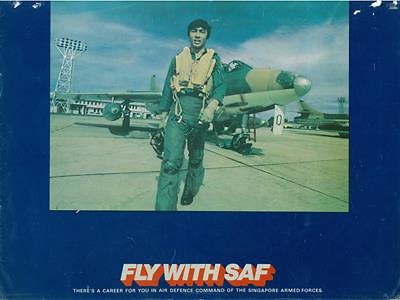
A Singapore Armed Forces (SAF) recruitment brochure for pilots in the 1970s. (Photo: Mindef)
He immediately shelved plans to study for a degree and enlisted as a cadet pilot officer in June that year. His parents offered their full support. “Whether they were really happy internally, I do not know, but they gave me all the encouragement.”
His father kept his job, and worked in Tengah till the day the British pulled out. For a short time, father and son were colleagues, but the “thrill” of joining the air force soon turned serious.
“After we joined it was quite clear that we had to provide Singapore with a credible air defence system,” he said. “That I must tell you is a very real feeling. Everybody felt the urgency and resolve to take over safely and be a force that others would respect.”
“Where it all started”: Mr Menon and 30 other officer cadets were part of the SAF Flying Platoon, set up with the formation of the SADC. (Photo: Ruyi Wong)
Three months later the SADC was formed from scratch, as it hastily borrowed two Cessna aircraft from the Singapore Flying Club. The arrival of eight Alouette III helicopters, making up SADC’s first operational unit, came next.
Mr Menon said there was “anxiety” in the early days of the SADC.
“Can we continue to operate on an airfield for 24 hours if necessary? Where are my men going to come from? Do I have sufficient spares for my radars?” he said. “We knew that people were trying their level best.”
Tried they did. Everyone was consumed with putting in the training hours, he added. They realised the “enormity” of the work ahead. “People were stretched, but I don’t think anybody complained, really.”
An Alouette III helicopter landing at Seletar. (Photo: Mindef)
One of the biggest challenges then was manpower, Mr Menon said. The SADC had started with fewer than 100 personnel, and it needed people of various specialisations – pilots, engineers, air traffic controllers. “Each vocation has got to attract its own people.”
But it did attract people. They joined because of the good training opportunities. “The exposure is enormous,” he added. “They can quickly see how their contributions benefit the country.”
A DIFFERENT PATH
Mr Menon’s home is filled with air force memorabilia – commemorative plaques, a signed model of a jet fighter, a pair of headsets he used to wear as an air traffic controller.
Why did he become a controller instead of a pilot? The bespectacled man – shirt neatly pressed and tucked in – spoke softly and eloquently, recounting what would be his proudest days in the force.
Mr Menon donned this type of headset during his days as a controller. (Photo: Ruyi Wong)
It began in October 1968, with a “very unfortunate” bout of pneumonia. “I was subsequently told I was being sent to air traffic control,” he said. “In those days you don’t argue with your superiors.”
Naturally, he was disappointed. “But you have to do the best you can and strangely enough you grow into your job,” he added.
For two-and-a-half months Mr Menon went through a civil air traffic controller course to learn how to manage aircraft and ensure they don’t collide. Then he jetted off to Shawbury, England to learn the military side of things.
Mr Menon at RAF Shawbury for the military air traffic controller course. (Photo: Ruyi Wong)
His time in the United Kingdom was “eye-opening” because he worked with new systems and was attached to an aerodrome, where he managed live aircraft. “We were very serious with what we did,” he said.
Upon his return in October 1969, Mr Menon was commissioned as an officer. Part of the pioneer batch of six air traffic controllers, he was posted to Seletar for a two-year training stint before returning as a full-fledged controller to Tengah, “where I had grown up”.
Mr Menon’s commissioning certificate. (Photo: Ruyi Wong)
Life had come full circle, but there was no time for nostalgia.
By then the SADC had bought eight Cessna 172K Skyhawks for its first flying unit, the Falcon Squadron. The hardest part of Mr Menon’s job was the “intensity”. “Everybody was training, so there was a lot of aircraft,” he said.
Compared to now, the workload for controllers then was heavier, because Singapore’s pilots were training locally “all the time”. Military aircraft from Australia, New Zealand and the UK were also flying in and out for exercises.
“Sometimes, we would have as much as about 40 to 50 aircraft at our dispersals, but not all from Singapore,” Mr Menon said, using the term to describe where airplanes are parked.
The SADC’s first Cessna was hand-painted by its airmen. (Photo: Mindef)
Working hours were stretched too. Shifts ran from 7.30am to 1pm for morning flying and resumed at 6.30pm till 11pm for night flying. “We try and get some rest, but those are things you have to do,” he added. “I think they’ve improved it now as they should.”
Nevertheless, he has fond memories of those days. In 1973, a British aircraft was forced to make an emergency night landing in poor visibility at Tengah. Mr Menon guided the plane down without a hitch.
“The pilot came up to the tower to thank us,” he said. “Very nice, very gracious of them to do that. But that’s your job; that’s what you’re there for.”
THE PROGRESS
The interview had gone on for more than an hour, but Mr Menon remained every bit as enthusiastic. He grew more animated as he talked about how the air force developed.
In September 1971 the final British aircraft flew out from Tengah, making it the last flight out of a British-controlled aerodrome. Sembawang and Changi followed soon after. Singapore flags were raised – the handover was complete.
Mr Menon was hosting officer for then-Prime Minister Lee Kuan Yew at an SADC dinner, where Mr Lee told attendees about the imminent name change. (Photo: Ruyi Wong)
Four years later, the SADC was renamed the RSAF. Mr Menon started taking on more important appointments.
In 1981 he became commanding officer of the flying support squadron, calling it a milestone in his career. He also served as head of the flying support branch, before performing a similar role at air force doctrine.
Mr Menon (first row, middle) oversaw the redevelopment of Tengah in 1980, as new taxiways and runways were built. (Photo: Ruyi Wong)
Mr Menon retired in 2001 as head of the airspace branch, based at the RSAF headquarters in Bukit Gombak, after 33 years in the force. Even then he was still deeply involved – he was in the midst of negotiating a bilateral issue when “they were chasing me to get this formally done”.
“So I took some time off from what I was doing, met the chief (of air force), collected the certificate and went back to work,” he mused.
Mr Menon’s retirement certificate, five Presidents later. (Photo: Ruyi Wong)
It’s no wonder then that Mr Menon accepted an offer to continue as a consultant. He felt like he had more to give. But does he still have the same energy? “I would like to think so,” he said with a laugh.
The years that followed saw “tremendous growth” in the RSAF, as it shifted focus from air defence to deterrence.
“We became a full spectrum air force, which means that we are able to handle crises in peace and war,” he added. “We made use of technology that was coming in – weapons, unmanned aircraft.”
The RSAF acquired its first F-16, a multi-role fighter, in 1983. (Photo: Mindef)
The RSAF helped out in foreign crises too. Mr Menon helped to coordinate the humanitarian response to the 2004 tsunami in Aceh, where it set up a mobile air traffic control tower to replace the one that was badly damaged.
RSAF aircraft were deployed in Indonesia to help with disaster relief efforts. (Photo: Mindef)
He’s particularly proud of this effort. “They landed there in driving rain,” he said, adding that a “small group” started deploying the tower at 11pm and got it up and running by 5am the next day.
“It was very significant because people were going to an area where we knew very little about the terrain and facilities. And this spirit of improvisation that had been part of our culture for so long continued to be shown.”
LOOKING BACK
Mr Menon said the air force of his time would have needed help pulling off an operation of such scale.
“We didn’t have the infrastructure, certainly not the experience,” he said. “We do what we can, but the level of assistance and the speed at which we can move things shows how far we have come.”
The day before he retired, Mr Menon returned to his roots by controlling an aircraft at Tengah for one last time. (Photo: Ruyi Wong)
So, how different would things be for Mr Menon had he joined the air force of today?
“For one, I think I would have more answers than I had before,” he said. “I would come into an organisation that is well-established. I didn’t have that when I joined; we were learning as we went along.”
Still, Mr Menon has no regrets about his career. In June, he will celebrate 50 years in the air force, at the same time it commemorates its golden jubilee.
“Given the circumstances, I’m happy,” he said. “How many opportunities can one get to work on something one is so passionate about for such a long time, and see it grow?”
SINGAPORE: Three people have been arrested at land checkpoints on suspicion of attempting to import items believed to be counterfeit in two separate cases, the Singapore Police Force and Immigration and Checkpoints Authority (ICA) said in a joint release on Wednesday (Jan 17).
The suspects, a Malaysian and two Singaporeans, were arrested on Jan 3.
The Malaysian, a 33-year-old man, was arrested at Tuas Checkpoint after he declared to officers that he had to pay Goods and Services Tax (GST) for his earphones, speakers and headsets of assorted brands.
However, a Singapore Customs officer noticed that the declared amount for the items – ranging from RM3 to RM18 (S$1 to S$6) – were too low for the items.
Suspecting that the man could be importing counterfeit items for commercial purposes, the officer referred the case to the police.
The man was arrested for offences under the Trade Marks Act. Police seized more than 70 pieces of items, all suspected to be counterfeit, in a follow-up operation. The items were estimated to be worth $800.
Suspected counterfeit goods seized at Woodlands Checkpoint. (Photo: ICA)
In another case involving two Singaporeans, an officer at Woodlands Checkpoint found several bags in the boot of the Malaysian-registered car they were traveling in.
The bags contained several branded items wrapped in transparent plastic, which were suspected to be counterfeit goods.
Police arrested the 62-year-old man and the 60-year-old woman under the Trade Marks Act.
A subsequent raid at their home uncovered more than 110 pieces of suspected counterfeit goods, estimated to be worth S$1,800.
Police said investigations for both cases are ongoing.
If convicted, the suspects may be fined up to S$100,000, or jailed for up to five years, or both.
SINGAPORE: Three of the Republic of Singapore Air Force’s (RSAF) sleekest fighter jets will be pulling off acrobatic manoeuvres in a never-before-seen aerial display to kick off its 50th anniversary celebrations.
At next month’s Singapore Airshow, two F-16s and an F-15SG will perform together for the first time.
The fighters will participate in aerial displays as part of the RSAF50 celebrations. (Photo: Hanidah Amin)
RSAF50 steering committee chairman Brigadier-General (BG) Kelvin Khong told reporters on Wednesday (Jan 17) that the display is “not easy” to pull off.
“The F-16 is actually a small and very nimble aircraft. The F-15 is bigger and is very powerful,” he explained.
“As far as we know, we are one of the first air forces in the world to have done this. So, our pilots had to apply their years of operational experience to practise it so that it will be exciting for the audience.”
The F-15SG beside a KC-135. (Photo: Hanidah Amin)
BG Khong declined to reveal the type of acrobatics that will be on display, only saying that it will be a “little bit different” from previous displays.
“We put quite a bit of thought into how we want to choreograph the aerial displays, what sort of assets we wanted to put up,” he added. “We wanted to have things that were fresh and would be of interest to Singaporeans.”
President Halimah Yacob will launch the RSAF50 celebrations on Feb 7 at the airshow, which will feature double the number of RSAF assets on display compared with previous airshows.
Madam Halimah will also unveil a special livery RSAF50 F-15SG and contribute the first picture to a 50,000-photograph commemorative mural that the RSAF hopes to put together over the course of the year.
The fighter jets executed various manoeuvres. (Photo: Hanidah Amin)
New highlights at the RSAF50 airshow display include a mock-up runway with airfield landing aids, an aircraft arming display and realistic aircraft and weapon system simulators.
Also at the airshow on Feb 10 and 11, Singaporeans and Permanent Residents will get to experience flying on the Super Puma helicopter. Those interested have until the end of January to ballot for slots on the Mindef website.
The birthday bonanza continues in the heartlands from March to May, as RSAF brings its assets to Sembawang, Bedok and Punggol for the first time. Toa Payoh and Jurong East also make a comeback after they featured at the RSAF45 celebrations in 2014.
Defence Minister Ng Eng Hen will launch the first exhibition at Toa Payoh on Mar 10. The exhibitions will involve demonstrations unique to each heartland location. For example, visitors at Sembawang will witness live helicopter operations for the first time.
The celebrations culminate over the National Day weekend at Marina Barrage, where Singaporeans can enjoy a commemorative flypast comprising more than 20 flying assets, including unmanned aerial vehicles for the first time.
The F-15SG, F-16s and Apache AH-64D attack helicopters will also perform aerial displays over the barrage.
In addition, the RSAF will hold a parade on Sep 1 – in conjunction with its anniversary – at Tengah Air Base. Prime Minister Lee Hsien Long will grace the parade, which will feature a mobile column and a salute-to-the-nation flypast. The Multi-Role Tanker Transport will also be making its public debut.
BG Kelvin Khong. (Photo: Hanidah Amin)
BG Khong – who is also chief of staff, air staff – revealed that based on the RSAF’s “cycle for when we renew our platforms”, it will be bringing in new assets this year.
“We look forward to celebrating this milestone with everyone through the various events we have planned,” he added.
“The transformation over the past 50 years into a capable air force today is only possible with the support of Singaporeans and dedication of past and present airmen and women.”
SINGAPORE: Floods at Tampines Avenue 12 last week were aggravated by runoff from a construction site after a ditch near the worksite was blocked by a temporary access road, national water agency PUB said at a media briefing on Wednesday (Jan 17).
A PUB spokesperson shared that stormwater runoff from a construction site and a field next to the flooded area would typically flow into an “earth drain”, then discharge directly into Sungei Tampines.
However, PUB’s investigations revealed that the contractors of the construction site built a temporary access road across the ditch, obstructing its flow completely.
The runoff flowed into the roadside drain on Tampines Avenue 12, which was already overwhelmed by the heavy rainfall on Jan 8.
Flash floods occurred at Tampines Avenue 12 after intense rain on Jan 8. (Photo: PUB)
PUB said the flash floods in the area subsided in 25 minutes.
The agency said it will work with the developer, understood to be the Housing and Development Board (HDB) to improve drainage at the access road, and a permanent drainage system will be built “in tandem” with the upcoming development project, PUB added.
PUB INVESTIGATING WHETHER ACTION SHOULD BE TAKEN AGAINST CONTRACTOR
PUB said the contractor, Huationg Contractor, should not have built the access road without first informing the agency, saying they “changed the entire landscape”.
“It was the access road which ended up obstructing the flow, that was the key issue,” the spokesperson said.
It is conducting a detailed investigation as to whether the contractor submitted plans to authorities and if so, who they submitted them to. Any works that might impact the drainage system need to be run by PUB.
The obstruction of an earth drain by a construction access road led to the flash flood at Tampines Avenue 12 on Jan 8. (Photo: PUB)
“We have not received any plans, so we need to know: Did they notify anyone else? We need to find out before we go into prosecution actions,” the spokesperson said.
“Those are serious actions so we must make sure we take all the necessary measures to see if things were done properly. Our focus now is to try and improve the temporary drainage in the area.”
PUB said the main task now is ensuring that the contractor removes the section of the access road that resulted in the obstruction of the ditch, to restore the original flow.
This involves digging out a part of the road, which should be done by the end of the week.
Tampines Avenue 12 was among nine locations in the eastern part of Singapore that experienced flash floods due to intense rainfall last week.
PUB shared that the other eight locations experienced flash floods due to their locations in low lying areas.
SINGAPORE: A director of a logistics company has been sentenced to 40 months’ jail and fined S$8.7 million for dealing with and storing duty-unpaid cigarettes.
Iskandar Abu Bakar, a repeat offender, pleaded guilty to two charges while another two charges were taken into consideration, said Singapore Customs in a press release on Wednesday (Jan 17).
The 44-year-old was previously sentenced to 12 months’ jail on Jun 23, 2008 for dealing with 500 cartons of duty-unpaid cigarettes, said Singapore Customs.
Iskandar was arrested again on Jul 6, 2017 during an operation at the Changi Airfreight Centre (CAC) by Singapore Custom officers.
The officers had inspected a consignment of two wooden crates that had been declared as “machinery parts and accessories” and meant to be sent to Iskandar’s logistics company. They uncovered 3,050 cartons of duty-unpaid cigarettes instead.
Investigations revealed that Iskandar had ordered the cigarettes from Jakarta, and had engaged another Singaporean, Hashbullah Taufiq Bin Mohd Amin, 44, to retrieve and repack the duty-unpaid cigarettes from the wooden crates.
Iskandar had planned to smuggle the cigarettes in his car out from the CAC in multiple trips, added Singapore Customs.
During a follow-up search of Iskandar’s car, customs officers found local and foreign currencies of more than S$120,000 and an additional one carton and 25 packets of duty-unpaid cigarettes.
The contraband cigarettes were seized. The cash was subsequently handed over to the Commercial Affairs Department (CAD) for further investigation.
Singapore Customs said the total duty and Goods and Services Tax (GST) evaded amounted to about S$287,330 and S$21,000 respectively.
Singapore Customs officers conducted a follow-up search of Iskandar’s car and found local and foreign currencies of over S$120,000. (Photo: Singapore Customs)
As a repeat offender, Iskandar is liable to an “enhanced punishment” under the Customs Act. This includes a mandatory prison term of up to six years, as well as a fine of at least 30 times of the duty or GST evaded.
Hashbullah was sentenced to 30 months’ jail on Jul 31 for dealing with duty-unpaid cigarettes, Singapore Customs added.

A woman wielding a toy samurai sword not only harassed patrons at a coffee shop but resisted arrest, kicking and head-butting a female police officer during the process.
She was sentenced to three months’ jail and fined $400 on Tuesday (Jan 16).
Chen Yuhong, 31, faced charges of being a public nuisance and the obstructing the duties of a civil servant.
The court heard that on Aug 31, 2017, at around 7pm, Chen and a male friend were in a coffee shop at Block 418, Yishun Avenue 11.
The two wanted to share a table with a female customer.
At the time, Chen was holding onto some documents which she threw onto the table.
The customer was upset by the action and the two got into a heated argument.
The customer then left.
About 15 minutes later, Chen was on the phone when she suddenly started slamming the table and making a scene.
Chen resisted her friend’s attempt to lead her away from the coffee shop and shouted:
“I’m not going anywhere!”
She also warned her friend not to touch her.
During the outburst, a male customer noticed that she was carrying a ‘samurai sword’ and called the police.
The ‘samurai sword’ was actually a toy sword adorned with LED lights, reports Shin Min Daily News.
Officers were dispatched to the scene and brought Chen to the void deck where they questioned her.
When they attempted to arrest her, she became agitated and struggled.
She had to be forcefully subdued by officers.
As she was transported onto the patrol vehicle, she kept resisting and hurled vulgarities at the officers.
She even taunted the officers, saying that ‘unless they break her legs, she was not getting onto the patrol car’.
A female officer was about to move Chen’s feet into the car when she was kicked on her left hand.
Her hand became numb for a moment.
Chen also headbutted the female officer on her forehead.

assault