SINGAPORE: The prominent Angsana tree that stood sentinel at the junction of Bras Basah Road and Prinsep Street for around 40 years was cut down on Sunday (Jan 21).
Known affectionately as the Tree of Knowledge to The School of the Arts (SOTA) – whose grounds the tree occupied – it was recently found to have a cavity at its base and significant decay that had worsened over the years.
Workers cutting the Angsana tree outside SOTA. (Photo: Gaya Chandramohan)
SOTA vice-principal Pauline Ann Tan, who was on site to oversee the removal of the tree, said she was sad to see the iconic tree go but agreed it was a matter of safety.
“It came to a point where every heavy downpour worried us, in case the tree fell in strong winds. Even yesterday’s downpour had us worried,” she said.
A worker cuts a branch of the angsana tree outside the School of the Arts along Bras Basah Road. (Photo: Gaya Chandramohan)
Henry Tan who attends church in the vicinity was taking videos of workers cutting down the tree when Channel NewsAsia approached him.
“I pass by this tree every week after church. It’s sad that it has to be removed because it provided shade for those waiting at the traffic light,” the 53-year-old accountant said.
Workers chopping up the trunk of the decaying Angsana tree beside the School of the Arts along Bras Basah Road. (Photo: Gaya Chandramohan)
Housewife Melanie Woo who frequently jogs in the vicinity was also sad to see the towering Angsana tree go.
“It’s a very majestic tree, but that also means if it falls, it could be a disaster because the area sees a lot of foot traffic,” she said.
But new beginnings will soon take root when sapling is planted in place of the SOTA Tree.
“We’re in talks with NEA to select a suitable tree to be planted to replace the tree,” said Tan.
LONDON – British singer/songwriter Ed Sheeran said on Saturday he is engaged to long-time friend Cherry Seaborn, whom he first met at school at the age of 11.
“Got myself a fiance just before new year,” he wrote on an Instagram photo of him and Seaborn. “We are very happy and in love, and our cats are chuffed as well xx.”
Sheeran, 26, and accountant Seaborn, 25, were pupils at the same school in Suffolk, eastern England and began dating in 2015.
The ginger-haired Grammy winner has enjoyed a string of hits since his debut album + (Plus) topped the UK charts in 2011 and reached No. 5 in the United States.
His single “Shape of You” was 2017’s biggest selling single in the UK, according to the Official Charts Company, and “Perfect”, featuring Beyonce, was Britain’s Christmas No. 1 last year.
Seaborn, a keen field-hockey player, studied at Duke University in North Carolina and later worked in the Wall Street financial district of New York before transferring back to England.
SINGAPORE: While Pulau Ubin is best known for its rustic charm, bike trails and seafood restaurants, archaeologists think it may have hidden historical secrets.
A casual walk around the island provides some clues to its history, with storied shrines and temples, abandoned historical sites dating back to the 1800s, as well as two World War II gun emplacements nestled in a corner of the National Police Cadet Corps campsite.
More surveys may be carried out at the gun emplacements, as shown here. (Photo: Justin Ong)
Little is known about these emplacements, apart from the fact that they are estimated to have been constructed between 1936 and 1939. But wind back the clock to World War II, and they would have been playing a key part in Singapore’s defences as Japan turned its attention to Southeast Asia.
Today, time has taken its toll on the battery, which betrays little of its colourful past. Not much remains apart from the basic concrete infrastructure, some of which has been transformed into a rock climbing wall.
However, attempts are now underway to assess whether there are more historical artefacts to be discovered, with the first in-depth archaeological surveys on the island.
HALF A MILLION ARTEFACTS UNEARTHED FROM DIGS
A key focus for National Parks Board (NParks) and ISEAS-Yusof Ishak Institute (ISEAS) is to try to unlock more information about Ubin’s – and Singapore’s – past, beginning with the battery.
The first phase of the surveys, which involved fieldwork and basic sampling of the site, recently wrapped up earlier this month.
Depending on what is found, more surveys might be conducted in the western part of the island.
“It’s virgin territory for us, because the western side remains largely unexplored till today,” said Lim Chen Sian, ISEAS associate fellow and archaeologist, who is involved in the survey.
Depending on what’s found in Ubin’s first phase of surveys, more might be conducted in the western part of the island, which has been labeled as “virgin territory”.
And the same could be said about the rest of Singapore.
So far, all of the sites that have been excavated for hidden clues into Singapore’s past are clustered in the downtown area, where the British colonial settlement existed, starting with the arrival of Sir Stamford Raffles in 1819.
But the Republic’s rich history stretches much further back, with more secrets to be uncovered. Archaeologists believe there may be several possible excavation sites dotting the coast of Singapore, where the hypothetical ancient coastline existed.
“When Raffles was poking around looking for a place to start a new port, he settled on Singapore without ever being here,” said Dr John Miksic, professor of Southeast Asian Studies at the National University of Singapore.
“Because he read in the Malay Annals that said Singapore was the first great Malay trading port, which used to be called Temasek before they changed the name to Singapura.
“That’s why he came here and immediately found a number of archaeological remains which confirmed his suspicions that Singapore was old … So there probably are 4,000-year-old objects still (to be) unearthed in Singapore,” said Dr Miksic.
Excavations conducted over the last three decades have revealed a treasure trove of artefacts, with over half a million objects recovered from the 14th to 17th centuries, such as ceramic pieces, ancient coins and beads.
Chinese coins found at the Empress Place archaeological excavation site in front of the Victoria Theatre and Concert Hall. (Photo: Goh Chiew Tong)
Bit by bit, archaeologists have been able to piece together Singapore’s rich heritage with the help of these long-forgotten objects, to show a fuller picture of pre-colonial – and even prehistoric – Singapore.
For example, archaeological evidence points towards the existence of prehistoric people who lived along the coasts of Singapore and its surrounding islands during the Stone Age.
At the dawn of the 14th century, a rapid expansion of urban settlements around the Singapore River indicated an economic boom due to international trade.
However, after Melaka was established, Singapore’s prominence as a thriving port began to shrank from the 15th century onwards.
And the island remained relatively uninhabited for two centuries until a new population began growing around 1811 – which was what Raffles encountered when he stopped onto Singapore’s shores eight years later.
“LARGEST RESCUE EXCAVATION”
Singapore’s largest ever excavation took place around the Empress Place area three years ago, yielding more than three tonnes of artefacts over a 100-day period.
Leading the dig was Mr Lim, along with a troupe of volunteers.
“It was a major marathon excavation, and we worked non-stop for 12 to 14 hours a day, rain or shine,” the archaeologist recalled.
Some of the artefacts excavated at the Empress Place dig. (Photo: Goh Chiew Tong)
“We were working on an extremely tight schedule, because we were sharing the site with the developer,” Mr Lim said, referring to the deadline to develop the area into an integrated arts, culture and lifestyle precinct.
“We were just literally inches just digging from them … it’s amazing how we managed to work side by side.”
But he also stressed that archaeology is not against development.
“Most of our work in Singapore is to remove objects – or to preserve things on record. So based on that there’s no reason to oppose development. Development goes hand in hand with archaeology because it gives us opportunity to investigate the site.”
Mr Lim Chen Sian, the lead archaeologist for the project and a research fellow at the NSC-ISEAS. (Photo: Goh Chiew Tong)
Objects unearthed during the Empress Place excavation included pottery shards, bronze coins and Buddhist figurines, some of which stretch as far back as 700 years, providing further testimony to Singapore’s deep historical roots.
Still, it’s not just about finding archaeological gold in the ground. The behind-the-scenes post-excavation process forms a huge part of the work – from data collection, to cleaning and cataloguing the artefacts.
It’s a time-consuming and delicate process, described Michael Ng, research officer at Nalanda-Sriwijaya Centre’s Archaeology Unit at ISEAS, as he held up a porcelain shard.
A porcelain shard unearthed from the Empress Place dig in 2015. (Photo: Wendy Wong)
“The first thing is to wash and clean them – and even to clean and to wash there will be certain things where the glaze will be fragile. (They’re) susceptible to damage so we have to be very careful with them.”
“(After washing, they) will start to reveal a lot of details previously covered with soil. And subsequently we will sort these artefacts based on various categories, based on the materials used to make it. So for example ceramics, there’s also subcategories like porcelain, stoneware, earthenware,” said Mr Ng.
“After this step we’ll go into labelling, because what we’re trying to do is to create a database where we can retrieve information so researchers can have access to it.”
Currently, the majority of local artefacts are stored at the Nalanda-Sriwijaya Centre’s Archaeology Unit at ISEAS, as well as the Archaeology Laboratory for the Department of Southeast Asian Studies at the National University of Singapore, where hundreds boxes of artefacts from various digs conducted over the years have yet to be processed.
The Archaeology Laboratory alone currently houses half a million local artefacts from digs as far back as the 1980s, along with a few thousand artefacts excavated from other sites in the region.
Some of the artefacts at the Archaeology Unit have been processed and labeled, even down to their weight. (Photo: Wendy Wong)
The two-storey facility keeps shelves stacked with boxes containing all sorts of artefacts, some neatly packaged and labeled with precise facts and details, others with just a brief description of where they were found.
“There’s this connection between human beings and past objects. And it’s hard to explain but it’s obvious there’s a strong relationship – that’s why people collect various kinds of antiquities,” Dr Miksic said.
“For many people just touching a 14th century object already puts them in direct contact with people who made it, who used it and who were their ancestors who lived here 700 years ago. And they feel touched by that.”
ARCHAEOLOGY TO FEATURE IN FIRST NATIONAL HERITAGE PLAN
For this reason, Singapore’s first national heritage plan is placing a spotlight on archaeology. So far, more than 700 people have been consulted on the upcoming masterplan, with feedback highlighted in a travelling exhibition launched on Jan 9, and the masterplan to be officially launched this April.
The exhibition features information about Singapore’s first comprehensive masterplan regarding heritage. (Photo: Mayo Martin)
“We’ve been holding focus group discussions with different archaeology experts, researchers (and) volunteers who have experience in volunteering in past archaeology research and excavations, and they’ve given us a lot of feedback,” said Yeo Kirk Siang, Director of the Heritage Research and Assessment Division at the National Heritage Board.
This includes doing more in the areas of research and promotion of archaeology, attracting more Singaporeans to join the field, and “a more robust and systemic way of looking at where the archaeology sites are in Singapore”, Mr Yeo said.
Archaeologists say they welcome the spotlight on the field.
Stressing its significance was Mr Lim, who said that archaeology is a crucial part of unlocking Singapore’s history.
“History is usually linked to printed records – but what about unwritten stuff? We have very little historical record because manuscripts in tropical climates tend to deteriorate, like those written on palm leaves. So studying the past through objects and how things change is a huge part of it,” said Mr Lim.
“Archaeology plays a very important role in not just telling you about beautiful objects. Of course it’s nice to look at beautiful stuff – it’s like finding treasure. But I believe (that) archaeology can tell us a lot about ourselves.
“I may not be related to anyone from Temasek 700 years ago, but I’m connected to the people from Temasek because I stand on the same ground. I have a history, link, connection with them. And archaeology can speak to all of us in terms of a sense of belonging and identity.”
SINGAPORE: 2017 has been a year of revival for the Singapore property market.
A surge in transaction volume in the private housing market after the third quarter may have seemed like the first sign of optimism. But the pick-up came much earlier as prescient developers snapped up lands put up for en bloc sale starting in the second quarter.
With 37 tenders worth more than S$8.7 billion being awarded last year and even more properties put up for collective sale since, the en bloc frenzy seems unstoppable – not least because of property owners who have been waiting all this while and are more than happy to cash in on the hype.
2018 is therefore the year to watch for signs of the market cooling off.
In recent months, experts have warned against getting swept up in the en bloc frenzy and urged for investors and authorities to look out for tell-tale signs of a property market bubble.
They advise caution, having borne witness to the two previous waves of en bloc frenzies in 1997 and 2007.
In the three years preceding the Asian Financial Crisis in 1997, almost 100 en bloc sales were completed.
Just before the Global Financial Crisis hit in 2007, almost 170 properties changed hands in collective sale deals, with the fever reaching a total transaction price of S$12.61 billion in one single year.
Although the 2017 en bloc round seemed small compared to the last two waves, the words of experts urging for clear heads have credence.
The deals closed thus far over the past year involved much larger sites, exposing developers to significant financial risk.
Aggressive land banking by developers have not let up, even as their costs have reached record-breaking collective sale prices.
Former HUDC estate Rio Casa was sold for S$575 million on May 25, 2017. (Photo: Knight Frank Singapore)
Will the en bloc fever cause future housing prices to edge up especially when aggressive developers continue to place sky-high bids? Will these cause rising prices to spill over to neighbouring projects?
Alternatively, when this round of musical chairs stop, will developers be stuck with large tracts of property, forced to sell at significant discounts?
UPTICK IN PRIVATE HOUSING PRICES LIKELY
In the near term, we think there is room for optimism as this round of en bloc sales looks set to boost prices in the private housing market.
We can expect the uptick to fuel even more collective sale activities. More of such deals are already being put together by en bloc sale committees and real estate consultants in 2018.
Past data supports this optimistic projection – a bumper crop of en bloc sales in 2007 seemed to have underpinned a strong upward price trend in the private housing market that subsequently peaked in 2008.
There is a one-year lag between an uptick in en bloc sales (in blue) and an increase in property prices in the private property market (in red is the URA Residential Property Price Index). Just look at the bumper crop of en block sales in 2007 and the strong upward price trend peaking in 2008.
Meanwhile, it is premature to argue that the en bloc frenzy in 2017 will lead to overheating in the private housing market, given the strong slew of anti-speculation measures that are still in place since February 2010.
As Minister for National Development Lawrence Wong may have subtly hinted, the high bids put in by developers might not translate into higher sale prices down the road when developers are incentivised to maintain realistic expectations or risk getting penalised.
“Bear in mind that developers are also subject to the Additional Buyer’s Stamp Duty”, he added in a reply to a parliament question on the en bloc frenzy in November 2017.
Developers are only eligible for the Additional Buyer’s Stamp Duty remission rule if they complete and sell all units of their developments within five years from the land purchase.
Let’s also not forget that authorities can make adjustments to the amount of land released via the Government Land Sales to correct supply imbalances in the private housing market and curb rising prices in a hot market.
Authorities have been using the Government Land Sales as a tool to regulate supply of land, so as to keep the private property market in check. In blue are GLS sites, more of which have been released to cool off rising prices in the late 1990s and over 2010 and 2012.
All these should temper the chances of a scenario where developers are stuck with properties they cannot sell for a price that recoups their cost or a situation where prices soar beyond what is affordable for a Singapore household in the middle to high income bracket.
There is also reason to believe that new developments at old en bloc sites are likely to continue to command a premium, where many provide a rare source of high-quality land in usually well-developed estates with dense transport links.
URBAN REDEVELOPMENT A LIKELY WINNER
In fact, we’ll argue there is also good reason to keep the en bloc frenzy on a slow boil – and to keep the music going.
News coverage and commentary on en bloc sales usually spotlight on property owners, an obvious group of winners who benefit from the sale proceeds, save the few reluctant to move out of a long-held home.
But what most news coverage ignores is that an en bloc sale is a cure for mounting maintenance costs for an ageing property reaching a critical half-life milestone in their leases.
En bloc deals also aid in the Government’s goal of urban redevelopment and renewal, particularly in older estates.
These provide useful injections to old, low-density neighbourhoods, attracting younger families with higher incomes and stimulating commercial interests in those areas. They also go some way in rejuvenating local communities while getting rid of older, more dilapidated buildings.
Analysts have said the residential en bloc market in Singapore is poised to pick up in 2017. (File photo: AFP)
Through en bloc sales, the gentrification of mature estates may not only be a common occurrence but an encouraged phenomenon.
En bloc sales may be an effective tool for urban redevelopment, if coupled with infrastructure and transport planning that keeps up with changing demographics in a neighbourhood.
The local community also stands to benefit. Land developments taxes collected by the Government from granting higher density developments and extending the lease period of land plots can be indirectly redistributed back to the neighborhood through investments in better local amenities and public transport networks.
The Government also has a say in refusing redevelopments of older en bloc sites, if new developments incur signiicant negative externalities in terms of traffic congestion and overcrowding.
In November 2017, the URA introduced a new rule requiring a pre-application traffic impact study before an en bloc redevelopment application can be processed.
So it seems not only will this round of musical chairs continue for a while, boosting prices in the private housing market, but it’s also in Singapore’s urban redevelopment interests to keep the music going.
Associate Professor Sing Tien Foo is the Dean’s Chair and Director of the Institute of Real Estate Studies at the National University of Singapore. Chia Liu Ee is a researcher at the same institute.
SINGAPORE: The normally light-hearted, witty and fast-talking Neil Humphreys pauses for moment. He looks increasingly perturbed as we discuss why, for all the love that he professes for Singapore, he hasn’t fully committed to the country by becoming a citizen. At times, he is almost defensive.
While he’s unassuming, often seen in a T-shirt, jeans and sneakers, Neil Humphreys’ tall and lanky frame guarantees that he stands out in a crowd. In a sea of largely Asian faces in Singapore, the Caucasian also stands out simply because of his race.
In every other way, he likes to think he has assimilated.
In his 20s, Humphreys was hit by the travel bug. While studying at the University of Manchester, he became friends with a Singaporean who let him stay at his late grandparents’ home in the city-state. It was 1996 and he had planned to stay here for only 3 months, but fell in love with Singapore immediately and ended up staying for 10 years.
He lived in the heartland of Toa Payoh all that time and among his favourite everyday hangouts are hawker centres. He is the friendly ang moh with no airs about him. He has more or less mastered Singlish and during this interview with me he uses words such as “tekan” at times. Among his friends are local taxi drivers and hawkers. While he left in 2006 to go to Australia for five years to “scratch a travel itch”, it was Singapore he came back to.
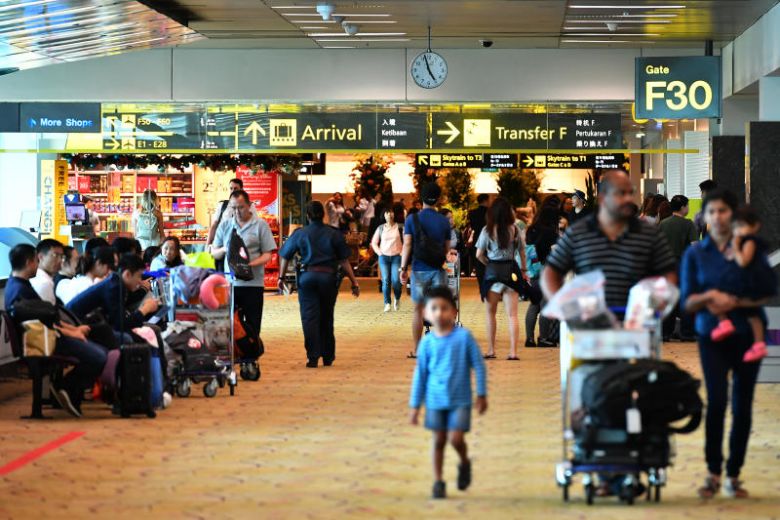
“I feel Singapore is home. Sometimes, it really is as simple and profound as that. When I go to Changi Airport, it’s home. I’m in the hawker centres its real, it’s natural, it’s home,” he says.
A “SINGAPOREAN” WRITER?
In an interview with another publication a few years ago, he even said he’d like to be known as a “Singaporean writer”.
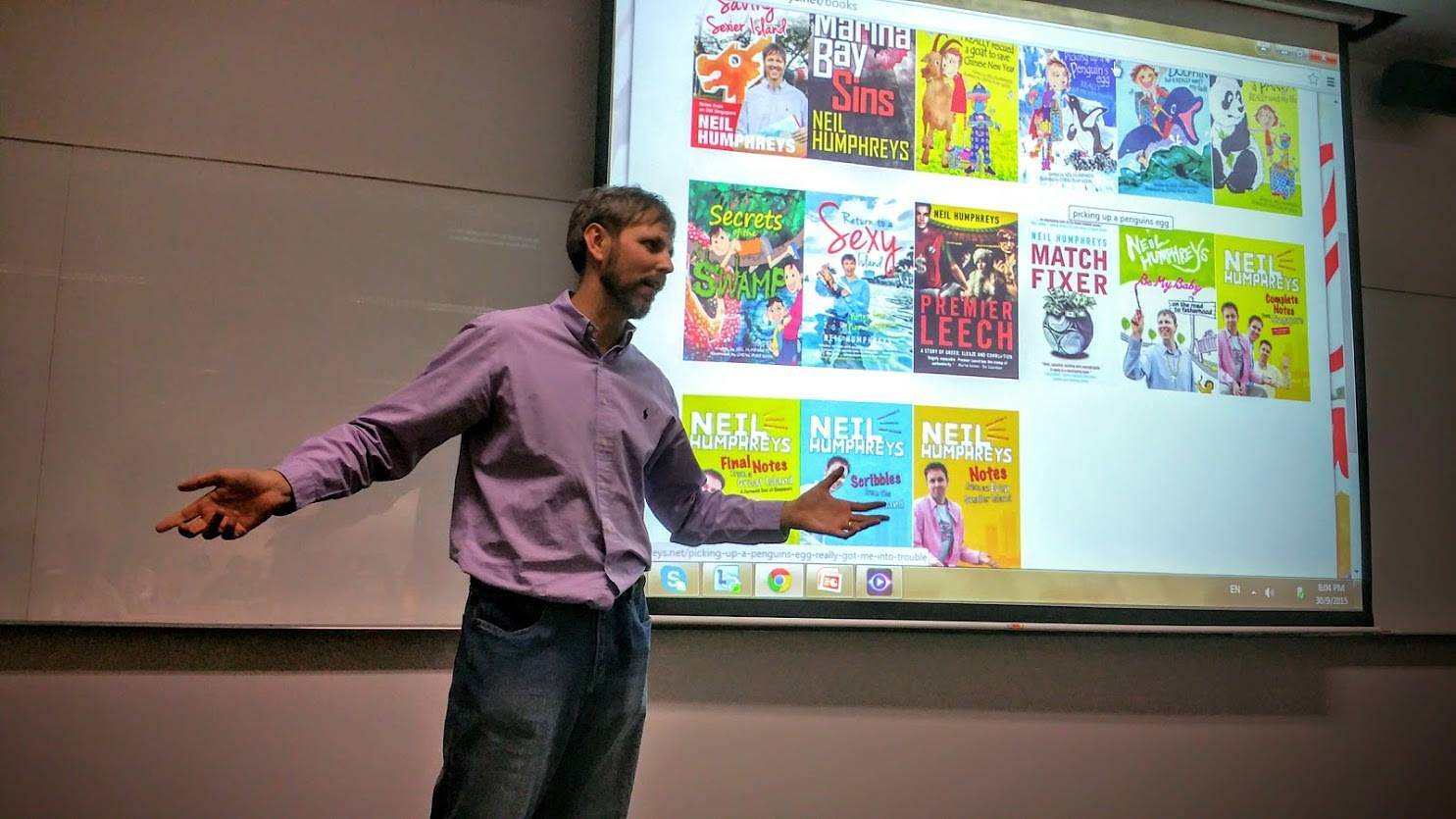
There is no doubt that he is prolific. His many works on Singapore include Notes from an Even Smaller Island (2001) and Saving a Sexier Island: Notes from an Old Singapore (2015). He has also written two football novels, thrillers and children’s books.
But Humphreys is not a Singaporean. After all these years, he is still a Permanent Resident (PR), and has not attempted to become a citizen.
“I feel like I’m being pressured,” he says as I attempt to find out why he hasn’t taken what would seem like a natural step for someone who claims to love this country and calls it “home”.
Some might say his reason for not seeking citizenship is perfectly understandable. While his wife and daughter live here, the rest of his family still lives in the UK.
“Last year, there was a very unexpected and sudden death in my family. It was an accidental death and out of respect for my family, I don’t want to talk anymore about that.”
“But because of that, I needed to get to the UK instantly and urgently and I needed to stay there for an undetermined length of time.
“That brought home to me that I still have all of my family in the UK, my parents, my wife’s parents. Being a PR helps me go between the two countries. If I had to stay in England to look after my parents for six months, a year, two years or whatever, it would be a lot simpler if I still had a British passport.”
The unfortunate death that led to this realisation however took place only last year.
Humphreys had lived in Singapore for many years before that. Why hadn’t he ever thought of becoming a citizen before this?
HE CONSIDERED CITIZENSHIP
“We felt like foreigners in the UK. I could not wait to come back and my wife was exactly the same,” says Neil Humphreys. (Photo: Facebook / Neil Humphreys)
“I looked into citizen issues but I was always aware that I have aging parents. I have a British citizen friend who lived in Singapore for many years. He married a lady from Thailand and she has had enormous visa issues, even though she’s married to a British citizen.
“I wouldn’t want to be in a position where I’d have to be in the UK for a long period of time, dealing with grief and having to deal with long-term visas as well,” he says.
“It’s a pragmatic, logistical and administrative thing. I have no problems becoming a Singaporean citizen. I possibly see that happening at some point. But while my family is still in the UK, it’s difficult.”
He claims he does “everything else”.
“I pay my taxes. I get all mushy on National Day. I cried when Joseph Schooling won the gold medal. If Singapore plays England, in any sport, I want Singapore to win.”
Assimilation was effortless for him.
“I just swapped one working class culture for another. I also grew up in London where everybody was a different colour, Indians and Chinese and Bangladeshis and Pakistanis so it was no big deal to me, to eat in a coffee shop in Toa Payoh.”
We discuss whether he ever thought of moving his family here.
“You’re talking about people in their late 60s, early 70s. They’ve lived in the UK their entire life, they’ve lived in the same town their entire lives. The culture shock would probably kill them. I have enough issues with them on holidays when they come and they come here two, three times a year. To them, chicken rice is exotic.”
Humphreys taught English at a local school when he first came to Singapore and proudly says that he needed the help of a Singaporean coach to neutralise his Cockney accent.
He then started writing for a local football fanzine. It was working for the fan club that brought him in contact with local journalists. He applied for a job in the media and became a full-time journalist and writer. Today, he freelances for various media.
He attributes his success as a satirist to having grown up “in a very funny household”.
“I grew up in a culture and an environment and a school system that encouraged us to speak out and encouraged us to laugh at ourselves.”
His wife currently teaches at an international school here and his daughter is a student at the same school.
To not go to a Government school was not a deliberate decision.
“My wife was teaching in a local school with me in the beginning but she had a friend who worked at this international school that was looking for people. She had worked there before we went to Australia. While we were in Australia, they asked if she would come back and said they’d have a place for my daughter as well. My kiasu light bulb went off. We felt that’s perfect. They can go to school together and come home together.”
“It was just a convenience thing. My daughter takes a lot of classes outside school. She just started an aikido class at the community club. She’s exposed to Singaporeans. Integration is not an issue.”
NATIONAL SERVICE
A few years ago, Humphreys even considered doing National Service.
“Because I always get that: ‘You ang moh, arh? You never do National Service what.’ That’s the only stick left that Singaporeans have legitimately got to beat me with.
“I had a meeting with some people from MINDEF and some TV people about the possibility of me doing Basic Military Training. The TV people were considering making a documentary out of it. I was running out of time, approaching my 40th birthday. But at that time my PR status hadn’t come through yet, so there were some issues with that.
“Now I’ve passed the age.” He’s 43 now.
NOT HERE BECAUSE HE COULDN’T “HACK IT” ELSEWHERE
Neil Humphreys has published 17 books across various genres. (Photo: Facebook / Neil Humphreys)
After graduating from university in the UK, Humphreys worked as a stockbroker for six months in the UK, a job he claims paid him well.
He asserts he’s not one of those foreigners who couldn’t make it in his own country and came to Asia to “rip off Singapore”.
He claims he has options even today – job opportunities from media organisations in the UK and Australia.
His books have done well in those countries as well. But he says he continues to choose Singapore and he does so because he truly loves it here, not because he can’t “hack it” elsewhere.
“I’ve said before that if I meet one more foul director, foul writer, foul producer, foul commentator, or foul teacher who couldn’t hack it in their own country and then came to Singapore and get a nice cushy expat job, I don’t know what I’ll do.”
Cushy expat packages are less common these days anyway.
WHITE WAS RIGHT
He admits the deferential attitude Singaporeans had, especially in the 90s, towards Caucasians had a part to play in his success. It helped him be heard.
“I’ll never lie about that. In the early days, I sensed people here were interested in me. It was more apparent to me because I’d come from a working class background back home where I was essentially written off as trash as soon as I opened my mouth. Then I came here and suddenly everybody listened to me. In the early years, white was right. That has thankfully faded now.”
But he claims that the deference and novelty, rightfully, didn’t last.
“If my work had no substance, my skin colour wasn’t going to save me. Maybe with my first book, yes, there was a slight novelty factor, but that novelty ended a long time ago.”
He cautions against being wowed by “ang mohs” with no substance, but “can talk for weeks”.
“Ang mohs are constantly encouraged to speak up and that’s not always the case in Singapore. So when they come here, they’re very confident in front of a crowd or a business delegation whereas a Singaporean, even some of our politicians, are quite timid, they can’t sustain eye contact. That’s a real problem. We need to fix that.”
In 2006, Humphreys left Singapore to go to Australia where he became increasingly bored.
“Within about two or three years of being in Australia, I got homesick for Singapore. I went to the suburbs of Australia and I was basically cutting the lawn and waiting for death. It wasn’t for me.”
A STRAWBERRY COUNTRY?
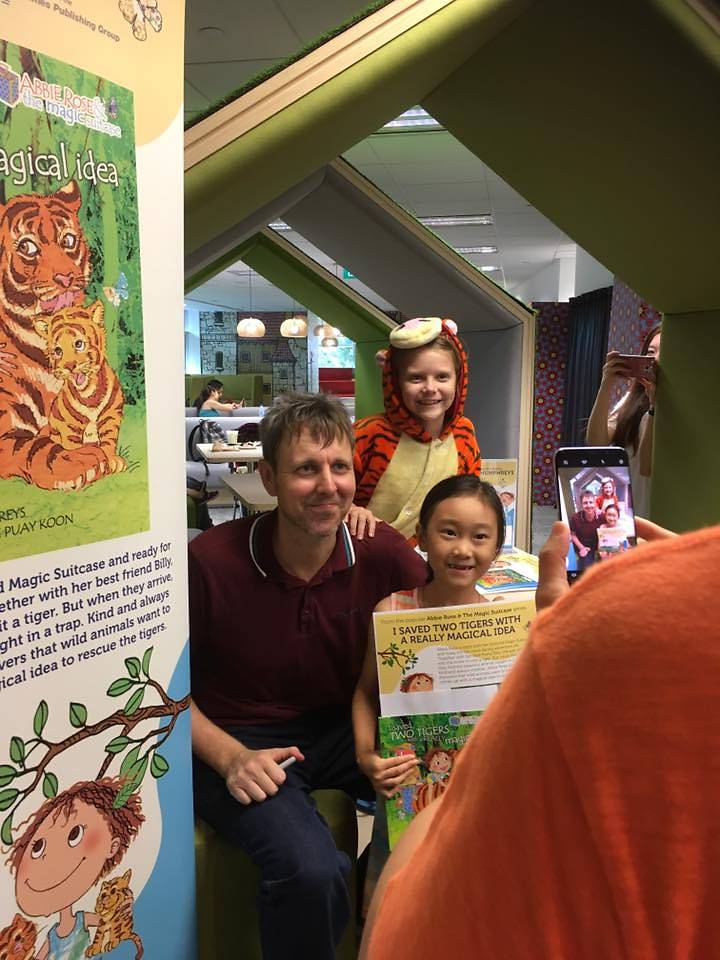
Neil Humphreys’ children’s books have garnered him adoring young fans in recent years. (Photo: Facebook / Neil Humphreys)
“I want the vibrancy and the colour of a 24-hour city but I also want the safety and security that you often get in most suburbs and villages. Singapore is one of the few cities on Earth that has that.”
Singaporeans take this for granted.
“I grew up in England. I was mugged twice. A friend of mine was killed in a nightclub incident, so I don’t take things for granted. When I say this in colleges here, I get the collective eye roll of restless 18-year olds who cannot wait to leave the boring, sterile Singapore. Leave. Explore the world and then see if you still take Singapore for granted.”
There are many other things he feels we take for granted.
“We’ve become a ‘strawberry country’. We complain about the MRT being four minutes late. Guys, get a grip. See what’s happening just in the neighbouring countries before you wreak havoc on social media.”
Still, chronic train breakdowns he agrees are a real problem.
“When we start to see alarming levels of inconsistency with the public transport system, that is different. But if it’s just a little late, is it so bad?”
When he moved back to Singapore in 2011, he moved into a condo.
As a PR he couldn’t buy an HDB flat immediately as HDB rules stipulate a waiting period of several years.
“I refused to pay rent to parasitic landlords for a moment longer. So I had to buy private.”
But he’s not living in an “ang moh enclave”.
“I’m on the border between Buangkok and Seng Kang. I’m back to being the only ang moh in the village. I’m walking distance from five coffee shops and hawker centers.”
“WE FELT LIKE FOREIGNERS IN THE UK”
So what’s his long-term plan? Does he plan to eventually return to the UK?
Again, his defences to go up.
“I feel like I’m being bullied now. I don’t know why.”
He claims when he and family went back to the UK last year, it became clear that they “no longer belong there”.
“We felt like foreigners in the UK. I could not wait to come back and my wife was exactly the same.”
“I’ll continue to travel because I love to travel, and if a job opportunity comes up in say Manhattan, I’ll go and work there for one or two years, but Manhattan won’t be my home. Singapore is my home. This is my base. There is no other home I can potentially foresee.”
There’s a deeper reason for his loss of love for the country he was born in.
“At the risk of upsetting right-wing leaning British expatriates, Britain has changed. It’s gone through a fundamental shift pre- and post-Brexit. There is very much a kind of ‘you’re either with this or against this’ type of thing. It’s becoming more insular.”
He says what bothers him is the hypocrisy he witnessed even among his own family members who voted for the Brexit.
“They say there are too many foreigners in our country. They need to go home. Those same people in my family used Polish contractors to do their kitchen and their bathroom because the foreign workers did the best work for the best salary.”
CHAMPIONING THE WORKING CLASS
But aren’t we seeing a similar dynamic in Singapore?
“I’m just too wary of excessive nationalism. We’re not there in Singapore yet. There are nuances to the issue here.
“I come from and still see myself as a working class guy, so I will always champion the working classes of Singapore. If a foreigner and a citizen are equal for the job, then the citizen should get it. That’s the issue in Singapore.”
He admits that this means some of his foreign friends in Singapore would be jobless. He himself is self-employed, so he has no skin in that game.
“But if it’s jobs that Singaporeans don’t want to do, and we have foreigners doing them, then you can’t use their services, but tell them to leave the country.”
A TICKING TIME BOMB
He cites the rich-poor divide in Singapore as a “ticking time bomb”.
“We can’t keep ignoring it. Wages are stagnating, hawkers are earning the same, retail employees are earning the same that they earned 10, 15 years ago but everything else has gone up.
“We have one of the lowest taxes in the world and you don’t see many Singaporeans campaigning to put our taxes up. I would pay more tax if it meant that certain HDB properties like hawker centers and other things like hospitals, whatever became a little bit cheaper. But until that happens, we might have to pay more for services.”
Clearly, while Humphreys loves Singapore, he also doesn’t hesitate to criticise it.
“You should be able to criticise. My wife loves me but she could sit here all day and list a thousand things about me that drive her mad. Love doesn’t mean you should be blind. Yes, you love a person, or a country dearly, but you love them enough to acknowledge the quirks and the nuances and the inconsistencies. That’s true love, to recognize flaws and hopefully try to address them and improve them.”
When asked what else he loves about Singapore warts and all, he talks about Asian values like filial piety.
“Respect for your parents, look after your parents, grandparents, also aunties and uncles in the street. They’re given a certain level of deference that I think we are losing in the UK, sadly.”
Neil Humphreys with students of Bartley Secondary School, inspiring a new generation of readers and writers. (Photo: Facebook / Neil Humphreys)
Education is another.
“Not to the kiasu degree. I’m not a big fan of tuition at all. But I do cherish the importance and the value of a quality education. I grew up in a society, a working class culture where there was no emphasis on education. We, in Singapore, tekan ourselves like nobody I’ve ever seen about the education system, but we also recognise our system as being one of the best in the world. So why do we need a ‘top-up’ through tuition?”
In spite of his working class roots, he made it to university in the UK.
“Because I was the beneficiary of the last of the government grants. That made it possible for me to get my tuition fees paid for by the government.”
As we end our conversation, Humphreys suggests more issues he thinks need to be urgently addressed in Singapore.
“We have to start in the year 2018 as a First World nation, starting to talk about the sensitive issues to avoid a potential Brexit-type situation down the line.
“We need to listen to those who ordinarily don’t have voices and we need to get the discussion going.
“I’d like to see more open discussion shows both on the mainstream media and the social media. We have this intellectualism obsession that we must always have a guy on a panel show that has a few letters after his name, a professor. I want to hear real people talk about real issues. That’s it.”
Being real is what he too aims to be remembered for. “Just an honest speaker, honest writer who wrote the best he could.”
SINGAPORE: It was nearing dusk on Jan 22, 2008, but Captain Benjamin Lim and Major (NS) Mark Lim weren’t retiring for the day.
The F-16D pilot and weapon systems officer (WSO), based at Changi Air Base (East), were part of the standby crew, which is the team activated for air defence responses.
At about 6.40pm their paging system went off with a siren: A call to scramble. “It was quite glaring,” the WSO MAJ (NS) Lim, 48, said. “Everybody could hear it.”
Scramble calls are not uncommon. These Republic of Singapore Air Force (RSAF) standby airmen go through numerous drills to achieve a heightened state of readiness, so they treat “every scenario as real”.
The F-16D. (Photo: Mindef)
Things moved in a matter of minutes. The pair suited up, climbed into the dual-crew cockpit and closed the canopy. “The instructions were just for us to take off,” MAJ (NS) Lim said. “We were not absolutely clear what we were up against, but we were ready for it.”
Once airborne, the men soon realised it was not just another drill.
“We received further orders to carry on with the particular profile, and that day’s was to basically intercept and escort an unknown aircraft back into Singapore,” CPT Lim, 37, said.
There was also “nervousness and anxiety” in the air, he added. “But when the engine starts up, all of these will automatically go away and you just execute what you’ve been trained to do.”
Together with another F-16, they flew across the evening sky to a location 113km away from Singapore. While that was in international airspace, the aircraft in question was heading towards Singapore airspace without an approved flight plan, the Ministry of Defence had said.
File photo of a Cessna 208. (Photo: Facebook/Central Queensland Plane Spotting Blog)
The F-16s caught up with the Cessna 208 and immediately sent back “valuable information” – the aircraft type, colour and its flight profile – to ground controllers and commanders.
Then came the warning.
“You have been intercepted by Republic of Singapore Air Force armed fighters. You have to comply with our instructions,” MAJ (NS) Lim said. They requested for the Cessna’s call sign, clarified its intentions and waited for instructions before escorting it back to Singapore.
The crew speaking to media. (Photo: Hanidah Amin)
“Could be a lost sheep. Could be somebody coming in with loads of bombs in the aircraft,” he added. “When we first contacted him, his voice return was very shaky. He told us he’s heading to Singapore to do some aircraft repairs.”
Even so, the pilots had to turn the Cessna away to “buy some time” for commanders to make an assessment. By then, everyone was running on adrenaline, CPT Lim said. “No questions asked, we just do what we were trained to do and wait for instructions.”
Insignia on CPT Lim’s uniform. (Photo: Hanidah Amin)
The F-16s were ready for all types of instructions, including an order to engage. They were armed with heat-seeking and beyond-visual-range missiles. “In the event that we need to neutralise the threat, yes, we will do it,” MAJ (NS) Lim said.
Despite that, CPT Lim stressed, the crew is not “trigger-happy”. “There are strict rules and processes to follow,” he said, like getting clearance from a higher authority. “No such thing as being able to just flip on a switch and go armed.”
Insignia on MAJ (NS) Lim’s uniform. (Photo: Hanidah Amin)
The entire operation took one-and-a-half hours, with the bulk of the time used for gathering information on the Cessna before allowing it to land at Changi Airport. Its Australian pilot was subsequently fined S$5,000 for flying without an airworthiness certificate.
“The whole mission was executed flawlessly, which meant that airborne and ground assets worked seamlessly together,” CPT Lim said, pointing to a team effort involving radar and air defence controllers on the ground.
THREATS ARE REAL
In the bigger picture, the RSAF detects a wide range of threats on a daily basis, with some unidentified aircraft bearing no information on where they are headed.
“This is a very important incident to remind all of us that threats are real,” MAJ (NS) Lim said. “It also demonstrated the air force’s capabilities; how important it is for us to maintain a high alert state.”
An F-15SG escorting a “suspicious civilian airliner” during an exercise. (Photo: Xabryna Kek)
Indeed, the airmen go through strict training to earn a spot in the standby crew. There are procedure reviews, simulators and actual flights. Then there’s a syllabus to complete before qualifying for the job.
“Everything happens like clockwork,” MAJ (NS) Lim said. “We’ve been practising this; not anybody can do it.”
Are they also prepared for the ultimate sacrifice, in the event the unidentified aircraft turns hostile?
“We dedicate our lives to Singapore, so we are ready to do what is necessary to make sure that the mission is executed properly,” CPT Lim said.
SINGAPORE: Nyana Priya is effectively bilingual and is studying to become a Tamil language pre-school teacher. But the 24-year-old wasn’t always so confident in her use of Mother Tongue.
Her own pre-school did not offer Tamil classes due to a lack of teachers – which meant Ms Priya had to choose between Mandarin and Malay for her second language.
But this proved challenging in the next few years.
“When I went to primary school, I had to take up Tamil because it was mandatory. But since I did not have a foundation in Tamil, I struggled,” she said.
RISING DEMAND
Out of about 1,400 childcare centres here, most offer only Mandarin classes. But the pages are turning.
The demand for Mother Tongue pre-school teachers is growing, as some operators say parents are hoping for their children to acquire a strong foundation in bilingualism to ease their transition to primary school.
My First Skool deputy general manager Thian Ai Ling said some parents may be conversant in their Mother Tongue, but may not have the confidence to teach their children.
“Today, many parents want the schools or the centres to teach more Mother Tongue languages because they find themselves needing help in that area,” she added.
So, the anchor operator started a pilot programme for Malay Language in 2015 at 22 of its centres, as well as a Tamil programme in 2016 at two centres.
Ms Thian said the centres were chosen due to their high population of Malay and Indian students.
This year, the operator hired two more Malay language teachers and extended the Malay Language programme to eight more centres.
A Malay learning corner set up at My First Skool. (Photo: Deborah Wong)
However, Ms Thian acknowledged that the shortage of manpower remains a challenge.
“It’s a known fact that manpower in the early childhood education area is not easy to get in the first place. So when we started our programme, we didn’t have a large number of centres in mind,” she said.
As an interim measure, the operator first recruited teachers within its centres who expressed strong interest in sharing their passion for their Mother Tongue.
Tamil language teacher at My First Skool, Aisha Banu, is one such individual who took up the mantle.
She agreed to teach the subject after she realised the urgency of establishing a good bilingual foundation in pre-school.
“I discovered that some of the Tamil-speaking children don’t reply or talk to me in Tamil, so I felt disconnected. I realised that many of them don’t even speak the language at home, so I started by singing songs to them in Tamil,” Ms Banu said.
The pilot began with 16 Malay language teachers and one Tamil language teacher – all recruited from within its centres.
“At areas where class sizes are small, some of our teachers go out to teach at least two centres. So more children can benefit from the lessons,” Ms Thian said.
Some pre-schools like Little Footprints and Etonhouse, which only offer Mandarin as a second language, employ a mix of local and foreign teachers, due to the lack of local Mother Tongue pre-school educators.
“It is a challenge to hire local Chinese Mother Tongue teachers, as they tend to have higher expectations compared to foreign Chinese; higher exceptions such as salary, location, hours and workload,” said Mindy Chng, cluster principal at Little Footprints.
LANGUAGE AND CULTURE
Meanwhile, privately-run pre-school Child at Street 11 overcomes the manpower shortage by hiring effectively bilingual local teachers who can switch between subjects.
It has six full-time staff and two part-time Mother Tongue teachers. At least four of them can speak up to three languages.
The school, which offers all three Mother Tongue Languages, believes the language should still be taught even if only one child wanted to learn.
A Tamil lesson at Child at Street 11. (Photo: Deborah Wong)
“All children have rights – the right to education and the right to learn. I think it is a huge sin to deprive anybody of that learning opportunity to learn about their culture and language,” said Nirmala Murugaian, the school’s founding director.
The school also prefers to hire local teachers as it believes language should be taught through cultural immersion.
These include teaching the children to sing a mix of Tamil, Malay or Chinese songs, regardless of their ethnicity. The school also organises frequent field trips to Chinatown, mosques, Hindu temples and churches.
“So in this way, the child understands the diversity, the complex issues of living in a diverse community. Questions of how do you encourage racial tolerance, acceptance and inclusion are brought in,” Ms Nirmala added.
SCALING UP MANPOWER
Help is on the way, though. The Early Childhood Development Agency (ECDA) told Channel NewsAsia that it has been working with the Education Ministry, Ngee Ann Polytechnic (NP) and private training providers to offer Mother Tongue Language training for early childhood professionals.
In fact, nearly 700 students were enrolled in courses at NP and private training providers in 2016.
Ms Priya is one of the 29 students enrolled in NP’s Tamil Studies with Early Education Diploma – a new programme launched last year to cater to a growing need for Tamil language educators.
Those interested in being a Chinese language educator can opt to specialise in the Chinese Early Childhood Teaching Track under NP’s Diploma in Chinese Studies during their second year.
Ngee Ann Polytechnic students attending a literature class under the Tamil Studies with Early Education Diploma. (Photo: Deborah Wong)
This programme was launched in 2016, with 19 out of 48 students choosing the teaching track.
Chinese Studies student Sim Jia Ning said she hopes to take the specialisation in her second year after going through the foundation courses in her first year.
“The teachers brought me to different childcare centres, and invited guests to speak to us about the industry and the life of a pre-school teacher. Through the real-life setting at the pre-schools, the interaction with the kids, I learnt that passion and patience are qualities a pre-school teacher should possess,” Ms Sim added.
Currently, Singaporeans and permanent residents make up about 60 per cent of Mother Tongue Language teachers in pre-schools.
To encourage more to come on board, ECDA said it works closely with all training partners to make the career an attractive choice.
It added that the new National Institute of Early Childhood Development, which will open next year, will also study the needs of the sector and consider the best way to support the training of Mother Tongue Language pre-school teachers.
American rocker Tom Petty died in October of an accidental drug overdose after taking a variety of medications for his ailments including a mix of opioid painkillers, his family and the Los Angeles county medical examiner said Friday.
The autopsy report says the 66-year-old Petty had fentanyl, oxycodone, temazepam and other drugs in his system when he died of cardiac arrest.
Petty’s wife Dana and daughter Adria said the medical examiner told them he “passed away due to an accidental drug overdose as a result of taking a variety of medications.”
“Unfortunately Tom’s body suffered from many serious ailments including emphysema, knee problems and most significantly a fractured hip,” they said in a statement on his band’s Facebook page.
Petty, the Southern-accented rocker whose classic melodies and dark storytelling created 40 years of hit songs, died shortly after wrapping up a tour celebrating 40 years of his band The Heartbreakers.
His family explained he was on tour, even with the fractured hip, when his condition worsened.
“On the day he died he was informed his hip had graduated to a full-on break and it is our feeling that the pain was simply unbearable and was the cause for his overuse of medication,” they said.
The analysis bore striking similarities to the death in 2016 of pop icon Prince, attributed to an accidental dose of painkillers.
“As a family, we recognise this report may spark a further discussion on the opioid crisis and we feel that it is a healthy and necessary discussion and we hope in some way this report can save lives,” the Petty family statement said.
“Many people who overdose begin with a legitimate injury or simply do not understand the potency and deadly nature of these medications.”
Petty is known for such hits as “American Girl,” “I Won’t Back Down,” and “Free Fallin’.” He sold 80 million records during his career.
The singer and guitarist — a three-time Grammy winner recognizable for his shoulder-length blonde hair — struggled with depression most of his life and was at one time addicted to heroin.
In his later years, his only substance was marijuana and he calmed himself with transcendental meditation.