Singapore
Tuesday, February 6, 2018 – 09:29
PM Lee Hsien Loong responds to ESM Goh Chok Tong's 'watching' FB posts
The Straits Times
Others


SINGAPORE: Every canteen stall at Mayflower Primary School has icons and photos to indicate the food and drinks available and most of the vendors know some simple sign language.
The school has been making adjustments to its teaching and even canteen operations to cater for six Primary 1 pupils with hearing loss who joined this year. It is the first designated primary school for such students, and the entire school community spent the past few months preparing for their arrival.
“We did some simple, small charts, so they know that this is a chicken bun or pizza,” said Ms Wendy Yap, a vendor selling snacks and tidbits.
The photos are meant as visual cue cards for the students with hearing loss, so they can order their food by pointing – although some vendors said they encountered teething issues on the first few days of school.
Mayflower Primary is the first designated primary school for students with hearing loss. (Photo: Rachelle Lee)
“When they bought one item, it was okay. But once they took a bun and a drink and added up the amount, we had difficulties. We gave feedback to the school, which came up with a chart showing various amounts in dollars and cents, where we can point to let them know how much their food costs,” said Ms Yap.
The hearing-impaired students have also been assigned two buddies each from upper primary to look after them during recess.

The photos of food are meant as visual cue cards for the students with hearing loss, so they can point and order their food more easily. (Photo: Rachelle Lee)
All the six deaf pupils are in the same class, studying and learning alongside their peers. It is only during mother tongue lessons that they go to a separate classroom to learn sign language.
Besides that, they attend all other lessons, such as English, mathematics, physical education, social studies, drama, arts and craft and even music classes.
Mayflower Primary said some of the children have residual hearing, and although they are unable to hear clearly, they are still able to learn tempo and rhythm as they can feel the beat of the music. While the rest sing along to the songs, the six sign the lyrics.
Mayflower Primary said some of the children have residual hearing, and although they are unable to hear clearly, they are still able to learn tempo and rhythm as they can feel the beat of the music. (Photo: Rachelle Lee)
For all lessons, the mainstream teacher wears a microphone that transmits and amplifies sound into the pupils’ hearing devices, while a specialised teacher, who is present at every lesson, also teaches and signs along.
“Like any new programme, it takes time for everyone to adapt to a new way of doing things. At the start, the pupils with hearing loss had to be reminded not to look at me when I was teaching, but to look at the teacher who was doing the signing during the lesson instead,” said English teacher Elaine Lim.
“Students and teachers in this class have also started using sign language to greet each other. Even though most of them have not learnt a lot of sign language, they use their own gestures to communicate with one another,” said Ms Lim.
While the rest sing along to the songs, the six students with hearing loss sign the lyrics. (Photo: Rachelle Lee)
Madam Siti Nuraisyah Mohamed Murat, a parent of one of the deaf students, said she was the one with the first-day-of-school jitters, and not her daughter.
“She kept on signing to me that she wanted to see her old friends and teachers … This will benefit her as she will have more confidence in herself with the hearing students surrounding her,” said Mdm Siti.
“She’s been adapting well in school. Every time she comes back, she will surely have a lot of stories to tell me.”
Mdm Siti’s daughter, Nurfasha Elaisyah Muhammad Khairul, who communicated via an interpreter, said she hopes more of her classmates can learn the sign language, so she can play with them.
Mayflower Primary will be offering sign language enrichment classes for those keen to learn after school. So far, 30 teachers have already signed up, and students of all levels have also indicated interest, the school said.
SINGAPORE: Every canteen stall at Mayflower Primary School has icons and photos to indicate the food and drinks available and most of the vendors know some simple sign language.
The school has been making adjustments to its teaching and even canteen operations to cater for six Primary 1 pupils with hearing loss who joined this year. It is the first designated primary school for such students, and the entire school community spent the past few months preparing for their arrival.
“We did some simple, small charts, so they know that this is a chicken bun or pizza,” said Ms Wendy Yap, a vendor selling snacks and tidbits.
The photos are meant as visual cue cards for the students with hearing loss, so they can order their food by pointing – although some vendors said they encountered teething issues on the first few days of school.
Mayflower Primary is the first designated primary school for students with hearing loss. (Photo: Rachelle Lee)
“When they bought one item, it was okay. But once they took a bun and a drink and added up the amount, we had difficulties. We gave feedback to the school, which came up with a chart showing various amounts in dollars and cents, where we can point to let them know how much their food costs,” said Ms Yap.
The hearing-impaired students have also been assigned two buddies each from upper primary to look after them during recess.
The photos of food are meant as visual cue cards for the students with hearing loss, so they can point and order their food more easily. (Photo: Rachelle Lee)
All the six deaf pupils are in the same class, studying and learning alongside their peers. It is only during mother tongue lessons that they go to a separate classroom to learn sign language.
Besides that, they attend all other lessons, such as English, mathematics, physical education, social studies, drama, arts and craft and even music classes.
Mayflower Primary said some of the children have residual hearing, and although they are unable to hear clearly, they are still able to learn tempo and rhythm as they can feel the beat of the music. While the rest sing along to the songs, the six sign the lyrics.
Mayflower Primary said some of the children have residual hearing, and although they are unable to hear clearly, they are still able to learn tempo and rhythm as they can feel the beat of the music. (Photo: Rachelle Lee)
For all lessons, the mainstream teacher wears a microphone that transmits and amplifies sound into the pupils’ hearing devices, while a specialised teacher, who is present at every lesson, also teaches and signs along.
“Like any new programme, it takes time for everyone to adapt to a new way of doing things. At the start, the pupils with hearing loss had to be reminded not to look at me when I was teaching, but to look at the teacher who was doing the signing during the lesson instead,” said English teacher Elaine Lim.
“Students and teachers in this class have also started using sign language to greet each other. Even though most of them have not learnt a lot of sign language, they use their own gestures to communicate with one another,” said Ms Lim.
While the rest sing along to the songs, the six students with hearing loss sign the lyrics. (Photo: Rachelle Lee)
Madam Siti Nuraisyah Mohamed Murat, a parent of one of the deaf students, said she was the one with the first-day-of-school jitters, and not her daughter.
“She kept on signing to me that she wanted to see her old friends and teachers … This will benefit her as she will have more confidence in herself with the hearing students surrounding her,” said Mdm Siti.
“She’s been adapting well in school. Every time she comes back, she will surely have a lot of stories to tell me.”
Mdm Siti’s daughter, Nurfasha Elaisyah Muhammad Khairul, who communicated via an interpreter, said she hopes more of her classmates can learn the sign language, so she can play with them.
Mayflower Primary will be offering sign language enrichment classes for those keen to learn after school. So far, 30 teachers have already signed up, and students of all levels have also indicated interest, the school said.

SINGAPORE: 2017 did not end well for SMRT. SMRT had to deal with a train collision at Joo Koon, disruptions across its three major MRT lines at various points in the year, and the Bishan MRT station tunnel flooding.
Following these events, a number of senior leadership appointments and announcements were made over the past month to right the situation and restore public faith.
Chairman of SMRT Mr Seah Moon Ming announced in December that he planned to step down from his role as CEO of Pavilion Energy to focus on SMRT, signalling to the public the high-level commitment and focus SMRT will be dedicating to restoring service excellence and public trust.
In late January, SMRT announced that its vice-president for corporate communications Patrick Nathan would be leaving the company, with Margaret Teo taking over to lead the organisation’s external and internal communication to “drive strategic messaging, media relations, international communications, corporate affairs, community engagement, corporate social responsibility and online engagements”.
She would also assume the role of chief spokesperson for SMRT Group.
SMRT also announced on the same day that they’ve appointed Elaine Koh, SMRT’s director of marketing for SMRT Commercial, to assume the new role of Chief Commuter Engagement Officer, to lead a team to enhance service quality and improve commuter satisfaction through listening and gathering feedback from commuters.
No doubt these leadership changes including the creation of a new Chief Commuter Engagement Officer role to serve better serve commuters’ information needs are welcome moves to improve SMRT’s communications.
Untangling SMRT’s communication woes is a complex exercise that these executives will have to undertake – not an enviable task for anyone in any case.
But will a deeply sceptical public buy in? Will SMRT’s move fundamentally change its communication efforts and transform the commuter experience?
Margaret Teo, vice-president of corporate communications at SMRT.
TALK IS EASY
The knee-jerk reaction to this decision from the man on the street is “talk is easy and actions speak louder than words.”
Some say resources would be better invested in auditing processes, operations management and engineering to improve the quality of train services – so that trains come on time and events like the tunnel flooding incidents do not recur.
To add salt to injury, a few have said SBS Transit is doing a better job in replying to negative feedback and has fewer complaints.
In my view, it is commendable that SMRT is finally investing resources into communications, but shifting towards a customer-centric communication approach is not enough if it isn’t accompanied by quality train service.
What the public expects is not just better engagement when a delay or disruption hits but something more fundamental – the reduction of such instances.
In this, it is laudable that SMRT recognises the problem as the need to improve its responsiveness to commuters as a strategic agent in its bid to improve readiness in dealing with delays – and is beefing up its communications and engagement outfit.
But such a move will only work if there is substance behind the (added) spin.
Just look at the example of Asia Pulp and Paper, a company in the news for its association to the forest fires that caused severe haze in Singapore in 2015.
In Feb 2016, former CEO of the Singapore Environment Council Jose Raymond joined Asia Pulp and Paper, in the company’s move to improve its public reputation after having long battled environmental groups about its land clearance practices.
Yet the company did not seem any closer to improving its reputation when he left after eight months.
(File photo: SMRT)
CONCRETE CHANGES NEEDED
Moves like the appointment of a new Chief Commuter Engagement Officer to engage stakeholders will only be as effective as the concrete changes made in other parts of the organisation that aligns SMRT’s departments with stakeholders’ expectations and bears productive outcomes – including timely trains and upfront communications with commuters when a delay is expected.
No amount of spin or technocratic responses can make up for the genuine organisational change that SMRT needs – in the areas of better operational performance, good governance and strong leadership.
So SMRT’s move to appoint three new officers to strengthen its focus on rail operations is a welcome sign that complements its boost to its communications and engagement departments
The mention that these new appointments were undertaken to strengthen engineering capabilities and ongoing asset renewal may also go some way to help the public understand what SMRT is doing as an organisation to move towards its goal of a better commuting experience.
RESPONDING DECISIVELY TO THE NEXT INCIDENT AND DELAY
But let’s imagine better communications and engagement is SMRT’s goal. If so, then a measure of success for SMRT is whether it can respond decisively when the next serious incident happens. One way is to enlist its people to tell its story.
Selected representatives from engineering experts to front-line employees and the leadership team should be trained to face the media and take questions should another press conference be needed during the next major disruption. This training needs to start now.
While a balance must be struck so that media engagement does not distract them from their work, research shows that having a team of subject matter experts speak to the press diffuses tension and projects organisational solidarity that reinforces public confidence in incident management.
Transport Minister Khaw Boon Wan being briefed by SMRT engineers on the power rail replacement project. (Photo: SMRT)
This is especially important in a crisis where leaders and subject matter experts are expected to come forward to give more background to an incident.
In scenarios of delays and disruptions, an engineer is also more likely to have quick access to and be able to interpret the technical information accounting for the incident. He or she may also be better equipped to explain the details than the SMRT chief spokesperson.
When a delay or disruption happens, the challenge for the communications team is understandably having to deal with the influx of information and complaints. Where information moves swiftly over smartphones and news can be rapidly shared peer-to-peer, it is important for SMRT to get ahead of the curve by providing timely, accurate updates.
Even in a 5-minute delay, commuters are always looking for verified information from trusted sources. It’s times like these that are ripe for SMRT to be proactive and build relations with commuters.
Most Singaporeans rely primarily on public transport and the MRT for their daily commuting needs. Many do not have the luxury of getting a taxi or Grab.
With close to 160,000 fans on its Facebook page, emotions are aggravated when there are no updates from SMRT after an initial announcement.
Instead of relying on official communications when a delay happens, why not consider a webcam at each station much like what SingHealth Polyclinics do to help the public set expectations of its queue time at each location? There are also cameras showing traffic conditions at the Causeway and Second Link at Tuas for the same purpose – giving commuters real-time (human) traffic information.
SMRT should see how it can employ technology and marketing communications to enhance the journey experience for commuters. After all, the SMRTConnect app is already a step in the right direction in giving commuters real-time bus and MRT information to plan their journey.
TIME IS NEEDED
After a spate of incidents in 2017, it will take time for the public to see and feel the difference.
While SMRT’s moves to shore up its communications with the public are commendable, what is key is for it not to let up with its engagement and service quality improvement efforts.
The signalling project is slated for completion in 2019 and SMRT may well be seeing the light at the end of this tunnel soon.
Wong Pei Wen is a lecturer at Nanyang Technological University’s Wee Kim Wee School of Communication and Information.
SINGAPORE: The Attorney-General’s Chamber (AGC) said on Monday (Feb 5) that it will take firm action against contempt of court, including the institution of committal proceedings in appropriate instances.
In a statement, the AGC said it has written to Mr Neo Aik Chau about a post he published on a Facebook group on Feb 2, which made reference to the widely publicised Feb 1 decision of the Court of Appeal ruling in favour of the accused people involved with City Harvest Church (CHC).
Speaking in Parliament earlier on Monday, Home Affairs and Law Minister K Shanmugam said that the AGC was looking into a piece of “fake news” relating to the CHC saga as a case of contempt by scandalising the courts.
After announcing the Government’s view of the sentences as “too low”, he was asked by Member of Parliament (MP) Gan Thiam Poh for his take on the public commenting how the CHC case was handled by a lawyer who is also an MP from the ruling People’s Action Party (PAP) – Mr Edwin Tong of Marine Parade.
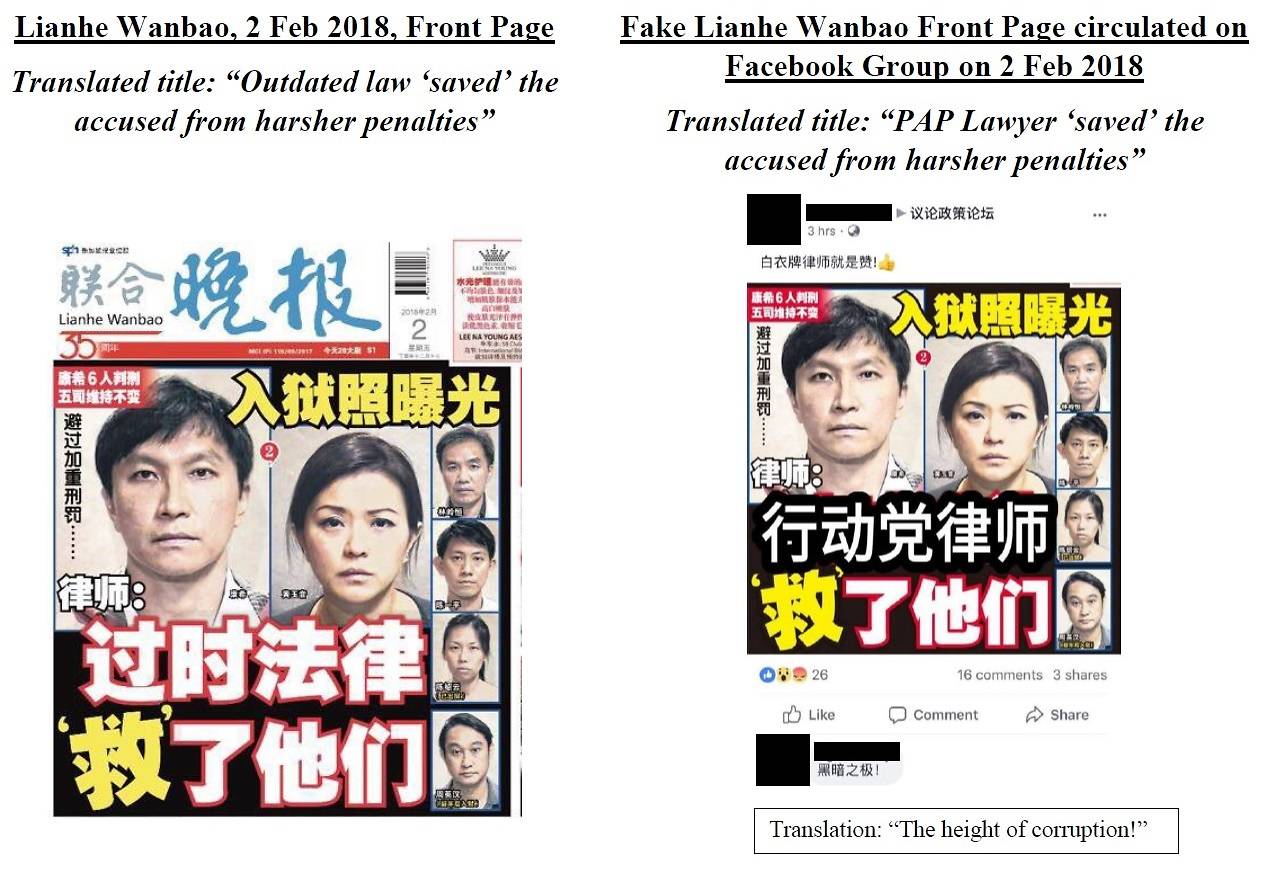
In response, Mr Shanmugam gave an example of a public Facebook group which last week circulated a doctored front page image of local Chinese tabloid Lianhe Wanbao. The original, translated title of “Outdated law ‘saved’ the accused from harsher penalties” had been changed to “PAP lawyer ‘saved’ the accused from harsher penalties”.
Front page of Lianhe Wanbao (left) and doctored front page circulated on Feb 2, 2018. (Image: MHA)
Mr Shanmugam said: “AGC takes the view that the suggestion from the fake title is that the PAP MP was responsible for an unfair, unjust outcome and the Courts have let off the defendants lightly because of him.
“The matter is with AGC and will be dealt with in accordance with the law.”
“This sort of attack based on deliberate faking is quite unacceptable,” he continued. “I cannot see how any reasonable person will justify such faking as a legitimate expression of free speech.”
Earlier, Mr Shanmugam also said that attacks on the CHC judges “ascribing improper ulterior motives to their decision” was “a clear case of abusing the anonymity of the Net”.
“People who abuse judges, challenge their integrity, will be prosecuted if a case for contempt can be made out. Courts should be free to decide in accordance with what they believe the law to be, and criminal cases must be tried in the court of law – not in the court of public opinion.”
He added: “We don’t want to end up like the United Kingdom, where the press freely attacks the judiciary. You get newspaper headlines labelling judges as enemies of the people, because the courts had the temerity to decide in a way the media did not like. If we are not careful we will easily go down that route.”
“I’ve asked the police to take a serious view of those who scandalise court – not only for this case, if there are other comments which cross the threshold and are in contempt of court, our approach is that action will be taken,” Mr Shanmugam noted.
“In coming to a decision whether to prosecute for scandalising the courts, the factors will include assessing who said it, how seriously is the statement likely to be taken, how wide was the publication, and other relevant factors.”
“SHAMEFUL” TO “HOUND” LAWYERS
Mr Shanmugam also emphasised that defendants were entitled to lawyers of their choice and lawyers “should not be made to feel they will be hounded online” should they take up certain cases.
“Rule of law, a civilised system of having trials in court, depend amongst other things, on lawyers being able to act for defendants, whatever offences the defendants are accused of,” he explained.
“Even a child rapist is entitled to his day in court, and to be defended. It doesn’t mean that we, or the lawyer defending the person, approves of child rape.”
Mr Shanmugam then shared a personal example from when he was a lawyer in practice.
“I am probably in the unique position, in Singapore, someone who has both acted for the three PMs of Singapore, and also of having acted against all three of them,” he said.
“In 1995, PM Goh (Chok Tong), SM Lee (Kuan Yew) and DPM Lee (Hsien Loong) as they were then, sued the International Herald Tribune (IHT) for libel. The IHT came to me. The conversation as to whether I will act for them took about two minutes. I told them they must know I was a PAP MP. Were they comfortable, that they will get the best possible advice from me, given my position?”
“They said it was ok with them, if it was ok with me. It was ok with me. I didn’t see any need to clear with the Party or anyone connected to the Party or Government. By taking on the case, I was simply doing my professional duty.”
“I didn’t need to take on the brief. I was very busy with other work. But I thought the IHT had a right to Counsel of its choice. They were faced, obviously, with particularly formidable plaintiffs and hoped to get Counsel of their choice. And so I should help the IHT,” said Mr Shanmugam.
“The import of my acting for the IHT, and it went to court, did not escape SM Lee Kuan Yew. In court, after his evidence was over, and before he stepped out of the witness box, he said he had to point out the situation. He said that I was close to the three of them, meaning the PM, SM and DPM. I was a PAP MP. The decision by the IHT, despite the situation, to instruct me was, I quote, the ‘highest tribute to the integrity of the Counsel’, and ‘possibly reflected also on the integrity of the Government’.”
“Over the years, I have also acted for various others whose conduct will not be approved of by the general public, and some of whom were impecunious and could not pay fees.”
Mr Shanmugam concluded: “The headline that I referred to earlier in the Facebook page, is part of a mob mentality to hound lawyers, to intimidate them into not acting in cases which the mob disapproves of. It is quite shameful.”
“Supposing no action is taken when public Facebook pages do this, then what is there to prevent the media itself from publishing such articles in the future?”
“We should not get there. It will be a sad day for Singapore, if we do get there.”

SINGAPORE: Authorities are investigating an alleged incident of curry being poured into Tampines River.
On Sunday (Feb 4), Facebook user Shirley Lc Tan posted a photo of a reddish-brown substance in the river, writing that it was a wedding caterer at the void deck of Block 408 Pasir Ris that had dumped curry gravy into the river.
The post was shared more than 2,400 times as of Monday, but it has since been taken down.
Replying to Channel NewsAsia’s queries, the National Environment Agency (NEA) said on Monday that both NEA and national water agency PUB received reports on Sunday of “a substance resembling curry” being disposed into the river.
NEA and PUB officers went down to the site immediately, and NEA is investigating the alleged incident, it added.
SINGAPORE: Smoke was seen rising from an escalator at Ang Mo Kio MRT station leading to the underground linkway to AMK Hub on Monday afternoon (Feb 5).
All three escalators to the linkway were shut down and the linkway closed “for commuter safety”, said SMRT vice president for corporate communications Margaret Teo in statements to the media. She added that train services on the North-South Line were not affected.
“Initial investigations show that the smoke could have come from overheated motor bearings in the faulty escalator which were replaced earlier today,” Ms Teo said in an update at about 7.50pm. “Further checks will be carried out before the escalator is put back in service.”
The linkway reopened at 6.10pm but the escalators are still not in service.
The other two escalators next to the faulty one have been turned off pending safety checks but commuters can use the escalator steps to access the linkway, Ms Teo said.
“Station staff will be on hand to guide commuters. The elderly and commuters with special needs are advised to use the lift,” she added.
The Singapore Civil Defence Force (SCDF) said one person was taken to Singapore General Hospital at about 3pm for smoke inhalation. The person, who is under observation in hospital, is an SMRT employee, Ms Teo confirmed.
Eyewitness Pan Zhengxiang told Channel NewsAsia that he saw smoke rising suddenly from the escalator some time between 1.30pm and 2pm.
SCDF personnel at Ang Mo Kio MRT station. (Photo: Matin Akmal)
“Many were still using the escalator initially,” he said. “The public later helped raise awareness of the situation … so (people can) avoid the escalator.”
According to Facebook user Jas Chua, there was a “pungent smell” and it was difficult to breathe.
Fire engines from SCDF were seen parked outside the MRT station.
Fire engines were seen parked outside Ang Mo Kio MRT station. (Photo: Pan Zhengxiang)
Police outside Ang Mo Kio MRT station after smoke was seen coming from an escalator. (Matin Akmal)
A cordon was set up around the affected escalator and SMRT technicians were seen on-site.
Channel NewsAsia understands that SMRT had been aiming to reopen the underground linkway leading to Ang Mo Kio Hub before the evening peak hour.
A cordon set up at Ang Mo Kio MRT station where smoke was seen coming from an escalator. (Photo: Dewi Fabbri)
(Photo: Dewi Fabbri)
(Additional reporting by Dewi Fabbri)
This story came from a reader tip-off. If you would like to send in photos or videos of something newsworthy, WhatsApp our Mediacorp news hotline at +65 8218 8281 or message us on Facebook.
SINGAPORE: From a free jazz concert at the Botanic Gardens, to site-specific shows at the Armenian Church grounds and the National Gallery Singapore, to even more events held at the Civic District – this year’s Singapore International Festival of Arts (SIFA) promises to be an intense 17-day experience when it kicks off earlier than usual in April.
The 41st edition of the national performing arts festival will run from April 26 to May 12. While SIFA was previously held around August, organisers decided to bring it forward to avoid the crowded events calendar during the latter part of the year.
Commissioned by the National Arts Council and organised by Arts House Limited, the festival will feature around 46 shows from 15 countries, including Singapore.
23-year-old Youtube sensation and two-time Grammy winner Jacob Collier will be performing at SIFA 2018. (Photo: Betsy Newman)
Highlights include acclaimed productions of George Orwell’s 1984 and Henrik Ibsen’s Enemy Of The People; and performances by YouTube sensation and two-time Grammy winner Jacob Collier, and India’s arts power couple, poet Javed Akhtar and actress Shabana Azmi.
Closing the festival will be the renowned Duke Ellington Orchestra, who will be performing with local jazz singers, at the Botanic Gardens.
This year marks the first festival helmed by new director Gaurav Kripalani, who will be helming three editions until 2020.
The artistic director of the Singapore Repertory Theatre (SRT) takes over from theatre director Ong Keng Sen, who had given the festival a distinctly cutting-edge and avant-garde identity during his four-year tenure since 2014, when the old Singapore Arts Festival was relaunched as SIFA.
For the next three editions, Kripalani said the festival will be presenting shows that will appeal to a wide range of audiences.
France’s Cirque Rouages will be one of the outdoor performers at Empress Lawn during the festival. (Photo: SIFA)
“We wanted to make sure there were shows that would appeal to your first-time festival goer, shows that would cater to your seasoned arts lover, and make sure there’s a spectrum. There are different audiences who will want different things,” he said.
He cited as an example of SIFA’s new approach the multiple events taking place during the opening weekend. There will be three simultaneous ticketed events to attract audiences of different persuasions: The poetry reading event by Akhtar and Azmi; the concert by 23-year-old Collier, whose music covers have garnered millions of views on social media; and the stage adaptation of Orwell’s 1984.
Of the decision to stage the latter as one of SIFA’s opening shows, Kripalani said: “The themes it deals with are probably among the most burning and pressing in the world today – fake news, state surveillance. There is a reason why it’s back on the bestseller list again.”
Ibsen’s Enemy Of The People by German director Thomas Ostermeier. (Photo: Arno Declair)
Aside from these, there will also be free outdoor performances at the Empress Lawn, such as a circus theatre piece by France’s Cirque Rouages, and music by the likes of Korean band Sultan Of The Disco, and pop-up dance performances.
Meanwhile, The Arts House will also be transformed for the first time into a SIFA hub called the Festival House. “It will be the heartbeat of the festival where masterclasses, workshops, talks, performances and collaborations will take place,” explained Kripalani.
Other SIFA acts include contemporary tap dance artist Michelle Dorrance, French dance company Ballet Preljocaj, and singer-songwriter Toshi Reagon.
The Duke Ellington Orchestra will be holding a free concert at the Botanic Gardens to wrap up the festival. (Photo: SIFA)
Among the Singapore shows are Toy Factory’s reinvention of the Ming opera epic A Dream Under The Southern Bough; and collaborations between SA, NADA and Brandon Tay, among others.
A new Monuments series will see local artists presenting works at some national monuments sites: Zelda Tatiana Ng will present a piece tackling the death penalty at the National Gallery, while Kamini Ramachandran heads to Armenian Church with a storytelling piece.
Meanwhile, the artist collective Inter-Mission will be using virtual reality technology to allow audiences to explore a reimagined Civic District without its familiar landmarks.
Kamini Ramachandran’s The Hidden, which will be held at the Armenian Church grounds, is one of the site-specific performances under SIFA 2018’s Monuments Series. (Photo: Karnan Balakrishnan)
And while Kripalani said they are still in talks with various local artists and groups for more Singapore productions for the next two editions, SIFA audiences can get a sneak peek at one of these: Checkpoint Theatre will be presenting an excerpt stage reading of playwright Huzir Sulaiman’s new play for the 2019 edition.
When Kripalani’s appointment was first announced last year, there was much speculation regarding the direction in which he would be taking SIFA, especially after the experimental vision of the previous director.
At SRT, he had presented mainstream, crowd-pleasing fare such as the Shakespeare In the Park series, and productions like Forbidden City.
Festival organiser Arts House Limited’s chief executive Sarah Martin, who came on board before Kripalani, was also known for her past work as WOMAD music fest director and Singapore Grand Prix’s director of operations.
Both of them do not see the new festival direction as the complete reversal of the past four years.
SIFA director Gaurav Kripalani (left) and Arts House Limited chief executive Sarah Martin. (Photo: SIFA)
“I very much see it as an evolution –it’s not pivoting 180 degrees,” said Kripalani.
Martin, who describes this year as the beginning of a “new era” for SIFA, pointed out that every festival director has put a stamp on their respective tenures. “This is a festival that has been evolving for four decades and not just the last four years. That’s the beauty of having different directors and why you have different phases of an arts festival,” she said.
She also pointed out how the new SIFA is building on the strengths of the previous editions, citing the previous pre-festival OPEN series of talks and workshops.
For the next three years, the festival will include a series of free talks, events and workshops that spin off from the festival line-up. For instance, a “book club” and a lecture will supplement the production of 1984, while there will be masterclasses based on the different dance productions.
One main issue that had cropped up during the previous SIFA editions was that of arts licensing. Former director Ong Keng Sen had raised concerns regarding the festival’s independence, and had clashed with authorities regarding a few shows.
Israeli dancer Sharon Eyal presents OCD Love. (Photo: Regina Brocke)
The festival was not exempted from arts licensing during the past three years, but last year, NAC had announced the possibility of exemption from this year onwards.
But Martin clarified that this year’s SIFA will still have to apply for arts licensing for its shows.
She said that Arts House Limited, which runs the festival, will be looking to apply for a collective exemption across all its centres and programmes later this year.
It also manages other venues such as The Arts House, Aliwal Arts Centre, Goodman Arts Centre, the Victoria Theatre and Concert Hall, Drama Centre and the upcoming revamped Stamford Arts Centre.
SINGAPORE: A fallen tree on Balestier Road resulted in eastbound traffic congestion on Monday (Feb 5).
A Channel NewsAsia reporter on the scene observed traffic backed up until Thomson Road after two of three lanes were blocked in the area. Workers were seen sawing off branches from the fallen tree.
A tree fell on a car along Balestier Road on Monday (Feb 5). (Photo: Lin Suling)
A tree that fell along Balestier Road being cleared away on Monday (Feb 5). (Photo: Lin Suling)
In a tweet at around 6.45pm, the Land Transport Authority alerted drivers to an obstacle on Balestier Road after Boon Teck road.
Channel NewsAsia has reached out to the Singapore Civil Defence Force and the police for more information.
A tree fell along Balestier Road on Monday (Feb 5). (Photo: Lin Suling)