Singapore
Tuesday, February 13, 2018 – 12:25
Man who beat adoptive father to death pleads guilty
The Straits Times
Others

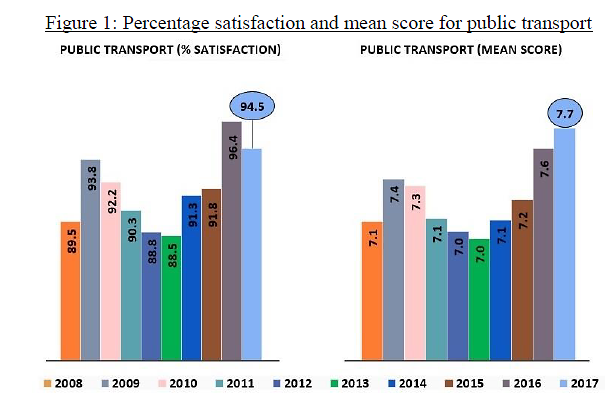
SINGAPORE: Commuters’ satisfaction levels with public transport dipped last year mainly due to the fall in satisfaction levels with MRT services, according to the results of a survey released by the Public Transport Council (PTC) on Tuesday (Feb 13).
They dipped to 94.5 per cent last year – down from 96.4 per cent in 2016, the first time in four years that satisfaction levels have dropped.
(Source: Public Transport Council)
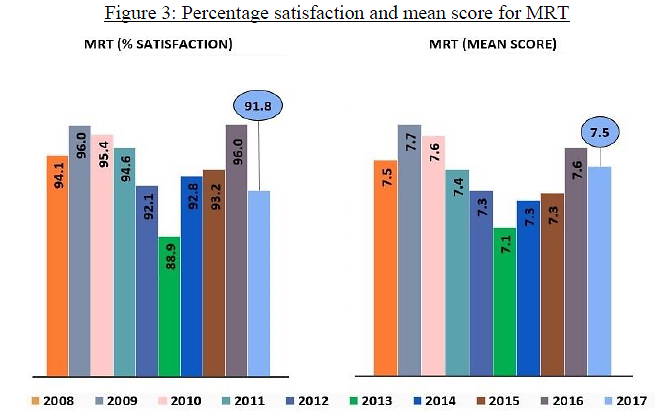
Satisfaction levels with MRT services dropped to 91.8 per cent from 96 per cent in 2016.
The mean satisfaction score for MRT services also dipped to 7.5 out of 10, down from 7.6 in 2016. This was largely driven by lower scores in the areas of reliability, waiting time, comfort, travel time and service information.
“The decrease in the mean satisfaction score for MRT services follows the Oct 7, 2017 tunnel flooding incident between Bishan and Braddell MRT stations, as well as the teething delays experienced by commuters from testing of the new signalling system on the North-South Line (NSL) from March 2017,” the PTC said.
(Source: Public Transport Council)
However, the survey found that there was an improvement in scores for station accessibility. The PTC said that this could be due to the opening of the 20 new stations on the Tuas West Extension and Downtown Line 3.
Despite the dip in satisfaction scores for MRT services, the mean satisfaction score for public transport rose from 7.6 in 2016 to 7.7 last year, PTC said. The slight improvement is due to the sustained improvements in ratings for bus services.
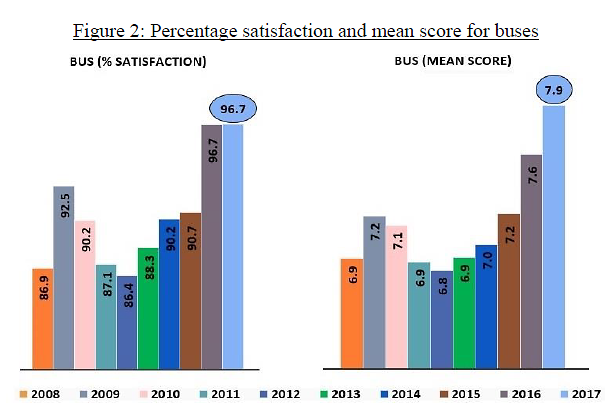
Satisfaction with bus services remained at 96.7 per cent. The mean satisfaction score rose to 7.9 from 7.6 in 2016.
The rise was largely driven by improvements across all eight bus service attributes – waiting time, reliability, service information, bus interchange/bus stop accessibility, comfort, travel time, customer service and safety/security.
It’s the fifth consecutive year of improvement in the mean satisfaction score for buses. The PTC said that this may be attributed to several factors, including the successful implementation of the five-year Bus Service Enhancement Programme.
(Source: Public Transport Council)
Commuters now enjoy more frequent and timelier bus arrivals, enhanced bus connectivity and more comfortable rides, the PTC added.
The Public Transport Customer Satisfaction Survey has been conducted annually since 2006. For the latest survey, 5,007 regular bus and MRT commuters, aged 15 years and above, were randomly selected and interviewed in October 2017 at bus interchanges, bus stops and MRT stations, during both peak (7am to 9am and 5pm to 7pm) and off-peak periods.
Rival Singtel had started offering the LTE-enabled variant of the wearable device from Feb 9, the first telco in Singapore to do so.

Apple Watch features new processor that allows Siri to speak from watch, says COO Jeff Williams.
SINGAPORE: Local telco StarHub is looking to bring the Apple Watch with built-in cellular capability, and will announce details closer to a commercial launch while M1 said it is “monitoring the developments” in this space.
StarHub told Channel NewsAsia in an email: “Support for Apple Watch GPS + Cellular is in the works; we will announce details when we are ready for commercial launch.” It added that those looking for a cellular-enabled watch can consider the Samsung Gear S3 Frontier (LTE).
A M1 spokesperson, meanwhile, said the smart watch with cellular capability is “still in its early phase of rollout” and it is monitoring the developments in this market.
The two telcos’ responses come after Singtel became the first in Singapore to offer the Apple Watch Series 3 with GPS and cellular capabilities when sales started on Feb 9. The wearable device was first launched in Singapore last September, but the LTE version was not available then.
Singtel said then that it also launched its NumberShare service for customers looking to get the LTE-enabled smart watch, as they will be able to use the same number as their iPhone and share data and talk time on their mobile plan. It is available for S$6.90 per month on a 12-month contract with the first three months free, as part of the telco’s introductory offer, according to the website.

A series of enforcement operations conducted against unlicensed massage establishments and public entertainment outlets on Feb 7 and 8 has led to the arrest of 14 women.
The raids targeted shops located along Chinatown, Jalan Besar, Serangoon Road and Beach Road.
The police said in a news release that they detected three unlicensed massage establishments during the course of the operations.
A 30-year-old woman, believed to have provided sexual services at one of these outlets, was arrested under the Women’s Charter.
Actions will be taken against the owners of the unlicensed massage establishments under the Massage Establishment Act.
Thirteen women, aged between 20 and 51 were found working illegally at two public entertainment outlets. They were arrested for offences under the Employment of Foreign Manpower Act.
In addition, one of the outlets was found to be operating without a public entertainment licence and also supplied liquor without a liquor licence.
Actions will be taken against the public entertainment outlet operators for contravening licensing conditions.
In their statement, the police added that they “take a serious view of anyone found breaking the law and will continue to take tough enforcement stance against such activities.”

Police raids


SINGAPORE: They say in space, no one can hear you scream. That is unless of course you’re a Singaporean consumer who may soon have to pay GST on your digital purchases.
There has not been as much attention as we have seen in recent weeks on the topic of GST since 2007 when the rate increased from 5 per cent to 7 per cent.
In the last decade or so since, the GST rate has remained unchanged despite the chatter on a rate hike that comes up from time to time.
Finance Minister Heng Swee Keat’s comments in Budget 2017 to “raise revenues through new taxes or raise tax rates” and a comment from Prime Minister Lee Hsien Loong during his speech at the PAP convention in November 2017 “that raising taxes is not a matter of whether but when“, has led to wide speculation that an increase in the GST rate could be announced on Feb 19 when the Budget 2018 statement is delivered.
The speculation has been further fueled by a subsequent comment from Senior Minister of State for Finance Indranee Rajah that “we’re still working on the when”.
TAX ON DIGITAL ECONOMY LIKELY
While a rate hike for GST has always been a possibility given Singapore’s relatively low rate of 7 per cent, what is more certain is that measures would be introduced to expand the tax net such that transactions which are currently not subject to GST will come within scope.
Given that our GST currently applies to virtually (excuse the pun) all goods and services but not if the same goods and services are digital in nature, it is no wonder that the Finance Minister had raised the matter of taxing the digital economy in Budget 2017.
Senior Minister of State for Finance Indranee has since named e-commerce as an area that would allow Singapore to diversify its tax base to fund the growing spending on healthcare, infrastructure and other social services.
A man delivers parcels during the ‘Double Eleven’ online shopping festival day in Shanghai on Nov 11, 2016. (Photo: AFP/JOHANNES EISELE)
The method of taxation is expected to be by way of a reverse charge regime for business-to-business transactions and the taxing of digital business-to-consumer supplies and low-value imports of goods purchased by consumers.
What would be of particular interest to the man on the street is the latter.
So what does the taxing of digital supplies and low-value imports mean, and how does it affect the regular Singaporean?
TAXING ONLINE PURCHASES
The taxing of e-commerce and digital supplies is a complex area as traditional tax rules were not written with the digital economy in mind. GST or VAT, as a consumption tax, seeks to levy tax in the jurisdiction where final consumption occurs.
However, in the virtual world, the existing taxation principles for consumption are found to be wanting and have often resulted in the non-collection of GST or VAT on e-commerce transactions.
The non-taxation of GST or VAT for the supplies of goods and services by overseas vendors to consumers is hence an issue for governments who have lamented a loss of tax revenue and that is an uneven playing field between foreign suppliers and domestic suppliers from a tax collection perspective.
Bolstered by the efforts of the Organisation for Economic Cooperation and Development (OECD), there have been significant international responses around the world, with Norway ahead of the curve when it introduced rules in 2011 to address the taxing of electronic supplies.
A growing list of countries, including countries in the region such as Japan, South Korea, New Zealand and Australia, have taken steps to introduce changes in the recent few years to ensure the appropriate taxing of e-commerce transactions.
Billionaire Alibaba founder Jack Ma celebrates taking US$25 billion (S$33 billion) in the company’s annual Singles Day promotion. (Photo: AFP/STR)
The model that most jurisdictions have adopted is the registration of overseas vendors or intermediaries (such as electronic platforms and parcel forwarding companies) for GST or VAT such that they are required to charge and account for GST on digital services (e.g. music, software subscriptions, e-books) that are sold to local consumers.
While one may argue that such rules create enforcement issues for the tax administrations, we should keep in mind that many authorities have exchange of information arrangements that would enable the sharing of information to counter any possible tax evasion.
As for the taxing of goods purchased from overseas vendors, therein lies a different set of challenges.
While import GST or VAT is levied upon the import of goods into the country, most countries have a de minimis threshold for non-dutiable goods to be brought into the country with no requirement to pay the tax.
For example, postal imports of non-dutiable goods with a value of not more than S$400 are granted GST relief. Such imports, referred to as low-value imports, are not taxed so that customs authorities are not besieged with voluminous low value transactions where the tax collection efforts cost more than the tax collected.
To date, there have not been many jurisdictions, if any, which have successfully introduced a collection mechanism to tax low-value imports – with Australia expected to be the first to introduce this with effect from Jul 1 this year.
END OF GST-FREE PURCHASES IN SINGAPORE?
There is never a good time to raise taxes or talk about raising taxes. Yet, we have to acknowledge that Singapore’s spending on healthcare, education and infrastructure has grown significantly over the last ten years with no increase in the GST rate.
While an increase in the rate may be on the cards, expanding the scope of GST to cover e-commerce transactions provides a sustainable avenue to raise government revenue.
This is especially the case for Asia-Pacific countries, which make up nearly half of the world’s digital population and whose e-commerce sales are expected to double and reach US$3 trillion (S$3.98 trillion) by 2021, according to reports by eMarketer.
Online retail is taking an increased share of total retail sales in China. (Photo: AFP)
As for Singapore, market research company Statista forecasts that the e-commerce market would reach US$3.8 billion in 2018 and this figure will undoubtedly continue to grow.
It is no secret that the Inland Revenue Authority of Singapore (IRAS) has reached out to a number of businesses and industry associations for consultation and feedback on the proposed collection models following the Finance Minister’s comment in Budget 2017 on the possibility of a tax on e-commerce.
What observers would be keen to know in the upcoming Budget is when the changes will be introduced and the lead time before the rules kick in.
For the ordinary man in Singapore, this would mean an end of the GST savings that could have otherwise been enjoyed from purchasing from an overseas vendor.
No doubt Budget 2018 will mark a significant milestone for the Singapore GST regime as it moves into the virtual world.
Koh Soo How is the Asia Pacific Indirect Tax leader and Rushan Lee is senior manager of Indirect Tax at PwC Singapore.
SINGAPORE: The death of radio has been heralded for close to a hundred years.
It was first predicted with the invention of television in the 1920s and its widespread adoption into homes after World War II.
30 years ago, the culprit was the VCD. Today, people say it’s live-streaming channels and apps like Spotify.
So it’s apt to discuss how dead radio is today, on World Radio Day, where many others around the world are celebrating radio’s contributions to the advancement of humankind.
I did just that by asking my students at NTU’s Wee Kim Wee School of Communication and Information this question.
“Do you think radio is dead?” They replied, “not in the car”.
So there you have it, radio lives on in our cars.
It is curious and certainly intriguing for an industry that has laid the foundations for film, television, videos, and some newer technologies like mp3 players, podcasts and Skype, to be alive but confined to the car.
Is this true?
The data shows otherwise. According to a 2013 Nielsen report, which surveys audience responses from around the world, 92 per cent of Americans listen to the radio each week. In 2015, over 93 per cent of Malaysians listened to their radio.
A man uses headphones in Buenos Aires, Argentina on Jul 14, 2016. (Photo: REUTERS/Marcos Brindicci)
And in Singapore, there have been significant rises in listenership in 2017.
That is indeed a lot of cars. Or is it?
So maybe radio is not dead, only misunderstood.
NEW FORMATS, NEW CHANNELS
The confusion over this perception stems from people talking about different parts of the same subject as if they are all one.
Recently, a report by Variety that considered traditional radio’s grim future was followed by an online report by Digital Music News. It ran the headline “Radio is dead in 10 years” and went on to say that “the medium now brings in less revenue than streaming platforms”.
Sometimes caution is necessary when economics is confused with popularity and where, in this case, the redistribution of audio from a terrestrial network to the internet is wrongly interpreted as the demise of a whole industry.
What it does necessitate, is the need for clarity.
The term “radio” encompasses many factors, ranging from the presentation format of content, the type of transmission (digital or analogue), and the distribution of audio (whether terrestrial, cable or internet streaming), to how listeners consume the content, such as through a radio set, personal computer or a smartphone.
Nielsen reported that 60 per cent of what the survey termed, American millennial heavy radio listeners, are more likely to listen to online radio.
The findings don’t indicate a drop in radio listening but a change in listening habits and the way content is being distributed.
In other words, it is like taking a coin out of your left pocket and putting it into your right pocket.
Radio is now distributed on sites like iTunes, Pandora and Spotify; in podcasts, online archives and radio streams; and in new hybrid forms like YouTube, audio slideshows, and digital soundscapes. Ironically, “sound has now become a screen medium”, claims Professor Michele Hilmes at the University of Wisconsin.
If anything, it underlines the main issue that terrestrial distribution is being threatened, not radio.
There will always be segments of the population who will want ease of use. A traditional radio set only requires turning it on or off and selecting a station.
Maybe this is the reason why new radio stations are still being launched in Singapore, as recent as last month.
Headphones are seen in front of a logo of online music streaming service Spotify in this Feb 18, 2014 illustration picture. (File photo: REUTERS/Christian Hartmann)
Conversely, depending on your digital device, there are a few more steps needed before you can listen to your favourite programme, like opening the device and finding the application, all assuming that the WiFi connection or a data stream through a service provider is robust, and that the interface of the application is user-friendly.
RADIO STILL FILLS THE VOID
If radio’s audience numbers are increasing then what is it about radio content that makes it special?
I find that radio is unique, because of its ability to fill the space, the void of time passing, as we take on other tasks, like driving or sitting on a bus or perhaps studying at home.
Perhaps, radio’s pervasive attitude makes it the perfect friend, always there keeping us informed, educated, entertained, if not ultimately involved.
We listen to our favourite songs and symphonies, the news of the day in quick, easy-to-understand audio “tweets”, and we learn what road to avoid because of traffic delays.
It is simple, easy and somehow, we don’t need to filter information.
What makes radio engaging is the effect and emotional power that this medium offers. For instance, the many places it could take you, or take you back to. Or having the experience of hearing a piece of music bring tears to your eyes.
Radio can also act as your own virtual space, where pictures are created with your imagination in your mind’s eye, when the voice of a Syrian refugee talking emotionally about experiencing personal loss after her family was brutally murdered in one night of terror reaches out to you.
This is the purity of thought that radio offers without the clutter of vision. It is also why radio is the chosen medium for discussion programmes that engages readers in discussing complex conceptual ideas – in this aspect, it is far more effective than any other medium.
(Photo: Pixabay/StockSnap)
Radio forces our minds to focus on what is being said and not on the stream of visual interference which surrounds our daily lives.
RADIO WILL LIVE ON
So is radio dead? It was not long ago that we heard of similar well-worn tropes and society survived. The internet was the death of television, television was the end of cinema and so forth.
The idea that radio is dead is more broadly a discussion between digital online services and the legacy of radio broadcast transmissions.
In New Zealand, radio expert Rufus McEwan in his study of digital platforms concluded that “one initiative seeks to depart from the conventions of radio while the other seeks to champion them”.
The fact that these two responses emerge at the same time suggests that maybe a change is necessary when it comes to producing news and entertainment.
Already we are privileged to have podcasts and high-fidelity digital audio which we listen to through our speakers or headphones. We have the choice to listen to what we want, when we want and where we want.
But radio will still be radio. It may be served to us in another way and possibly on another plate, but radio will continue to be alive and well.
And still living on in the car.
Dr Kym Campbell is a senior lecturer at the Wee Kim Wee School of Communication and Information. His interests are in broadcast production, journalism and mobile media.
SINGAPORE: Chinese New Year is usually a bittersweet time for interior designer Ong Eng Chuan.
While most people celebrating the festival would be with their loved ones, this 23-year-old ushers in the new year for strangers, as a lion dance performer.
“Every year … while everyone is out visiting their relatives, I’d be spending my time on lion dancing. I’d be so tired at the end of the day,” said Mr Ong, who spends more time on this sport than with his family.
It is just one of the sacrifices he and his buddy, Lee Kai Ming, also 23, have been willing to make for their craft, which they’ve pursued with a passion since they were in their early teens – a single-minded determination that has turned them into champions.
Mr Ong (below) and Mr Lee in a practice session.
The duo from the Yi Wei Athletic Association may be part-timers – they both hold day jobs – but they are a formidable force that has won competitions across Asia, beating professional teams from China and Malaysia, among others.
Their athletic routine involves heart-stopping acrobatics from pole to pole, sometimes 3 metres or more above the ground, all while having to be in perfect, split-second sync with each other.
Unsurprisingly, over the years, it has not been a journey without pain.
The two lion dancers have struggled with injury, work commitments and objections from their families, even keeping their practices a secret from them at one point, as the programme Unusual Suspects discovered. (Watch the episode here.)
HIS MOM DIDN’T KNOW
Once while competing in Taiwan, Mr Ong fell from the dance poles, hit his face, fractured a cheekbone, and had to be treated in a nearby hospital. His mother banned him from the sport after that.
“Some people thought I’d quit after that, but in the end I still returned,” he said in Mandarin.
That time he split his cheek open. (Photo courtesy: Ong Eng Chuan)
“Since then, I’ve kept my mother in the dark. I don’t want her to know I’m still performing,” he added.
I feel guilty about deceiving her, but this is something I really love, so it’s best I don’t tell her about it.
For his partner-in-craft Mr Lee, a freight forwarding executive, the worst injury he sustained was to his leg after falling from the poles. He needed 17 stitches to close the wound.
He has also faced objections from his family, who felt that being a lion dance performer “wasn’t a good thing” and was “dangerous”.
“My family was opposed to me doing this at the start … but they saw how good an exercise it was,” he said. “So now, they just tell me to be more careful instead.”
For all the risks, the adrenalin rush of leaping from pole to pole was what attracted him to this sport.
He controls the movements of the lion’s body and focuses on the difficult acrobatics, while Mr Ong manoeuvres the head and all its expressive movements that are vital in the performance.
Said Mr Lee: “I became interested in it after watching (lion dance performers) do difficult moves. It’s so exciting, especially when we have to jump about in the air.”
His partner recalled being fearful yet thrilled while watching his first performance at the Chinese Garden when he was seven – from a safe distance. “I was afraid to get too close,” said Mr Ong.
As the ‘body’, Mr Lee carries his partner while keeping his balance.
THEY NEARLY GAVE UP
The two joined a lion dance troupe to pursue their interest, but did not count on the training regime being so tough in the initial years.
One of their training camps took place in Malaysia. For two weeks, they had to wake up at 7am daily and practise the whole day.
They had difficulty adjusting to the kampung environment; there was no internet connection, and they could not use their smartphones.
Irritated and tired, they even contemplated escaping from the training facility and flagging down a cab to return home on the second day. “We wanted to go home,” said Mr Lee.
But we decided against it after realising that this was what we’d asked for, and that only practice produces better results.
They stuck with the training and participated in a competition in Malaysia after that, coming in third.
As Mr Lee put it, already in those early years, “we had this dream and set our ambition to take part in competitions together”.
Pushing out the poles, or ‘jongs’ as they are called, at the start of each practice session.
While they have done well in overseas competitions, none compares to the annual National Lion Dance Championships on home ground, organised by the Singapore Wushu Dragon and Lion Dance Federation.
To secure the overall championship trophy – one of the highest honours a local lion dance troupe can achieve – a team must win the competition for three consecutive years, explained Mr Ong.
The duo emerged victorious for the first time in 2014 and were hoping to repeat that success in 2015. But it was not meant to be.
“We made a small mistake: I was doing a somersault and I fell,” Mr Lee recounted.
At that instant, sitting on the floor, I was thinking how everything was finished because we could no longer defend our championship title.
Being a winner is easy – having the fortitude to get back up and try again is what makes a true champion. And that’s what the boys did.
WATCH: Their winning moves (3:51)
They practised harder, and won the competition in 2016 and 2017, giving them a shot at the overall trophy this year.
During last year’s semi-finals in September, the duo were a fraction of a point behind the top team during the semi-finals. Though they made no mistakes, Mr Lee said critically: “Our movements were a little sloppy; our speed and coordination weren’t perfect.”
They upped their game in the final, and won by 0.5 over their main rival. “The audience and the judges recognised our sacrifices and efforts, so we’re quite satisfied,” said a relieved Mr Lee.
“Now we have to work harder.”
Their 2017 winning moment.
IS IT WORTH IT?
Although their love for lion dance has taken its toll on their bodies and their relationships with their loved ones, they would not have it any other way.
“Lion dancing is important to me because of how much I’ve sacrificed for it,” said Mr Lee said, admitting that his relationship with his friends and family would have been better had he not joined the sport.
Mr Ong thinks his life would be simpler without lion dance.
“Normally after work, we’re already quite tired, but we don’t have time to rest or to even have our dinner. We really need to put our blood, sweat and tears into our practice,” he said.
“For the sake of lion dance, I sacrifice a lot – time that I could spend with my family, friends and my girlfriend.”
Watch this episode of Unusual Suspects here.
The Yi Wei Athletic Association
SINGAPORE: Full-time national servicemen (NSFs) who are assigned to cyber vocations will come under a newly announced Cyber NSF scheme, and those who demonstrate the required aptitude and skill will be eligible for the Cyber Specialist Award, said Second Minister for Defence Ong Ye Kung on Monday (Feb 12).
The Cyber Specialist Award is a short-term contract offered to NSFs in cyber vocations who demonstrate the requisite aptitude and skill and meet the “stringent selection requirements”, Mr Ong added.
This award is made possible through the signing of a work-learn memorandum of understanding (MOU) between the Ministry of Defence and the Singapore Institute of Technology (SIT) on Monday. It is the first work-learn programme between the ministry and an educational institute where NSFs are sent for academic upgrading while employed in an operational role, the press release said.
This was done via a collaboration between MINDEF and the Defence Cyber Organisation and the Ministry of Education and SIT, with support from SkillsFuture Singapore, it added.
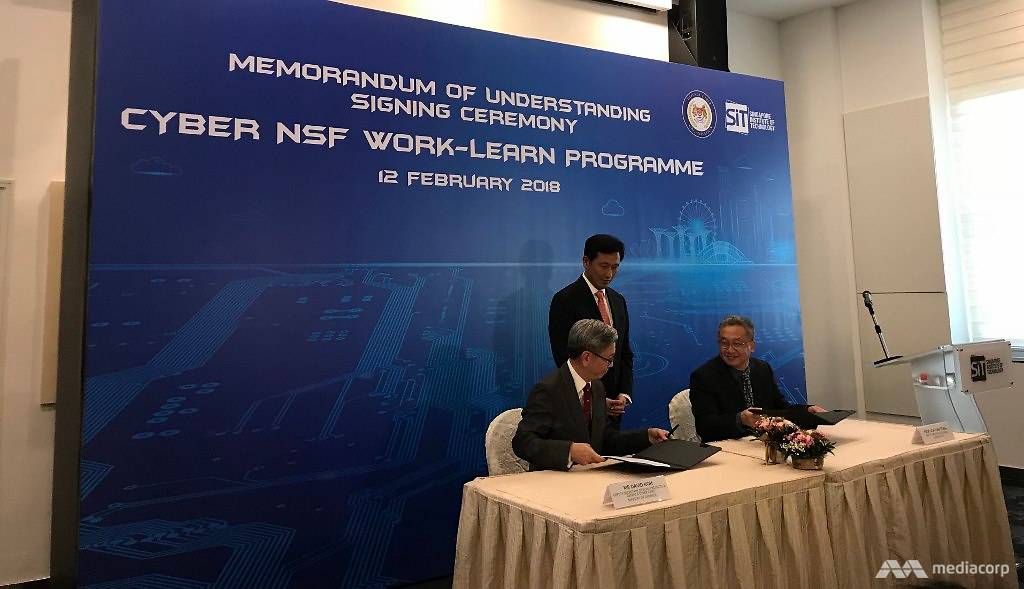
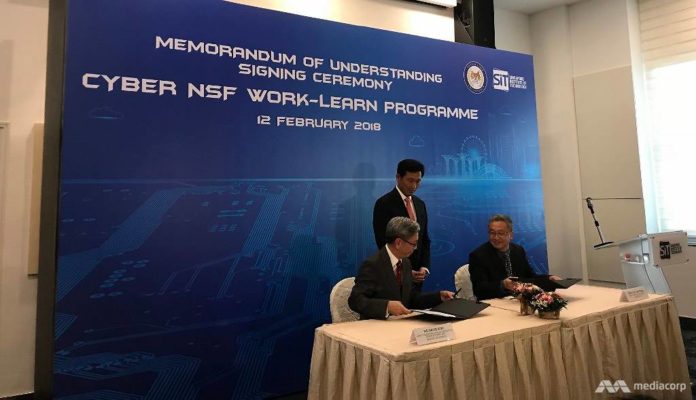
Second Minister for Defence Ong Ye Kung (standing) watching on as the work-learn programme MOU was signed between Mr Koh and Prof Loh.
The new cyber defence vocation within the Singapore Armed Forces (SAF) was first revealed by Defence Minister Ng Eng Hen in last year’s Committee of Supply debate, together with the creation of the Defence Cyber Organisation that will monitor and defend its networks from online threats around the clock.
Giving more details on the two initiatives, MINDEF said at the basic level, NSFs in the vocation will be trained as cyber operators. There will be four broad areas they will be deployed in: Cybersecurity monitoring, threat assessment and response, vulnerability audit and penetration testing and malware analysis and cyber forensics.
These NSFs will be deployed based on their aptitude and organisational need, the ministry said.
FULL PAY, DEGREE CREDITS FOR CYBER SPECIALISTS
Those with higher aptitude and skills, and meet the selection requirements, will be offered the opportunity to take up the Cyber Specialist Award, it added.
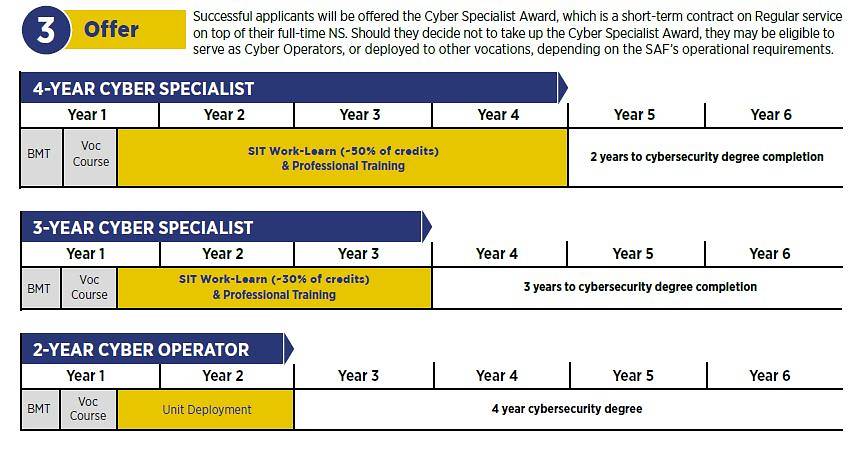
This means they will have the option to sign on for one- or two-year contracts with MINDEF, during which they will undergo intensive training and take modules that would prepare them for their roles. It is understood that the award will, in general, be offered after the Basic Military Training phase.
Time will be set aside for them to attend these courses and they will receive SIT academic credits in areas such as network security, digital forensics and applied cryptography. Amid their day-to-day operational duties, cyber specialists will have one learning day a week.
(Infographic: MINDEF)
Once they complete their contracts, the credits accumulated can go towards a relevant degree at SIT and the cyber specialists can expect to graduate alongside their peers who completed their full-time NS ahead of them.
The academic credits are for relevant degrees at SIT, but whether these can be transferred to other varsities depend on the other schools’ admission procedures, Channel NewsAsia understands.
They will also have the opportunity to upgrade their skills through professional courses, such as those offered by information security training provider SANS Institute, MINDEF added.
During the NSF period, cyber operators will receive NSF allowance, while cyber specialists will receive a full-time regular pay under the terms and conditions of their contracts. Depending on their training and operational roles, they could be promoted to First Sergeant, the ministry added.
The Cyber NSF scheme will be launched via a pilot trial for those enlisting in the second half of this year. Those eligible can apply via MINDEF’s website. They are expected to possess “baseline knowledge and skills” in cybersecurity.
Applicants will be put through a selection test to assess their skills and aptitude in areas such as cryptography, security architecture and application security, as well as psychometric tests and practical problem-solving scenarios, MINDEF said.
It hopes to have 60 cyber operators and 50 to 70 cyber specialists during the initial one-year trial period, and increase the number to 80 to 90 cyber specialists thereafter.
Defence cyber chief David Koh, who signed the MOU with SIT’s Professor Loh Han Tong, said in his speech the critical success factor in the cyber domain is highly skilled and talented individuals with deep cyber expertise.
“Our younger generation are digital natives who are very comfortable in this digital realm. Someone of my generation may be able to speak the language, but we will always have a bit of an accent,” Mr Koh said.
“MINDEF/SAF aims to tap on the skills of our young NSFs, like these digital natives, with the launch of the Cyber NSF scheme.”
SINGAPORE: Full-time national servicemen (NSFs) who are assigned to cyber vocations will come under a newly announced Cyber NSF scheme, and those who demonstrate the required aptitude and skill will be eligible for the Cyber Specialist Award, said Second Minister for Defence Ong Ye Kung on Monday (Feb 12).
The Cyber Specialist Award is a short-term contract offered to NSFs in cyber vocations who demonstrate the requisite aptitude and skill and meet the “stringent selection requirements”, Mr Ong added.
This award is made possible through the signing of a work-learn memorandum of understanding (MOU) between the Ministry of Defence and the Singapore Institute of Technology (SIT) on Monday. It is the first work-learn programme between the ministry and an education institute where NSFs are sent for academic upgrading while employed in an operational role, the press release said.
This was done via a collaboration between MINDEF and the Defence Cyber Organisation and the Ministry of Education and SIT, with support from SkillsFuture Singapore, it added.
Second Minister for Defence Ong Ye Kung (standing) watching on as the work-learn programme MOU was signed between Mr Koh and Prof Loh.
The new cyber defence vocation within the Singapore Armed Forces (SAF) was first revealed by Defence Minister Ng Eng Hen in last year’s Committee of Supply debate, together with the creation of the Defence Cyber Organisation that will monitor and defend its networks from online threats around the clock.
Giving more details on the two initiatives, MINDEF said at the basic level, NSFs in the vocation will be trained as cyber operators. There will be four broad areas they will be deployed in: Cybersecurity monitoring, threat assessment and response, vulnerability audit and penetration testing and malware analysis and cyber forensics.
These NSFs will be deployed based on their aptitude and organisational need, the ministry said.
FULL PAY, DEGREE CREDITS FOR CYBER SPECIALISTS
Those with higher aptitude and skills, and meet the selection requirements, will be offered the opportunity to take up the Cyber Specialist Award, it added.
This mean they will have the option to sign on for one- or two-year contracts with MINDEF, during which they will undergo intensive training and take modules that would prepare them for their roles. It is understood that the award will, in general, be offered after the Basic Military Training phase.
Time will be set aside for them to attend these courses and they will receive SIT academic credits in areas such as network security, digital forensics and applied cryptography. Amid their day-to-day operational duties, cyber specialists will have one learning day a week.
(Infographic: MINDEF)
Once they complete their contracts, the credits accumulated can go towards a relevant degree at SIT and the cyber specialists can expect to graduate alongside their peers who completed their full-time NS ahead of them.
The academic credits are for relevant degrees at SIT, but whether these can be transferred to other varsities depend on the other schools’ admission procedures, Channel NewsAsia understands.
They will also have the opportunity to upgrade their skills through professional courses, such as those offered by information security training provider SANS Institute, MINDEF added.
During the NSF period, cyber operators will receive NSF allowance, while cyber specialists will receive a full-time regular pay under the terms and conditions of their contracts. Depending on their training and operational roles, they could be promoted to First Sergeant, the ministry added.
The Cyber NSF scheme will be launched via a pilot trial for those enlisting in the second half of this year. Those eligible can apply via MINDEF’s website. They are expected to possess “baseline knowledge and skills” in cybersecurity.
Applicants will be put through a selection test to assess their skills and aptitude in areas such as cryptography, security architecture and application security, as well as psychometric tests and practical problem-solving scenarios, MINDEF said.
It hopes to have 60 cyber operators and 50-70 cyber specialists during the initial one-year trial period, and increase the number to 80-90 cyber specialists thereafter.
Defence cyber chief David Koh, who signed the MOU with SIT’s Professor Loh Han Tong, said in his speech the critical success factor in the cyber domain is highly skilled and talented individuals with deep cyber expertise.
“Our younger generation are digital natives who are very comfortable in this digital realm. Someone of my generation may be able to speak the language, but we will always have a bit of an accent,” Mr Koh said.
“MINDEF/SAF aims to tap on the skills of our young NSFs, like these digital natives, with the launch of the Cyber NSF scheme.”