Home Blog Page 1127

Defence Minister Ng Eng Hen conferred French Legion of Honour award

0

SINGAPORE: Defence Minister Ng Eng Hen was on Tuesday (Feb 20) conferred France’s highest award –  Legion of Honour – awarded for both civilian and military merit regardless of citizenship, by French President Emmanuel Macron.

French Minister for the Armed Forces Florence Parly presented Dr Ng the award at an investiture ceremony held at the Ministry of Armed Forces in Paris, after Dr Ng had reviewed the French Honour Guard. 

Past Singaporean recipients include former Chiefs of Defence Force and Service Chiefs, according to a press release by the Singapore defence ministry (MINDEF). 

Dr Ng and Ms Parly meeting before the investiture ceremony on Tuesday (Feb 20). (Photo: MINDEF)

The two ministers had met prior to the ceremony to reaffirm their commitment to strengthening bilateral defence cooperation, as well as discuss security developments of mutual interest, said MINDEF.

As part of his two-day programme to Paris, Dr Ng also toured the French aeronautics, space and defence research laboratory ONERA and was briefed on its existing collaboration with MINDEF. 

“Dr Ng’s visit underscores the strong and broad-based defence relationship between Singapore and France,” said MINDEF, adding that both the countries’ armed forces and defence establishments have regular high-level interactions. 

The ministry also mentioned the Republic of Singapore Air Force’s Advanced Jet Training in Cazaux, France – held since 1998 – and the countries’ range of bilateral defence technology interactions and exchanges such as the Singapore and France Advanced Research Initiative meetings. 

“These wide-ranging interactions have strengthened the friendship and mutual understanding between both countries,” said MINDEF. 

Source link

GST hike: Early lead time ‘unprecedented’ but helpful, experts say

0

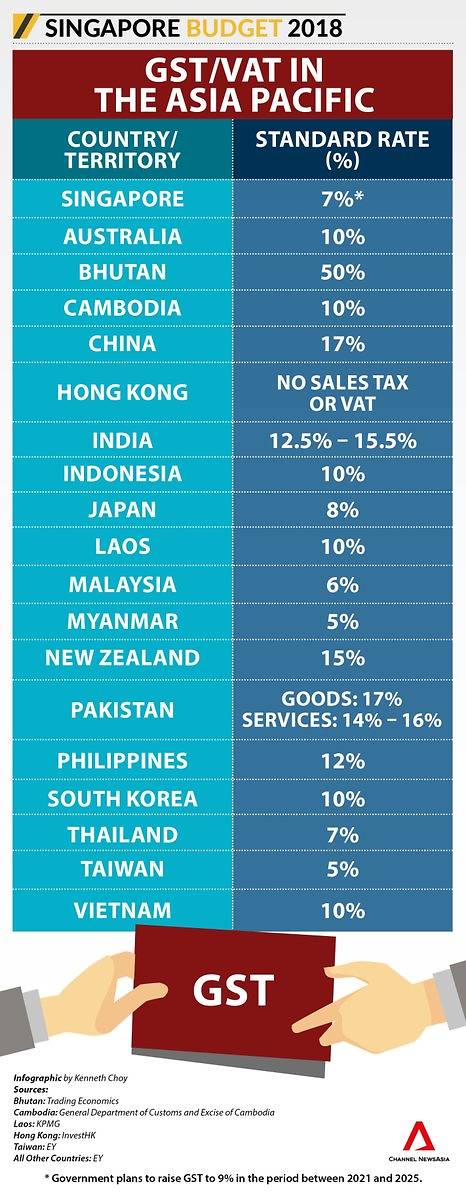
SINGAPORE: It will be at least three more years before the goods and services (GST) tax will be raised from 7 to 9 per cent. While the long lead time is “unprecedented”, said experts, it is helpful to “kill off speculation” of when the hike will happen.

Finance Minister Heng Swee Keat announced in his Budget 2018 speech on Monday (Feb 19) that the GST will go up some time between 2021 and 2025, adding that it will be implemented “earlier rather than later in the period”.

Mr Yeo Kai Eng, partner for GST Services at Ernst & Young (EY), told Channel NewsAsia that the announcement of the hike at least three years ahead is “interesting” as it has not been done before. Previous announcements were usually made about one to one-and-a-half years ahead of time, he added.

The last time GST was raised in 2007, when it went up from 5 to 7 per cent, it took effect about five months after the Budget announcement.

That said, Mr Yeo referenced then-Finance Minister Tharman Shanmugaratnam’s statement that the revenue measures the Government had already undertaken would provide sufficiently for increased spending until the end of the decade, and said the timing of the hike is “consistent” with past messages from authorities.

“It is good to give advance warning,” Mr Yeo said. “This will kill off speculation of when the rate hike will happen, and give certainty to the people. Now, people’s lives go on knowing that the hike will happen from 2021.”

Asked if the news would go down well with Singaporeans, the EY executive pointed out that the Finance Minister “took pains” to explain the pressing need for the funds to pay for increased healthcare, infrastructure, security and education spending.

Mr Heng also revealed he will further moderate the pace of ministries’ budget growth – from 0.4 times of Gross Domestic Product (GDP) growth to 0.3 times from Financial Year 2019 – and this, Mr Yeo pointed out, should also assure some of the Government’s fiscal prudence.

Another industry watcher, PwC Singapore’s Asia Pacific Indirect Tax Leader Koh Soo How, said deferring the GST rate hike to the period between 2021 and 2025 “would provide sufficient time” for the Government to explain why it is necessary to raise the GST rate for the next decade. This is what Prime Minister Lee Hsien Loong had called on his People’s Action Party colleagues to do at last November’s party convention, he added.

“Raising the rate to 9 per cent still puts us below the regional average of 10.5 per cent and the Organisation for Economic Cooperation and Development (OECD) average rate of 19 per cent which suggests that the Government is keeping its options open on whether the rate can increase further depending on our spending needs,” Mr Koh said.

UNPRECEDENTED MOVE TO BOOK THE POLITICAL PRICE, ANALYSTS SAY

Deputy director for research at the Institute of Policy Studies Gillian Koh said that this is the first time that the Government has announced a GST hike that crosses the threshold of the next parliamentary term.

“So politically, we’re in new territory. It does mean that when the People’s Action Party (PAP) goes into the next election, depending on what it does over the next two to three years, the GST issue cannot be but a political issue,” Dr Koh said.

As discussions and speculations on potential GST increases intensify, timing the GST hike way ahead of its implementation could be a wise political move, according to another political watcher Walter Theseira.

“It’s become a political problem in the sense that if you don’t end the uncertainty now, you will have continual uncertainty over the years with people every year saying is it going to be this year? So I saw it as a preemptive move to try to quell the uncertainty and also to book the political costs of doing it,” Dr Theseira said.

“The political price is already being paid now with all the talk about GST so you might as well book it in right now … There’s an election going to be due before the end of this decade and if you can book that political price now instead of the election year, why not right?” he added.

CIMB Bank economist Song Seng Wun said that ultimately, the impending GST hike reflects a “confident” Government that is “certain it is stable enough and will still be around three years down the road”.

“Not today, not tomorrow, not next year, but after the next GE (General Election) itself,” he observed. “No politician wants to hike taxes. So it’s also a message from the Government it doesn’t engage in populist measures, but takes fiscal responsibility seriously.”

“It wants to prepare everyone that the hike is coming, and also to explain to everyone why it’s important GST has to be adjusted every now and then, to ensure the burden is not just on future generations but shared amongst all,” Mr Song said.

Mr Heng, in his Budget speech, said that the increase is necessary because even after exploring various options, there are still gaps in managing future expenditures. On this, analysts agreed on the messaging of why hikes are necessary but cautioned that it may not come through to Singaporeans.

“There is never a good time for tax increases. So the Government has to handle the matter with sensitivity. … What is needed is to present the Budget as an integral part of the social compact, that the Budget is not merely about taxes and public expenditures but also how it promotes the greater good, sharing the largesse, attending to current imperatives and preparing for future needs and challenges,” said law professor Eugene Tan.

“I think we always have this issue in Singapore that because we have the good fortune of having a healthy surplus and also reserves and people will always say why not use the reserves? The public should consider this question – if you spend the reserves, what are you doing? You are reducing the amount of resources in the future,” said Dr Theseira.

Source link

Budget 2018: 900,000 households to receive S$126m in S&CC rebates

0

Eligible households will each receive 1.5 to 3.5 months of rebates for their service and conservancy charges, depending on HDB flat type.

File photo of HDB flats. (Photo: Xabryna Kek)

SINGAPORE: Around 900,000 HDB households will receive service and conservancy charges (S&CC) rebates in the 2018 financial year, Minister for Finance Heng Swee Keat said in his Budget statement on Monday (Feb 19).

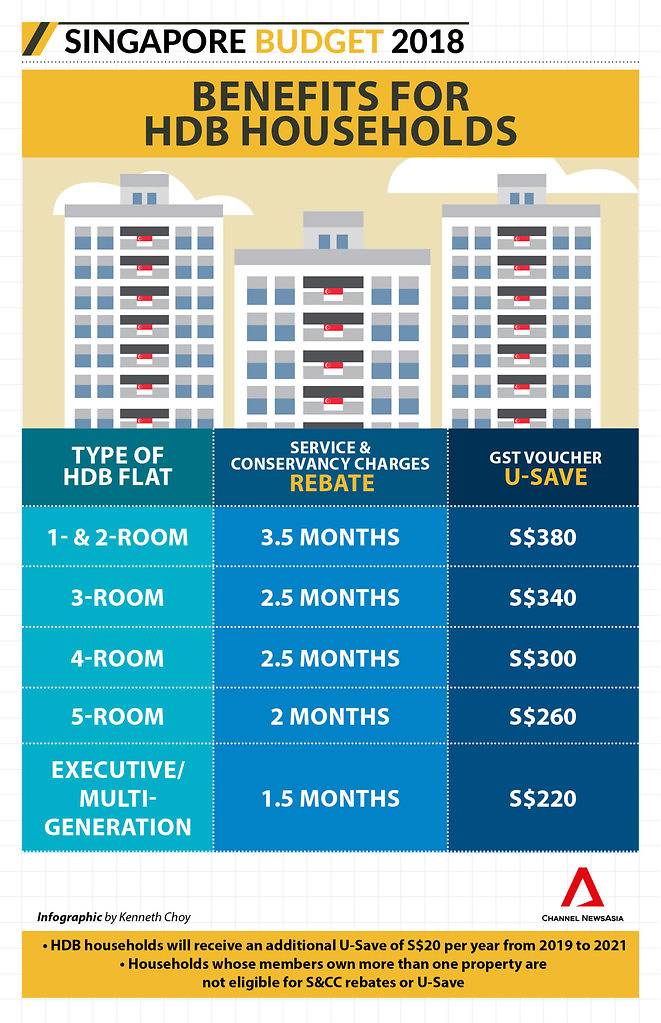
Eligible households living in 1- and 2-room flats will receive 3.5 months of rebate, while those in 3- and 4-room flats will receive 2.5 months of rebate. 

The rebate will be two months for households in 5-room flats, and 1.5 months for those living in executive and multi-generational flats. The Government will spend S$126 million on these rebates, which will be disbursed on a quarterly basis.

Currently, most Singaporean households pay between S$19.50 and S$95 per month for S&CC. The money is typically used to pay town council expenses like cleaners’ wages, pest control, as well as the maintenance and replacement of lifts.

In the last financial year, 880,000 households received S$120 million worth of rebates. 

Source link

Budget 2018: Singaporeans to get ‘hongbao’ SG Bonus of up to S$300 following 2017 Budget surplus

0

SINGAPORE: All Singaporeans aged 21 and above this year will get a one-off SG Bonus of up to S$300 each as the Budget for 2017 came in with a surplus of almost S$10 billion. 

Finance Minister Heng Swee Keat shared this during his Budget speech in Parliament on Monday (Feb 19), saying that this “reflects the Government’s long-standing commitment to share the fruits of Singapore’s development with Singaporeans”. He described the Bonus as a “hongbao”. 

It will be paid according to people’s assessable income. About 2.7 million people will get the payouts, which are due at the end of 2018. 

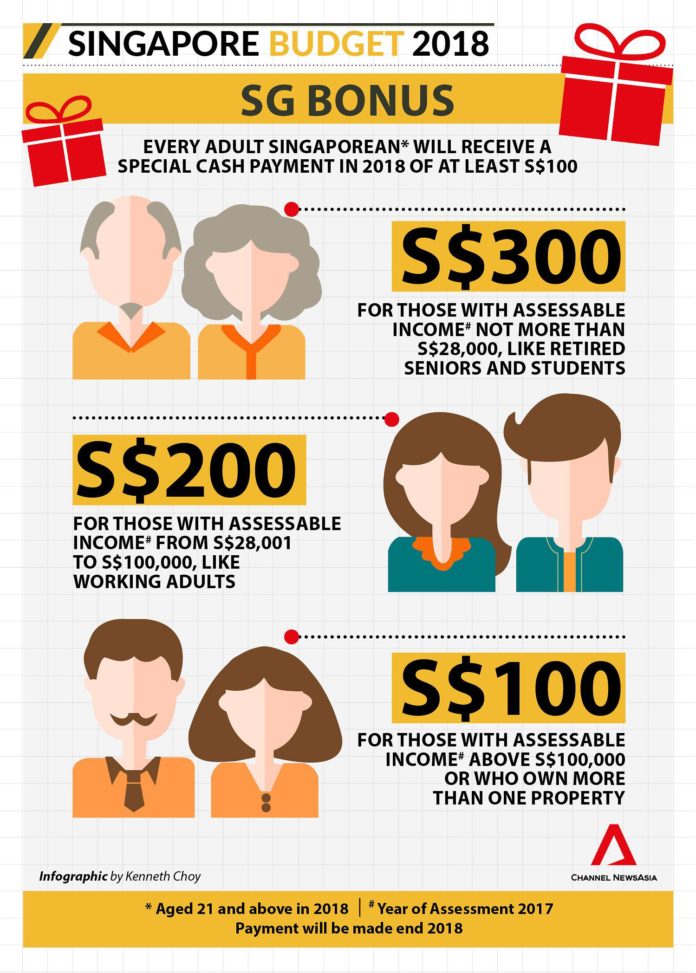
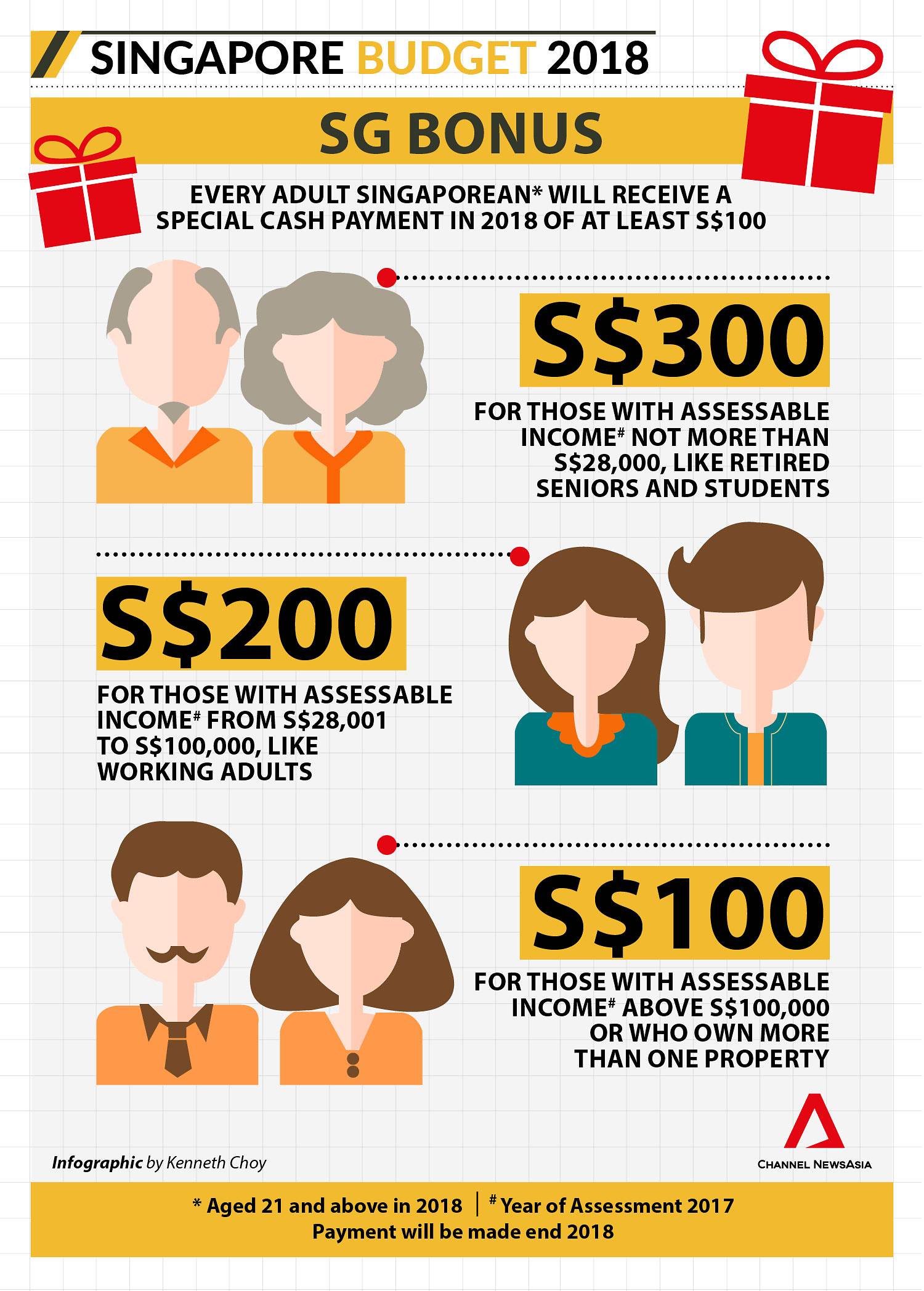
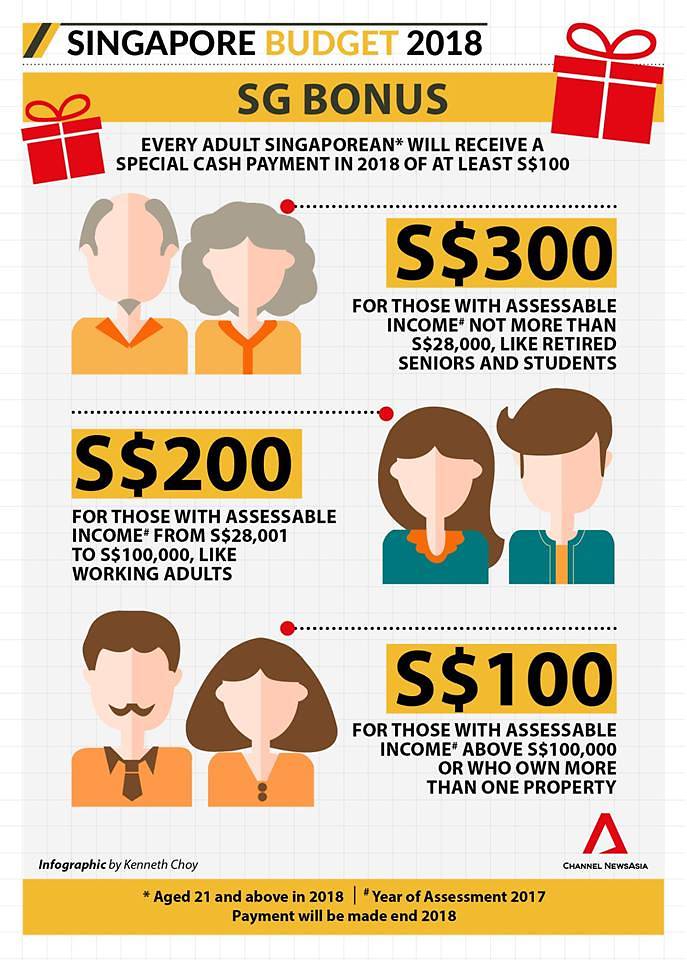
Those with an annual income of S$28,000 or below will be eligible for a payout of S$300, those whose income is S$28,001-S$100,000 will receive S$200, and people whose income is in excess of S$100,000 will receive S$100. 

This SG Bonus will cost the Government S$700 million. 

It will be the first time since 2011 that the Government is handing out cash bonuses to Singaporeans. 

In 2011, which was also an election year, 2.5 million Singaporeans aged 21 and above were given “growth dividends” of between S$100 and S$800, which cost the Government S$1.5 billion. Prior to that, the Government gave out dividends of between S$100 and S$400 in 2008.

Singapore’s revised Budget position for FY2017 showed a surplus of S$9.61 billion, helped by exceptional contributions from Statutory Boards and higher-than-expected Stamp Duty. 

The surplus will also be used in other ways. 

Mr Heng said that S$5 billion will be set aside for the Rail Infrastructure Fund, to save up for the new rail lines that Singapore is building. 

Furthermore, S$2 billion will be set aside for premium subsidies and other forms of support when the ElderShield review is complete.

Source link

Hongbaos and taxes: 8 things you need to know about Budget 2018

0

SINGAPORE: Finance Minister Heng Swee Keat ended his 2018 Budget speech on a “prosperous” note with the handing out of a one-off SG Bonus to Singaporeans, but he also warned of coming tax hikes that are needed to finance the country’s greater spending in the next decade.

How will Singaporeans and Singapore businesses be affected by the measures Mr Heng announced on Monday (Feb 19)?

Here is Channel NewsAsia’s quick guide to the major Budget announcements:

1. GST HIKE COMING

An increase of the Goods-and-Services Tax (GST) was widely anticipated and Mr Heng duly made an announcement about this. When it comes, it will be the first rise in GST for well over 10 years.

The hike of 2 percentage points to 9 per cent will kick in sometime from 2021 to 2025. The exact timing will depend on the state of the economy, how much Singapore’s expenditure grows and how buoyant existing taxes are.

But he expects it to be “earlier rather than later”, Mr Heng said, as after exploring various options to manage future expenditure, there is still “a gap”.

GST will also be imposed on imported services such as apps, movies and music from 2020.

2. LARGEST BUDGET SURPLUS IN 30 YEARS

Singapore also ended 2017 with its largest Budget surplus in recent years in absolute terms – S$9.61 billion, or 2.1 per cent of the GDP.

As a percentage of GDP, the figure outperformed recent years but remained lower than FY2007, 2000, 1999 and 1997.

Spending on housing, transport, education and healthcare was lower than expected, while revenue from Statutory Board contributions and Stamp Duty was higher than anticipated in 2017. 

3. BUT SPENDING IS SET TO RISE 

So why the need to increase taxes? Mr Heng listed a range of items that will need financing in the next decade – from healthcare and education to security and infrastructure projects.

For infrastructure investments, the Government saves ahead. This year, it will set up a new Rail Infrastructure Fund to save up for major rail lines in the future. Stat Boards and Government-owned companies will also borrow to spread the cost of larger investments, such as the KL-Singapore High-Speed Rail, over more years.

However, for recurrent spending for healthcare, security and other social needs, Mr Heng said that the “responsible way” to pay for them is through taxation so that “every generation pays its share”. Hence, the upcoming GST hike.

4. WHEN IT COMES TO TAX, IT’S NOT JUST GST

Besides the GST, Mr Heng announced a few other tax increases.

Smokers, take note: Tobacco excise duty on all tobacco products just went up by 10 per cent.

For those looking to buy a property of more than S$1 million, the Buyer’s Stamp Duty is going up on Tuesday.

A new top marginal rate of 4 per cent will apply to the portion of residential property value which is in excess of S$1 million, up from 3 per cent.

The foreign domestic worker levy will also go up from the current S$265 a month. From Apr 1, 2019, households will have to pay a levy of S$300 for its first worker and S$450 for the second worker. Families with caregiving needs will continue to pay just S$60.

5. PREPARING FOR CLIMATE CHANGE 

Mr Heng also gave more details on a carbon tax, which he already mentioned in last year’s Budget.

From 2019, the tax will be S$5 per tonne of greenhouse gas emissions for large emitters producing 25,000 tonnes or more of greenhouse gas emissions in a year. This will be reviewed by 2023 and raised progressively.

On average, households will experience a small rise in electricity and gas expenses of about 1 per cent but they will get some help in the form of U-Save rebates.

6. MORE GRANTS AND SUBSIDIES

As often happens at Budget time, Mr Heng announced some goodies.

Students will see an increase in annual Edusave contributions – from S$200 to S$230 for each primary school pupil and S$240 to S$290 for each secondary school student.

Those who want to move nearer to their family members will benefit from an enhanced Proximity Housing Grant. Households will also get a one-year extension of the Service & Conservancy Charges (S&CC) rebate.

The Community Networks for Seniors initiative will be expanded nationwide by 2020, among other initiatives to improve care for seniors which Mr Heng announced.

7.  HELPING BUSINESSES INNOVATE

With a buoyant economy, Mr Heng focused on measures and initiatives that will help Singapore businesses innovate, build capabilities and expand overseas.

As the Productivity and Innovation Credit (PIC) scheme expires, existing grants supporting the adoption of off-the-shelf technologies will be streamlined into a single Productivity Solutions Grant (PSG).

A virtual crowd-sourcing platform called the Open Innovation Platform will also be piloted this year to “matchmake” companies with technological challenges to ICT firms and research institutes that can work with them to develop solutions.

A new Enterprise Development Grant and other tax incentives were also announced.

There will also be some short-term measures to help businesses, including a larger corporate tax rebate.

8. HUAT AH! SG BONUS

Singaporeans from the age of 21 will each get a one-time “hongbao” from the Government ranging from S$100 to S$300, depending on their income.

This is to share the surplus of nearly S$10 billion with all Singaporeans and will cost the Government S$700 million.


Source link

Budget 2018: 900,000 households to receive S$126 million of S&CC rebates

0

Eligible households will each receive 1.5 to 3.5 months of rebate for their service and conservancy charges, depending on HDB flat type.

File photo of HDB flats. (Photo: Xabryna Kek)

SINGAPORE: Around 900,000 HDB households will receive service and conservancy charges (S&CC) rebates in the 2018 financial year, Minister for Finance Heng Swee Keat said in his Budget statement on Monday (Feb 19).

Eligible households living in 1- and 2-room flats will receive 3.5 months of rebate, while those in 3- and 4-room flats will receive 2.5 months of rebate. 

The rebate will be two months for households in 5-room flats, and 1.5 months for those living in executive and multi-generational flats. The Government will spend S$126 million on these rebates, which will be disbursed on a quarterly basis.

Currently, most Singaporean households pay between S$19.50 and S$95 per month for S&CC. The money is typically used to pay town council expenses like cleaners’ wages, pest control, as well as the maintenance and replacement of lifts.

In the last financial year, 880,000 households received S$120 million worth of rebates. 

Source link

Hongbaos and taxes: 8 things you need to know from Budget 2018

0

SINGAPORE: Finance Minister Heng Swee Keat ended his 2018 Budget speech on a “prosperous” note with the handing out of a one-off SG Bonus to Singaporeans, but he also warned of coming tax hikes that are needed to finance the country’s greater spending in the next decade.

How will Singaporeans and Singapore businesses be affected by the measures Mr Heng announced on Monday (Feb 19)?

Here is Channel NewsAsia’s quick guide to the major Budget announcements:

1. GST HIKE COMING

An increase of the Goods-and-Services Tax (GST) was widely anticipated and Mr Heng duly made an announcement about this. When it comes, it will be the first rise in GST for well over 10 years.

The hike of 2 percentage points to 9 per cent will kick in sometime from 2021 to 2025. The exact timing will depend on the state of the economy, how much Singapore’s expenditure grows and how buoyant existing taxes are.

But he expects it to be “earlier rather than later”, Mr Heng said, as after exploring various options to manage future expenditure, there is still “a gap”.

GST will also be imposed on imported services such as apps, movies and music from 2020.

2. LARGEST BUDGET SURPLUS IN 30 YEARS

Singapore also ended 2017 with its largest Budget surplus in recent years in absolute terms – S$9.61 billion, or 2.1 per cent of the GDP.

As a percentage of GDP, the figure outperformed recent years but remained lower than FY2007, 2000, 1999 and 1997.

Spending on housing, transport, education and healthcare was lower than expected, while revenue from Statutory Board contributions and Stamp Duty was higher than anticipated in 2017. 

3. BUT SPENDING IS SET TO RISE 

So why the need to increase taxes? Mr Heng listed a range of items that will need financing in the next decade – from healthcare and education to security and infrastructure projects.

For infrastructure investments, the Government saves ahead. This year, it will set up a new Rail Infrastructure Fund to save up for major rail lines in the future. Stat Boards and Government-owned companies will also borrow to spread the cost of larger investments, such as the KL-Singapore High-Speed Rail, over more years.

However, for recurrent spending for healthcare, security and other social needs, Mr Heng said that the “responsible way” to pay for them is through taxation so that “every generation pays its share”. Hence, the upcoming GST hike.

4. WHEN IT COMES TO TAX, IT’S NOT JUST GST

Besides the GST, Mr Heng announced a few other tax increases.

Smokers, take note: Tobacco excise duty on all tobacco products just went up by 10 per cent.

For those looking to buy a property of more than S$1 million, the Buyer’s Stamp Duty is going up on Tuesday.

A new top marginal rate of 4 per cent will apply to the portion of residential property value which is in excess of S$1 million, up from 3 per cent.

The foreign domestic worker levy will also go up from the current S$265 a month. From Apr 1, 2019, households will have to pay a levy of S$300 for its first worker and S$450 for the second worker. Families with caregiving needs will continue to pay just S$60.

5. PREPARING FOR CLIMATE CHANGE 

Mr Heng also gave more details on a carbon tax, which he already mentioned in last year’s Budget.

From 2019, the tax will be S$5 per tonne of greenhouse gas emissions for large emitters producing 25,000 tonnes or more of greenhouse gas emissions in a year. This will be reviewed by 2023 and raised progressively.

On average, households will experience a small rise in electricity and gas expenses of about 1 per cent but they will get some help in the form of U-Save rebates.

6. MORE GRANTS AND SUBSIDIES

As often happens at Budget time, Mr Heng announced some goodies.

Students will see an increase in annual Edusave contributions – from S$200 to S$230 for each primary school pupil and S$240 to S$290 for each secondary school student.

Those who want to move nearer to their family members will benefit from an enhanced Proximity Housing Grant. Households will also get a one-year extension of the Service & Conservancy Charges (S&CC) rebate.

The Community Networks for Seniors initiative will be expanded nationwide by 2020, among other initiatives to improve care for seniors which Mr Heng announced.

7.  HELPING BUSINESSES INNOVATE

With a buoyant economy, Mr Heng focused on measures and initiatives that will help Singapore businesses innovate, build capabilities and expand overseas.

As the Productivity and Innovation Credit (PIC) scheme expires, existing grants supporting the adoption of off-the-shelf technologies will be streamlined into a single Productivity Solutions Grant (PSG).

A virtual crowd-sourcing platform called the Open Innovation Platform will also be piloted this year to “matchmake” companies with technological challenges to ICT firms and research institutes that can work with them to develop solutions.

A new Enterprise Development Grant and other tax incentives were also announced.

There will also be some short-term measures to help businesses, including a larger corporate tax rebate.

8. HUAT AH! SG BONUS

Singaporeans from the age of 21 will each get a one-time “hongbao” from the Government ranging from S$100 to S$300, depending on their income.

This is to share the surplus of nearly S$10 billion with all Singaporeans and will cost the Government S$700 million.


Source link

From GST to hongbao giveaway: Budget 2018’s impact on economy, environment and society

0

SINGAPORE: The Government’s Budget statement for Financial Year (FY) 2018 was unveiled by Finance Minister Heng Swee Keat in Parliament on Monday (Feb 19).

Chief amongst the announcements was the raising of Goods and Services Tax (GST) from 7 to 9 per cent “sometime in the period” from 2021 to 2025, cushioned by news of a one-off “hongbao” or red packet for Singaporeans.

“This GST increase is necessary because even after exploring various options to manage our future expenditures through prudent spending, saving and borrowing for infrastructure, there is still a gap,” Mr Heng explained.

“Increasing GST by two percentage points will provide us with revenue of almost 0.7 per cent of GDP per year. This boost … will be vital in closing this gap.”

Mr Heng said the Government will continue to absorb GST on publicly-subsidised education and healthcare, while topping up the permanent GST Voucher Fund to help seniors and the lower-income bracket, and also implementing an offset package to help Singaporeans adjust to the increase.

Another highlight of Budget 2018 was an “SG Bonus”, where part of the expected FY2017 budget surplus of S$9.6 billion will be “shared” with Singaporeans aged 21 years and above in 2018. They will receive S$100 to S$300, depending on their income, in a payout costing the Government S$700 million.

FOR SOCIETY

Earlier, Mr Heng introduced measures aimed at helping Singaporeans prepare for their futures, care for those in need and adopt a spirit of giving.

From January 2019, students will see an increase in annual Edusave contributions by the Government, from S$200 to S$230 for each primary school student, and S$240 to S$290 for secondary school ones.

There will also be updates to the income eligibility criteria for bursaries, and greater assistance for lower-income families with the annual bursary quantum for pre-university students raised from S$750 to S$900. Additionally, the School Meals Programme will cover more meals for secondary school students.

A new financial education curriculum will also be piloted at polytechnics and ITEs.

With immediate effect, the Proximity Housing Grant (PHG) will be increased to S$30,000 for families buying a resale flat to live with their parents or children. The PHG will be raised to S$15,000 for singles – identified by Mr Heng as “often a key source of caregiving support within their families” – who buy a resale flat to live with their parents. Those who buy a resale flat near their parents will receive a PHG of S$10,000.

The criterion for “near’ will also be revised to “within 4km”.

Households will see a one-year extension to the S&CC rebate.

From Apr 1, 2019, the foreign domestic worker (FDW) levy framework will be adjusted from S$265 to S$300 for the first FDW and S$450 for the second. Concessionary levy rates will remain at S$60 for qualifying families with elderly, children or members with disabilities. But the qualifying age for the levy concession under the aged person scheme will be raised from 65 to 67 years old.

The Community Networks for Seniors initiative will be expanded nationwide by 2020. Health and social-related services for seniors will be consolidated under the Health Ministry from April this year.

The Agency for Integrated Care (AIC) will be designated the central implementation agency, and merge with the Pioneer Generation Office – which in turn will be renamed the Silver Generation Office.

The Community Silver Trust and Seniors’ Mobility and Enabling Fund will be topped up by the Government to the tune of S$300 million and S$100 million respectively. Another S$150 million will be spent over the next five years for transport to subsidised eldercare and dialysis centres, said Mr Heng.

He also announced extended tax deductions for donations to Institutions of Public Character, for another three years until Dec 31, 2021. For Community Development Councils, the current annual matching grant cap will be upped from S$24 million to S$40 million.

The Business and IPC Partnership Scheme will be extended for three more years to Dec 31, 2021, with the SHARE as One scheme stretched till FY2021. For the next five years, there will also be dollar-for-dollar matching on donations received by the Empowering for Life Fund (ELF) under the President’s Challenge.

In total, around S$190 million will be set aside each year to support such enhancements in the realm of philanthropy and volunteerism, said Mr Heng.

FOR THE ENVIRONMENT

Pointing to climate change and Singapore’s particular vulnerability to rising sea levels, Mr Heng provided an update on a move which was first announced last year to encourage companies to further reduce emissions.

There will be a carbon tax of S$5 per tonne of greenhouse gas emissions for all facilities producing 25,000 tonnes or more of greenhouse gas emissions in a year, in the first instance, from 2019 to 2023.

This rate will be reviewed by 2023, and the Government intends to increase it to between S$10 and S$15 per tonne of emissions by 2030.

Starting from 2019, schemes like the Productivity Grant (Energy Efficiency) and Energy Efficiency Fund will be enhanced to support companies in their efforts to improve energy efficiency and reduce emissions.

“We expect to collect carbon tax revenue of nearly S$1 billion in the first five years,” said Mr Heng. “I am prepared to spend more than this in the initial five years, to support worthwhile projects which deliver the necessary abatement in emissions.”

Households will experience a small impact at about 1 per cent of total electricity and gas expenses on average. To help with the transition, there will be additional U-Save for three years, and eligible HDB flats will receive an annual increase of S$20 from 2019 to 2021.

This increase will cover the expected average increase in electricity and gas expenses, said Mr Heng.

FOR THE ECONOMY

The Wage Credit Scheme, which co-funds wage increases for Singaporean employees up to a gross monthly wage of S$4,000, will be extended for three more years to provide 20 per cent co-funding for 2018, 15 per cent for 2019 and 10 per cent for 2020.

This will cost about S$1.8 billion, said Mr Heng.

The Corporate Income Tax rebate will also be raised to 40 per cent of tax payable, capped at S$15,000, for Year of Assessment (YA) 2018. It will be extended to YA2019 at a rate of 20 per cent tax payable, capped at S$10,000. Mr Heng said these changes are projected to cost an additional S$475 million.

Increases in the Foreign Worker Levy rates for the Marine Shipyard and Process sectors, which were announced earlier, will be deferred another year.

Further, Adapt and Grow initiatives will help workers facing career transitions to stay employed and employable. The current Work Trial scheme will be upgraded into a Career Trial programme, with more funds for workers to try out new careers.

Businesses will be helped in their efforts to innovate through the likes of a Productivity Solutions Grant, which will streamline existing grants supporting the adoption of pre-scoped, off-the-shelf technologies. There will also be raised tax deductions on IP licensing payments to unrelated parties as well as IP registration fees and local R&D, plus an Open Innovation Platform to find partners to co-create solutions.

The National Research Foundation (NRF) and Temasek will launch an NRF-Temasek IP Commercialisation Vehicle, while R&D programmes such as Aviation and Maritime Transformation programmes will be launched

The National Robotics Programme will be expanded to encourage wider use, particularly in construction.

In April, Spring and IE Singapore will merge into Enterprise Singapore. An integrated Enterprise Development Grant (EDT) will provide more targeted support to companies.

The Start-up Tax Exemption and Partial Tax Exemption schemes will be adjusted to more directly help firms develop capabilities.

And the Tech Skills Accelerator, launched in 2016, will be scaled up into new sectors like manufacturing and professional services.

A Capability Transfer Programme will be piloted to support the transfer of skills from foreign specialists to Singaporean trainers and trainees.

In addition, an Infrastructure Office will be set up to bring together local and international partners to work on projects in Asia.

FOR FISCAL FUTURE

In closing, Mr Heng warned that although Singapore was “on sound fiscal footing … In the next decade, between 2021 to 2030, if we do not take measures early, we will not have enough revenues to meet our growing needs”.

“We must continue to manage our expenditure growth carefully and get the best value for every dollar we spend,” he added.

Measures to achieve this include reducing the pace of ministries’ budgets growth from 0.4 to 0.3 times of GDP growth from FY2019.

A new Rail Infrastructure Fund will be set up to save for major rail lines ahead, and will start out with a S$5 billion injection which can be topped up in future. This is on top of a Changi Airport Development Fund which now has S$4 billion in reserves.

Mr Heng also announced the top marginal Buyer’s Stamp Duty (BSD) rate for residential properties will be raised from 3 to 4 per cent.

“The new top marginal rate of 4 per cent will apply to the portion of residential property value which is in excess of S$1 million,” he said. “This change will apply to all residential properties acquired from tomorrow.”

Mr Heng also revealed that GST will be introduced on imported services with effect from January 1, 2020. “Local consumers … do not pay GST when they download apps and music from overseas,” he explained. “This change will ensure that imported and local services are accorded the same treatment.”

“Finally, to discourage consumption of tobacco products, I will implement a 10 per cent increase in tobacco excise duty across all tobacco products with effect from today,” added Mr Heng.

Some of the FY2017 budget surplus will also be channelled for future spending such as in the aforementioned Rail Infrastructure Fund. A further S$2 billion will be set aside for premium subsidies and other support when the ElderShield review is complete.

“In FY2018, our budget position will remain expansionary,” said Mr Heng, noting that the ministries’ total expenditures are expected to be S$80 billion, 8.3 per cent higher than in FY2017.

“Budget 2018 is about laying the foundation for our nation’s development in the next decade,” he concluded. “At its heart, the Budget is a strategic and integrated financial plan to position Singapore for the future. It is a means for us to achieve the aspirations of our people, a roadmap for us to achieve our vision for Singapore.”

Source link

Budget 2018: More financial support for students, particularly from lower-income families

0

In his Budget speech, Finance Minister Heng Swee Keat announced three ways the Government will increase support for education, at an estimated overall cost of close to S$200 million per year.

Students at a secondary school hall.

SINGAPORE: The Government will provide more financial support for students, particularly lower-income students, with increased annual Edusave contributions and an updated income eligibility criteria for bursaries.

Finance Minister Heng Swee Keat outlined these schemes in this year’s Budget speech, at an overall cost of close to S$200 million per year.

“Education helps our children realise their full potential,” he said. “We invest heavily in every child, to ensure that everyone, regardless of background, has access to a quality education.”

To that end, he outlined three ways the Government will increase its support for education.

First, the annual Edusave contributions provided by the Government will be increased, from S$200 to S$230 for each primary school student, and from S$240 to S$290 for each secondary school student. This will take effect from January 2019.

To expand support to students from lower- to middle-income families, Mr Heng also announced that the Government will update the income eligibility criteria for the Edusave Merit Bursary and the Independent School Bursary. The Edusave Merit Bursary is awarded to Singapore citizen students who are in the top 25 per cent of academic performance of their level and course, and whose household income does not exceed the prescribed income criteria.

Currently, the income eligibility criteria for the Edusave Merit Bursary is S$6,000 in gross monthly household income, or S$1,500 in gross monthly household per capita income. Mr Heng announced that from this year, this will be increased to S$6,900 and S$1,725 respectively.

The Government will also increase specific support for students from lower-income families. Mr Heng announced that the MOE Financial Assistance Scheme will be enhanced, by raising the annual bursary quantum for pre-university students from S$750 to S$900. The income eligibility criteria will also be updated, he added.

More meals will also be covered for secondary school students under the School Meals Programme.

Students in special education schools will also benefit from the enhancements, Mr Heng added, and more details of these enhancements will be provided at the Ministry of Education’s Committee of Supply debate.

Mr Heng also outlined new initiatives to support Singaporeans in preparing for their financial needs.

A new financial education curriculum will be piloted at polytechnics and the Institute of Technical Education, he said, to give youth a good foundation in financial literacy.

Source link

Budget 2018: Proximity Housing Grant enhanced, more singles eligible

0

The criterion for determining what is “near” will also be simplified, to allow those living within 4km to benefit.

An HDB block in Singapore.

SINGAPORE: The Government will enhance the Proximity Housing Grant (PHG) to give more support to family members who want to live with or near each other, Finance Minister Heng Swee Keat announced in his Budget speech.

Singles, who Mr Heng noted are often a “key source of caregiving support within their families”, will be one group that will benefit from the enhancements.  

Currently, eligible singles who buy a resale flat to live with their parents receive a PHG of S$10,000. Mr Heng announced that this amount will be increased to S$15,000.

Singles who buy a resale flat near their parents will also now receive a PHG of S$10,000.

Mr Heng added that families buying a resale flat to live with their parents or children will also benefit from an increased PHG of S$30,000, up from S$20,000 currently. Those buying a resale flat near their parents or children will continue to receive a PHG of S$20,000.

The Government will also simplify its criterion of determining what is “near”, Mr Heng added. Currently, this proximity condition is defined as living in the same town, or within 2km. But this will be revised to “within 4km”, said Mr Heng, in order to give applicants more choices when choosing a resale flat to live near their loved ones, including flats in nearby towns.

In a joint press release, the Ministry of National Development (MND) and Housing and Development Board (HDB) added that the revised proximity condition of 4km will also apply to the Married Child Priority Scheme and Senior Priority Scheme for new flats, with effect from HDB’s May 2018 Build-To-Order (BTO) and Sale of Balance Flats (SBF) exercise.

Mr Heng pointed out that with the recently-enhanced CPF Housing Grant and the Additional CPF Housing Grant, a first-timer applicant can now receive up to S$120,000 in housing grants when buying a resale flat to live with their parents. This, he said, is a 50 per cent increase compared to three years ago.

The enhancements will cost the Government an additional S$80 million per year, and will take immediate effect. Eligible resale flat applications received on or after 3.30pm on Feb 19 will benefit from the enhanced PHG, said MND and HDB.

The PHG was introduced in 2015 to help Singaporeans buy a resale flat with or near their parents or children “for mutual care and support”. As at Dec 31, 2017, close to 11,000 households have benefitted from the PHG, or a total grant amount of about S$211 million. ​​​​​​​

Source link