Home Blog Page 1122

Concerned about HIV infection? Think twice before buying a self-test kit online

0

SINGAPORE: While getting an HIV test at a clinic in Singapore is straightforward, some people apparently prefer self-diagnosis.

Which is perhaps why a simple search online turns up at least 40 from local suppliers’ advertisements for self-test human immunodeficiency virus (HIV) kits which promise accuracy, privacy and convenience. 

They also assure speed, with a result promised within 20 to 30 minutes. All that is needed is a mouth swab or blood sample. 

The catch? The suppliers of the kits are not licensed.

Currently, such tests are only allowed to be conducted in a clinic, the Health Sciences Authority (HSA) and Ministry of Health (MOH) told Channel NewsAsia. 

They said this is to ensure that potential carriers of the HIV virus, which causes Aids and is often transmitted sexually, receive comprehensive care. 

“It is important for patients to be managed holistically by receiving appropriate testing, including screening for other sexually transmitted infections and pre- and post-test counselling,” an MOH spokesperson said. 

She added that testing at a clinic would allow access to follow-up care in the event of a positive result. Some clinics here currently offer rapid testing options that give results in 20 minutes. If a positive result is found, a sample will be sent for a lab confirmation, which could take two weeks.

MOH has also listed 10 clinics and sites where members of the public can be tested anonymously. At these sites, people are assigned numbers instead of having to provide their personal particulars.

HSA said only dealers that it licenses are allowed to import and supply HIV test kits. Such test kits are required to be registered by HSA as medical devices prior to import and supply under the Health Products Act, a spokesperson said. 

A licensed rapid HIV test used in Singapore, at Dr Jeremy Chan Medical Clinic. (Photo: Jalelah Abu Baker)

“Medical devices, including the sale of such devices on local online platforms such as Carousell, are subject to the regulatory controls under the Act,” she added.

Any person caught selling unregistered medical devices or dealing with such products without the relevant dealer’s licence faces up to S$50,000 in fines, a maximum two-year jail term, or both. 

DANGERS OF SELF-TESTING: MISINTERPRETATION, FALSE RESULTS

Doctors and experts warned that using such self-test kits is fraught with risks. Dr Tan Kok Kuan, Chief Medical Officer at the Doctor Tan And Partners Clinics Group, said that that there is no way to police the quality and accuracy of test kits bought off the Internet. 

In fact, some are “just plain fake” and do not work, he added. He also said that there is no way to ensure that patients are conducting the tests properly and the results they are getting are accurate.

“We have no way to ensure patients are interpreting the results correctly. Even pregnancy test kits are sometimes interpreted wrongly,” he said. 

Screenshot of an advertisement for a HIV self-test kit being sold online. 

Dr Jeremy Chan who runs a medical practice in his name in Toa Payoh said that before being authorised to conduct HIV tests, doctors have to attend training courses and that the efficacy of the tests is frequently audited. 

“It may seem simple, but the science behind it still needs training. They could be using the wrong technique or even the wrong body fluid,” he said.

It could also be tricky to use mouth swab samples which some of these unlicensed kits require, he said. Taking a swab from the wrong part of the mouth, and taking too much or too little of the swab could affect results. 

A wrongly-done or interpreted test could lead to false negatives, a case where the tester is infected, but gets a result that he is not – or false positives in the opposite situation, he added.

Ms Sumita Banerjee, general manager of Action For AIDS, a non-governmental organisation dedicated to fighting HIV and AIDS infection, also cautioned against self-testing.

“A positive result needs to be confirmed by a laboratory-based test. Furthermore, members of the public need to understand that a negative test needs to be repeated if there was recent high-risk sexual exposure,” she said. 

The latest figures from MOH show that a total of 361 new cases of HIV infections were reported among Singapore residents from January to October last year. In the whole of 2016, 408 new cases of HIV infections were reported among Singapore residents.

ONLINE SELLER SAYS HE IS DOING GOOD

An online seller, who spoke to Channel NewsAsia on the condition of anonymity, said that he has been selling his unlicensed kits for almost two years, and that he has repeat customers. 

He said that while he is aware that selling or distributing them here without a licence is against the law, research states that self-testing helps people in dealing with their emotions if they test positive.

I still feel that I am doing a good thing in helping people.

The seller, who said his kits are from the United States, pointed out that the World Health Organisation (WHO) approves of self-testing to defend his sales.  

In December 2016, WHO recommended that HIV self-testing should be offered as an additional approach to HIV testing services. The international body also pre-qualified the first HIV self-test in a move to increase HIV diagnosis and treatment in July last year.

However, MOH said that WHO’s pre-qualification of one brand of self-testing kit is a complementary approach to increase testing capacity, and improve access to testing, especially in countries with low testing service coverage and poor laboratory infrastructure.

Dr Tan said self-testing is more suitable for resource-poor countries where people have limited access to quality medical care.

“In Singapore, it is too easy to walk into any clinic for a HIV test. There is really no need to initiate self-testing,” said Dr Tan whose clinic in Robertson Walk is one of 10 approved anonymous HIV testing sites. He conducts 200 to 300 tests a month. Action for AIDS conducts about 1,000 tests a month, Ms Sumita said. 

Still, infectious disease specialist from Mount Elizabeth Novena Hospital Dr Leong Hoe Nam said self-testing should be allowed in Singapore. 

“It is just like a knife. It has benefits and it can be subjected to abuse. But being able to abuse it doesn’t mean we don’t use it. It should come with clear instructions,” he said. 

WHY WOULD POTENTIAL CARRIERS WANT TO SELF-TEST?

Doctors and experts said those who self-test are looking for quick answers without having to go to a clinic or testing site for fear of being judged, or being embarrassed. 

Screenshot of an advertisement for a HIV self-test kit being sold online. 

“Those who suspect they have HIV may want to test themselves in the secure comfort of their home,” said Ms Sumita, adding that such knowledge may be empowering for individuals who are not comfortable discussing their sexual behaviours. 

Dr Tan said that potential HIV carriers may feel “extremely self-conscious” walking into a clinic and talking to a doctor about HIV testing and convenience, as going to a clinic involves travelling and waiting.

He added that even with anonymous testing options, they may not be convinced that their details are not recorded. “They have the mistaken impression that if they test positive, they will still be asked to submit their personal information to MOH and somehow their family or employers will find out,” he said. 

He debunked this, saying that there will be no record of them ever having had the test done, he said. 

“Even if a patient tests positive for HIV, we do not ask them for their name or any other form of identification. Basically, once they walk out of the clinic, there is no way we or anyone else can trace them,” he said.

MOH said it regularly reviews new diagnostic technologies including self-tests, and will consider including them as part of its HIV management policy if they are suitable for the Singapore context, “taking into account considerations regarding access to counselling and linkage to follow up care”.

Doctors encouraged potential carriers to go to a clinic, instead of resorting to buying kits online. They assured the public that the process is not distressing.

Dr Tan said: “I can understand that if a patient has not undergone this before, he or she may have the wrong impression that doctors will grill them with many embarrassing questions before the test. The way we conduct pre and post-test counselling is very non-intrusive, non-judgemental and very professional.”
Source link

Commentary: GST on imported digital services a mouthful but I see what you did there

0

SINGAPORE: Budget 2018 has introduced some of the most significant changes to the GST landscape in Singapore.

In addition to the GST hike slated to take effect in three to seven years’ time, Finance Minister Heng Swee Keat confirmed the broadening of the GST to include tax digital services rendered by overseas vendors to Singapore consumers.

Both pieces of news have Singaporeans worried and concerned about the possibility of higher prices and a hit on their pockets. One also wonders which of his or her current purchases made online would be affected.

TAX NET WIDENED TO INCLUDE OVERSEAS BUSINESSES

The 7 per cent GST is applicable when a Singapore service provider who is registered for GST renders services – such as music or movie subscription services – to Singapore consumers over the Internet.

Prior to the announcement at Budget 2018, the rules in Singapore did not require the GST to be paid when online services are purchased by a Singapore consumer from an overseas supplier.

Yet GST, being a consumption tax, should rightly apply where the goods or services are consumed.

The proposed change therefore updates Singapore’s GST rules with respect to services rendered by overseas vendors to Singapore consumers, with effect from Jan 1, 2020.

Examples of services that will be taxed include downloadable digital content such as mobile applications, e-books, music, games and movies, subscription-based media, software programmes, and cloud services.

In the Budget Statement and the draft guidance on the new rules since published by the Inland Revenue Authority of Singapore (IRAS) for public consultation, it is explained that there has been an uneven playing field between local and overseas businesses and the rule change will ensure that imported and local services are accorded the same GST treatment.

Man walking by the Inland Revenue Authority of Singapore building. (Photo: Gaya Chandramohan)

What is missing is that there has been little said about the additional tax revenue that would be collected by the Government as a result of the rule change.

While this could be due to lack of specific data on business-to-consumer services, since there is no apparent regulatory reporting in Singapore of such services, it could also be an intentional omission where the Government wishes to focus on the principle for introducing the new rules and avert speculation that the change is driven by the intent of seeking additional revenue collection.

Having said that, the Organisation for Economic Cooperation and Development (OECD) reported that the European Union, which implemented the rules in 2015, collected more than Euro 3 billion in its first year of implementing the changes.

In any case, the new rule should lead to a sustainable and growing revenue collection with the continued advancement of the digital economy, given that the scope of digital services is non-exhaustive and is expected to extend to new service offerings or service delivery models with the advent of technology. 

This also signals the first step that the Government is taking to tax purchases made over the internet or an electronic network which may eventually extend to purchases of goods from overseas vendors.

File photo of a person shopping online. (Photo: Christy Yip)

WHY GOODS WERE LEFT OUT FOR NOW

Yet the proposed changes do not affect the purchase of goods from overseas vendors. In the Budget Statement, Mr Heng explained that the Government will conduct further review before deciding on the approach to tax such transactions.

Under current rules, the 7 per cent GST applies where the value of goods imported into Singapore exceeds S$400. There is an import relief for non-dutiable goods valued not more than S$400 (also referred to as low value imports), where no import GST is payable to the Singapore Customs.

The Government’s decision on a phased approach to introducing changes to taxing the digital economy is understandable, given that the mechanism to tax low value imports is not straight-forward.

In its International VAT/GST guidelines, the OECD recommends a model where the overseas seller and intermediaries, such as an electronic marketplace or a parcel forwarding company, be the party collecting the tax.

Such a new regime would affect various parties in the supply chain where sellers and intermediaries would have to register for GST in the purchasing country. Various features of the regime and implementation rules would therefore need to be carefully considered to ensure that they are practical and enforceable.

Looking to New Zealand and Australia which have implemented the rule changes in recent years, both countries had similarly taken the approach to first introduce a tax on the import of digital services while seeking feedback and refining the rules for taxing low-value imports.

Australia is slated to introduce GST on low-value imports from Jul 1, 2018, and will be the first country to effect the recommended model of having overseas vendors register for GST and charge GST on the goods sold to Australia consumers.

Australia is slated to introduce GST on low-value imports from Jul 1, 2018. (Photo: AFP/WILLIAM WEST)

Singapore is no doubt observing the global developments and seeking to learn valuable lessons from the early mover countries.

EARLY ANNOUNCEMENT A GOOD MOVE

GST/VAT reforms with respect to taxing the digital economy have already swept the European Union, including some of our neighbouring countries. 

This has enabled Singapore to learn from the experiences of other countries in coming up with what we see as fairly comprehensive rules on taxing digital services purchased from abroad.

The lead time of approximately twenty two months before the new rules kick in, is a calculated and considered move by the Government.

We will have to wait to see if the Ministry of Finance broadens the tax base to include low-value imports of goods.

In the meantime and until GST moves into the virtual world come Jan 1, 2020, there is still reprieve from GST on imported digital services for the Singapore consumer.

Koh Soo How is the Asia Pacific Indirect Tax leader and Rushan Lee is senior manager of Indirect Tax at PwC Singapore.

Source link

Carbon tax of S$5 per tonne of greenhouses gases to give companies time to adjust: Masagos

0

SINGAPORE: The Government decided to impose a carbon tax of S$5 per tonne of greenhouse gas emissions, instead of the previously announced range of between S$10 and S$20, so as to give affected companies time to adjust, Minister for Environment and Water Resources Masagos Zulkifli said on Thursday (Feb 22).

“We considered a few things,” he said. “Number one: To make sure that the cost of compliance is comparable to the tax being paid. We impose it only on the highest greenhouse gas emitters. This means that to cut off at 80 per cent of the total emission, about 40 companies will be affected by this.”

On the decision to implement flat rates without exemptions, Mr Masagos said: “These companies also ask us to be transparent, to know what the rates will be like in the long term as well as to make it simple so compliance costs are not difficult. Because of that, we made the rates flat.”

Mr Masagos was speaking to reporters on the sidelines of the launch of JOULES Smart Centre, a green classroom at Bukit View Secondary School.

The centre will be used for the school’s environmental classes, as well as other events and functions.

Minister for Environment and Water Resources Masagos Zulkifli during his visit to the JOULES Smart Centre. (Photo: Deborah Wong)

The school also plans to use the JOULES Smart Centre to conduct coding lessons for senior residents in the neighbourhood.

The centre itself uses sustainable products, such as tables made from repurposed pallets, and a thermal air conditioning system that harnesses solar and ambient heat to reduce electricity.

The JOULES Smart Centre is a green classroom at Bukit View Secondary School that will be used for environmental education. (Photo: Deborah Wong)

It has an indoor green wall that purportedly gives better air quality and reduces noise levels by absorbing acoustic energy.

The Singapore Green Building Council (SGBC), which had a hand in building the JOULES Smart Centre, said it hopes to use the facility to make the case for greener, healthier classrooms.

“Green building should not be adopted by just the building and construction industry alone,” said the council’s president Tan Swee Yiow. “Research has shown that Green Mark-certified buildings are not only better for the environment, but also have positive effects for the building occupants.”

BVSS has a strong focus on sustainability education. Its students attend a four-year enrichment programme, where they learn about key environmental issues and developments, how to build a solar car, as well as coding.

Source link

S$5 carbon tax to give companies time to adjust: Masagos

0

SINGAPORE: The Government decided to impose a carbon tax of S$5 per tonne of greenhouse gas emissions, instead of the previously announced range of between S$10 and S$20, so as to give affected companies time to adjust, Minister for Environment and Water Resources Masagos Zulkifli said on Thursday (Feb 22).

“We considered a few things,” he said. “Number one: To make sure that the cost of compliance is comparable to the tax being paid. We impose it only on the highest greenhouse gas emitters. This means that to cut off at 80 per cent of the total emission, about 40 companies will be affected by this.”

On the decision to implement flat rates without exemptions, Mr Masagos said: “These companies also ask us to be transparent, to know what the rates will be like in the long term as well as to make it simple so compliance costs are not difficult. Because of that, we made the rates flat.”

Mr Masagos was speaking to reporters on the sidelines of the launch of JOULES Smart Centre, a green classroom at Bukit View Secondary School.

The centre will be used for the school’s environmental classes, as well as other events and functions.

Minister for Environment and Water Resources Masagos Zulkifli during his visit to the JOULES Smart Centre. (Photo: Deborah Wong)

The school also plans to use the JOULES Smart Centre to conduct coding lessons for senior residents in the neighbourhood.

The centre itself uses sustainable products, such as tables made from repurposed pallets, and a thermal air conditioning system that harnesses solar and ambient heat to reduce electricity.

The JOULES Smart Centre is a green classroom at Bukit View Secondary School that will be used for environmental education. (Photo: Deborah Wong)

It has an indoor green wall that purportedly gives better air quality and reduces noise levels by absorbing acoustic energy.

The Singapore Green Building Council (SGBC), which had a hand in building the JOULES Smart Centre, said it hopes to use the facility to make the case for greener, healthier classrooms.

“Green building should not be adopted by just the building and construction industry alone,” said the council’s president Tan Swee Yiow. “Research has shown that Green Mark-certified buildings are not only better for the environment, but also have positive effects for the building occupants.”

BVSS has a strong focus on sustainability education. Its students attend a four-year enrichment programme, where they learn about key environmental issues and developments, how to build a solar car, as well as coding.

Source link

Chew Eng Han’s boatman owns a fish farm off Ubin, was well-known in boatman community

0

SINGAPORE: The man who is alleged to have helped in Chew Eng Han’s failed boat escape from Singapore owns a fish farm off Pulau Ubin, and is a familiar face in the boatman community.

Tan Poh Teck, 53, was on Thursday (Feb 22) charged with abetting ex-City Harvest Church member Chew’s attempted illegal departure by taking him on his fishing boat bound for Malaysia.

On Thursday morning, Channel NewsAsia took a 10-minute boat ride from the Pulau Ubin jetty to Tan’s farm and was greeted by two men.

One of them, who only wanted to be known as Mr Yong, claimed to be Tan’s friend and confirmed that Tan owned the 5,000-sqm farm.

“I don’t want to get involved in anything,” the 50-year-old said, initially reluctant to talk about the case. 

Mr Yong, however, opened up when speaking about Tan personally.

“If you go to all the farms here, and you go to Changi Point to ask the old uncles driving the boats, they will know him well,” he said.

Organised groups that kayaked off Ubin would also hire Tan to use his vessel as a safety boat, as per regulations, Mr Yong said. It is understood that Tan was supposed to go for a similar job the day he was arrested.

When asked how business had been at the fish farm, Mr Yong said it was sufficient for a basic livelihood.

“If you want to make big money, I’m not sure,” he added. “If it’s just for your expenses, you still can survive. Maybe you get a cheap car, cigarettes and food for the fish. But you must be hardworking too.”

It seemed to be business as usual at the farm. Two dogs lazed beside barrels, batteries and boat equipment. Rows of criss-crossing wooden walkways created mini ponds, where fish were kept in underwater nets.

Fish farms off Ubin. 

ILLEGAL TO GO FROM UBIN TO MALAYSIA

Back on Ubin, Channel NewsAsia spoke to three boatmen who regularly ply the Singapore-Ubin route. All were aware that it was illegal to ferry someone from Ubin to Malaysia.

“You will get caught,” one of them said.

Passenger boats at Ubin jetty.

“Our boats can only go from jetty to jetty; we can’t go out to sea,” said Ah Sooi, 74. 

The veteran boatman, who has been ferrying people to Ubin for 40 years, said police cameras are everywhere. “You can’t run,” he said. “Even if you go behind Ubin at night, they will know.” 

Ah Sooi behind the wheel.

However, Ah Sooi said, around five or six boatmen on Ubin still organise fishing trips off Pulau Tekong. But the number of such requests has fallen because of rising costs and a dwindling catch, he added.

Still, the boatmen recognised that the only way to get to Malaysia from the area was from Changi Point Ferry Terminal. Travellers would have to get their passports stamped at Changi before hopping on a ferry to Penggerang in Johor Bahru.

Travellers on Ubin jetty. 

When asked about Tan, Ah Sooi said he had been in the business for at least a decade. Tan would rear fish at his farm and sell it on the mainland, according to Ah Sooi. He would also deliver food to Ubin.

“Everyone here knows him,” Ah Sooi added. “I see him every day.”

Source link

PSA buys shares from Singtel, CAAS to increase stake in CrimsonLogic

0

PSA International and CrimsonLogic will collaborate on new innovations and trade solutions that can help facilitate global trade flow and improve processes in the supply chain.

A port in Singapore. (File photo: AFP/Roslan Rahman)

SINGAPORE: Global port giant PSA International has increased its stake in digital service provider CrimsonLogic from 15 per cent to 45 per cent, after purchasing shares from telco Singtel and the Civil Aviation Authority of Singapore (CAAS). 

The remaining 55 per cent is held by International Enterprise (IE) Singapore, according to a joint press release issued on Thursday (Feb 22).

With this, both entities will collaborate on new innovations and trade solutions that can help facilitate global trade flow and improve processes in the supply chain. 

CrimsonLogic, which helped operate e-citizen service SingPass until it lost to Accenture in 2014, also operated TradeNet and TradeXchange until its contracts ended last year.

Its subsidiary, Global eTrade Services, offers services to help traders meet regulatory and compliance requirements from government agencies and trade associations around the world, and is currently connected to 23 custom nodes and more than 174,200 parties, the press release said. 

PSA, meanwhile, is one of the world’s largest port operators with more than 40 terminals in 16 countries, with flagship operations in Singapore and Antwerp, it added.

Mr Tan Chong Meng, Group CEO of PSA, said: “Together with IE Singapore as a crucial government-business partner that has access to an integrated network of overseas markets, PSA and CrimsonLogic will partner to co-create the next-generation of B2B2G global platform solutions that can integrate processes, improve efficiencies and deliver added value to global shippers and other stakeholders within the supply chain.”   

Source link

Maintenance work to resume on Sengkang and Punggol LRT systems on Mar 4

0

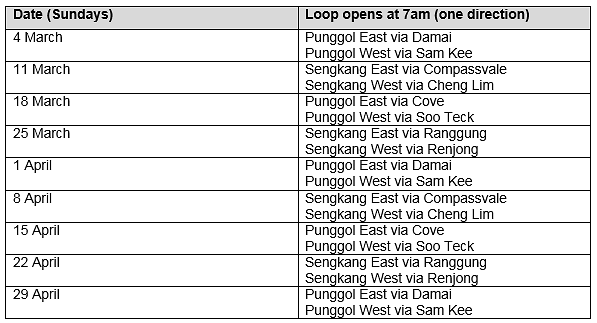
SINGAPORE: Maintenance work on the Sengkang and Punggol Light Rail Transit (LRT) systems will resume on Mar 4 and go on until the end of April, SBS Transit said in a press release on Thursday (Feb 22).

Work on Sundays had started in January this year before stopping for the Chinese New Year period in February.

For the next two months, work will continue to be carried out on Sundays during passenger service hours, said SBS Transit, adding that LRT services will still be available at all stations on one platform. The other platform will open later at 7am on maintenance days.

“We seek commuters’ understanding that one platform will have to be closed as power supply to its guideways will need to be turned off for safety reasons,” said the transport operator.

Guideways are paths on which the light rail vehicles move.

SBS Transit is replacing the power rail and power rail assemblies, as well as conducting preventive maintenance works on the signalling cables.

Source link

Cambodia, North Korea the most corrupt Asia Pacific states

0


HERMIT dictatorship North Korea is the most corrupt country in Asia according to a newly released index, followed closely by an increasingly authoritarian Cambodia.

The Corruption Perceptions Index 2017 was released by Berlin-based anti-corruption non-profit Transparency International on Wednesday, which found that “the majority of countries are making little or no progress in ending corruption”.

Out of a possible score of 0 to 100 – 0 being “highly corrupt” and 100 being “very clean” – North Korea scored just 17. According to US thinktank the Heritage Foundation, “bribery is pervasive and corruption is endemic at every level of the state and economy” in the repressive, one-party state.

SEE ALSO: How do Cambodians feel about Hun Sen’s war on democracy?

Cambodia wasn’t much better with a score of only 21 on the CPI – ranked 161 out of 180 nations and territories surveyed. GAN Integrity says that while Cambodian anti-corruption law is of international standard, it is “poorly enforced and public officials continue to engage in corrupt practices with impunity.”

Prime Minister Hun Sen and his family have been described by UK NGO Global Witness as having a “stranglehold” on the economy of the small Southeast Asian nation.

In contrast, New Zealand and Singapore were the best performers in the region on the CPI, despite both experiencing “their share of scandals in the last year”. NZ was in fact the highest-ranking country in the world, while neighbouring Australia’s index score has declined since 2012.

2018-01-07T042842Z_783763786_RC19BC605980_RTRMADP_3_CAMBODIA-ROUGE

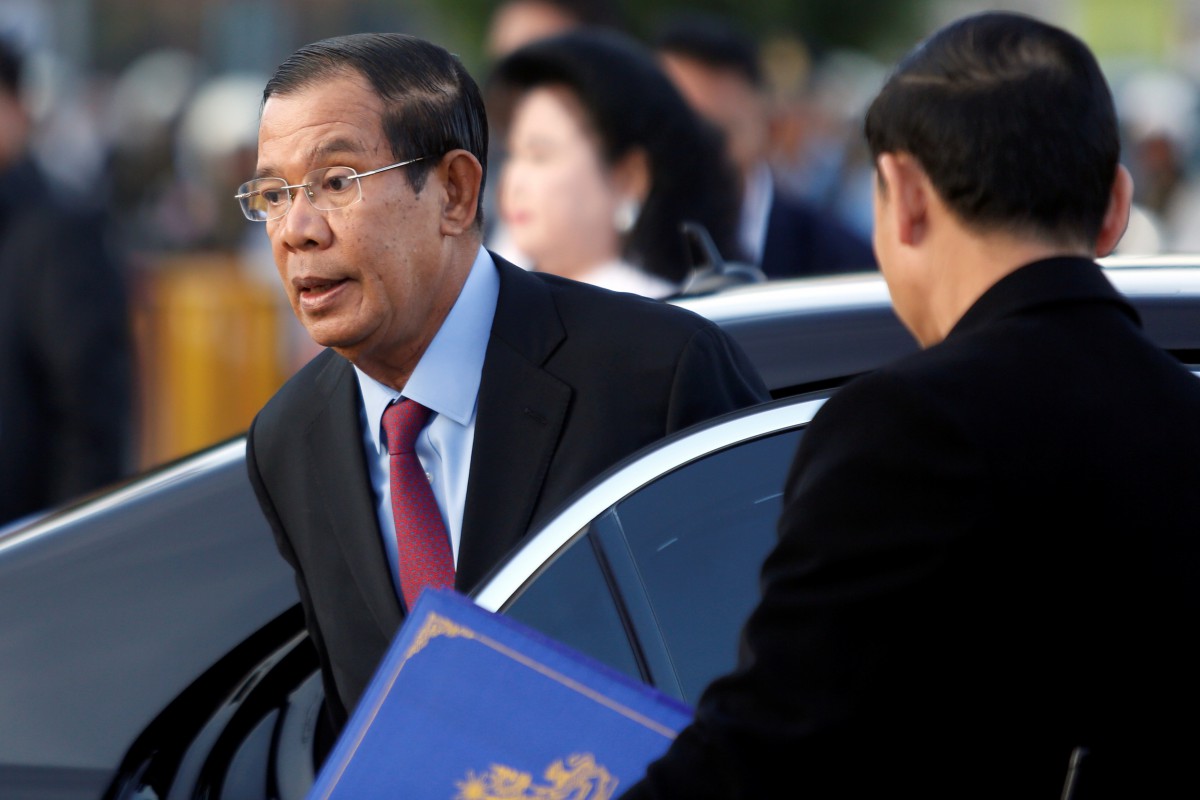
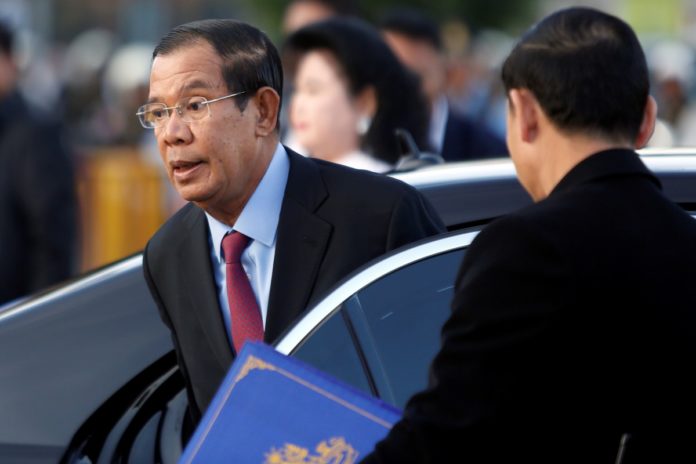
Cambodian Prime Minister Hun Sen arrives to attend the ceremony to mark the 39th anniversary of the toppling of Pol Pot’s Khmer Rouge regime, in Phnom Penh, Cambodia, January 7, 2018. Source: Reuters/Samrang Pring

Other countries in the region fared poorly with Thailand, Vietnam and the Philippines being ranked 96, 107 and 111, respectively.

Malaysia – whose Prime Minister Najib Razak has been accused by the US Department of Justice of siphoning almost $700 million from state development fund 1Malaysia Development Berhad – was ranked 62 behind its tiny oil-rich neighbour Brunei Darussalam at 32.

“There are clearly significant issues which remain unaddressed, to the detriment of the country’s international standing and the ability of Malaysian companies to operate successfully in the global economy,” said Dr Mark Lovatt of the Kuala Lumpur-based Business Integrity Alliance in a statement.

SEE ALSO: US calls Malaysia’s 1MDB corruption scandal ‘kleptocracy at its worst’

One positive case study was Indonesia, which while scoring just 37 “has a long way to go in the fight against corruption” has also seen a modest improvement in reducing public sector corruption in the past five years.

This “could” stem from the work of Indonesia’s anti-corruption agency taking action against corrupt officials despite “strong opposition” from parliament, Transparency International said.

The watchdog noted that while corruption was still strong in many countries in the Asia Pacific, journalists, activists or other whistle-blowers were increasingly being threatened for speaking out, including in some cases being killed.

2018-02-09T165545Z_2046775779_RC1C9D884590_RTRMADP_3_MALDIVES-POLITICS

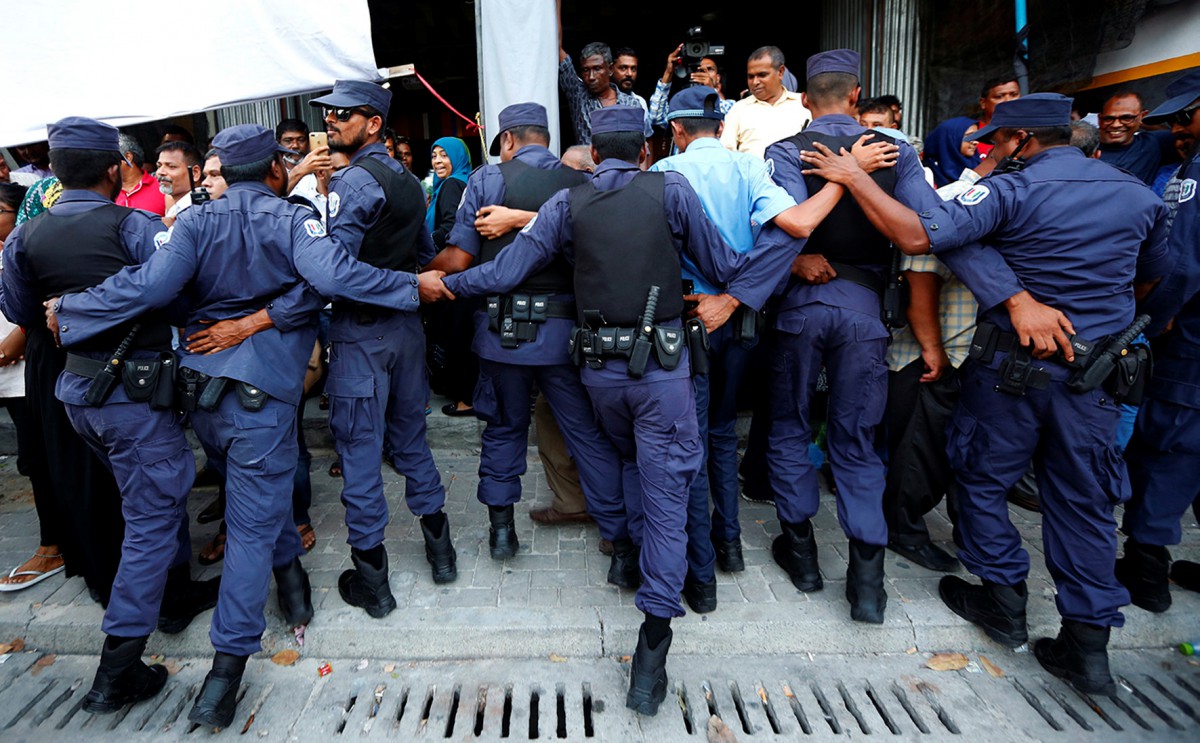
Maldivian Police officers push back opposition supporters near the main opposition Maldives Democratic Party (MDP) headquarters during a protest in Male, Maldives February 9, 2018. Source: Reuters

“CPI results correlate not only with the attacks on press freedom and the reduction of space for civil society organisations,” said Delia Ferreira Rubio, the Chair of Transparency International. “In fact, what is at stake is the very essence of democracy and freedom.”

The Philippines, India and the Maldives were the worst off in terms of intimidation and violence against those who report or lobby against corruption. In highly corrupt countries, a journalist is killed every week, said its analysis.

SEE ALSO: Philippines remains one of the most dangerous places on earth for journalists

“No activist or reporter should have to fear for their lives when speaking out against corruption,” Transparency International’s Managing Director Patricia Moreira said. “Given current crackdowns on both civil society and the media worldwide, we need to do more to protect those who speak up.”

The NGO recommended that governments impement tougher legal frameworks to prevent corruption, to reduce impunity, increase space for civil society to hold power to account, and for education systems and the corporate sector to promote greater integrity and ethics.

“Rather than focus solely on scores, rankings and methods, countries across the region should decide where to make substantial changes that will bring about real improvements in their countries,” it said.

{“total”:1,”error”:””,”linkedin”:0,”stumbleupon”:0,”pinterest”:0,”google”:0,”facebook_total”:0,”buffer”:0,”twitter”:1,”vk”:0}

Source link

More shuttle buses to support shorter EWL operational hours for March weekends: SMRT

0

SINGAPORE: More shuttle bus services will be made available to support the shorter operational hours along the East-West Line (EWL) on weekends in March, SMRT said on Thursday (Feb 22). 

Six shuttle bus services – shuttles 1, 2, 3, 6, 7 and 8 – will run parallel to stretches of the EWL and stop at designated pick-up and drop-off points near MRT stations along the way, including interchange stations where commuters can continue their journeys on other MRT lines. 

This is an increase from the four services that were made available in January, when operational hours on the EWL were also shortened. 

Four express bus services will be made available as well, the transport operator said.

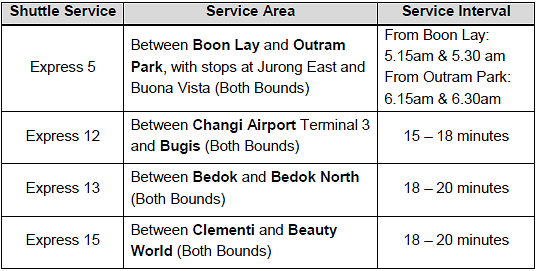
“Express 5 and 12 will provide commuters with direct connections to the city area, and two new express bus services will be introduced to provide commuters with connection from the EWL to Downtown Line (DTL),” SMRT said. 

“Express 13 will bridge between Bedok and Bedok North for the eastern sector, and Express 15 will connect between Clementi and Beauty World for the western sector.” 

From Mar 2 to Apr 1, all 35 stations along the EWL will close earlier and open later on weekends and selected weekdays to allow for more testing of the new signalling system, as well as more engineering works to be carried out.

SMRT reminded commuters to cater additional travel time when using the shuttle bus services.

“As the timing of the first and last departing train may vary from station to station, commuters are advised to check the respective timings before making their journeys,” SMRT said. 

“Commuters travelling longer distances may wish to plan their journeys using other operational MRT lines, or seek alternative travel options, for a faster journey.”

Source link

Former City Harvest Church leader charged for trying to flee jail sentence

0

SINGAPORE – A church official convicted in a multimillion-dollar fraud case was charged again in court on Thursday after trying to flee Singapore on a boat a day before he was to begin serving a reduced jail sentence.

The five-year-long legal battle that mixed fraud and faith had gripped the wealthy southeast Asian island, where there is little tolerance of corruption.

Chew Eng Han, who was the treasurer of the City Harvest Church and an investment manager, had hired a boat to escape to neighbouring Malaysia, a trip of less than an hour, when he was arrested by the coast guard on Wednesday, Singapore police said.

Chew was arrested “for attempting to leave Singapore illegally,” the police said in a statement, adding that their investigation continued.

Chew and another man were arrested in a motorboat off the island of Pulau Ubin. Chew had S$5,000 in cash, the police said. The pair claimed to have been fishing when questioned.

Chew, who is in custody, could not be reached for comment. Reuters could not immediately contact his lawyer to seek comment.

Chew was among six church leaders convicted in October 2015 of misusing millions of dollars to support the pop-singing career of the wife of a church co-founder. She was not charged in the case.

Chew was to have begun serving a sentence of three years and four months, which had been cut from six years on appeal.

Ex-CHC leader Chew Eng Han tried to flee Singapore: Other criminals who did the same

Earlier in February, a Singapore court rejected a prosecution appeal to reinstate longer jail terms for the church leaders, after they were cut by the High Court in April 2017.

Chew and the other accused all had their sentences cut nearly in half, prompting public criticism and a pledge by the government to amend a law that led to the shorter sentences.

The 57-year-old Chew had been allowed to stay outside of prison on bail until after the Lunar New Year so that he could spend time with family, his lawyer told the court last month.

While megachurches originated in the United States, some of the largest are in Asia, where packaging the traditional biblical message into a more dynamic format of pop music, lively services and social media has lured a new generation of followers and turned the churches into major enterprises.

City Harvest had a congregation of 15,923 and more than 50 affiliations in China, the United States, and seven other countries in 2016, its latest annual report shows.

Singapore

Thursday, February 22, 2018 – 16:39

More about

City Harvest Trial

Reuters

Others

Source link