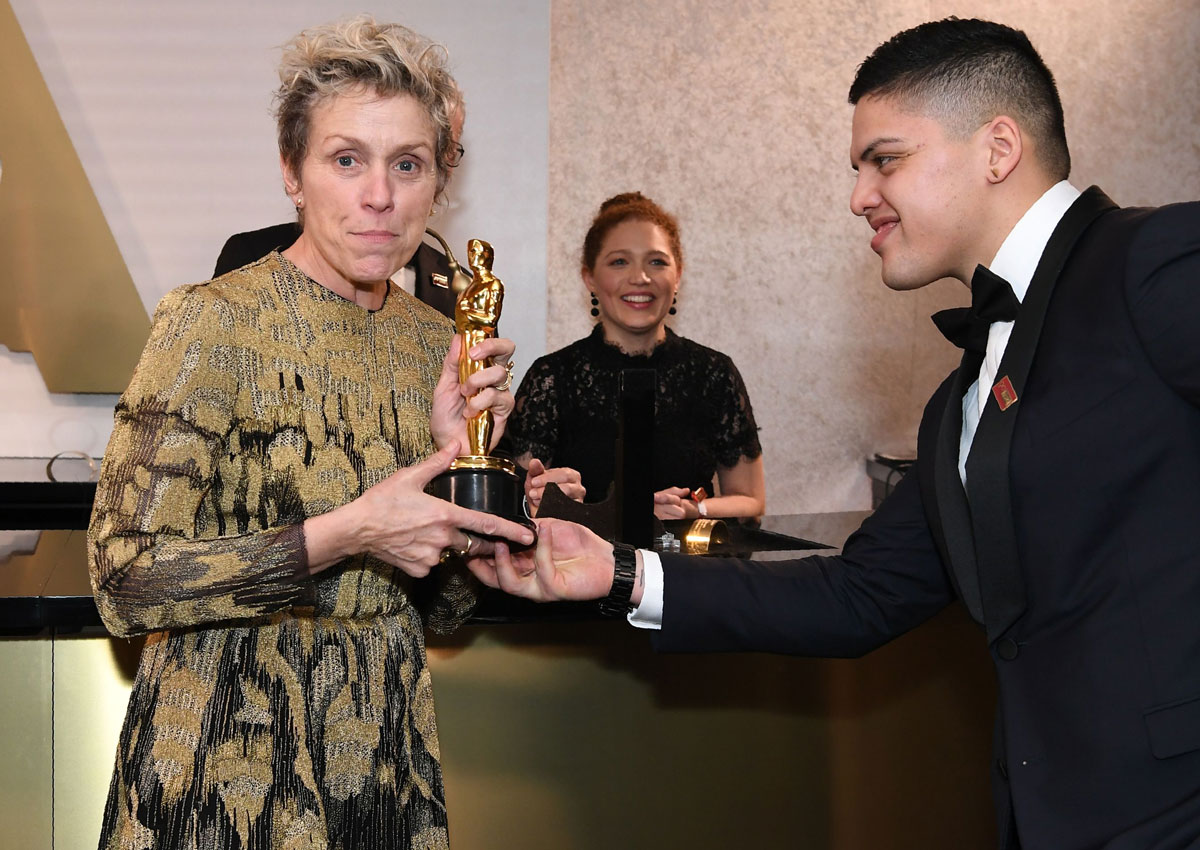
LOS ANGELES – Oscar-winner Frances McDormand had her statuette stolen at a post-show party by a man who allegedly snatched it from her table before he was arrested, police and witnesses said on Monday.
McDormand, 60, won best actress at Sunday’s awards for her role as a rage-filled mother seeking justice for her murdered daughter in Martin McDonagh’s “Three Billboards Outside Ebbing, Missouri.”
“Security at the Governors Ball are looking for this guy, who grabbed Frances McDormand’s Oscar and ran out with it,” said New York Times writer Cara Buckley, who was at the event and live-tweeted the drama.
She said a photographer working for celebrity chef Wolfgang Puck – who was providing the catering – stopped the man and seized the Oscar, before the thief disappeared back into the ball.
The actress “had set it down and was chatting” when it disappeared, according to Ms Buckley, who added that the actress had said to “let him go”.
“We can confirm that an incident occurred at the Governor’s event. There was an arrest made of a Terry Bryant for grand theft,” a spokeswoman for the Los Angeles Police Department told AFP.
Stars put sparkle back on Oscars red carpet after Golden Globes blackout
She wasn’t able to give further details, except to confirm that the 47-year-old suspect had a ticket for the party.
Variety magazine reposted a Facebook Live video it said showed the suspect brandishing the golden statuette he says he won “for music” and joking: “Got this tonight! This is mine. We got it tonight, baby.”
The African American man, dressed in a tuxedo with hair held back in hairpins, is seen in the 165-seconds of footage posted to the page of a Terry Bryant Djmatari kissing the trophy and allowing bystanders to touch it.
It was the second time McDormand had bagged the best actress statuette following her win for “Fargo” 21 years earlier, and her acceptance speech was a highlight of the evening.
Ratings slide McDormand, whose representatives didn’t immediately respond to a request for comment, delivered a rallying cry for the #MeToo movement against harassment and gender double-standards.
Placing her statuette on the stage, an animated McDormand asked all women nominated across categories to stand up and be counted.It was otherwise a relatively uneventful show, however, and early ratings for ABC’s telecast showed the US audience at an-all time low during the 5.00pm (0100 GMT) to 8.00pm ceremony, according to US media.
The near four-hour broadcast, hosted by Jimmy Kimmel, averaged an 18.9 overnight Nielsen rating – a number equating roughly to the percentage of America’s estimated 118.4 million households that tuned in.
That is a 16 per cent drop on last year, which will go down in infamy for its disastrous climax, when the wrong movie was briefly awarded best picture due to a mix-up with the envelopes.
Experts stress that preliminary ratings are not adjusted for time zone differences, meaning the live west coast audience is not accurately reflected in the overnight numbers, as they only measure primetime hours.
The 2017 Academy Awards, which earned a 22.4 overnight rating, ended up drawing 32.9 million viewers. It was the second lowest in Academy history after the 2008 show, hosted by Jon Stewart, pulled in just 31.8 million.
“It was a show in which nearly every winner had been exhaustively pre-ordained by the endless awards season, but one in which first-time and long-overdue winners still brought the crowd to its feet,” the Hollywood Reporter’s Daniel Fienberg said in a review.
All three big set-piece television events so far – the Golden Globes, the Grammys and the Super Bowl – have all returned lower audiences than in 2017.
SINGAPORE: As global competition intensifies, and technological disruption reshapes entire industries, one thing is clear – it is no longer business-as-usual.
Recognising this, at Budget 2016, the Singapore Government announced that to ensure the continued growth and competitiveness of the economy, enterprise-level support on its own was no longer sufficient.
Instead, growth strategies had to be developed for each industry in order to position us well for the future. Industry Transformation Maps (ITMs) covering 23 industries, or 80 per cent of Singapore’s GDP, were created.
Having been closely involved in a number of ITMs these last two years, what is evident to me is that for an ITM to be effective, it must satisfy a few conditions. They include:
A high degree of private-sector participation, helping to create ownership and focus
Rollout of well-orchestrated industry-level iconic projects, to align participants
Strong focus on people and skills agenda
The financial services ITM checks the box on all three.
PRIVATE SECTOR INVOLVEMENT AND FOCUS
For a start, the financial services ITM has strong industry participation, driven by the Financial Centre Advisory Panel (under the aegis of the Monetary Authority of Singapore (MAS)) comprising members from banks, asset managers, and insurers.
This has allowed us to zero in on principal businesses where future opportunities lie. Singapore’s financial services ITM has, as focus areas, wealth management, asset management, foreign exchange, infrastructure finance, capital raising and insurance.
In addition to selecting focus areas, the ITM also creates a clear focus on the innovation agenda. This covers a range of technologies in payments, blockchain and APIs.
Second, some key iconic projects have been identified to anchor the transformation. High-level government support is crucial to enabling iconic projects to take off, and this has indeed been forthcoming.
Marquee projects also open up opportunities for non-traditional players such as technology companies to participate by providing solution sets.
The financial sector has done well in this regard, with strong public-private partnership facilitating the rollout of a number of path-breaking initiatives in the last two years in four areas:
1. Creation of a common set of API standards. Banks have traditionally operated as pipe companies, facilitating money flows in the global monetary system. As we go forward, however, banks need to make the shift from being a pipe company to becoming a platform company, with banking seamlessly integrated into the daily lives of customers. API technology enables this.
As we transition from a traditional to API economy, it is helpful for the industry to have a framework by which to think about new ecosystem-based business models. It is also important to be guided by a common set of standards.
The API playbook, launched in November 2016, meets this need. Developed by The Association of Banks in Singapore (ABS) and MAS, together with the industry, the playbook identifies common and useful APIs for industry and non-industry players.
It also provides guidance on information security standards and governance models.
In November 2017, DBS launched a banking API developer platform with over 155 APIs across more than 20 categories: Funds transfers, rewards, PayLah! and real-time payments.
DBS Bank, which launched e-wallet PayLah! in 2014, has introduced biometric verification. (Photo: DBS)
At the time, more than 50 companies including AIG, McDonald’s, MSIG and PropertyGuru had already tapped into the DBS API platform to develop solutions which bring convenience and value to our customers.
2. Establishment of a common Know-Your-Customer (KYC) utility. Over the years, Singapore has solidified its reputation as a trusted international financial centre. As criminals become smarter and more sophisticated, however, banks need to step up their ability to detect illicit activity. This includes being able to identify clients of a dubious nature at the onboarding stage.
To facilitate this, one initiative in the works is a common KYC utility. Performing due diligence on potential clients can be a time-consuming and laborious activity. If the load can be shared across the industry, this will allow banks to focus their efforts on more complex aspects of customer due diligence or transaction monitoring. KYC processes will be strengthened.
Customers could also save time, as they need not provide the same information to multiple institutions.
This initiative is led by ABS, and involves multiple financial institutions, government agencies, MAS and external vendors. The coming together of an entire ecosystem is required to drive material change.
3. Experimenting with distributed ledger technology across payments and trade finance. Distributed ledger, or blockchain technology, has the potential to make financial transactions and processes more transparent and resilient, and at lower cost. Its application is also potentially widespread, covering areas from payments to trade finance.
One experiment by the industry involves MAS, the Singapore Exchange, banks and technology companies leveraging distributed ledger technology to create a more efficient inter-bank payment and settlement system without MAS acting as the trusted party.
In another example, MAS and the Hong Kong Monetary Authority have agreed to use the technology to set up a cross-border platform to boost trade finance.
Traders and guests pose for photos at an event to celebrate the end of floor trading at the Hong Kong Stock Exchange on Oct 27, 2017. (PhotoL AFP/ISAAC LAWRENCE)
The initiative, which is expected to go live in 2019, will allow users to exchange digital trade documents across borders with confidence. Its development was driven by the associations, governments and regulators on both sides.
This Singapore-Hong Kong partnership rides on Singapore’s National Trade Platform (NTP), a trade and logistics IT ecosystem connecting businesses, community systems and platforms, and government systems. The NTP is itself a collaboration involving GovTech, Singapore Customs, different government ministries and MAS.
4. Driving the e-payments agenda. To execute on the vision of an e-payments society in Singapore, there needs to be greater collaboration within the payments industry. Today, we have multiple e-payments solutions and limited interoperability among them.
To address this, in August 2017, MAS launched a 20-member payments council, comprising not only representatives from banks, but also payments providers, non-traditional players such as Grab and Lazada, and trade associations. This underlines, once again, a collaborative effort across businesses and industries to shape the payments landscape in Singapore.
The creation of PayNow and the SGQR (a common QR standard for point of sale payments in Singapore) are outcomes of this initiative, and are set to transform the payments landscape in the country by the end of this year.
File photo of a person using the PayNow electronic funds transfer service. (Photo: Gaya Chandramohan)
STRONG PEOPLE FOCUS AND SKILLS AGENDA
Finally, an effective ITM needs to have a strong people focus and agenda. Digitalisation in the financial industry is fast reshaping job roles. In such an environment, skills training, re-development and job mobility take on heightened importance.
The Government has recognised that reskilling and re-tooling the workforce is not the responsibility of banks alone. A supportive national infrastructure is also helpful.
To this end, the Institute of Banking and Finance (IBF) plans to set up a career centre to provide advisory services for financial sector professionals. This expands IBF’s mandate to cover not just the setting of competency standards and promoting skills development, but also career advisory, job matching and placements.
In short, to be successful, an ITM needs to have broad-scale industry participation, iconic projects which move the needle and a strong people focus.
The financial services ITM is an exemplar one that checks all these boxes, and is a fitting role model for other industry transformation roadmaps.
Piyush Gupta is CEO of DBS Bank.
READ: A commentary on the challenges faced by Scanteak, as they sought to digitalise their business and expand on their showroom model, in Channel NewsAsia’s second series on Transforming Industries.
SINGAPORE: As global competition intensifies, and technological disruption reshapes entire industries, one thing is clear – it is no longer business-as-usual.
Recognising this, at Budget 2016, the Singapore Government announced that to ensure the continued growth and competitiveness of the economy, enterprise-level support on its own was no longer sufficient.
Instead, growth strategies had to be developed for each industry in order to position us well for the future. Industry Transformation Maps (ITMs) covering 23 industries, or 80 per cent of Singapore’s GDP, were created.
Having been closely involved in a number of ITMs these last two years, what is evident to me is that for an ITM to be effective, it must satisfy a few conditions. They include:
A high degree of private-sector participation, helping to create ownership and focus
Rollout of well-orchestrated industry-level iconic projects, to align participants
Strong focus on people and skills agenda
The financial services ITM checks the box on all three.
PRIVATE SECTOR INVOLVEMENT AND FOCUS
For a start, the financial services ITM has strong industry participation, driven by the Financial Centre Advisory Panel (under the aegis of the Monetary Authority of Singapore (MAS)) comprising members from banks, asset managers, and insurers.
This has allowed us to zero in on principal businesses where future opportunities lie. Singapore’s financial services ITM has, as focus areas, wealth management, asset management, foreign exchange, infrastructure finance, capital raising and insurance.
In addition to selecting focus areas, the ITM also creates a clear focus on the innovation agenda. This covers a range of technologies in payments, blockchain and APIs.
Second, some key iconic projects have been identified to anchor the transformation. High-level government support is crucial to enabling iconic projects to take off, and this has indeed been forthcoming.
Marquee projects also open up opportunities for non-traditional players such as technology companies to participate by providing solution sets.
The financial sector has done well in this regard, with strong public-private partnership facilitating the rollout of a number of path-breaking initiatives in the last two years in four areas:
1. Creation of a common set of API standards. Banks have traditionally operated as pipe companies, facilitating money flows in the global monetary system. As we go forward, however, banks need to make the shift from being a pipe company to becoming a platform company, with banking seamlessly integrated into the daily lives of customers. API technology enables this.
As we transition from a traditional to API economy, it is helpful for the industry to have a framework by which to think about new ecosystem-based business models. It is also important to be guided by a common set of standards.
The API playbook, launched in November 2016, meets this need. Developed by The Association of Banks in Singapore (ABS) and MAS, together with the industry, the playbook identifies common and useful APIs for industry and non-industry players.
It also provides guidance on information security standards and governance models.
In November 2017, DBS launched a banking API developer platform with over 155 APIs across more than 20 categories: Funds transfers, rewards, PayLah! and real-time payments.
DBS Bank, which launched e-wallet PayLah! in 2014, has introduced biometric verification. (Photo: DBS)
At the time, more than 50 companies including AIG, McDonald’s, MSIG and PropertyGuru had already tapped into the DBS API platform to develop solutions which bring convenience and value to our customers.
2. Establishment of a common Know-Your-Customer (KYC) utility. Over the years, Singapore has solidified its reputation as a trusted international financial centre. As criminals become smarter and more sophisticated, however, banks need to step up their ability to detect illicit activity. This includes being able to identify clients of a dubious nature at the onboarding stage.
To facilitate this, one initiative in the works is a common KYC utility. Performing due diligence on potential clients can be a time-consuming and laborious activity. If the load can be shared across the industry, this will allow banks to focus their efforts on more complex aspects of customer due diligence or transaction monitoring. KYC processes will be strengthened.
Customers could also save time, as they need not provide the same information to multiple institutions.
This initiative is led by ABS, and involves multiple financial institutions, government agencies, MAS and external vendors. The coming together of an entire ecosystem is required to drive material change.
3. Experimenting with distributed ledger technology across payments and trade finance. Distributed ledger, or blockchain technology, has the potential to make financial transactions and processes more transparent and resilient, and at lower cost. Its application is also potentially widespread, covering areas from payments to trade finance.
One experiment by the industry involves MAS, the Singapore Exchange, banks and technology companies leveraging distributed ledger technology to create a more efficient inter-bank payment and settlement system without MAS acting as the trusted party.
In another example, MAS and the Hong Kong Monetary Authority have agreed to use the technology to set up a cross-border platform to boost trade finance.
Traders and guests pose for photos at an event to celebrate the end of floor trading at the Hong Kong Stock Exchange on Oct 27, 2017. (PhotoL AFP/ISAAC LAWRENCE)
The initiative, which is expected to go live in 2019, will allow users to exchange digital trade documents across borders with confidence. Its development was driven by the associations, governments and regulators on both sides.
This Singapore-Hong Kong partnership rides on Singapore’s National Trade Platform (NTP), a trade and logistics IT ecosystem connecting businesses, community systems and platforms, and government systems. The NTP is itself a collaboration involving GovTech, Singapore Customs, different government ministries and MAS.
4. Driving the e-payments agenda. To execute on the vision of an e-payments society in Singapore, there needs to be greater collaboration within the payments industry. Today, we have multiple e-payments solutions and limited interoperability among them.
To address this, in August 2017, MAS launched a 20-member payments council, comprising not only representatives from banks, but also payments providers, non-traditional players such as Grab and Lazada, and trade associations. This underlines, once again, a collaborative effort across businesses and industries to shape the payments landscape in Singapore.
The creation of PayNow and the SGQR (a common QR standard for point of sale payments in Singapore) are outcomes of this initiative, and are set to transform the payments landscape in the country by the end of this year.
File photo of a person using the PayNow electronic funds transfer service. (Photo: Gaya Chandramohan)
STRONG PEOPLE FOCUS AND SKILLS AGENDA
Finally, an effective ITM needs to have a strong people focus and agenda. Digitalisation in the financial industry is fast reshaping job roles. In such an environment, skills training, re-development and job mobility take on heightened importance.
The Government has recognised that reskilling and re-tooling the workforce is not the responsibility of banks alone. A supportive national infrastructure is also helpful.
To this end, the Institute of Banking and Finance (IBF) plans to set up a career centre to provide advisory services for financial sector professionals. This expands IBF’s mandate to cover not just the setting of competency standards and promoting skills development, but also career advisory, job matching and placements.
In short, to be successful, an ITM needs to have broad-scale industry participation, iconic projects which move the needle and a strong people focus.
The financial services ITM is an exemplar one that checks all these boxes, and is a fitting role model for other industry transformation roadmaps.
Piyush Gupta is CEO of DBS Bank.
READ: A commentary on the challenges faced by Scanteak, as they sought to digitalise their business and expand on their showroom model, in Channel NewsAsia’s second series on Transforming Industries.
MELBOURNE: When he was younger, Seth Yee was a real handful in childcare – his parents kept getting complaints about his out-of-control tantrums in class.
“The feedback from the teachers was that he already understood what they were teaching and he was just distracting the other kids,” recounted his father Mr Ray Yee. “Having to sit down and to listen to the teacher was like a prison to him.”
Unknown to his parents at the time, Seth was a gifted child. And he was typical of many such highly-talented kids who struggle with behavioural issues that can affect their social and emotional development, as the programme On The Red Dot explores in a series on Wonder Kids.
When he was one and a half years old, Seth could already differentiate between a hexagon and an octagon, and tell how many sides each shape had.
At five, he was learning science topics meant for Primary Six students. And at eight, he was fluent in three computing languages – Aldruno, JavaScript and Python – which he learnt by watching online tutorials.
Said the prodigy: “When I code on the computer, I feel really excited because I might be able to programme an AI (artificial intelligence) and I can have virtual conversations with it.”
But it seemed clear Seth would not be able to adapt to the Singapore school system. And so, when he was six, his parents packed him up and moved to Melbourne, hoping that a change in environment and school would do their son good.
AT WIT’S END
Ms Daphlyn Gao recounted how her son’s behavioural issues cropped up when he was merely a baby. He would often throw tantrums when things didn’t go his way.
When he was four, he had an odd obsession with lifts – he could remember the different lifts and even how many buttons they had. On one occasion, he insisted on taking only a particular one.
“It happened that the lift broke down, so he had a very huge meltdown, throwing a tantrum and then lying on the floor,” she said. “It was very difficult for the both of us because they (the tantrums) can happen quite a lot.”
Frequent outbursts aside, Seth was a special kid who seemed to be ahead of his peers.
“When we brought him to shopping centres with kiddy rides, he would be looking at the mechanism of the rides, to see how it actually works and why it moves,” recalled Ms Gao.
Concerned that he might be autistic or have Asperger’s syndrome, she and her husband sent him to a psychologist to be tested. The results were bittersweet for the couple – Seth was certified ‘gifted’ on the Stanford-Binet 5 Intelligence scale with an IQ of 134, in the top 1 per cent for children.
“He is highly intellectual, but that comes with other traits like asynchronous development,” said Mr Yee.
Which means that his social and emotional (skills) might be at the (level) of a four-year-old, but his intellect might be that of an eight-year-old.
When Seth was six, he started playing with an online space flight simulation game, Kerbal Space Programme, which features a realistic physics engine.
Mr Yee, a software engineer, recalled trying it out with his son and finding it difficult to master. It involved configuring a complicated spaceship – which Seth eventually built successfully.
“I was quite amazed,” he said of his son’s feat.
He had started exposing his son to robotics and simple coding using the programming language Scratch. “I realised that Seth was actually creating programmes that some 17-year-olds are just beginning to do,” he said.
The Kerbal Space Programme,
A COMPLETE CHANGE DOWN UNDER
For Seth’s sake, in 2015 the family of four – which included Seth’s younger brother Zane – moved to Australia. In part, they were attracted by the curriculum offered by a primary school in Melbourne.
They settled in the quiet suburb of Endeavour Hills with a modest population of about 25,000, a 30-minute drive from the city.
“We had to uproot our life, we had to give up our careers, leave our family and start a brand new life in Melbourne,” said Ms Gao.
Seth was enrolled at Wooranna Park Primary School where the students were given the autonomy to choose whatever they want to do on a certain day. Said Mr Yee: “I felt that for Seth, that would be a good thing.
We worked with the teachers, and he started to have fewer tantrums in school. Within a year, his behaviour had changed totally.
Computer teacher Kieren Nolan’s first impression of his new student from Singapore was just how intelligent he was for his age. “What struck me was the fact that he was so advanced. I honestly think that a lot of his thinking is at university level,” he said.
Mr Nolan currently teaches Seth coding, computer building and blockchain technology.
Kieran Nolan and Seth, at Wooranna Park Primary School
Fellow teacher Lizzie Maroni, however, noted that Seth needed to work on his social development and social awareness. It was initially tough to get him to join a group, and a relationship with him had to be built.
But they managed to make him feel that all the kids cared about him. “His transformation is absolutely amazing. Now he can do everything and really engage. He’s so social and so funny,” said Ms Maroni.
LESS STRICT THAN SINGAPORE TEACHERS
Seth says he has adjusted well to his new school, and that Mr Nolan, his favourite teacher, has taught him “a few cool things”.
“I like going to Wooranna Park Primary School more than Singapore schools because it’s more interesting here and the teachers are less strict,” he said. “You get to choose what you want to learn.”
Over the last year, Seth has even taken on the role of a teacher – conducting lessons two to three times a week on strategies to excel in the video game Minecraft.
“I think Seth is really happy to teach. Having that status as a teacher has given him confidence,” said Mr Nolan. “He is quite confident and is able to speak in front of a group of people, (something) he was not able to do a couple of years ago.”
Seth teaching a class.
On The Red Dot arranged a special surprise for Seth – to travel to the University of New South Wales in Sydney to see a new quantum computer developed by researchers.
Seth has always been fascinated with quantum computers (which are supercomputers capable of solving calculations in healthcare, climate modelling and aerospace that existing computers are unable to do). So he was understandably excited.
Dr Andrea Morello, a professor of quantum engineering at UNSW, showed the eight-year-old around and explained his research. His advice for Seth, if he ever wants to become a “professional scientist”: Have perseverance.
Dr Andrea Morello and Seth.
“The most important thing for a bright and very curious kid like that, is to at some point learn to stick to one thing and take it to the end,” he said. “He would have to decide that this is what he is going for, and become the best at something.”
For Ms Gao, uprooting to a foreign country for their gifted son’s sake has paid off.
“I felt that our sacrifice was worth it when we saw the change in him. He has learnt to care for the people around him,” she said.
“I hope that with the books he has read and with all the knowledge that he has in his brain, he will be able to create something that would help mankind.”
On the Red Dot profiles four children with exceptional gifts, exploring the sacrifices they and their families make, and the challenge of pursuing their potential without losing their childhood. Watch the series here. New episodes every Friday at 9.30pm on Mediacorp Channel 8.
What’s one thing we look forward to besides all the nominees and awardees at the Oscars? Well, it’s the all-out swag bags that Distinctive Assets give out to all the 25 nominees. So even if you don’t get to take home that most-coveted gold trophy, you’re still not empty-handed.
Some of the people who will take this bag are Margot Robbie, Meryl Streep, Daniel Kaluuya, Saoirse Ronan, Timothee Chalamet, and more.
Each bag will include over US$100,000 (S$132,045) worth of gifts that range from skincare, charcoal toothpaste, a trip to Tanzania, a fancy pepper spray, and so much more. Want to know what’s in the amazing swag bag? Keep scrolling.
The guests will stay at the Serengeti Migration Camp which they say is one of the best hotels in Africa. Business Insider also reports that the trip will include a hot air balloon safari, private safari guide, horseback riding, and a lot more. Total cost of this particular gift is about US$40,000.
A SEVEN-DAY TRIP AT THE GOLDEN DOOR SPA IN CALIFORNIA
Photo: GoldenDoor.com
The relaxing trip includes a private room, in-room massage, a meal plan, herbal wraps, and even skin care products. Total cost? US$8,850.
A WEEK-LONG STAY IN KOLOA LANDING RESORT AT POIPU, HAWAII
Guests will get a two-bedroom ocean view villa and be able to do a zipline adventure, and a helicopter tour. If they just want to chill, they can lounge by the pool or head on to the spa.
DNA KIT FROM 23ANDME
The kit includes genetic reports about your health, traits, and ancestry. Think of it as the next level intolerance test.
10,000 MEALS DONATED TO AN ANIMAL SHELTER OR RESCUE BY HALO
This is worth around US$8,000 and the recipients can get to pick which animal shelter or rescue this will go to. The celebrity pets will also get treats from the brand.
PERSONAL TRAINING SESSIONS WITH CELEBRITY TRAINER ALEXIS SELETZKY
As if they need to look even better, each one will get 10 one-on-one sessions with the LA-based trainer.
Be stylishly protected with this sleek pepper spray that retails for US$27, but for sure celebs want to take it next level and get the US$125 bedazzled sprays.
So, what else are they getting?
– A stay at the Avaton Luxury Villas resort in Halkidiki, Greece
– A $200 sterling silver bracelet from Safi Kilima Tanzanite
– A Modern Innovations levitating Bluetooth speaker
– Color-changing lipstick from Blush and Whimsy
– Soy candles from Charleston & Harlow
– A 10-piece marble makeup brush set from Inception of Beauty
– Shirts from Happiest Tee
– Dandi underarm patches (yes, to prevent sweat stains!)
– Face It reusable face and eye makeup removers
– Luxurious Le Celine eyelashes, curlers, and brushes
– Makeup from Look Fabulous Forever
– A limited edition diamond necklace and pendant from Luxura Diamonds
– One-year supply of Healing Saint luminosity serum and hair follicle stimulant
– A handmade Bangarang wooden box with cards that have positive actions and quotes
– My Magic Mud activated charcoal toothpaste
– Quip electric toothbrush
– A bottle of Southern Wicked Lemonade with moonshine
– A bath bomb from PETA
– Rouge Maple 100 per cent pure organic maple syrup
– A forearm sleeve with a built-in water supply from Wetsleeve
– Reusable Gigantote from The Green Garmento
– Mophie charger with exclusive access to a dating app called NeverMissed
– Lifetime supple of Oxgenetix foundation and moisturizer
– Collagen eye mask and eye treatment from MZ Skin
– Oranges from delivery app EpiFruit (yum!)
– A copy of “My Improper Mother and Me” by Esther Fairfax with private dances from Jill Rose Jacobs
– A year supply of DNA-based skincare by Allel
– Chao Pinhold surgery that treats gum recession (woah!)
– A sampling of Mexican soda Jarritos at an event of the nominee’s choosing (maybe Friday night Netflix?)
– Chocolatines’ latest line of chocolates
– “Cook Yourself Happy: The Danish Way” cookbook
– Children’s book Curlee Girl which empowers girls to love themselves
– Organic and vegan lollipops from Delicacies Candy & Confections
– Hydroxycut Organic (to burn all the extra carbs!)
– A signature treatment with celebrity skin specialist Debbie Thomas
– A Justice for Vets coin which acts as a reminder to leave no veteran behind
– CD and a book on phobia relief from Kalliope NYC
– Jewelry from Irish-brand Liwu
– A 99 Creative Words of Wisdom for business celebrity creative kit
– Full face rejuvenation from Nurse Gigi
– No. 9 Daily Chemical Exfoliant skin care from Oumere
– A cleanser and mask from Paiva Aloe, Gorgeous
– Pretzels from Posh Pretzels
– Skincare from Proven
– Herbal tea from Quincy Herbals
– Commissioned original art from Reian Williams
– Hair products from Totalee Hair
– Youth Blast anti-aging supplement from Age InterventionRX
Stars put sparkle back on Oscars red carpet after Golden Globes blackout
The WSH2028 Tripartite Strategy Committee will study how to develop WSH over the next 10 years.
(Updated: )
Bookmark
SINGAPORE: Even as Singapore’s workplace fatality rate has fallen to a record low, the country still lags behind other nations and needs to do more to ensure its workers can work in safe and healthy conditions, said Minister of State for Manpower Sam Tan in Parliament on Monday (Mar 5).
Mr Tan announced the formation of a new Workplace Safety and Health (WSH) tripartite committee during the Ministry of Manpower’s Committee of Supply debates.
The WSH2028 Tripartite Strategy Committee will chart out a comprehensive plan for WSH development over the next 10 years. It will be chaired by Mr John Ng, CEO of Singapore LNG Corporation and a WSH Council Member.
“Our workplace fatality dropped to 1.2 (per 100,000 workers) last year … but we should not be complacent. We are still lagging behind other countries with a workplace fatality rate of less than one,” he said.
WSH2028 will succeed WSH 2018 set 10 years ago with the aim of reducing the workplace fatal injury rate from 2.8 per 100,000 workers in 2008 to 1.8 by this year.
“We can do more. Over the next 10 years, we must aspire to provide our workers with workplaces that are among the safest and healthiest in the world,” he added.
The committee will study five broad areas of workplace safety and workplace health.
It will look at the strengthening WSH ownership among companies and workers, and study how it can influence all employees – from senior management to rank-and-file workers – to being more committed to the cause.
It will also look at increasing integration of of workplace safety with workplace health, as well as deepen the WSH capabilities of companies and workers.
Additionally, it will also look at strengthening partnerships with different stakeholders to promote and reinforce positive WSH behaviour, and review the regulatory regime to ensure that it remains effective without excessive burden on compliant companies.
The committee will start work in April, and plans to submit its report in a year’s time.
Apart from making workplaces safer and healthier, Mr Tan also spoke on making them more age-friendly.
He announced that a Tripartite Standard on Age-friendly Workplace Practices has been developed and will share more when it is launched next month.
“What we should all do is to work towards a workplace culture where older workers feel valued, and companies think about the needs of older workers, when they put in place policies and practices,” Mr Tan said.