Mr Singh, who had been tipped as Mr Low’s likely successor, was elected unopposed.
The Workers’ Party’s Pritam Singh arriving at the party’s headquarters on Apr 8 for the WP’s Central Executive Council elections. (Photo: Lianne Chia)
(Updated: )
Bookmark
SINGAPORE: The Workers’ Party’s Member of Parliament Pritam Singh has been elected as the party’s new Secretary-General, following WP’s biennial Central Executive Council (CEC) elections on Sunday (Apr 8).
Mr Singh takes over from Mr Low Thia Khiang, following the latter’s announcement in November that he would not contest the election to make way for new blood. Mr Low has held the top post since 2001.
Mr Singh, who was the party’s assistant secretary-general, was elected unopposed, following the meeting held at the party’s headquarters.
Party chairman Sylvia Lim was re-elected to her post unopposed.
Mr Singh had been tipped as the likely successor to Mr Low. WP Non-Constituency MPs Dennis Tan and Leon Perera, as well as former NCMP Gerald Giam, had all expressed support for Mr Singh, according to an article in the TODAY newspaper.
Fellow NCMP Daniel Goh had also made a Facebook post in February, backing Mr Singh as the favourite to become the next party chief.
In 2016, WP MP for Aljunied GRC Chen Show Mao had mounted a challenge for the post of secretary-general, which was fended off successfully by Mr Low with a reported 61-45 vote.
SINGAPORE: A topping out ceremony was held for Wisma Geylang Serai (WGS) on Sunday (April 8) to mark the completion of the 0.67 ha social and cultural heritage space, which will open its doors to residents in May.
At the ceremony, some 1,000 residents, community leaders and partners witnessed the symbolic placement of 100 wooden valence boards.
Senior Minister of State for Defence and Foreign Affairs and Mayor for South East District Maliki Osman and Grassroots Adviser to Geylang Serai Grassroots Organisations Fatimah Lateef joined residents.
They also unveiled the new WGS logo and were given a preview of the new facility.
The new Wisma Geylang Serai logo was unveiled at the topping out ceremony on Sunday (Apr 8). (Photo: Elizabeth Neo)
The logo was chosen from than 5,700 votes garnered online and through public engagement activities with residents that ran from Mar 17 to Apr 1.
Also in attendance were Minister in the Prime Minister’s Office and Chairman of the People’s Association Chan Chun Sing and Adviser to Marine Parade GRC Seah Kian Peng.
The WGS is Singapore’s first social and cultural heritage hub which brings together various Malay-Muslim Organisations and government and community agencies to address residents needs.
It is developed by the People’s Association and Wisma Geylang Serai, and will house the new Geylang Serai Community Club, the South East Community Development Council office, a Malay Heritage Gallery, arts facilities, a senior care centre, childcare centre and a family service centre. The hub includes the incorporation and reuse of the architectural features from the former Malay Village.
Residents had a chance to preview some of the facilities and architectural features of the new Wisma Geylang Serai at its topping out ceremony on Sunday (Apr 8). (Photo: Elizabeth Neo)
Dr Maliki said: “From a broader perspective, it is a symbolic realisation of the unique spirit and heritage of Geylang, but in a modernised manner”.
“After all, the roots of the Geylang Serai market place go back more than 50 years ago. Wisma Geylang Serai remains a centre stage for a variety of services to be rendered, programmes and community-based activities and facilities not only to the Muslim community but also to the non-Malay/Muslim residents, to interact and bond together and build a united Singapore,” he added.
PA said the co-location of the various agencies under one roof will allow opportunities for more collaborations that will bring greater benefit to residents and address their needs better.
One such initiative is the enhanced Marine Parade Cluster Heritage Trail Mobile Application, previewed at the ceremony. The augmented reality mobile app will allow students from Marine Parade cluster schools to discover the history, landmarks and artefacts of Geylang Serai through a series of quizzes and tasks.
Other collaborations include one with the Marine Parade Leadership Foundation, Marine Parade Cluster and the Singapore University of Technology and Design that will foster greater engagement among youths and the community through the set up of common platforms to generate creative solutions that enhance the public spaces in WGS and around the Geylang Serai neighbourhood.
Upcoming plans for the space include the Hari Raya Bazaar.
Dr Maliki also announced that WGS would be conducting an Expression of Interest exercise in May to invite interested retailers to submit proposals for retail spaces at the WGS building.
The WGS project was first announced by Prime Minister Lee Hsien Loong at the 2011 National Day Rally and is a National effort led by multiple government agencies including the People’s Association, Ministry of Social and Family Development, Ministry of Health, National Arts Council, National Heritage Board and Ministry of National Development.
SINGAPORE: From when he just a young boy, it looked like Carlos Andres Monasterios, now 23, was headed towards a life of trouble.
By the grand age of 16, he had done drugs, been a loanshark runner and inked himself on his forehead.
He had also inked his left middle finger with the letter R, to stand for Rascal – a nickname he identified with – joined a gang and tried sniffing glue.
That wasn’t all.
Carlos had beaten a fellow student into a pitiful state, extorted money from his school mates, and thrown chairs at teachers.
The law eventually caught up with him. He was arrested twice by the police, first sentenced to a stay in a boys’ hostel, and later, to three weeks in remand.
Then, suddenly, he decided it was time to turn things around, while he was alone in a cell in the basement of the State Courts, before his court appearance after being remanded.
“It was so quiet, it was so cold, and I had nothing. I just had a pair of blue shorts, a grey t-shirt. And that transparent slipper,” Carlos recounted, speaking to Channel NewsAsia in an exclusive interview.
“There were so many thoughts running and screaming in my head … there were just so many whys and I was just overwhelmed with emotions, and that was when I decided I can’t just continue this, I can’t leave this prison cell and just go back to being how I was, I can’t.”
At his lawyer’s suggestion, he agreed to go to halfway house The Hiding Place, and the Carlos of today is a far cry from the one before.
FROM YOUTH CRIME TO YOUTH PANEL
Carlos, who is currently a full-time national serviceman, sits on a Government youth panel that advises agencies on the relevance and effectiveness of their policies and programmes.
He is one of 12 members on the Youth Advisory Group (YAG), which was formed in Aug 2017 to advise on initiatives by the National Committee on Youth Guidance and Rehabilitation (NYGR). The NYGR addresses issues related to juvenile delinquency in Singapore.
Minister for Social and Family Development Desmond Lee said in an interview with the media in January this year that when he was with the Ministry of Home Affairs in his previous appointment, he worked with his current ministry to set up the YAG. Mr Lee said that the panel is an example of an “upstream” approach to address drug problems.
Carlos as a child. (Photo: Carlos Andres Monsterios)
“We need to work with schools, with school counsellors, youth work agencies, and find better ways to connect with young people,” he said.
So far, the group, whose members are appointed by NYGR co-chair Mr Lee, has been engaged thrice.
Most recently, the police sought the YAG’s views as they are looking to implement a series of policies or communications aimed at preventing youths from committing crimes like rioting, unlawful trespassing and molest, Carlos said.
This involved Carlos reflecting on his past, and providing first-hand observations that moved the conversation forward.
“I believe that it wasn’t just something for show, because they actually internalised what we said and it was a bit of a debate. They were trying to prove their point, and we were trying to answer it back, and it was a very fruitful session,” he said.
The Central Narcotics Bureau (CNB) also engaged the group on youths’ perceptions and attitudes on anti-drug advocacy efforts in Singapore. A spokesman for MSF said that the YAG’s contributions validated the CNB’s and the National Council Against Drug Abuse’s initiative to develop anti-drug advocacy in Singapore. The Central Youth Guidance Office also engaged the group on the effectiveness of a website.
Carlos agreed to join the group after being asked by his former probation officer. Being able to contribute to the society in this way has come to him as an unexpected form of satisfaction.
“I was a liability, I was a menace. I was going to amount to nothing, and to think that I could actually take those experiences and share my point of view of the matter, and be the voice for people who are going to head to that path, or people who are already walking down that path. That made me feel a strong sense of pride in doing what I’m doing with YAG,” he said.
GOING FROM BAD TO WORSE TO NOTORIOUS
Carlos was not always getting into trouble. In fact, up to the age of 11, he had stayed out of trouble. With a thirst for competition, he was even in the school’s football team, but got kicked out when his grades fell.
While she tried her best to be there for him, his mother, the sole breadwinner, was “pretty absent”, he said. He lived with his grandparents, but he was left to his own devices, and was not close to his siblings.
“At home, I had no one,” he said.
He leaned towards the rebellious pupils in school. By the time he was in Primary 6, he was starting to run away from home, and had had his first taste of cigarettes, after finding a stray packet by chance on the ground.
Secondary school did him no good. He would hang out with his older schoolmates.
“The group dynamics kind of spurred each of us to be more notorious than others. So we would pick fights with other schools, other neighbourhood schools, and we would challenge each other to do more daring stunts, more defying stunts, to see who was going to be the ‘top’ notorious one,” he said.
It was like he was graduating academically and criminally, he quipped.
At the height of his notoriety in school, when he was just 14 years old, he decided to immortalise the period with a tattoo. His friend would get one if he did.
“The foolish thing is he got the tattoo on his hand, and I got it on my face. Because to me it was like, ‘Oh I’ve got to be bigger, I’ve got to be even more gung-ho’, so I said you got it on your hand, I am going to get it on my face,” he said, recounting the incident.
But a year later, he used “primitive methods” to try and remove it, making almost invisible.
Carlos Andres Monsterios was doing drugs and in a gang when he was younger. Now 23, his life has totally changed. (Photo: Jeremy Long)
“It’s too much attention. You don’t realise how obvious it is until you have it.”
The same year, he started spending time with gang members. He then joined the gang and started doing harassment work for unlicensed moneylenders. In 2009, he was caught for that, and given the sentence to stay in a hostel for a year.
“Things just got worse and worse. I met even more offenders, and we just clicked well with each other, and I got introduced to drugs,” he said.
His life of drugs did not last long. About a year after he had been consuming and supplying them, he was approached by policemen while he was on his way home in Punggol. They tested him in a few ways to determine if he was intoxicated. When asked if he could go to the police station for a urine test, Carlos agreed, as he believed he was “above the law”.
His urine was found positive for drugs, and his mother had to bail him out.
“She was really devastated. Before that, she knew I was on drugs, but I guess that day was the day she realised her son was a drug addict,” he said.
THE ROAD TO CHANGE
Agreeing to stay at The Hiding Place was the first step Carlos took to reverse the years of going downhill.
“I knew if I left that place (the cell) that day, that if I left, and didn’t do anything about it, I would just go back, and its not that first time that’s happened. I was quite receptive to going to a more structured and guided place,” he said.
His intention was also to try and escape jail time, since he could show that he was making an effort to change, he added.
There, he met people who made him loved in a way he said he had not been. He recounted a man who was like a father figure to him.
“He was like the absent father that I never had. He was very stern at times, but he was always looking out for our needs,” he said.
Carlos’ own father is Bolivian. Carlos and his four siblings were bundled and brought here by his Singaporean mother from the South American country when he was four years old.
Carlos went to The Hiding Place in December 2011. To his shock, when his case was heard in court, the judge sentenced him to 1.5 years at the halfway house.
Carlos when he was at halfway house The Hiding Place. (Photo: Carlos Andres Monasterios)
“It just hit me that I was given a second chance. It felt like a real smack on the forehead. I was in disbelief,” he said.
“I knew I had to take this chance, this opportunity. I had to cherish it. That’s what led me to begin on this journey of transformation.”
Carlos made good, studying at The Hiding Place with the help of tutors. He completed his O-Levels and went on to get a diploma in hospitality and tourism management from Temasek Polytechnic.
He is now hoping to go to university. His life could not be more different than it used to be, but more than everything else, what has kept him on track on his new path is his family.
From someone they had to be cautious of, they now turn to him for advice and for decision-making in the family.
He said: “I was so unreliable before, and now to be this individual, this member of the family who can be so reliable – it makes me feel that I have so much to lose, and that’s one of the things which really keeps me from ever going back.”
Secretary-General Low Thia Khiang announced in November that he would not contest the party’s top post, to make way for new blood.
Workers’ Party leaders at the opening of party’s new headquarters on Friday (Sep 29). (Photo: Monica Kotwani)
(Updated: )
Bookmark
SINGAPORE: The Workers’ Party (WP) will elect its new party chief on Sunday (Apr 8), as it holds its biennial Central Executive Council (CEC) elections.
Secretary-General Low Thia Khiang announced in November, during the party’s 60th anniversary dinner, that he would not contest the top post in order to give the younger generation of party leaders the chance to take over the party.
The Party’s Assistant Secretary-General Pritam Singh, who is a fellow MP in Aljunied GRC, has been widely seen as the frontrunner in the race to be Mr Low’s successor, following recent reports in the media. WP Non-Constituency MPs Dennis Tan and Leon Perera, as well as former NCMP Gerald Giam, had all expressed support for Mr Singh, according to an article in the TODAY newspaper.
Fellow NCMP Daniel Goh also made a Facebook post in February, backing Mr Singh to become the next party chief. He also confirmed that the elections would be held on Sunday.
In 2016, during the party’s last CEC elections, MP Chen Show Mao mounted a surprise challenge to Mr Low for the leadership post. He lost to Mr Low with a reported 61-45 vote. Mr Chen had said then that the challenge provided an opportunity to “exercise (our) democratic rights”, and the new CEC would go ahead with full support from the party.
In response to the reports about support for Mr Singh , Mr Chen told Channel NewsAsia that he agreed with “many things that have been said in public”. But he noted that the elections are ultimately a matter for party members, and he “looks forward respectfully” to them making a decision soon.
Mr Chen has not said if he plans to contest Sunday’s election.
SINGAPORE: As she walks past the playground near her home, Pan Annan cannot help but turn to look. With her mother tugging her hand, however, she continues on her way.
If the children there should look up at her block, they might see her again outside her flat, peeking at them with a longing expression.
“Sometimes I’d feel that I’m missing out on playing,” she admits candidly. “I miss my friends a lot.”
But the 10-year-old with a “really packed schedule” knows that her childhood “is different from others”. Every day, she is in training for three hours to achieve her dream of becoming an Olympic champion for Singapore in rhythmic gymnastics.
If that is not enough, she is the youngest musician in the Singapore National Youth Chinese Orchestra, and at school, she is in the Gifted Education Programme (GEP) Chinese and the Math Olympiad.
“It’s quite hard to manage my time,” she told the programme On The Red Dot in its series on Wonder Kids. (Watch her episode here.)
But she is nothing if not determined to push herself. “I want to do better than I did before because I wouldn’t want to stay the same,” she said.
As a lot of people say, if you want to win, you have to win against yourself first.
This is not just talk about a pipe dream from a girl with stars in her eyes. She has already topped her age group in international competitions, even in China.
A 7-YEAR-OLD’S PLEA
It could have been so different, however, if Annan’s tears one day had not moved her mother.
Mrs Angela Pan’s daughter started her formal training when she was seven. A teacher had chosen her to be in the school team. But Mrs Pan, who has a doctorate in Chinese, had never heard of rhythmic gymnastics.
The women-only sport incorporates elements of ballet and is accompanied by music. Individual gymnasts perform floor routines with a rope, hoop, ball, ribbon and clubs, one at a time. They earn points for their apparatus handling, execution and artistic effect.
Pan Annan training with a ribbon.
“At that time, I didn’t accept it. We wanted her to be good academically,” said Mrs Pan.
I stopped her going to gymnastics. And she started to cry, asking why she couldn’t go. Then I realised she may really like it.
She did indeed. After two years of training, Annan took part in the Singapore Gymnastics National Championships last year. The then nine-year-old won second place in the overall All-Around category for 12 years and under, the competition’s youngest age group.
“My wife even cried at the time,” the girl’s father David Pan said with a little chuckle.
His daughter’s performance caught the eye of national sports association Singapore Gymnastics. She was selected to represent the country in her first international competition, on home soil: The Singapore Open Gymnastics Championships.
Victorious in the 2017 Singapore Open Gymnastics Championships.
This time, she was placed first in the 10-years-and-under age group. She has since won other individual medals in international championships, like her gold and silver for two events in China’s Zhong Ling Cup.
She has a gift in her chosen sport. Her coach and nine-time world champion Bianka Panova said: “Flexibility is a gift. Or you have to work to develop it. Annan has it naturally; she’s flexible like a Russian gymnast.”
Mr Pan is now eyeing opportunities for her to participate in the SEA Games and, if possible, the Youth Olympic Games. “We’re looking for an arrangement with the national team, to see what we can do for her,” he said.
PROUD PARENTS OF A SELF-STARTER
Annan is the Pans’ only child, and they put “a lot of effort” in raising her, said her father – but in different ways. “Somebody needs to push harder, somebody needs to take it a little bit back,” he said.
Annan’s parents videoing her at mock competition held by the Bianka Panova Academy.
No prizes for guessing that he is the one who “doesn’t put too much pressure” on her, given her “very tough schedule”.
It is Mrs Pan who fesses up with a smile that they call her “dragon mum” or “tiger mum”.
Annan shared innocently: “Sometimes my mother will start being angry with me, saying that I’m addicted to gymnastics and it’ll interfere with my studies.”
Explaining herself, Mrs Pan said: “To achieve success in life, in my experience, it’s no use if you’ve got talent but you don’t work hard.
“People may feel that I’m so strict with her. I treat her as an adult. When she makes a decision, she is responsible for it.”
At the same time, both parents, who were born in China, are proud of all their daughter has achieved so far.
On top of her gymnastics, she just finished a concert with the Singapore National Youth Chinese Orchestra, where she plays the pipa (a Chinese lute), the grand dame of the traditional stringed instruments.
The orchestra’s website states that it is a group of “highly talented musicians between the ages of 11 and 26”. But Annan joined when she was nine.
The Raffles Girls’ Primary pupil juggles her schedule by being a self-starter, working on her assignments in the car, for example, even before her father suggests it.
She enjoys school, but as with any child her age, whines about one thing.
“They’re really serious about our learning, so the homework will be a big pile. I’ll always pray to God, saying don’t give me any homework, please,” she said with a grin.
The reality, however, is that it has been “quite hard to cope” homework-wise, especially with an extra load coming from her GEP Chinese and Math Olympiad.
But that is where she shows the grit of the world beater she longs to be.
My teacher quoted to me, ‘The day that the body aches, the day that it rains, is the day that champions train.’
HERALDING A GOLDEN AGE?
In January, she won another feather in her cap when took home the National Athlete Award (Rhythmic Gymnastics) at the Singapore Gymnastics’ inaugural Annual Awards Dinner.
Mrs Pan with Annan after her award coup,
Ms Panova made it a double victory with the Coach of the Year Award (Rhythmic Gymnastics High Performance).
In 1987, she became the first rhythmic gymnast to score a perfect 10 for all five gold medals in the World Championship. And that has served to inspire her current prodigy.
“Sometimes I would dream of becoming Bianka number two,” Annan said with an unabashed smile.
Every year when I blow out my birthday candles and make my wish, I wish to qualify as an Olympic gymnast. I’ll never change it. I’m going to hold on to my dream.
“It’ll be very hard to become an Olympic champion. I’m not sure if I can. But I’ll try my best to achieve it.”
On The Red Dot arranged a special surprise for Annan, by gathering her neighbourhood friends to play with sparklers at the playground – with the help of her parents.
She was thrilled, dashing out the front door and for once transforming into a carefree 10-year-old laughing with her friends.
Said her mother: “I feel guilty that she doesn’t have much time to play with her friends as before. But what to do? She chose this.”
Mr Pan added: “As parents, we always would like our kids to become the best. Now she’s a child, but in future she’ll understand.”
That future could perhaps be a decade from now. According to Ms Panova, the best years for gymnasts are the ages of 18 to 20.
Bianca Panova coaching Annan.
“The journey to Olympic realisation or world realisation in our sport is a very long process,” she said.
“Annan has a great purpose, a great aim. She wants to participate in the big international competitions in the name of Singapore, which I believe is possible. And it would be the golden age of Singapore gymnastics.”
On The Red Dot profiled four children with exceptional gifts, exploring the sacrifices they and their families make and the challenge of pursuing their potential without losing their childhood. Watch the series here. Read about the 8-year-old computer prodigy and why his parents moved him to Melbourne.
SINGAPORE: When he was a child, Dr Goh Wei Leong’s hero was, of all people, his general practitioner.
“In those days, in the 60s or 70s, the doctors had little practices at home. It was just a little room and he looked after my family and me. I felt that connection. The very human touch of being a doctor was special for me.”
This, in addition to his tendency of being a generalist, meant that when he went to medical school, he was clear in his mind that he would be a GP instead of trying out perhaps more prestigious specialisations.
For him, medicine is about community.
“I like talking to people. I really can’t see myself peering down someone’s throat and that’s all. Medicine is sometimes more an art than a science. It could just be a matter of giving someone a listening ear and giving them the right advice on rest and diet, not only prescribing medicine. The art part of it is what thrills me.”
Today, one could say the bulk of his work is about the art of community.
His healthcare charity, HealthServe, provides migrant workers with affordable healthcare, social and legal assistance and skills training programmes.
He co-founded it in 2006 and today it has dental and medical clinics in Geylang, Mandai and Jurong.
The organisation has 10 full-time staff, 70 volunteer doctors, 20 dentists, and about 300 volunteers. These include students, lawyers, nurses and even tai tais who come in to cook for the workers.
Last year, HealthServe helped almost 500 workers with injury and salary-related disputes, provided over 20,000 free meals and even provided a home for workers in emergency shelters.
“A lot of the work is about listening to them and seeing the world through their eyes,” he says.
It is work that makes him happy and fulfilled.
As we talk about his work, his smile rarely wavers – only when he describes the plight of workers who don’t receive health assistance from their employers, or those who are shortchanged in terms of medical leave even after severe injuries.
A few years ago, he admits that the things that made him smile were quite different.
“A LITTLE MONEY CAN BE QUITE DANGEROUS”
“Many of us when we graduate, really want to save the world because that’s the reason we came into medicine. The moment I became a GP, I realised a little money can actually be quite dangerous. I bought my first car and I realised this is quite nice. Then I bought my house. At some stage, I bought a sportscar. I got a little sidetracked by the bright lights of the world.”
But a humanitarian trip to Mongolia in 1995 changed his perspective.
“It really opened my eyes. People were doing something for the common good, something beyond themselves and it really challenged me. It inspired me so much that I subsequently went to India. That was another culture shock for me, another tipping point in my life to be confronted with poverty. It’s in the raw painful unanswered questions.”
Subsequently, he started coordinating humanitarian trips to disaster hit areas, including to Indonesia after the 2004 Indian Ocean tsunami.
The experiences led him to question his role as a doctor, brought the issue of poverty, exploitation and suffering to the forefront of his consciousness and made him want to help.
Helping, he says, was actually a part of his family’s DNA.
One of his most powerful influences is his mother, who was a teacher.
“I remember my mum and her students. She would take in students who had troubles at home so our home was always open to those who needed it. That really shaped my thinking.”
MIGRANT WORKERS ARE SPECIAL
His dentist friend Dr Simon Mahendran, who had a clinic in Little India, inspired him to look more closely at the plight of migrant workers here.
“I think the migrant issue slowly clenched on me because at that time no one was talking about it.”
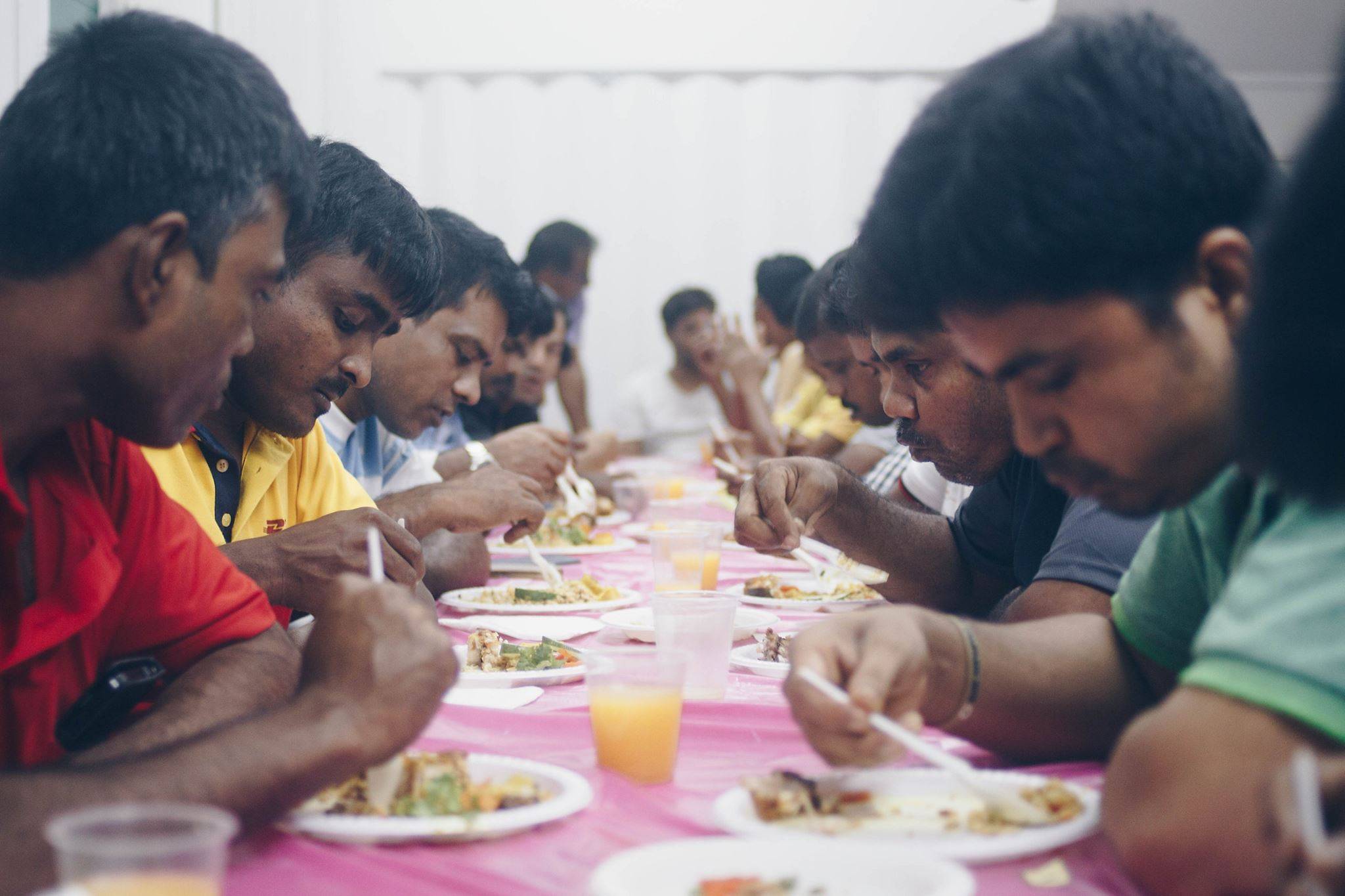
HealthServe runs an established food programme for migrant workers. (Photo: Facebook / HealthServe)
He thinks migrant workers are “special”.
“They build our homes. They’re part of our community but they are still largely unseen. I think we owe something to them.”
He admits he has been asked why he doesn’t reserve his assistance for low-income Singaporeans instead.
“The lower-income Singaporeans have safeguards. For example, they have Government assistance programmes, family service centres and so on. But migrant workers are vulnerable. They are from a different culture and they come here in debt.
“I think we need to we need to understand that they are like us, fellow human beings. If not we will be like some other places in the world where there’s more xenophobia and bigotry. That’s happening largely because we stereotype people, we put people aside, we box them up according to social class and status.”
He goes on to say that not interacting with the migrants in our midst will actually make us “poorer”.
“We will be missing out on human connections, human stories, stories of resilience, of grit. We can learn from the top CEOs, but we can also learn from migrant workers from Bangladesh, India, China, Myanmar or Thailand.”
He himself never imagined he could learn so much from the workers he helps.
“I had always thought that as a doctor, as a professional as a Singaporean, I am here to help these poor migrants who have come, but from them I’ve learnt generosity, resilience, being industrious and just taking things in stride.”
He tells me the story of a migrant worker from China he had been treating.
“He left for home just last week. But when he came to us, he had a hand injury and was desperate because his employer did not want to help. He perked up largely because he found a sense of community. As we were helping him, he started using the little money he had left to buy us drinks. His case was closed just about two weeks ago and he used a little bit from the compensation he received to give us a treat to show his gratitude.”
There are many such stories including of workers who want to donate to the cause.
Dr Goh’s instinct is to refuse and tell them to keep the money for themselves, but he quickly realised that there was value to accepting their help.
“His generosity taught me so much, but it also taught me to receive. I was unused to receiving. I had operated from a posture of giving, a posture of perhaps, power and I used to think that to receive is quite vulnerable. But I realised that adopting a posture of humility was liberating. When they contribute back to us, it also helps them develop a sense of dignity.”
“CAN’T BLAME THE POOR EMPLOYERS. WE NEED TO MAKE THAT SACRIFICE”
Many of the workers who approach HealthServe have been unjustly treated by their employers.
For instance, some employers refuse to take care of their workers’ medical needs after a workplace accident and insist on repatriating them instead. They may even pressure private clinics to give the worker inadequate medical leave even for severe injuries.
“What’s happened over the years, in the early years especially, is that we saw them as largely a labour force, a commodity of sorts. You come build and go. You’ve agreed to this payment and you work for us. We have commodified a very relational contract. It becomes a very transactional framework.
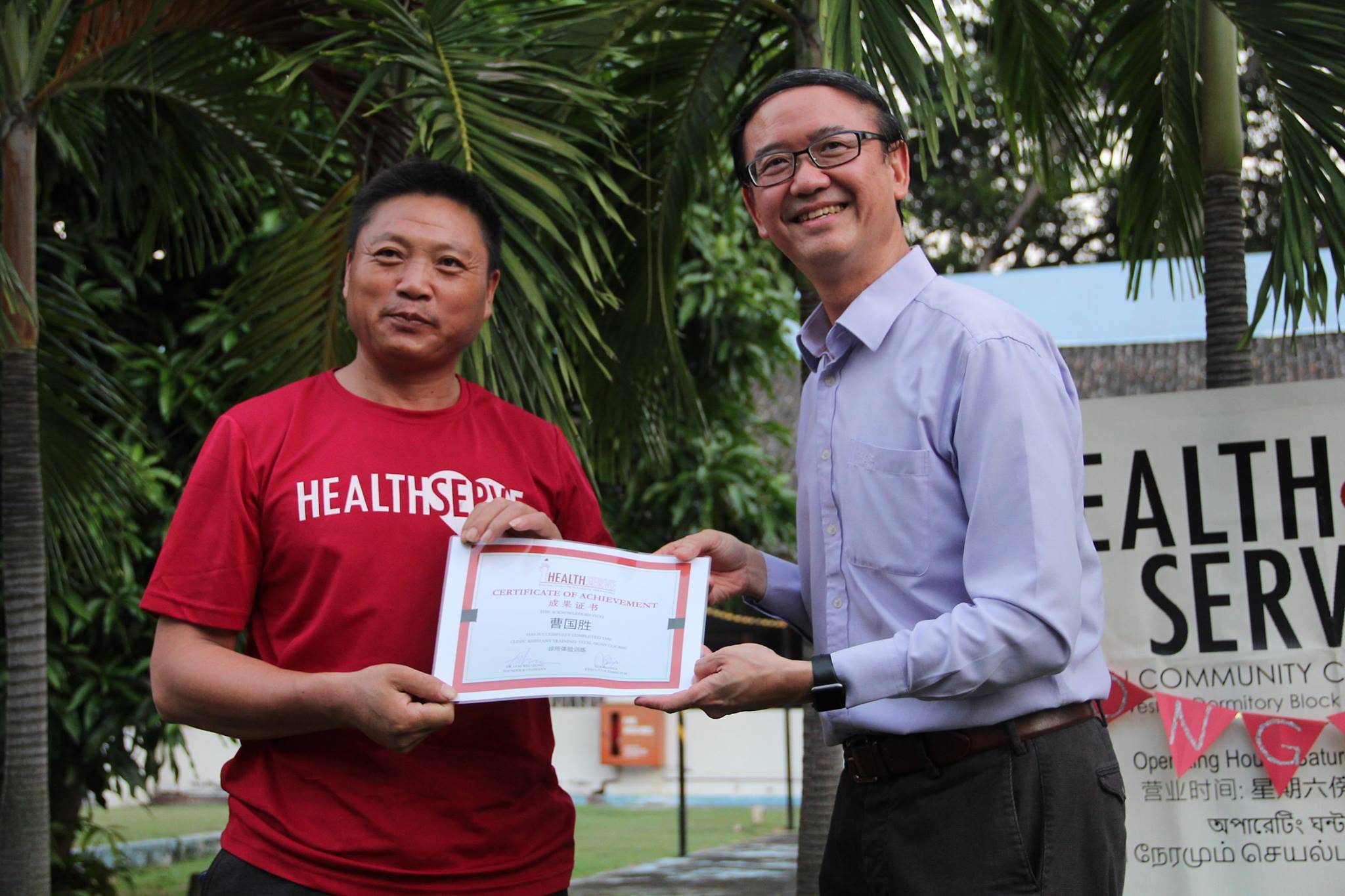
Dr Goh Wei Leong presenting a migrant worker with a certificate for a skills training programme. (Photo: Facebook / HealthServe)
“Everything is about the bottomline and KPIs. We think in terms of economic indicators, but what if there’s something more, a non-tangible. Perhaps if we’re able to have a relational society instead of a more transactional society…”
While many would criticise employers for not being “relational” in their approach and for not treating their workers as human beings, Dr Goh sees it differently.
“You can’t blame the poor employers. They are really responding to a much deep-seated cultural framework we have here.”
I ask him to explain since many may not be able to see the connection.
“Many of us who notice the poor treatment of the people doing menial work, cleaners or construction workers, be it Singaporeans or non-Singaporeans, when we say, ‘Let’s give them more pay. Let’s look into equity.’… while we are shouting out loud, advocating for them, are we ourselves willing to fork out a little more for cleaning services? Pay more for our buildings? Pay more for our conservancy, our monthly cleaning. We need to make that sacrifice. I think if all of us sacrifice a bit it would make such a difference to the poor and to the migrants.”
He admits that some employers perhaps do lack humanity, but many are merely reacting to the demands on them.
“For smaller businesses, if one or two workers fall ill from an injury, they may not have insurance that covers everything. If there’s a spinal cord injury, it can run up to S$100,000 but the insurance may be just S$20,000 or S$30,000. So what does he do? We’ve had companies that have gone bankrupt because of an injury of one worker, so it’s a real problem. If we are willing to pay more, perhaps the business can buy better insurance for workers.”
I suggest to him that even though many Singaporeans might be willing to pay more for products and services so that workers can be better looked after, many doubt if employers will use potential profits to improve workers’ welfare. Will the money merely go towards fattening business people’s wallets?
He admits this could be a problem.
“We are very business-friendly in Singapore, but business-friendliness should also demand ethical practices for example, ethical recruitment. If consumers are able to demand ethical recruitment, ethical products, then the businessman would be forced to be ethical. If I demand that the businessman pay a fair wages, then I must be willing to not patronise his establishment if he’s found not to have ethical practices.The consumers themselves have a lot of influence and I think we have to exercise that influence for good.”
In fact, he suggests financial incentives in the form of tax breaks for employers who are able to show ethical treatment of migrant workers.
“For example, if you recruit from agents who don’t fleece the workers, maybe you should be allowed to get some relief for that.”
POLICIES AND ENFORCEMENT
Ultimately he says we need to focus on being “efficacious” rather than being “efficient”.
“Efficiency is getting from point A to point B, cheapest, fastest. Efficacious means that we take a longer route to get there but we are more human. For example, we have better work conditions, workers are treated well, employers are happy. At the end, you may have some tradeoffs – spending more money, taking more time, building relationships, having to learn how to live in shared spaces, learning how to share. But I think it’s more efficacious.”
Focusing on such values in schools is important, but he feels that each of us need to actively start influencing others to be more “other-centred”.
“I think for too long we’ve depended on the Government. We say, ‘They have to look after this. Why aren’t they doing this? Why aren’t they doing that?’ I think we, as citizens must do something because what we do in Singapore could be that example and light for the world.”
However, several migrant workers’ organisations have pointed out that more can be done in terms of policy and enforcement too.
For instance, for many workers the waiting period for injury compensation or resolution of a workplace dispute may last several months to more than a year.
During this time, workers on Special Passes are not allowed to work and receive no income. This often discourages workers from making official complaints.
HealthServe offers a variety of social assistance programs to these unemployed migrant workers, including free meals, subsidised transport, an emergency shelter, and an emergency fund.
But can more be done on the policy level to make it easier for workers to stand up for their rights?
“I would say the regulations on employers are pretty tight. Some changes have also been made to the Employment Act when it comes to salary issues, but I think enforcement is a problem. The Ministry of Manpower (MOM) is engaging more on such issues over the last few years. MOM does have a Temporary Job Scheme that allows a migrant worker to seek alternative employer within a specified timeframe. This is after a thorough investigation from MOM on the migrant worker’s situation, but approval for Temporary Job Scheme are few and far between.
“I think we need to have polices that are daring, that take some risk. Yes, with any new policy there might be loopholes that some might exploit, but we can’t let that stop us. If something goes wrong, I think we should be also gracious enough to say, ‘Okay, didn’t work. Let’s try again.’
“If it were up to me, I would urge the authorities to treat everyone as a special case, because I think the one-size-fits-all rule is the problem.”
I wonder how realistic this is.
“Yeah, we can’t have every officer go through every case. It is really very complicated so I think if we are able to change the DNA of our society, so that everyone thinks of others more, then these things will happen less.
“All the stakeholders need to come together – employers, MOM, the migrant workers themselves and NGOs. I think we need to have more conversations. We can’t have too many watertight policies. They stop us from doing something more creative or more humane.”
Besides helping migrant workers, Dr Goh Wei Leong also actively contributes to community wellness programmes across Singapore. (Photo: Facebook / HealthServe)
For him, it’s simple.
“Let’s sit down and have coffee and say, how can we help, how can we contribute, I think that’s a better way of solving issues. It’s a community problem. I’m all for legislation and rules but what I’m saying is it should not be your only fallback. You need to bring in a much more compassionate, humane and community level relational framework. Without a relational framework, all these legislative steps are going to waste.”
WE SHOULD ALL BE INTERESTED IN SOCIAL JUSTICE
Igniting civic-mindedness can be a challenge in any society. However, he says we need to remember that inequity can be problematic for all of us, not just those directly affected by it.
“At the global level, the problem of inequitable societies where the divide between the rich and poor widens, you see political upheavals, increasing tensions. If the tensions here rise because of that or because of tensions within the migrant community it could come to the same thing. That’s why all of us should be interested in social justice.”
Going forward, he feels the mental health of migrant workers should be urgently looked into.
Several surveys over the last few years have shown that many suffer from depression.
“We are discovering more and more mental health issues. The workers are displaced from family, their own culture, from familiar landmarks. If their families are asking for money or their mother is ill or their daughter is sick and they have this constant threat of loan sharks, because they have borrowed money to come to Singapore, it can cause a lot of distress.
“A laceration or broken bone can be seen and fixed but the deeper problems of depression and suicidal tendencies among migrant workers are not easy. We’ve encountered migrant workers who actually wanted to kill themselves. I know of some who successfully killed themselves.”
HealthServe is currently working on a programme to teach volunteers, employers and migrant workers themselves detect signs of mental health issues.
Connecting with migrant workers on these various levels has “enriched” him, he says.
“I have grown. What’s important to me now is so different from what was before.”
Today, while he doesn’t drive a sportscar anymore, he makes enough from his first clinic in Chinatown where he sees paying customers. He works there for half the week. He spends the rest of the week at HealthServe.
“I’m still making enough to keep me going. I think I could make a lot more, but I think that’s not the point already. I can’t afford a Porsche or a Maserati today, but I can enjoy the little intangibles. That’s enough.”
SINGAPORE: In the name of giving our children the best start in life and helping them “check boxes”, many parents have been signing their young ones up for a wide array of classes.
Piano grade 8 exams by the age of nine for instance, or the recent trend in China of parents sending children to “CEO school” to learn manners and social skills and golf classes said to be part of critical emotional quotient training – all at the tender age of three.
Is it really beneficial to pack our kids’ schedules with classes, or to cram their young minds with as many lessons and experiences as possible?
Or is there such a thing as too much?
Before jumping onto the latest enrichment fads, perhaps parents should stop and think: Does my child really need to take another course, and will it add real value to their lives?
Or are these (often expensive) lessons really a means for us parents to live vicariously through our children, giving them opportunities that we ourselves never had in our growing years but perhaps wished we had?
HOW EQ IS PICKED UP
At the age of three, my own kids were still deep in the throes of the terrible twos. Tantrums and battles were practically a daily occurrence.
We took pains to help them understand that we all experience big emotions, and that we can use our words or work together to solve the problem.
Still, it required much time and patience before the storm clouds eventually parted. But when they did, out emerged slightly more socialised and eager-to-please pre-schoolers.
A lesson in teamwork.
EQ can be understood as the ability to recognise our feelings, and express them in ways that are socially acceptable and emotionally healthy. Seen to be as important as IQ in predicting future success, it includes the ability to regulate one’s own negative emotions and show empathy towards others.
Acceptance has a big role to play – acceptance of ourselves, and our emotions and thoughts, while appreciating that others often have different needs and feelings.
Even for the most patient and emotionally available parents among us, there are days that go haywire. What we do as parents when things don’t go our way is a key factor in predicting child behaviour.
Children look up to parents not just as authority figures, but also models to teach them how to respond to the world around them.
When things go wrong, do we stay calm? Do we address issues constructively or back away from dealing with conflict altogether?
Do we model timeless values such as kindness, honesty and self-control? If your child sees you saying one thing, and doing another, they are going to do what you did, and not what you said.
Back to the frenzy about packing our kids’ lives with classes. Since much of the responsibility of raising well-socialised and dependable children falls squarely on parents’ shoulders, why bother entrusting this crucial task to a vendor?
Are we paying for a quick fix, instead of getting our hands dirty in actively guiding and teaching our young?
Wouldn’t it be ironic if by signing them up for such classes, you actually send them the message that climbing to the top is of paramount importance, regardless of the cost (and I’m not just referring to the monetary aspect here).
DO CHILDREN REALLY NEED TO BE ‘CHARMING CEOS’?
Impeccable manners and charm seem like excellent qualities to inculcate in a child, so it can be tempting to dish out some money to achieve this outcome, but is there a flipside to emphasising these qualities at an early age?
In his book The Hurried Child, David Elkind expounds on the importance of spontaneous play for children in fostering interpersonal and social smarts. He advises parents to allow their children to be children, and not leapfrog the childhood phase altogether.
By around three years of age, children begin to take turns during play, mimic adult behaviour, and may even show concern for a friend in distress. Most of the time, they will pick these social skills up naturally through everyday interactions with other children at the playground and at school.
Play dates are an excellent and low-cost way to develop these skills; kids learn to converse with their friends, share, negotiate, manage conflict, and make decisions both independently and as a group.
Children at an MOE Kindergarten in Punggol View. (Photo: MCI)
So is reading a book and using it to facilitate discussions about the storybook characters, exploring what each feels, and asking the child what they would have done in the protagonist’s shoes. Such discussions help to open a child’s mind to the perspectives of others, and connect the dots between feelings and actions.
A child who is taught how to act like an adult may not truly feel like an adult. Just because they can imitate behaviour doesn’t mean they have internalised how to process stress or strife.
Emotional maturation is a gradual process that begins in childhood and continues through early adulthood, and requires frequent practice in handling difficult emotions and situations.
Overzealous parents seeking to accelerate this process through external coaching may have to contend with something more sinister in the long run.
Placing pressures on a pre-schooler to perform may lead children to learn to suppress their own child-like desires, instead of understanding how to express them in constructive ways.
Far from feeling accepted for who they are, the child may instead feel anxious about falling short, especially when they are placed in novel situations where they have not learned the “script”.
Their minds may get distracted from truly learning and enjoying a subject, as they are focused on their own performance and reaching an invisible bar.
Such unnecessary pressures may hinder a child’s sense of identity, sense of agency, and willingness to try new things.
Lee Zixi learns to overcome her social awkwardness.
EVERYDAY PARENTAL INVOLVEMENT STILL THE KEY
Achievement in itself is not a bad thing. But we need to constantly examine our choices and ask ourselves: Is this truly for my child, or is it to fulfil my own dreams?
The things that children really need don’t come at a hefty price tag; they include having a strong parent-child bond based on unconditional love and acceptance, and open and active communication as well as adequate nutrition, sleep and unstructured playtime.
If these foundational needs are not met, everything else will be built on sand. The external graces and adult-ish mannerisms become temporary frills at best.
If you truly want to raise a future CEO or high flyer, recognise that the everyday things you do in the home matter.
Giving your child small responsibilities, connecting with them, affirming them when they do well, confronting conflict with courage, and modeling the right values – all of these contribute to building a strong identity, self-esteem and resilience.
More than what external classes can ever achieve, these are the true essentials that will support your child in achieving their fullest potential.
June Yong is a mother of three, an educational therapist and owner of Mama Wear Papa Shirt, a blog that discusses parenting and education in Singapore.
KUALA LUMPUR: A Malaysian was killed and 13 others were injured in an accident at Kilometre 30.9 of the Karak-Kuala Lumpur Expressway on Saturday (Apr 7).
A spokesman at the Selangor Fire and Rescue Department said received a distress call at about 3.30 pm on an accident involving a bus and a lorry.
He said an engine from the Selayang Fire and Rescue station was then sent to the scene.
“The accident involved 12 Singapore nationals and two locals. All the injured were sent to Selayang Hospital for treatment,” he said when contacted by Bernama.
The cause of the accident is being investigated.
Editor’s Note: An earlier version of this story said that a Singaporean was killed in the crash, based on reports from Malaysian media. This has been corrected.
Photos circulating on social media show that the front of the bus was smashed in. (Photo: Facebook/KL吹水站 5Zones)
SINGAPORE: Ride-hailing platform Grab faced technical issues for the third time in a week on Saturday evening (Apr 7).
The disruption started at around 7pm, as users of the app posted on social media screenshots of the error message: “Looks like weren’t able to connect to our server. Please try again in a few minutes”.
It came back online about 10 minutes later when Channel NewsAsia opened the app, but with another error message saying that due to a “technical issue”, users may not be able to use the app as per normal.
“We are working hard to fix the issue and will be back to serve you as soon as we can.”
However, several users on Twitter complained that they were still unable to use the app.
Others also complained of glitches, as one user reported she had a confirmed booking – after a driver called her – but was not notified of it through the app.
@GrabSG I kept pressing book and the app didn’t show me anything, only stating server error.
But apparently a Driver got my booking and called me. Although I’m in the Grab right now, I don’t know if we are both synced up. pic.twitter.com/B3JvvBoOZD
At 8pm, Grab replied to several users’ posts on Twitter apologising for any inconvenience caused. It advised users to restart the app and try using it again.
Hi there! Can you restart your app & try again? Sorry for any inconvenience caused. 😞