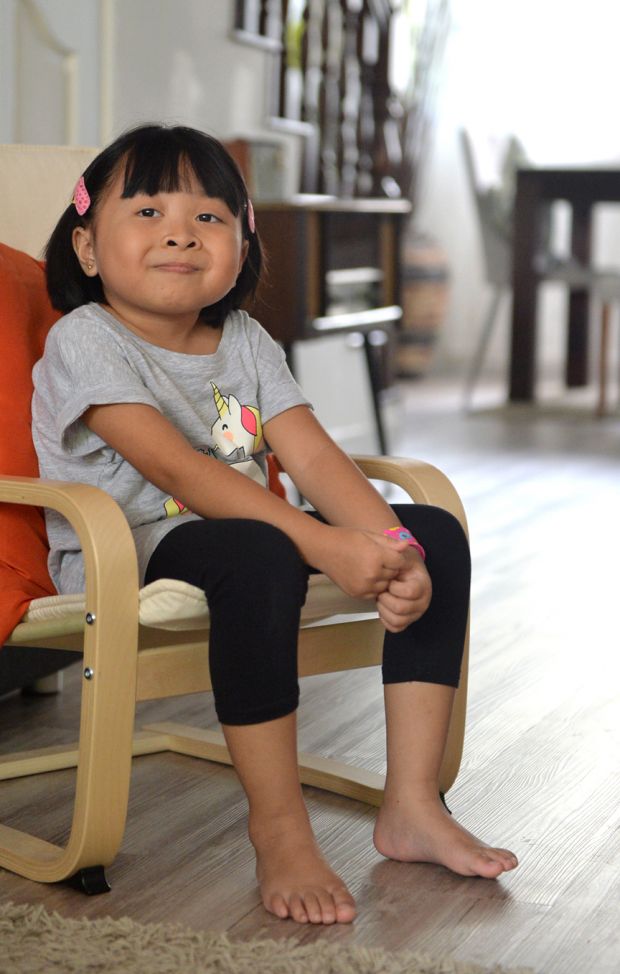
She was diagnosed with Hereditary Spastic Paraplegia in April. It is so rare, it is not known how many people in Singapore suffer from the condition.
She and her mother used to go on long walks at Bedok Reservoir.
Now, seven-year-old Qatrina Yusri needs a walker and sometimes a wheelchair to move about.
She was diagnosed with a rare disease called Hereditary Spastic Paraplegia (HSP) in April. It is an inherited neurological condition that causes the patient’s legs to become stiff and weak. (See report.)
In Qatrina’s case, the disease has also made her incapable of controlling her bladder.
Her story first came to light when a video of her struggles with HSP was shared on Facebook by media company Screenbox earlier this month.
The video has more than 500,000 views and was shared more than 11,000 times.
Madam Herlina Salamat, 37, first noticed her daughter walking more slowly than her peers in her primary school at the start of the year.
Qatrina, the third of four children, would also walk with her feet turned in – known as intoeing.
COMMON
“We were once told by a doctor that intoeing is a common condition and it would disappear when she grows up,” Madam Herlina, a personal assistant, told The New Paper at the family’s flat in Tampines.
The diagnosis of HSP came about almost by chance. After a routine height and weight check-up in school in February, the 100cm-tall Qatrina was referred to the Health Promotion Board (HPB) to have her height re-measured and to see a doctor.
But the family postponed the appointment. By April, she was walking less and less because her leg muscles had become stiff. Her family had to push her around in a stroller.
“We thought she was just being lazy,” said Madam Herlina. “At one point, we thought she was grieving for my mother, who died last year.”
When the family went to HPB in April, Qatrina was referred to National University Hospital (NUH) for an MRI scan.
Madam Herlina said: “It was only after the scan that the doctors at NUH diagnosed her with HSP.
“We were shocked when we got the diagnosis. My heart just dropped.
“I wanted to cry, but because Qatrina was in the room, I had to be strong, so I held it in.”
Their hopes for a treatment were dashed when they learned that there is no cure for HSP.
“We felt so helpless. It’s not like cancer, where you know what steps can be taken,” said Madam Herlina.
But it did not stop her from trying.
“We tried a lot of different things to help her, from buying walking aids to sending her for traditional massages,” she said.
“We would try almost anything to get help for her.”
Last month, Madam Herlina’s husband, a civil servant, came across an AsiaOne story about two brothers in Singapore living with HSP.
Madam Herlina then reached out to the brothers on their Mountain Tortoise Facebook page. (See report at right.)
“The brothers responded immediately and, a few days later, they came to our home to meet Qatrina,” she said.
Mr Kenneth Tan, 28, and his brother Eugene, 26, were diagnosed with HSP in 2014.
Said Mr Tan: “Aside from my younger brother, Qatrina is the only other person in Singapore with HSP that we know of.”
He felt it was his duty to share with Qatrina and her family how he and his brother fight back against the disease by walking long distances.
“We just wanted to show Qatrina that although there is currently no cure, it doesn’t mean she should give up and not exercise,” he said.
GODSEND
For Madam Herlina, meeting the brothers was a godsend.
“Although walking is not a cure, it will keep her active and help to strengthen her legs,” she said.
“I am really thankful that I was able to meet the brothers. They’ve really been so helpful to my family.”
As for Qatrina, who sat quietly beside her mother throughout the interview playing with a mobile phone, the journey is just beginning.
When asked what she wants be when she grows up, she replied: “I want to be a policewoman.”
“Hopefully,” her mother said in support.
“I just want her to be happy and continue to fight on.”